The American Passion
Canonical source: local (/Users/davidbussell/Downloads/TO PAINT/theamericanpassion.docx)
The American Passion
The American Passion
Street: The Democratic Metaphysics of the American Image
Original photograph of Hall of Famer Rube Waddell as a member of the St. Louis Browns, c.1910.
A 1910 New York Highlanders photograph.
Original photograph of the 1928 Pittsburgh Crawfords semi-pro baseball team picturing eleven including Hall of Famer Josh Gibson (1911-1947), who was only sixteen-years old at the time. Discovered by Crawford’s manager “Hooks” Tinker in an industrial league game that same year, the young Josh Gibson would play for the Crawfords through 1930 before signing with the Homestead Grays.
Original Graflex Camera salesman sample photograph of Shoeless Joe Jackson (1888-1951) as a member of the Cleveland Naps, c.1911. Created to demonstrate the camera’s swift action capture ability, the photograph features Jackson touching home plate against the New York Yankees and has embossed on the front in red Graflex Negative, Made with Cooke Lens and Velox Print.
What I would like to broach here is the concept of posed realities as a conceptualization of the human identity; the true breach and break that emerges in the urging forth of the 20th century via the camera lens: a revealing of truth.
The pose is the flattened, cardboard, illustrative gesture which produces a desired image; a manufactured image of self. The democratic breach into modernity is the light which shines on the broken field; the fracture — which illuminates the whole body of authentic humanity — without false elevation of class, status, or power; a revelation of death, mortality; the true existential condition of mankind.
Prior to the camera’s capacity to pierce the hazy daylight without the dressings of studio albumen, the human conception of Western existential identity was based firmly in social poseur — meaning the construction of identity as image before the camera or the painter. High class socialites and middle and lower class poseurs alike would take before the technological or biological eye and construct their identities with feathered garments; mock a fashion before the slow shutter or the brushstroke. Photographers like Elmer Chickering in Boston, Massachusetts; N.E. Maceo in colonial Cuba would photograph the important social and political figures of their day, as well as the perennial champion Boston Beaneaters; Habana teams of the latter part of the 19th century. This was a continuation of the very court painting which propelled the evolutionary technology of the photograph into being, as a machinic and industrial advancement of a prior technique; way of being and seeing in the world. Notably — some of these portraits, particularly in lower class communities as photography increasingly democratized via the CDV, dry plates, and silver gelatin, would be the only images ever captured.
The camera’s limitation to non-journalistic settings was broken open by the requisition of Civil War photography and the emergence of baseball as a market hunger from the mid to late 1800s. It radicalized the public image; furthermore, it made the image of history democratic and publicly accessible to all. It made history transparent; it made history a direct reflection of event. Shutter speeds accelerated the capture of action, captivating audiences like Shakespearean theatre; introducing a new, cinematic dimension to the still image — akin to the drama of a Caravaggio painting. No longer could identities be strictly constructed as a theatre or a playmaking of identity — nor as an illustration or an impression — but they were forced into the light of the day; opened up into public space and mediation by the naturalistic emergence of documentarian photojournalism, particularly regarding war and baseball; forcing the American and European public at large to confront existential realities not confined purely to image control and staged settings. The loss of image control meant that, both in news media and in the reality of image production itself, truth could no longer be curated or relegated to the institutional image of the salon. This process, exponentially driven into the 21st century with independent journalism, personal cell phones, artificial intelligence, and social media, made truth and history a shattered field of perception, fragmentation, false jurisdiction, subjective perception, and personal imagination.
This meant that state courts and the economic and political rule of the posed image was broken out into democratic space; the technological evolution and revolution of the camera via photojournalism and increasing shutter speed allowed for more and more of the authentic life to be captured. This was a revolution in the meaning of life for the masses. It meant that the historical life of the working poor now had reflection beyond the works of Victor Hugo’s Les Miserables, or the spirit of the works of Leo Tolstoy. The lives and images and meanings of real working class individuals was now being captured and projected into the mass public circulation of everyday life. It was not mere symbolic language, but direct representation.
This phenomenon would go on to be documented perhaps most notably in the WPA photography of the Great Depression Era in America, as an escalation of this principle now recognized after the fact as an essential contribution to Western art history and existential documentation of the human condition; documentation of the birth, growth, development; heart and soul of American history proper. This democratization, a democratization fundamentally of the streets and of the impoverished and destitute — was led first and foremost by the introduction of baseball photography as a pop cultural phenomenon at the outset of the 1900s. Baseball photographic history as a news media and commercial phenomenon of popular distribution radically terraformed not only Western art, but the political importance and possibility of the image; therein, identity itself as an existential construct. This was no mere conceptual revolution, theorem, or idea — but a direct impact at the heart of how American — and therein, Western; world — civilization constructed the image of itself; thus, construed self making.
This is the root of the existential revolution of the photograph as a photojournalistic device, which broke from portrait photography as an extension of portrait painting as political and economic power-making in the lineage of Western art history as an empirical construct. The portrait, in a Western sense, is a device of the projection of nobility, power, influence and status; as it became increasingly democratized at the fin de siecle, burst open — into the first truly socially democratic mode of public art: the historical, documentarian, street photograph. Photography not only in the streets, but of the streets; not only depicting, but elevating the humanity of the working class poor to heroic feats of civilizational meaning, purpose, and cultural community.
The artists and artisans of these photographs often worked for massive distribution and production offices under leading names of the day such as George Bain and Paul Thompson — churning out in demand images of early modern baseball stars and events for publication in news media outlets. The actual photographers were just one portion of this project; the developed gelatin photographs would then be handed over to editors for refinement; to be fixed on boards; mediated for publication. This is what is so particularly fascinating about photojournalism in baseball at the turn of the century — that it is a radical, political mode of distinctly American art as a way of celebrating America’s miners, factory workers, farmers, and soldiers — even as they worked part of the year as ballplayers before shipping off to perform manual labor in the offseasons; furthermore, that the industrial mode of American selfhood and self-making that it captured was reproduced with exactitude in the very method of the medium of its production, even to the point of which there is no one true author for this critical aspect of American art history — as it is, and was, a process of creation that changed hands multiple times over.
This distinct moment in American history represents a perfect collision course of the development of the translucent, increasingly time and space technologically efficient medium of the photograph with the development of baseball as an insatiable cultural force which captivated an entire nation in the midst of revolutionizing the very method of industrial production and reproduction which would allow for photojournalistic syndicates to churn out immense amounts of images — portraiture, casual shots, poses, action, panoramas, and group photos. This critical threshold of imagery depicted — as essential forms of mass public distribution of art as image and historical, cultural, social information — American poverty, struggle, and street life as dignity and celebration.
This revolution cannot be understated — as these early American photographic images reveal the striking beauty of the grotesque and the debilitated; the rubble and the ruins out of which baseball modernized; baseball’s greatest players carved a path through mill towns and mines into the cultural fame of the American historical eye — remembered perhaps most clearly and coherently through the photojournalistic revolution which cradled baseball’s modern infancy. Players like “Shoeless Joe” Jackson, who worked in the textile mills of Pickens County, South Carolina from the age of 7, to Jake Daubert, MVP award winner of the 1913 Brooklyn Dodgers — who was a coal miner in the anthracite fields in Shamokin, Pennsylvania at age 10. This was the same ethos of the unification of the beautiful and the sublime; heaven and hell; the high and low culture that characterized the revolution of modernity in the Parisian writings of the poet Baudelaire. This revolution being a revolution of total seeing; total sight; presence of being in the world — not elevated to false heights of egoic depiction as was the grandeur of the Medici and the Renaissance. It was the hard, rough, tough streets of Greenville, South Carolina, the tobacco plants of Richmond, Virginia and Langston Hughes’ Harlem alike. It was a spirit of humanity grounded in the rubble of a process of transformation which was sweeping away the religious idealism and iconography and false transcendental elevation of old; replacing it with the ennui, chaos, struggle, living flesh, and complexity which informed the writings of modern thinkers from Camus to Celine to Frederick Douglass.
The images themselves — liberated from the constraints of impressionistic painting and the need to establish class hierarchical distinction of nobility; unchained from the excesses of the immediacy and material necessity of portraiture and the studio shot — were discharged not only in the early wood and dirt stadiums of Boston’s South End Grounds, or the famed Spring Training destination of Majestic Park in Hot Springs, Arkansas, but on street corners, in front of houses; in the shambles of dirt fields and plains that stretched on for miles; dilapidated fencing. These were locales that made it abundantly clear that baseball itself was a mill town or a camp town. That America itself in the grit of modernity; outside of the gilded halls of the titans of industry, was rough, raw, unforged; between the Mayflower and the refinement of tenement housing into ruthlessly efficient digital currency and steel girded architectural might. It was a process, caught between mud and pixelation; summed up perhaps most clearly in a fallen, iconic cultural hero named Joe Jackson, who could not write his own name.
Baseball was in the midst of being forged, like America; the industrial, news media photograph provided the perfect confessional medium for the sport to strip away the history of the image. Like a solvent or paint thinner, this intertwined phenomenon produced an expulsive force of the American epithet of political consciousness grounded utterly in the sublime, mortal flesh and blood as it angled against the powers of the Moloch of modern industry as a titanic, machinic force of ruthless progress. This collision course of cultural institution and technology in America provided the perfect gateway for a revolutionary cultural, political, and existential movement — wherein the famed Russian cinematic architect Sergei Eisenstein’s vision was fulfilled before he even set reel to film — the total democratization of the visual medium of art wherein the workers are the players; the cinema as a scroll of news media production and distribution is a democratic reality.
This revolution, occurring via the capitalistic mode of photo syndication and transmission via newspaper, was the utilization of channels of production and distribution of goods and materials to actively and imminently terraform the American cultural and civilizational mind — creating a radical partisanship through the organic passage of baseball mastery as a practice of the American poor into the public eye. This visibility created the mythos of baseball as public image phenomenon; the lumbering swing of Honus Wagner; the spikes swung high of Ty Cobb. The news media photograph — depicting Daubert, Jackson, Cobb, Gibson, Paige, or even the great Walter Johnson — created a fully actualized cycle and method of prioritizing, and as such, revolutionizing, the image of the American poor and destitute through capture and transmission of the ballplayer both on and off the field.
It was a perfect system of producing myth via history as the intersection of the cultural medium of repetitious practice, movement, and figuration; the technology needed to capture and distribute images of the astounding and awe inspiring possibilities of human movement and the human body within it. This is a radical transference of the Western civilizational portrait as power to the democratic, action, casually posed; shot image as a photojournalistic act of mass transmission of image. It is the introduction of the language of the street as the idiom of American history; as the primary historical mytho-cultural method of conceptualizing American selfhood — not the language of royalty, power, or conquest. It is a revolution of the image as a way of perceiving and conceptualizing self and identity through the historical, dual emergence of American baseball and the photojournalistic camera. And as such, a way into a different form of political, social, existential, and communal organization of human selfhood.
Images such as the Pittsburgh Crawfords team photograph from the late 1920s and Rube Waddell standing in a disheveled natural setting before an un-manicured wooden fence were types of images that were regularly captured and syndicated and distributed for publication. These images were beatifically unafraid; courageous in their depiction of the unadorned and the rough, tough environments in which early baseball was truly conducted and concocted: on the fields and dirt of St. Louis, and in the steel transformer of Pittsburgh. They remain alive in their original silver gelatin forms, even as they were translated into newsprint in the days of their production; often reproduced once or twice more in the passage of time. These images depict an atavistic and yet early modern industrial humanity — a humanity situated entirely in authentic political situations — being as the subjects depicted were between the mines and baseball history; often destitute, mentally ill, or came from backgrounds of family slavery, indentured servitude.
Heritages of mining, farming, sharecropping, and brutally hard physical labor in mills and presses were the standard and the rule in the earliest hours of the 20th century. Figures such as Hack Wilson, lead plate carrier in an early printing press who went on to set the single season runs batted in record in baseball with almost 200, profoundly humanize the heritage — not only of the game — but of American, world, and Western art history. Wilson was regularly depicted in press photographs as he chased Ruth’s single season home run record in that same year, 1930 — swinging his bat like a great iron club. The depictions of Wilson also often include the editorializing commentary contextualizing his feats, character, demeanor; stature on the field via the clippings pasted on the backs of early press photography. This added context is a crucial aspect of this art historical revolution: humanizing and grounding the depictions; reiterating the path of direct circulation these photographs took into the main bloodstream of the collective, communal consciousness.
This form of profound humanization embodied by the baseball press photograph represents a massive; yet still unacknowledged breakthrough at the turn of the 20th century through the lens of baseball image history and image making as a mytho-cultural act — a breakthrough that hitherto is only referenced by way of the latter WPA work of the 1930s. The reason for this is that baseball as a cultural institution and mode of profound civic importance is trivialized in the contemporary eye — being that it is a sport; often considered a frivolous pastime by supposedly serious critical thought. And yet, the entirety of American civilization flocked to these great games. From the tens of thousands who made the trek each year to the East-West All Star Games of the Negro Leagues to the rapture of the early New York fans: dock workers, factory workers, construction, machine operators, pressers — all of whom gathered in fervorous throngs to watch a young Christy Mathewson pitch an electrifying three shutouts to help the Giants take home the 1905 World series.
This was an entire network of profoundly subversive, egalitarian, image based revolution and restructuring of social and political identity — conducted via industrial capitalism and distributed via mass produced lithographic cards packaged in tobacco and caramels, premiums, postcards, promotions; an entire image economy of projecting and promoting the salvationary images of the American working class celebrity directly to and into the hands of those who labored alongside their mothers, fathers, sisters, and brothers — many of whom died in the very factories and mines players like Ed Walsh, famed Chicago White Sox spitballer, crafted their athletic genius in. Many of these promotional items and cards, such as the 1910-1911 Turkey Red Cabinets, regularly depict players sliding before great smokestacks and surrounded by the emergent, proto-industrial American modern world. These documents and keepsakes were marketed explicitly toward the everyday worker; placed within publications and consumer goods which the working class American regularly consumed.
The development of the baseball centric image economy — which dominated American cultural visual language and art for over half a century — represents and represented an absolute, profound, and utter revolutionary work of collective art toward a new vision of humanity and human sociality; the importance and value and meaning of the lives of the workers who built the steel, wood, brick, and mortar undergirdings of what would become modern American civilization. This image economy, emergent from the embodied, imminent cultural language of baseball, would cascade forth into the mid 20th century America — not only in photography, but in cinematography as a root symbolic method and way of being in practice. The stories of the working class — unique to the American civilizational ethos, aperture, and register outside of masters such as Hugo, Tolstoy, and Dostoevsky — became the fundamental landscape and grounds for the exploration of identity, meaning, struggle, and vision in the modern world. Between Rembrandt, van Gogh; Basquiat, the rupture in Western civilizational art history began — not in form or content a la Dada or Surrealism — but in the deeply political, class based field of the emergence of American baseball; the inclusion of social, real, documentarian and historical images of the American worker into the grand oeuvre of Western art history.
As such, the worker was granted cultural primacy; the stature of the American baseball player was raised to great prominence as a station in the larger aperture of the social order of American history. Figures like Mathewson, from Factoryville, Pennsylvania; Babe Ruth, a deeply impoverished child from the Baltimore streets — were raised up to visibility akin to the highest celebrity; iconographic representatives of the American spirit and the American soul. Far from nobility or aristocracy, early modern baseball stars represented — particularly through photography and the lithographic card — a real historical, social, and cultural vision of humanity shared by the great mass of the working class, who were at work building the skyscrapers and shoveling coal in the factories of the dissociated, moneyed elite; often, as in the case of Daubert, directly at odds with the industrial consolidation of power at hand; figures who garnered not only union support within the game, but outside of it politically in their communities.
At its core, baseball, in intersection with the development of the fast, industrialized photograph as a capitalistic industry of image production and consumption, from cards to news media photographs, created the perfect storm in Western hemispheric image and existential history. It is the American contribution in whole and in sum as an image root; a mythos root for self conception in the modern world. It utterly terraformed, if but for a brief moment, the social and political conception of what power meant in relationship to humanity — unadorned, authentic; born from the trials of labor, suffering; the rising to the station of self mastery and physical transmutation: a true, soulful, initiatory depiction of the American dream.
Arthur Leipzig (1918-2014) Stickball, New York City.
Neighborhood kids playing stickball and eating knishes, New York City, 1940s.
A stickball game in mid-century New York City.
A group of boys playing stickball on the South Side of Chicago, 1940s.
The Compression of Being: An Exegesis of Displacement in the Early Baseball Photograph and the Birth of Industrial Subjectivity
Joe “Iron Man” McGinnity, c. 1907.
Christy Mathewson – Marlin Springs, Texas, 1912.
c. 1903 Fred Clarke by William Vander Weyde.
Here I will do an exegesis of how displacement functions in the early baseball photograph as an aesthetic phenomenon of modernity; particularly in the naturalistic, flattened, dirt field environs of the early practice field.
This is a phenomenon that directly intersects with and presages the modern imagistic move of drawing the subject or the figure out of the field; creating foreground and background isolation. This is drawing the human being out of the fold of nature; placing the human being in the alienated, isolated, industrially reproduced spectre of environment. This method is first conducted in the indoor photography studio; mass modernized with factory and mill spaces which enclose spaces with firm delineated room. This technique, along with industrial modernity, is critical in news media reproduction of photographs for clarity of transmission, as seen above with the isolation of the figure of Fred Clarke in the 1903 photo by William Vander Weyde. The figure is drawn out of space and alienate to be reproduced.
As we see with early baseball training spaces (in the above photographs with Mathewson and McGinnity), they are almost eerily reminiscent of labor camps: sparsely delineated fields with high walls and fences to create an enclosed and isolated field of vision; entirely constructed of wood. Often set up in such spaces as Waxahachie and Marlin Springs, Texas; Arkansas; Georgia, the field of vision beyond the fence line is unbroken sky. This creates the aesthetic phenomenon of, again, profound alienation.
This displacement is again found in the aesthetic artifacts of translation of the early Carl Horner cabinet photographs — used for the portraiture in the T206 series of lithographed baseball cards commissioned by the American Tobacco company. The lithographic method of suspension of the figure in the T206 set is normative; altogether typical of the reductive mode of baseball card printing for tobacco and candy at the time — isolate the space, fill in blocks of flat color; reduce and compress the subject to easily reproduce in mass, fast quantity.
The industrial method, in this way, is common to and seeded in what is likely the earliest historical artifact of compression: the trans-Atlantic slave trade, where slaves were compressed into inhuman dimension and space to fit in the stow of the ship as it made its passage across the ocean. This method, seeded in the 1500s, finds its technological device of acceleration in industrial modernity — an exponentially perfected method of brutal efficiency. And this is the eery quality again produced in the early training spaces of baseball history which presage its total financialization; elucidate the hypocrisy of its crackdowns against gambling and player unionization in the early 1900s, which culminated in the trial of Joe Jackson and the Chicago Black Sox. It is the quality of economic fascism as in the compression of the human being into a labor unit; the isolation and alienation of the individual as in the removal of the human being as a subjection from the natural environs; the insertion of the human being into the clock time of factory and mill — laboring under the lightbulb.
What we witness in the establishment of modernity as a total architectural space — image, culture, territory, rooms; the tonality of the psyche — is a reduction, a compression; as such, the production of a high strangeness which is the quality of alienation which appears in the air, space, time, and the production of all artifacts, images, and text which emerge from it. This is a fundamental architectural compression — elucidated most clearly in the methods of the technological production of the image; the intersection of the technological image with the capture of the architecture of the spaces introduced to the camera’s eye: tenement housing, the sausage factories of New York, and the labor camp training spaces of working class servitude at the onus of the ongoing war of industry in baseball between players and ownership — which culminated multiple times in the institution of the Players League, the Federal League; furthermore in the gambling scandals of Ty Cobb, Tris Speaker, the Chicago Sox, Heinie Zimmerman, Hal Chase, and others.
This is the unspoken root of baseball history not only in process but in product: a history of financial and economic class and racial warfare which produced the dire circumstances of the demise of Josh Gibson to alcohol and drug abuse; the destitution and violence which plagued the Negro Leagues; the ultimate decisions made by white laboring baseball players to partake in gambling in attempts to get ahead in a systematically exploitative, rapidly institutionalizing ecosystem. This, again, is baseball as factory — without hyperbole or metaphor.
The training space photographs of the early 1900s give us this language and elucidation most clearly. They are utterly unadorned, as they are not built for spectators. They are built solely for the devotional, cultic focus of the ballplayer upon the game — constructed with a brutalistic specificity of purpose; unadorned for humanity, undecorated for distraction. They perhaps are most reminiscent of the training grounds of the Roman gladiator — dirt, sweat, and unending field — populated only with the tools of the trade for eventual release in the Colosseum grounds. This brutal efficiency is replicated phenomenologically in factory design; the ballplayers themselves, covered in dirt and mud rather than soot and dust, emerge from the factory town. Without labor laws, the children who grew up in the mines and fields; from their forefathers both immigrant and enslaved, stepped into a terrain where owners held full contractual control; players were powerless over their fate and stake in the game. Figures like Hugh Duffy lived life perpetually on the run — going from town to town, team to team in search of a living wage; as the 20th century progressed, Negro League teams would bus day and night, endlessly chasing down gate money to sustain.
This language is difficult to spot in modernity, but in an architectural sense. This is how spaces are constructed; how ruthlessly they are cordoned off to produce specific psychological and physical results; furthermore, how semiotic transmission of information is constructed and occurs in the mediating technology of the world in reference: the removal of the individual from the field of the photograph; the isolation of subjects in nature and drawing them out for reproduction. This mechanism, as it perhaps goes without stating, is a direct replication of the process of industrial civilization proper — the leveraging of the labor of the individual toward the ontos and the language; the ordering, religious function of the civilizational body at large. This religious devotion is a devotion scattered and inefficient pastorally; dictated by seasonal time and daylight rhythms; brutally efficient industrially: dictated by company money, or scrip, electricity; the production of spaces which sever the individual from natural time and somatic rhythms — producing an infinite state of exhaustion, overwhelm, and collapse of the body and psyche.
This was typical of the Deadball era — an era in which pitchers would pitch back to back extra inning ballgames; throw well over 500 innings in a season. Pitchers like Ed Ruelbach, Hooks Wiltse, “Iron Joe” McGinnity, and Ed Walsh — many of whom came from backgrounds of industrial manual labor — threw a volume of innings that would buckle the knees of a contemporary ballplayer. The demands upon the body for machinic production and overproduction — especially for the Deadball era pitcher — were a direct representation of the ecosystem of machine production which became the norm in a blanket human civilizational sense as the pastoral, 19th century era of baseball, literature, and trade gave way to the automobile factories of Detroit and the steel ballasts of Pittsburgh. The United States was no longer ruled by the sun and moon, but rather by the rapid scaling of coal fires to light the electric lamps of the city that never sleeps.
As we see with the above photo of Clarke, the key to this seeming puzzle of complexity is the subjection of the individual as removal. It is, in short, the creation of subjectivity as a concept; the creation of the atomized individual as divorced from nature; created as an idea, a name, a role; a function in the gearwell of civilization proper. Without civilization, the extent of subjectivity experienced by the animal is the sensation of the body. It is not named, numbered, archetyped, diagnosed, nor patterned into a behavior of function other than the biochemical rhythms of the life of the flesh incarnate. And this is precisely the power that the press photo reveals to us — it is the power of the tell of industrial civilization’s true missive and function: reproduced in the image device which sustains it; its mythology and ideological anchoring.
This is fundamentally and primarily a religious function, as it is a function produced through culture. Clarke does not actually leave the surroundings elucidated in the photo, but rather he is removed as an artistic, creative, and functional act of isolating the subject with paint and ink on the page to properly register the translation of the image onto newsprint. It is an aesthetic act; an imaginative act — a spellcraft of linguistic practice which is the conviction of clock time; the conviction of the factorial progress of the American industrial reproduction as a viable solute to inevitable liberation of the collective psyche of the public; a conviction in the missive of capital generation unto the hands of the Carnegie class. The animal is lured out of the woods, so to speak, for the promise of a better life, a safer, more fulfilling life — under the onus and awning and veil of industrial civilization as a method of producing a speech bubble around the animal. Subjectivity is a created function which becomes psychological; fundamentally embedded into the acculturated organism as a blanket practice; a total psychological state of image production, reinforcement, and behavior patterning. This, in turn, is the creation of a state of mind and a way of mind which is a historical severance from the pre-linguistic function of humanity’s atavistic ancestors: totally ensouled in nature; asymbolic; utterly present with and in the rhythms of the body as a primordial field — a unity of the supposed subjectivity with the entire field, a microwave radiation background of pure presence and a field of body experienced ritualistically without separation.
The production of alienation, in this sense, is a absolute blanket field of the introduction of subjectivity as a way of being, way of seeing, and mode of perception. It is the creation of the individual as a method within a system of organization of beings into a functional unity in order to accomplish the civilizational task of generating profit and capital for the feudal tradition at large; accelerated by the break from field time into factory time — clock time, electrical time, supra night and day — the human being breaks and is broken from the last sense of natural rhythm which sustained it in an ecosystemic sense into a linguistic field of infinite, dissociative displacement of the sign.
The Imposition of the Street: Portraits of American Toughness in the Revolution of Western Art History
Tris Speaker, 1916 by Charles Conlon.
Photographic image capture of Nap Lajoie on field for the Cleveland Indians, c. early 1900s.
Another original photograph of Nap Lajoie, this time pictured with the Philadelphia Athletics.
Our discourse on baseball photojournalistic work and its impact on Western art history takes a fundamental turn and inquiry into how the subject work of living baseball radically transforms visibility, depiction; narrative importance in the grand scope of historical context.
The history of Western art is primarily religious, bureaucratic and royal — with commissions for powerful merchants, landowners, kings, and bureaucracies littering the early historical record. As the second millennium came into view, notable renegade, outsider artists such as Vincent van Gogh began to introduce personal styles, methods, and devices which were thoroughly outside of the canon of wealth and power — even as they often sold poorly and remained in obscurity in their contemporary lives.
As the collision course of American history pronounced the simultaneous practicality and importance of the news photograph with the explosion of baseball’s popularity on the cultural record, there was a spontaneous emergence of an entirely new form and figuration of the art historical subject: the con, the drunk, the madman, and the street tough. Never before was the scope of a world historical underclass depicted with such immediacy and fervency as America’s thirst for baseball imagery — and in that thirst, an entirely new form of image culture was born.
Subjects like Nap Lajoie, his cap crocked; cheek full of chewing tobacco, 6’1”, 200 lbs — carved a menacing figure. Just 8 months in schooling, then off to labor in the textile mill to help support his family when he was just 10 years old. Tris Speaker: a legendary brawler and lineman from the American South whose entire family fought for the Confederacy. These men were from the raw hide of the back of American civilization — first generation immigrants, grinders; children who from a young age fought to survive in and under profoundly alienating and difficult circumstances. These men wear their political condition in their photographs.
This institution, spearheaded by great photographic artists such as Charles Conlon and the aforementioned Paul Thompson, used light and the news media distribution channels to expand and contract history at will. The remaining relics and monuments to this effulgent burst of the news media photographic process as mass arts movement stands a testament to the profound functionality of this system of production and distribution which brought the eyes and soul and weathered, muddy faces of Speaker and Lajoie with deep whites, blacks, and grays — sophisticated chemical contrasts which rendered with utter immediacy the underbelly of the soul of America; the soul of American struggle, turmoil; victory amidst impossible odds.
Lajoie, considered the first star of the American League, had his images pronounced everywhere. Understanding the votive function of Western art history — which uses Christian iconography as a form of communication — this radical switch to a field of grounded demos through the depiction of the grit worn, lower class ballplayer, is a direct elucidation and incarnate grounding and extension of the Western art historical mission proper — which is fundamentally a Christic principle. As we discussed in essays prior, never before was a civilization’s living and working poor and destitute depicted with such blinding clarity and effusive immediacy as in the American baseball news photographic tradition of the early 20th century. The direct encounter with Speaker’s countenance or Lajoie’s piercing gaze speaks to the human, existential condition of American modernity with more power and immediacy than even the most lilting testaments of the words of Tolstoy, Dostoevsky, and Hugo. It is an immediacy of the direct confrontation with the living, the breathing; the weathered face of time which is the encounter with the entire compound movement of the human soul.
This is the magic and the beauty of American baseball news media photography — that these direct, discursive, candid images were captured as some of the most radical forms of portraiture in all of history; certainly the most revolutionary in all of Western history up until its emergence as a phenomenon. And this is made possible by the technology of the camera as a direct reflection of light, space, and flesh; urged forth into full fulgence by what baseball fundamentally is and represents and does in the American oeuvre: outwardly, surely, just a game — but inwardly, truly, the light that shines upon the beating heart and essence of the most forgotten, destitute, unknown; draws the American spirit, indefatigable, bloody, bleeding to the light of day and into the halls of eternal memory.
Figures like Bugs Raymond, Rube Waddell, and Ed Delahanty made the books. Men who were nicknamed after asylums, wild drunks; seemingly cerebrally, psychically bound to a total explosion of Dionysian chaos. All three died young. Waddell was known to chase firetrucks in the middle of games; Delahanty, great Irish slugger of the 19th century, was a violent drunk. Raymond had several seasons (one in which he struck out the impossible “Wee Willie” Keeler three times in one game) where he showed promise of mastery — but drinking and the chaos of his psyche drove him from it as well. Ed was the first child to survive infancy to Irish immigrants in 1867, whose family home was converted to a boardinghouse by his parents to generate a form of income. Delahanty then found a home away from home in the vacant lots of Cleveland, Ohio, where he became one of the greatest hitters in the game’s history.
These are men who came from the absolute bottom; the wheel-well of American history — trapped under it; almost doomed to be squashed by it by circumstances. And they stood upon the stage of America’s emerging golden glory of cultural edifice as the game’s primary figures; were captured by the leading photographers of their age for the leading papers of their time. The images themselves are not merely news media ephemeral; this is what is lost to the modern current of canonization and realization of art history — particularly how art history emerged in early modern America as a profoundly transformative communal, social, and cultural force. They stand alongside the greatest portraits in the history of Western art; often exceeding — not only for their stark, technical beauty and the full roundedness of the art object itself, equipped with pasted news taglines, stamping; written words and editorial brushstrokes and markings that litter the early news photograph — but for the subjects they depict, in their unadulterated, swaggering, immediate manner of physical stature.
The players themselves in these photographs are entirely candid, unmediated by conventions of portraiture or poseur. They stand with caps tilted, uniforms dirty — workmen in their environs; no different than the days as children that they worked in factories and in mills to sustain family income in utterly hopeless times. They stand as men as children — hardened by the iron and crucible of American modernity; now as cultural heroes to an adoring American public composed in vast sum by their true compatriots, the working class milieu. And in this way, the American baseball news media photograph is a total technological, philosophical, artistic, and cultural revolution on scale without precedent — as it advances the humanistic and existential works of Hugo and Dostoevsky with immediate incarnation of the spirit and body of the American poor without mediation by text or painterly interpretation; furthermore, delivers this image to the American poor with distributive mastery — via the news channels; translation of silver gelatin into news paper stock and press ink.
This is a total revolutionary technology which makes available the truth of the soul of the working poor — a fundamental truth mediated through the culture of industrial capitalism which is absolutely Christic in nature; Christic in the sense of communion with the world soul without false elevation, title, or status. A direct gaze into the soul of the working boy of Lajoie or Speaker; a throughway to a return to the fundamental aspect of all of creation; the deepest well of humanity — through the face, the gaze, the eyes; the countenance: which tells a story of profound life, feeling, joy, hardship, love, passion, and beauty.
In this total accomplishment at the unwitting cross-section of history, the American industrial news media and cultural complex accomplished a feat only gestured to symbolically by the greatest literary, historical, artistic, and philosophical humanistic figures in all of history. They created — through the convergence of the technology necessary to capture it; the rise of a game fantastic and immersive enough to cultivate it — the vehicle for the channeling of the American soul.
The Verso: Practice, Process, History & Downstream Implications of the Medium of Early Baseball Photojournalism
Underwood & Underwood news photograph of the pennant winning (and eventual World Series victor) 1916 Boston Red Sox infield.
Verso of the aforementioned photo.
The beauty of the foundational and fundamental meaning of early baseball history as a artifactual presence and consciousness; an imminent historiography encoded into the relics of a still-living civilization is not one object or organ — but rather a field of total representation encoded into its very processes. This cultural distillation is best represented in the news media practice of production, processing, and distribution of the baseball documentarian, journalistic photograph.
The image as representation is consummate and consummation of how we remember baseball; how early century baseball is encoded into the architecture of collective memory. Mickey Mantle is a swing and a smile, as much as deadball is the dirt and grime of the field; the sparkling blackness and deep tonality of the early gelatin practices which produced and authenticated history as a series or a constellation of images. Baseball itself is this entire history encoded in image representation as a collectivity of nodes which comprises baseball as civilizational memory; as such, a construct.
The way that this history is allowed is much akin to the memory the modern world has of an ancient civilization like the Olmec — it is entirely based in the images it leaves behind in stone; the encoded memory and speech and presence and language in this image ontology, or the dimension of the symbolic code behind it that presents images as objects in space and time as remainders. the baseball photojournalistic artifact of the early 20th century is a prime example of this greater historical rule of being in practice as trans-civilizational memory; the archival construct of the earth itself in perennial reflection back upon a past which is beyond linguistic; leaves only trace material with which to deduce the presence of being in time — what that signifier, sound, emblem, or resonance meant, was, does, and performs in space.
The early baseball photograph is a shroud of representation; an unassuming, anti-aesthetic piece of what was contemporary information production and distribution. Particularly when dissociated from photographers with intimations of artistic craft such as Conlon and Thompson, the early baseball photograph becomes an industrial, technological artifact stripped to the bone of pretense; serving as a lean, descriptive sentence to elucidate the tension of the poles of the presence of being in time and the necessity of documentation and transmission to capture and disseminate the historical moment across political lines. The personal experience, by necessity of the photojournalistic artifact; the desire for communication across physical limits, is transmuted into a collective experience by way of compression of the event into the dimensional space of the glass negative.
This service of transformative space; this necessity of immediate translation by way of and for communication opens up a profound frontier at the vanguard of the baseball photograph performed as an industrial process by unknown artisans — a linguistic muscularity of representation perhaps best present in writers such as Beckett and Hemingway — a post-intellectual, unadorned speech which is stripped of the pretenses and aesthetic concerns of all art, society, and politics — which is to say, of humanity as a civilizational construct itself. Baseball is the perfect ground for this phenomenon — wherein the players have no public image or social status to defend outside of baseball. As depicted in the photograph above, the players look jolly, relaxed, casual, leaned back, or else absorbed in thought or else entirely absent psychologically from the photograph; even vaguely uncomfortable. They lean against the railing in unadorned, nondescript uniforms, like workmen on a break being photographed by a fellow laborer or longshoreman.
All of these semiotic keys construct the total aesthetic field and dimension of baseball as a wide open space for the existential depiction of the human. Each mark made, each stamp, editing alteration, strip of paint; attachment of editorial lines, jotting of letter or number — is for the purpose of pure economic efficiency in communication, transmission, archive. One must understand just how important this innovation and intervention of industrial method is in relation to Western art history and the semiotics of communication — it is an intervention of pure unselfconscious necessity encoded into the very architecture of the artifact which collapses signifier-signified relationship and produces the very selfsame outcome of immediacy indicated most powerfully in the old Olmec statue work. It is an immediacy in which interpretation does not enter the space or the field of the image production and image relationship; the artifact as such is a purely unadorned event; it is an event that depicts truth without evoking subjective distance; is thus as such truth proper and in propriety — as it does not leave the field of objectivity for anthropomorphic flourish or commentary.
The news archival photograph functions as a pure expansion of space and time; it is a ruthless technology of efficiency which makes communication and understanding over space and time easier to apprehend. This is its sole function. In this way it is closer to the telephone or the cell phone or the internet as an apparatus than it is to Surrealism or Cubism as fields of subjectivity, interpretation, and sensation. It is a cold, electrical technology, which — precisely by way of the technological field of efficiency it constructs — perhaps paradoxically allows for authentic, existential humanity to emerge through it by way of pure documentarian depiction and representation to occur without structural egoic intervention. This is the difference between pure documentarian photography of historical event and the staged and posed shot — which draws history out of the candid dimension and into self conscious assembly and assemblage of identity as a construct of image and images.
This is the crucial difference — when and where early baseball photojournalism drops the leading industrial names of Conlon, Thompson, and Bain, and enters the void space of the unknown. The architects of the industrial process are dropped into the pure field of the machine and produce the image object without the necessity of the personal removal and framing and framework associated with the name, or the identity. The loss of the field of subjectification allows for the above Red Sox infield to occur as a pure field of presence — both in the class and political status of the players themselves (including their bare uniforms and the state of baseball at the time as a cultural pastime of the destitute, exiled, mad, laboring, enslaved, and outlawed), and in the functionary status of the unknown artisans who captured and transmuted these baseball images into halftone image currencies for the local, regional, and national papers of the era in a process of perpetual production, flow, and overturning.
These images themselves were not constructed as art; with such a self awareness therein, nor were they meant to be kept. Similarly, this is the period of baseball’s unselfconsciousness, wherein baseball was not yet an institution — but a new, mad fervor which gripped an adolescent nation. There was, strictly speaking, no language for baseball, just as there was no language for photography or industrial production. These were mass, imminent phenomena exploding into consciousness, awareness, and the daily function of the American people. And as such, this is what allowed for a profound existential authenticity to appear and occur through the intersection of these emergent phenomena — an existential authenticity of the true encounter with the paradigm shifting unknown.
The lack of solidification and daily, naturalized rhythm of all three of these phenomena in symphony produced a profound state of bare bones imminent experience. It was the sense that this utter, imminent paradigm shift of industrial and global innovation was to be lived through and lived through alone. It could not be reflected on, proselytized, or idealized — such as other historical periods of selfsameness, perhaps punctured only by the printing press or the advent of fire. It was these profound revolutionary mass cultural and technological events in cohesion and cohersion which forced America down a tunnel of profound subjective, ideological absolution. America, like France just several decades prior, became a period of total absolution — a void state of blank faced infancy of paradigm shift as in language shift and death of the former symbolic order which produced, naturally, as in naturalization, a state of profound authenticity.
And who better to represent this transformative change than the American destitute? Those who were never true adherents of the orders of power prior. Much as Mayakovsky, the Russian poet of the Red Revolution at the same time this very photo was taken — the vanguards of societal and cultural revolution emerge from the bottom up — taken by the current of possible change; revealed to be the authentic human groundswell and current beneath all civilization. The fundamental, rooted, grounded force beneath all archdiocese and tsarist regime. It is the human ground of dirt and blood which is upon the field of labor; the American field — between sharecropper and plantation — that is beneath all of the bluster of ideological histories of power and power relations; status and assertion of the divine right of kings. And it is precisely this ground level humanity of the workmans’ uniforms of the 1916 Boston Red Sox and their playful grins and casual rail-leaning which is the restoration of this true, fundamental image to American humanity as a vision of selfhood.
The historical issue with this separation that perennially emerges in human history in a racial and class sense of hierarchies is the delusion of difference which affords belief systems their power. Chasing status and elevation over the manifold masses, the construction of the elite class is a fundamental and persistent symbolic mechanism in the rise and fall of human civilization. Each one chasing elevation over the crowd; each one chasing transcendence. But what baseball reveals in the American oeuvre as a documentarian device of the particular consciousness shift and loci that is the American super-mind — is that the true, absolute, transformative power of consciousness, the soul, possibility, and humanity is in the mud and dirt. In the scramble, scrawl, and sprawl of the effort, the endeavor; the centrifugal force of the whipping motion of the bat from the explosion of the force of the hips meeting the propelling torque of the pitcher’s torso and arm. It is an imminency which removes all egoic image projection; melts subjectivity into pure process. And this is precisely what we see reproduced in and at the intersection of industrial news photography and the sport of baseball in early modern America.
And this gives us a profound new way to think about and conceptualize art, meaning, power, and humanity — a new course in humanity with which we can take and take up, a course which has been dormant since the pre-linguistic ritual syntheses of native and tribal civilizations of old — civilizations who were pre-linguistic in the sense that they were not symbolically mediated by conceptions of selfhood and nature that resided ‘outside of’ nature. They were totally submerged in the current of life; perceiving the whole of nature as the jaguar or the wave, or the sun — the force of power which illuminates all of life — without separation or difference in relation to mankind or the individual but as that imminent force or current itself. Fascinatingly, what early industrial modernity produced and reproduced is the return of that precise ritualistic experience of self as divine and absolute unity which was manifest in the crumbling of the ideals and constructs of the former time of emergent philosophical and Newtonian conceptualization of self; relationship to god as an external force, or a force disapparent or gone from the natural world — a higher force or a higher power which must be retrieved as in separate from; not imminently present as and in the field of life and being proper. This collapse; in the Nietzschean sense, is not the ‘death’ of god — but rather it is the death of ‘god’ as a conceptual artifact of language. The emergence of the machine language of modernity; the dissolution of the self into the mechanism of the flow of automated, robotic; even artificial industrial production — is the dissolution of the fabric of human selfhood into the overturning of natural life as a mass process of energetic current and flow.
And this is the nature of baseball — drawn to it in the time of its birth were those already disenfranchised — the true subjects of modernity. The cast out, orphaned, troublemakers, immigrants, lost soldiers. They gathered like ghosts around a monument or a grave; like vagabonds around a thin fire of the soul; grew it to unimaginable heights in the legacy of their collective participation as a perpetual overturning of lives, stories, narratives; inheritances which form the grand Homeric book of the legacy of baseball proper. And this is what gives the historical ‘art’ of baseball, as in the news media photographs it leaves behind as forgotten detritus — never contextualized as fine art, nor given the prudence of evaluation — a level of authenticity which surpasses all conscious artworking. For the medium at work is not subjective; it is not a plumbing of the individual mind in relationship to the world, nor is it branded as such. The medium at work is the massive terraforming of the American soul through the collective leverage both of industrial news media and photography — as the leverage of thousands of souls working in unison to produce an American mythology which unwittingly reunifies and returns the American soul to its Mesoamerican origins, 4,000 years in the past — origins of utter, ensouled authenticity of immediacy, stripped of all identity, concept, and linguistic modifier of symbol, posture, status, or interpretation. An immediacy of being, emergent from the most meek of its transforming modern world, which quietly, symphonically, changed American and world culture forever through its aggregate institution of production and consumption of the dream.
The Traces
A 1929-1930 Chicago Cubs signed baseball featuring Rogers Hornsby and Hack Wilson.
Here, I return to my origins — when I was working at the Smithsonian as a teenager documenting, archiving, and identifying early period autographed baseballs. This essay is to talk about restoring the trace to consciousness, or the remnants of history which are the living consciousness of language, through which deliberate symbolic contact speaks.
As we discussed with the Olmec, this signifying consciousness — or deliberate representational consciousness occurs primarily through the cultivation of stone art: jade, green serpentine. This is a method of the project of the conservation of time, or necessarily a project of half-life mortality and immortality — the hinge of deep historical time upon which the artifact rests, remains, and speaks.
In this way, the Olmec stone, like the American signed baseball, is a dual factor project. It is the writing or inscribing of consciousness into a medium which resists time. Michelangelo’s marble, or Egyptian pyramid stone — these are all forms like Shelley’s Ozymandias — mankind’s project of language memory and preservation as a return of the symbolic and ensouled consciousness which inhabited a specific period of time.
It is important to not that this is an ‘in utero’ consciousness — meaning that it is a consciousness which is not consciously formed at the time it is being created. The half life of the stone or leather and twine artifact, the hide bound book or the marble — this is impressed subconsciously on the mind that is creating or ritualizing language into the body. It is the same legacy preservation mechanism that is encoded dually, unconsciously, into the human genome as a project of action, activity.
This is the externalization of a the biochemical, hormonal language project of being human into the ecosphere; it is the terrain of all enduring art and communication and language as a preservation of a model of self in entropic, physical time subject to degradation. The majesty of four thousand year old Olmec stone is not merely a majesty of preservation and survival of carved serpentine — it is the majesty of the imminent return of a symbolic language and linguistic register which is dead to the modern world; utterly alien and unknown to it.
The Guennol Olmec Figure of a Deity, Middle Preclassic, circa 900 - 600 B.C.
We must view the project of American baseball history in a similar way. Where the Olmec had their rain gods, the were-jaguar; the Egyptians had Osiris and Isis — the American historical project of civilization has Hornsby, Wilson, Ruth. The American project of symbolic deification is encoded and en-noded directly into the neural, symbolic architecture of imminent cultural life without dissociation. The figures that it chose to raise to the heavens and carve into its scriptures were the heroes of the poor and destitute. The project of American deification is fundamentally a Christic project — the revelation that the millworker, too, is the son of god.
At the Smithsonian, I ran my hands and eyes across hundreds of these baseballs. A scrawl and sprawl of ritual memory carved into stone; immortalizing teams for franchise memory or the adoring fan. The American stone is not classical, nor is it neo-classical. The American History museum itself is surrounded by architectural relics which ape the Roman and the Greek like foam toys and plaster casts. They are all attempts of recalling the inauthentic replication of a civilization that apes its predecessors without establishing an identity of its own. And just miles away from these lawns of poseur is where Walter Johnson heaved his way to 417 career wins with his missile of a fastball — thrown dipped below the shoulder — and where Josh Gibson launched home runs which seemed to defy the laws of physics and the gravitational pull of the earth.
This is the question of American civilizational historical identity; the American project of self and self making. All civilizations have gods; I had to ask myself — where are America’s gods? Where do we place our faith, our hope, our sense of human possibility? The Olmec saw god in the jaguar, king of the jungle. The Egyptians and the Greek saw god as a multifaceted, many faced form of energetic appearance in figures like Athene, the goddess of wisdom, or Ares, the god of war. Heraclitus saw god in play and fire; like the Egyptians and the Greeks, the ancient Indians saw god as a thousand faced deity, comprised of all forms of appearance.
If you were to be placed in 1927 New York City, or 1897 Boston — you would immediately ask where all of the people have gone. And you would hear a distant roar… as Lou Gehrig swatted a double off the wall of the old Yankee Stadium, or the Royal Rooters were singing a hymn of victory. And you would see the temple of all temples — far more grandiose than all American predecessors — as it was used for profound, embodied, incarnate American joy in sweat, blood, dirt, and body — the old Yankee Stadium itself.
Yankee Stadium, 1923.
In ancient history, we are always already looking for the votive memory — because we ourselves are prayers of history; we are what remains, seeking and searching for what remains in the rubble of the body of time which is the body of the earth itself. We are always already on an archaeological dig for what rests just barely submerged and beneath the surface of time — the relics of a civilization still breathing; yet in the throes of paradigm shifting change, or else the bronze bodies the Mediterranean reveals to us, a hopeful Antikythera which shows us and reveals to us how our ancestors thought about time, space, existence, god, the universe, and the world.
This is a profound form of communion. It is of hands reaching out through time to embrace the utterly ulterior — forms of humanity with ways of seeing, thinking, and feeling which may in fact be able to redeem and complete our own. It is a communion with the dead, but not lost. And what remains of them so often remains in stone, or in tightly wrapped leather and yarn — with the scrawl of early century pen and ink.
For America is not what it was; much of this has entirely to do with technology and the compression of world time in and through technology as a seamless movement, flow, and current of information — both physical and digital; the spaces therein in between. When we look at the birth and flowering of baseball, we are looking at an entirely different civilization — whose orders of operation and daily flow of production and meditation was an ulterior order to our own, as the 21st century rapidly progresses in linear measure of time.
We are, imminently, but in a manner of three generations — staring back into an ulterior symbolic order whose form of ritual and form of linguistic, devotional utterance was in actuality developing a form of imminent secular religion without aesthetic, abstract breakpoint; incarnating in real time a devotional unity between man and god in the ballfield. As in the Popol Vuh, the Mayan creation myth — the ballgame plays a critical and sacred role in the American-mankind’s theorem of the universe, space, time, and the role of human existential agency within nature and the universe itself.
The feats of Ruth, the courage of Gehrig, the perseverance of Robinson — this is our American pantheon — of the Perseus, Heracles; the order of the demigod theorem which bound Greek life imminently to the sacred, just as Christ is a continuation of that ancient tradition. In the Greek vision of the demic hero, man is both man and god; through the trial, the task, or the labor — is rightfully put in his true place once more among the stars in a fulfillment of the existential task of incarnation, of being human. This might be said, in Grecian terms, to be the fulfillment of the specific, unique spiritual destiny of the individual; in doing so, satisfies the daemon, or the soul of incarnation; thus seals the ancient tablet of creation.
The ballgame in America is totally intuitive in this sense; it is remembered like the ancient Mesoamerican ground upon which it stands. The earth remembers the historical body; returns it to itself through the cultural artifact. It is as if history is asking for us, speaking for us to remember itself — remember that which we were and still are. The ancient genetic thread which we carry; the stories of our ancient ancestors which still speak in and through the land — even as they are buried like shrouds, treasures, and garments for us to recover; to learn their language. Their way of speaking and seeing the earth and the world.
The Mayan hero twins of the ballgame in the Popul Vuh.
Baseball provides America with this spiritual stage to ritualize both the Christic and the salvationary sacred texts of world yore — the stage upon which the soul can fulfill the spiritual destiny of its incarnation through the format of sixty feet, six inches of trial, sweat, and the outstretched hand toward the mystery. The labors, encoded into each dive; the webbing of the glove, the bare hand, or the catchers’ equipment built by innovators of the game like Roger Bresnahan, are the collective, intuitive, unconscious project of sacralizing the sacred into the formative dirt of American civilization — even as it was perennially upended by political, social, and world economic conflict and turmoil. In fact, it was this precise political turmoil that emerged its salvational and salvationary heroes of the republic: the dirt poor sharecropper Dizzy Dean; the son of slaves Rube Foster, the miner’s son Mickey Mantle.
It was not simply their play and feats on the field that captivated the American public — it was rather that their gods were human. Their gods were palpable. They were votive on baseball cards, magazine pages, postcards; television sets. The sound of the wiffling break of a cutting fastball on the radio into Campanella’s mitt, or the first grainy images of Jackie Robinson stepping up to the plate. The American gods were numerous; manifold; eternally recurring in each springing forth of a new star, waiting in the vacant lot dirt of a new arriving cosmos. America’s gods were refreshed, generation after generation — a mantle handed over not unlike the ancestry of Saturn and Uranus in the Greek — a mantle passed from Mathewson to Paige.
Christy Mathewson, one of the first great modern American heroes. Known best for both his screwball and his foundational sense of moral and ethical standard. It is thought that Mathewson’s manager, John McGraw, brought in the famed founder of the Negro Leagues, pitcher Rube Foster, to teach Mathewson the patented '“fadeaway” pitch.
When we are looking at the American trace of early baseball, it is critical to recognize this in utero status of American civilization and what actually capably emerges from it — a fully literate mythopoetic tradition of creation, change, and destruction grounded in the dirt and wood to steel transitional period of American democracy, moving from the fertile agrarian and brutal conquest of the plains of North America; in the midst of the war of the American North and American South over slavery and plantation capitalism — into the age of New York’s steel girded ballparks, pierced with sunshine; smokestacks and factory housing looming before them.
This is a trace of imminent total social and technological transformation experienced in medias res — even as American civilization was just gaining its legs and attempting to execute its constitutional missives, it was utterly terraformed by global technological forces hitherto unseen since the discovery of fire. And those forces did not cease to accelerate — as science became ever more imminently applicable in its discoveries of the nature of the chemical, elemental, and mechanical properties of existence. This was a technological revolution at the ground of the body of the universe; the principles that undergird materiality. And as such, even as American civilization was forming its beatific template for worship and grounding the cosmological body in man, it was swept up and away into a fervor of an ever deepening, new form of abstraction — from the separation of god in ideology into the somatic rift of digitality.
In the early modern, we are looking at the crack, or the crevasse in this tradition — where the old gods peer up from the factory worker’s face in soot. It is a rift in time — a rift in which the unconscious literacy of humanity’s deepest intuitions and instincts rose from the wood and mud of a factory town breaking from nature and the domesticated cycles of religion and power which held humanity and human civilizations in a lockstep rhythm with a form of the everyday that was a stable form of regulation — both socially and neurologically. This break in regulatory time was documented by American-kind’s god project of baseball. It was, in sum, both ancient, as in the Mesoamerican and the Greek and Egyptian, and Christic — a profound unity of the eternal return of the land itself, unconsciously in the American mind; a new synthesis which did not merely symbolically take from human ancestry as in the Freemason, but took intuitively at and to the very groundswell of the immediacy of man in relation to the cosmos. Early modern America peeked through the cracks of a millennial rhythm of European doctrine and conquest; it did so through the cultural artifact and embodied somatic memory of baseball — as a doorway to the ritualistic, unified singularity of rhythm of the ancient mind.
The Grit
Stan Coveleski, 1925.
The punctum of this work is the face of the miner, staring back into the camera; historical presence of past, present, and future; conqueror of trials; victor of the American game through cunning, skill, perseverance, and the honing of the craft of skill against impossible odds.
The photograph, particularly the confessional portrait as a mode of direct confrontation and consciousness of the face and eyes oriented towards the photograph — captured in a typical torso up suite and setting of the Renaissance architecture — is the ideal mode to institute an on the field baseball confessional of the trials and labors of the poor American soul.
Pictured here is Stan Coveleski, winner of three games in the 1920 World Series, leading the Cleveland Indians to their first title. Coveleski only allowed two earned runs in the entire seven game pull.
The baseball on the field confessional portrait — perfected by Conlon and Thompson — is the ideal mode of the elucidation of the democratic humanity of the human soul; the utter emotional and psychological depths of the trials of the American Prometheus: the Hercules both of the stables and the stars. Coveleski has experienced the full register — a child laborer in the anthracite mines to a World Champion hero of America’s highest cultural and symbolic order. No art nor science, nor medicine, philosophy, or literature registers as high as early American baseball in the civilizational vernacular proper.
Coveleski wears this experience viscerally in the profound, improvisational, candid confessional of a ballplayer at the end of his journey. No longer enraged like a warrior on the edge of his return to the enslavement of the mining camps — “baseball is a worrying thing”, proclaimed Coveleski — a man victorious and yet utterly consumed by the fullness of a soul’s confrontation with the absolute trials of descent and ascent in the entire scales of being: experienced viscerally in the immediate American cultural frame; embodied vernacular of the class hierarchies of the early modern Western soul.
That which Coveleski wears is central to my project — recovery not of any particular icon or edifice but the recovery of the specifically American grit of the immigration of industrial modernity; the face worn like a funeral mask or death shroud on the faces of the great victors; saints of the American game. This is an energetic recovery — not of a mask or merely a face worn, but of a state and prime characteristic and foundation of the human soul in trial and purgation.
Jake Daubert, Brooklyn Nationals.
It is the experience of the conquerors — not of any territory — but of the true terrain of the human soul. It is the experience worn on the face that is in truth inhabited in the body and known in the deepest psychological and neurological register of the living being: the triumph of oneself over impossible odds; in impossible conditions. A soul that has faced the paramount and the absolute and overcome in the face of death. It is the soul that wears this death mask like a shroud between material worlds and eternity. The victory over paramount trials.
As depicted above, Coveleski’s fellow child in the mines, Jake Daubert, anthracite coal — too from Coveleski’s very hometown, Shamokin, Pennsylvania. Both men with recent and deep immigrant pasts; destined to a life blowing coal deep in the earth. Man’s war and struggle with fate is not really a struggle, as it is a confrontation with the depths of the power of mens’ souls in the face of contemporary conditions. The act of self overcoming is not only individual, it is eternal, immortal, and a triumph within and against the world. The act of surmounting undergone by Coveleski and Daubert as children is not merely heroism, it is a victory of universal human possibility, potentiality; agency in the face of absolute and certain death.
This is the face and shroud that is worn that is American grit — worn on the face of the victors of American baseball. Not merely statistical, nor merely surface appearance — the mirror of the soul that is apparent upon the face and eyes after true, existential triumph; in the midst of survival against these impossible odds. It is the face of one who has climbed out of the earth with his own face and hands; turned about it to look back at hell; never left the knowledge of what the achievement cost him, nor what it proved within him.
Nap Lajoie, former child millworker of the Philadelphia A’s.
These are the American poets — all three born of the fact of child labor; hard, manual child labor in the bowels of America’s industrial modernity. They are the men who wear the forge of true poetry upon their faces and bodies — the Dantes of the factory furnace. And we look upon them today as in all times and see the true hardship, turmoil, struggle, courage, and victory that is true strength — we witness the admonishment of the soul to cruelty. Lajoie, depicted here among Daubert and Coveleski — were soft spoken champions of their working class fellows and communities. Lajoie, in particular, was revered in his hometown of Woonsocket, Rhode Island; would draw thousands of devoted fans wherever and whenever he played. Lajoie would rarely talk to the American press of his time, but would always dedicate urgency of presence to his fellow Woonsocket millworker. Lajoie’s father died when he was seven years old — an event which forced him into the mills.
These are men who were forged and hardened in the furnace of modernity. They fought against the quicksand of an impossibility — children of poor immigrants desperate for a living and working wage. They stepped into America’s industrial machine; shoveled coal, carried hot lead, swept and operated heavy factory machinery; pressed America’s metal corpse into the world of television, credit, and digital currency. They cultivated, out of joy and agony, pride and desperation, the craft which ritually revealed America’s very soul to itself — emergent from young men and boys who, in each step, glance, and swing of the bat — revealed America’s possibility of absolute, transcendent, incarnate self mastery to itself. The full extent of the labor.
This is the witnessing — captured and not forgotten in the industrial news images of the time; snuck into the world of art by cameramen with an eye for spirit. When all relics, forms, and materials fade — it is this look in the eyes and weather in the face which bears the heart of the world: a heart of the full scales of triumph and misery; the soul in the storm of fate; the raging, proud heart — a heart both soft and strong, carving its fate of destiny amidst the galing winds; raging seas.
It makes one think of the great American literary philosopher of Melville; his chase for the white whale in the wide open oceans. The years of agonizing searching; in Melville, the externalization of the American soul into literary metaphor and archetypal formation of the project of Ahab and his gleaming, spearing double. It is, within Daubert, Coveleski, Lajoie — and their fellows as diverse as the lead plate carrying Hack Wilson and the millworking Joe Jackson —the trials of the soul carried out into the light of the living, breathing, communally present and historically and ritually grounded American ballfield — where these men played out the very self overcoming of their souls into and through American and world history. They were no literary metaphor, nor were they a fresco of Dionysus upon the leopard — they were the leopard themselves in the jungle of American modernity, where Lajoie almost lost his arm on the factory floor; Daubert’s brother, Calvin, died in the mines in 1916 — the year Jake led the Brooklyn Dodgers to the World Series as team captain.
These men lived the absolute fullness of life; it is worn upon them and within them as a body of soma. It is the nervous system facing toward the storm; the defiant eyes to meet the challenge. To descend into history and carve upon the stone of hell: “I was here. I was triumphant”. It is this legacy that lives on — after all else, including the body, is washed away and gone. It is a triumph over death; a surmount of the soul upon the precipice of the body. It is, at last, a proclamation of the eyes, saying — as if only to the silence of oneself; the silence of the eternal; the great universe of creation: “I will do it. I have done it. It is done”.
Appendix
Additional passages & variants
Enfolded: The American Image (2025-12-07; formerly entry P-the-american-image-91d336f4)
Audit note (2026-10-19): this work was 86.4% present in this manuscript at passage level and has been enfolded here. Passages not otherwise present (including any variants or appended sections carried by the former entry) are reproduced below; ellipses […] mark already-present text.
the dream.
Additional passages / variants — from local manuscript: theamericanpassion.docx (2025-12-08)
Audit note (2026-10-19): the passages below occur in this source but were not found elsewhere in the archive; appended so that the source is fully represented. Ellipses […] mark where already-present text was skipped.
The American Passion
Street: The Democratic Metaphysics of the American Image
HYPERLINK "https://substackcdn.com/image/fetch/$s_!w7zl!,f_auto,q_auto:good,fl_progressive:steep/https%3A%2F%2Fsubstack-post-media.s3.amazonaws.com%2Fpublic%2Fimages%2Ff64dbff1-c668-4328-a170-d7b38733e454_1314x1782.png" \t "blank"
INCLUDEPICTURE "https://substackcdn.com/image/fetch/$s!w7zl!,w_1456,c_limit,f_auto,q_auto:good,fl_progressive:steep/https%3A%2F%2Fsubstack-post-media.s3.amazonaws.com%2Fpublic%2Fimages%2Ff64dbff1-c668-4328-a170-d7b38733e454_1314x1782.png" * MERGEFORMATINET
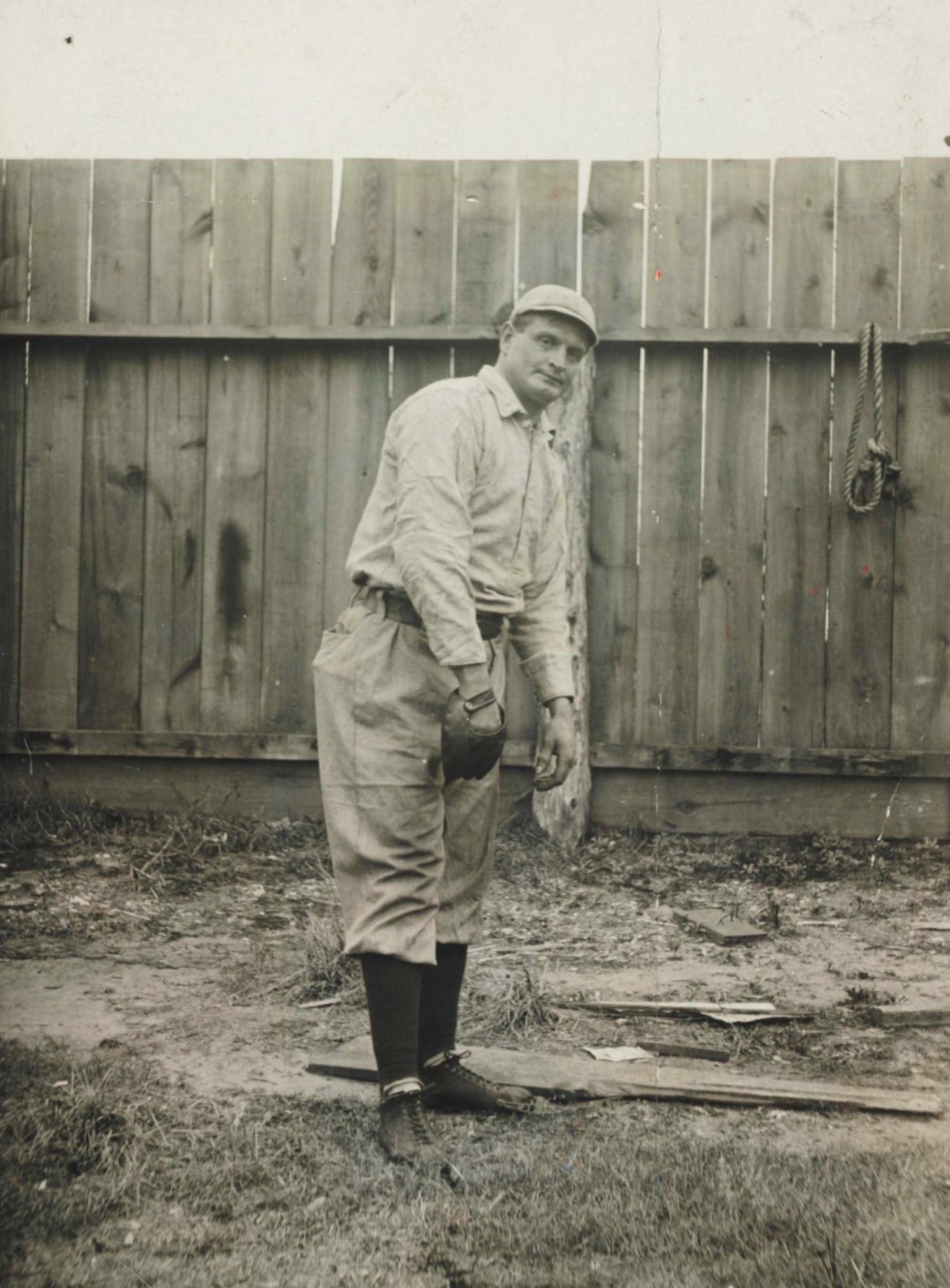
Original photograph of Hall of Famer Rube Waddell as a member of the St. Louis Browns, c.1910.
HYPERLINK "https://substackcdn.com/image/fetch/$s_!rY4p!,f_auto,q_auto:good,fl_progressive:steep/https%3A%2F%2Fsubstack-post-media.s3.amazonaws.com%2Fpublic%2Fimages%2F8d31406c-2963-44a2-9fd3-52b185754438_1818x1258.png" \t "blank"
INCLUDEPICTURE "https://substackcdn.com/image/fetch/$s!rY4p!,w_1456,c_limit,f_auto,q_auto:good,fl_progressive:steep/https%3A%2F%2Fsubstack-post-media.s3.amazonaws.com%2Fpublic%2Fimages%2F8d31406c-2963-44a2-9fd3-52b185754438_1818x1258.png" * MERGEFORMATINET
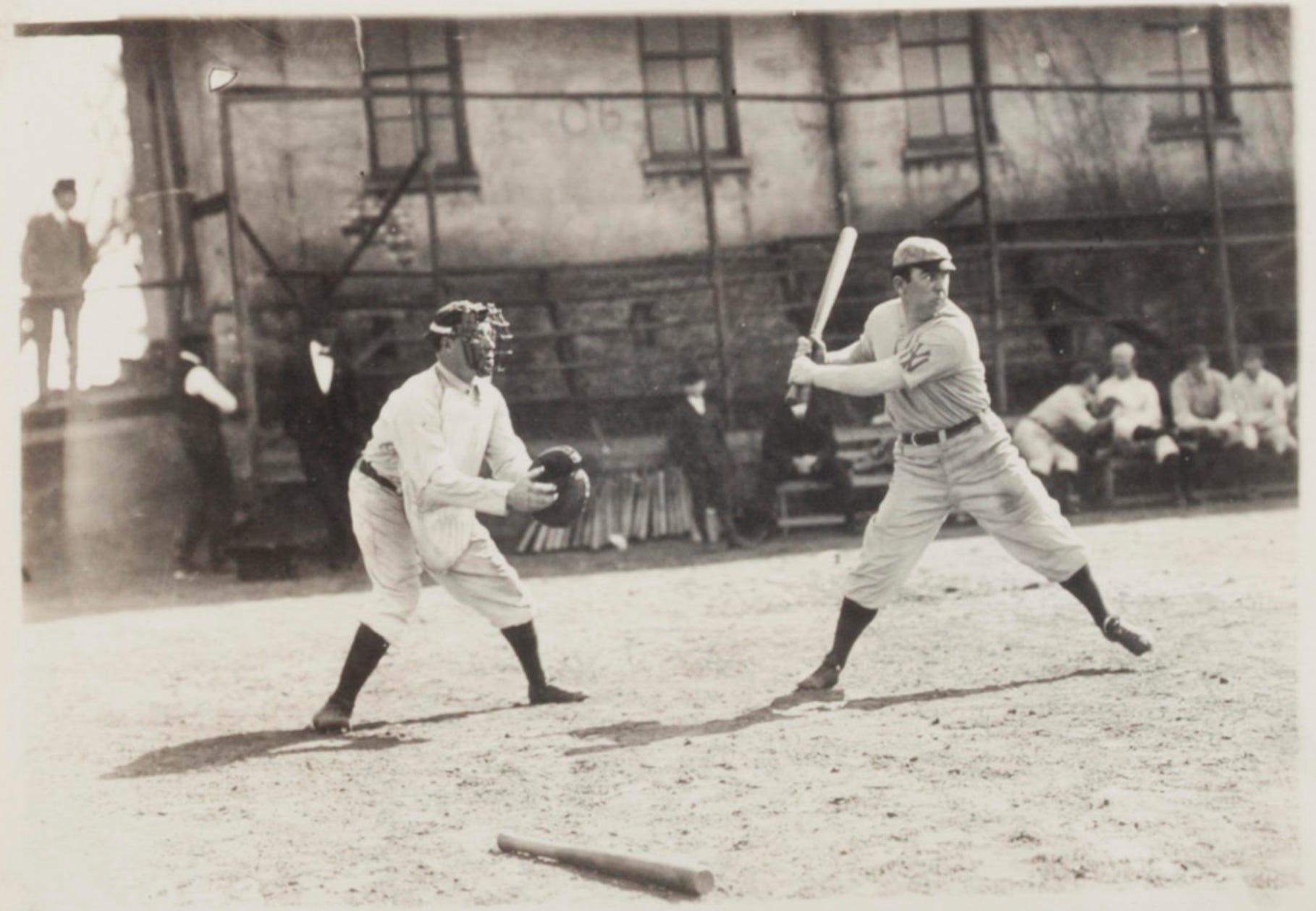
A 1910 New York Highlanders photograph.
HYPERLINK "https://substackcdn.com/image/fetch/$s_!w4YT!,f_auto,q_auto:good,fl_progressive:steep/https%3A%2F%2Fsubstack-post-media.s3.amazonaws.com%2Fpublic%2Fimages%2F944d791d-b7c1-46e3-a4a8-33bfe379d0e5_3502x1594.png" \t "blank"
INCLUDEPICTURE "https://substackcdn.com/image/fetch/$s!w4YT!,w_1456,c_limit,f_auto,q_auto:good
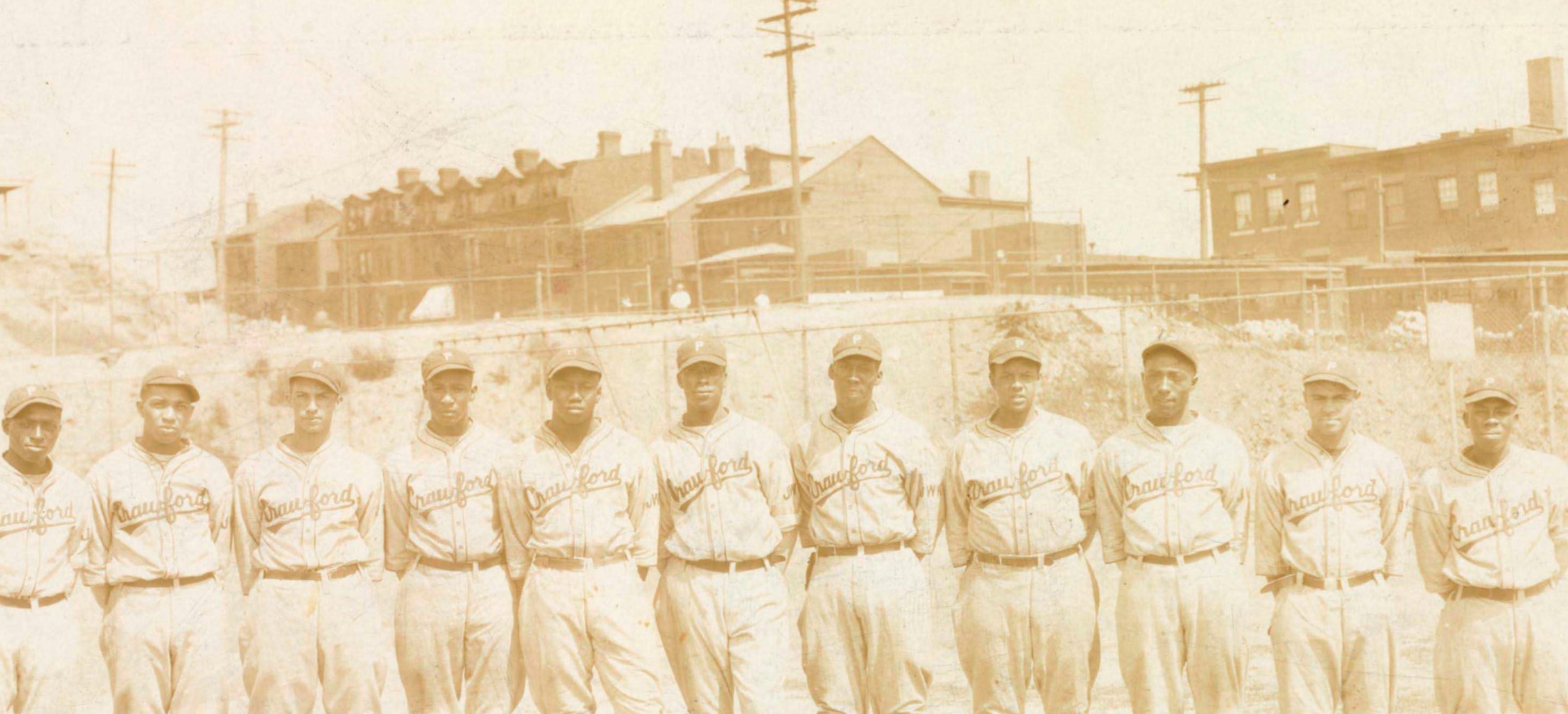
[…]
for the Crawfords through 1930 before signing with the Homestead Grays.
HYPERLINK "https://substackcdn.com/image/fetch/$s_!rec-!,f_auto,q_auto:good,fl_progressive:steep/https%3A%2F%2Fsubstack-post-media.s3.amazonaws.com%2Fpublic%2Fimages%2F34ebc70a-aedf-4520-8ea8-ee0fb63c6b8e_2654x1652.png" \t "blank"
INCLUDEPICTURE "https://substackcdn.com/image/fetch/$s!rec-!,w_1456,c_limit,f_auto,q_auto:good,fl_progressive:steep/https%3A%2F%2Fsubstack-post-media.s3.amazonaws.com%2Fpublic%2Fimages%2F34ebc70a-aedf-4520-8ea8-ee0fb63c6b8e_2654x1652.png" * MERGEFORMATINET
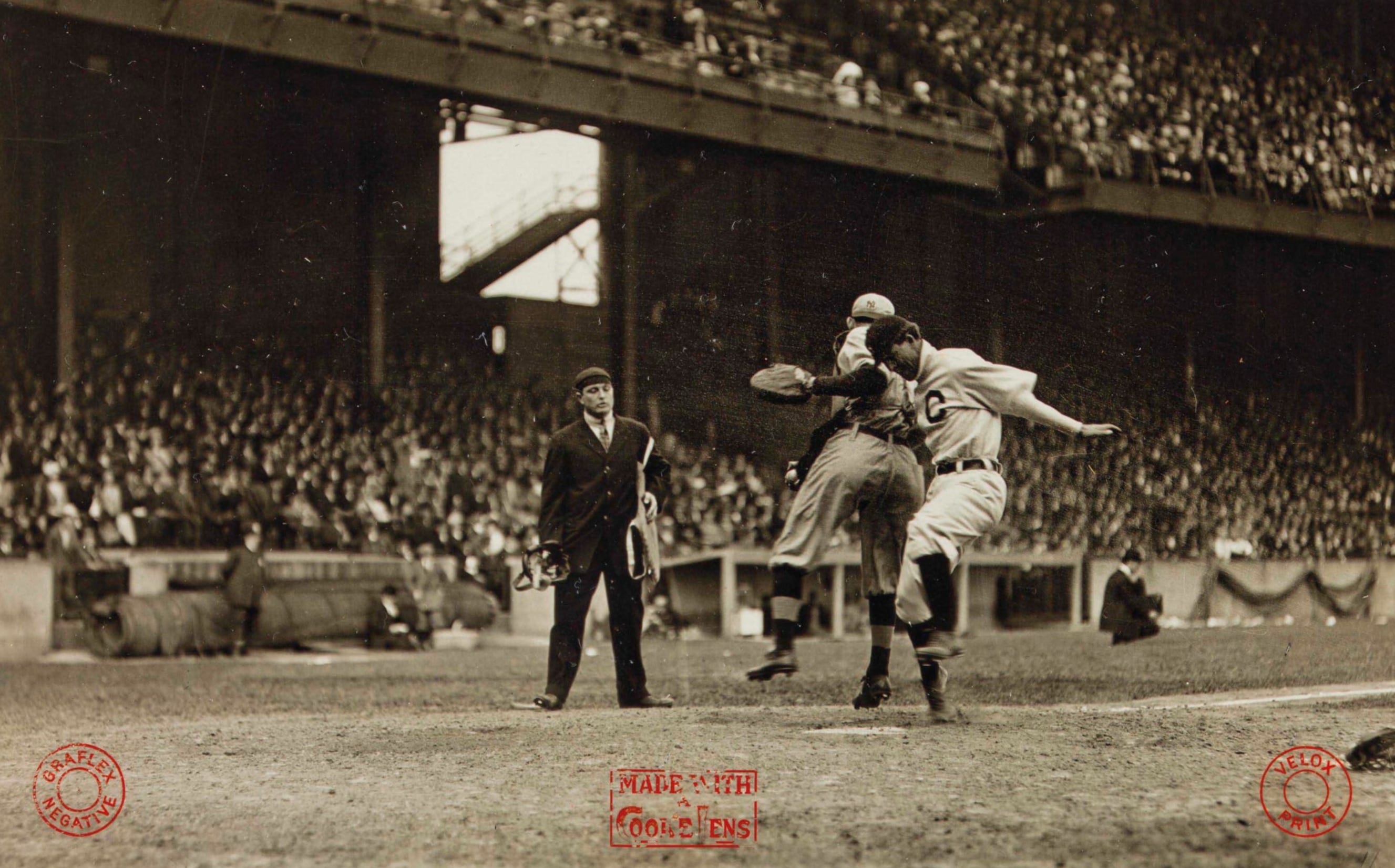
Original Graflex Camera salesman sample photograph of Shoeless Joe Jackson (1888
[…]
fl_progressive:steep/https%3A%2F%2Fsubstack-post-media.s3.amazonaws.com%2Fpublic%2Fimages%2Fe7c01c83-c7cd-4bea-b27d-6606ae1d30a4_3789x2880.jpeg" * MERGEFORMATINET
Arthur Leipzig (1918-2014) Stickball, New York City.
[…]
2Fsubstack-post-media.s3.amazonaws.com%2Fpublic%2Fimages%2F8514821c-32f4-4b29-bb1f-b44e45942e40_760x755.jpeg" * MERGEFORMATINET
Neighborhood kids playing stickball and eating knishes, New York City, 1940s.
HYPERLINK "https://substackcdn.com/image/fetch/$s_!AUdu!,f_auto,q_auto:good,fl_progressive:steep/https%3A%2F%2Fsubstack-post-media.s3.amazonaws
[…]
s3.amazonaws.com%2Fpublic%2Fimages%2F8ea2800d-d4b6-4f3e-8e89-2b4f4b4eb07a_2713x2440.jpeg" * MERGEFORMATINET
A stickball game in mid-century New York City.
HYPERLINK "https://substackcdn.com/image/fetch/$s_!FhnD!,f_auto,q_auto:good,fl_progressive:steep/https%3A%2F%2Fsubstack-post-media.s3.amazonaws.com%2Fpublic%2Fimages%2F1d6b7115-0d70-4d38-97e3-516331413c5d_1080x809.jpeg" \t "blank"
INCLUDEPICTURE "https://substackcdn.com/image/fetch/$s!FhnD!,w_1456,c_limit,f_auto,q_auto:good,fl_progressive:steep/https%3A%2F%2Fsubstack-post-media.s3.amazonaws.com%2Fpublic%2Fimages%2F1d6b7115-0d70-4d38-97e3-516331413c5d_1080x809.jpeg" * MERGEFORMATINET
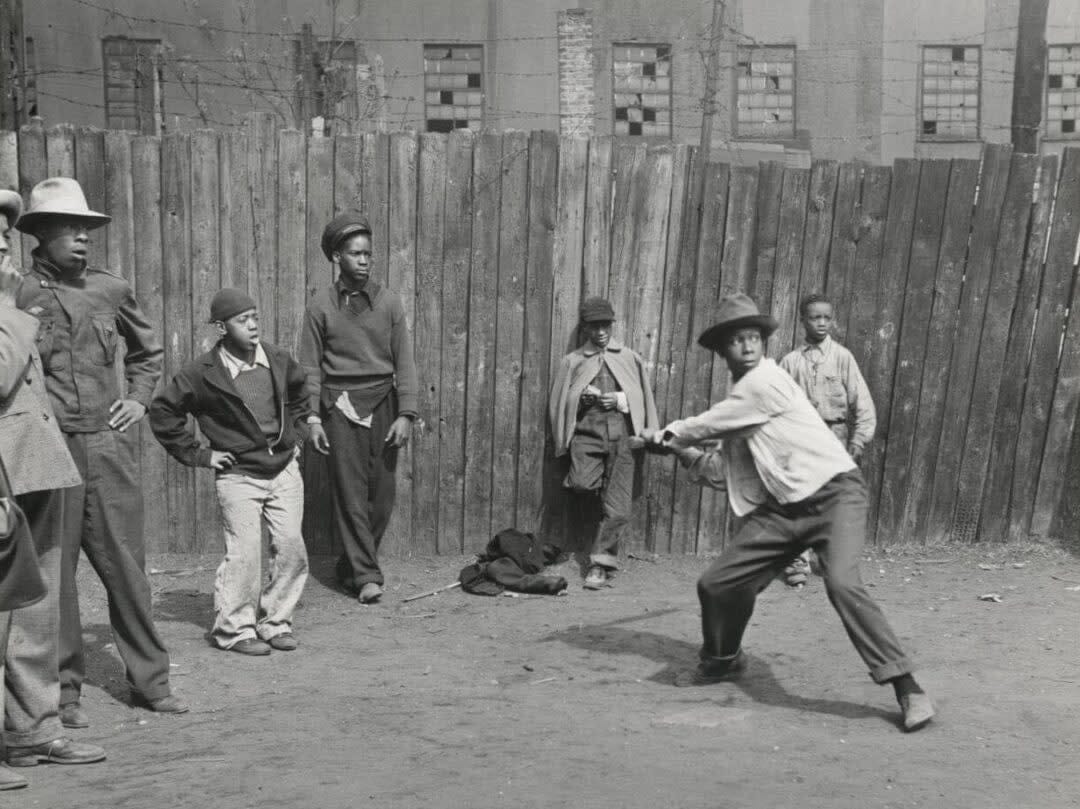
A group
[…]
auto:good,fl_progressive:steep/https%3A%2F%2Fsubstack-post-media.s3.amazonaws.com%2Fpublic%2Fimages%2F7ce2bc68-7703-4587-9166-3ef1117505bc_1000x726.webp" * MERGEFORMATINET
Joe “Iron Man” McGinnity, c. 1907.
[…]
post-media.s3.amazonaws.com%2Fpublic%2Fimages%2F078c33e7-4666-4ce7-8b08-f85c0276b890_1000x618.webp" * MERGEFORMATINET
Christy Mathewson – Marlin Springs, Texas, 1912.
HYPERLINK "https://substackcdn.com/image/fetch/$s_!xeZ0!,f_auto,q_auto:good,fl_progressive:steep/https%3A%2F%2Fsubstack-post-media.s3.amazonaws.com%2Fpublic%2Fimages%2F1af02f98-86a9-47a7-a7b2-f4345434c847_749x1000.webp" \t "blank"
INCLUDEPICTURE "https://substackcdn.com/image/fetch/$s!xeZ0!,w_1456,c_limit,f_auto,q_auto:good,fl_progressive:steep/https%3A%2F%2Fsubstack-post-media.s3.amazonaws.com%2Fpublic%2Fimages%2F1af02f98-86a9-47a7-a7b2-f4345434c847_749x1000.webp" * MERGEFORMATINET
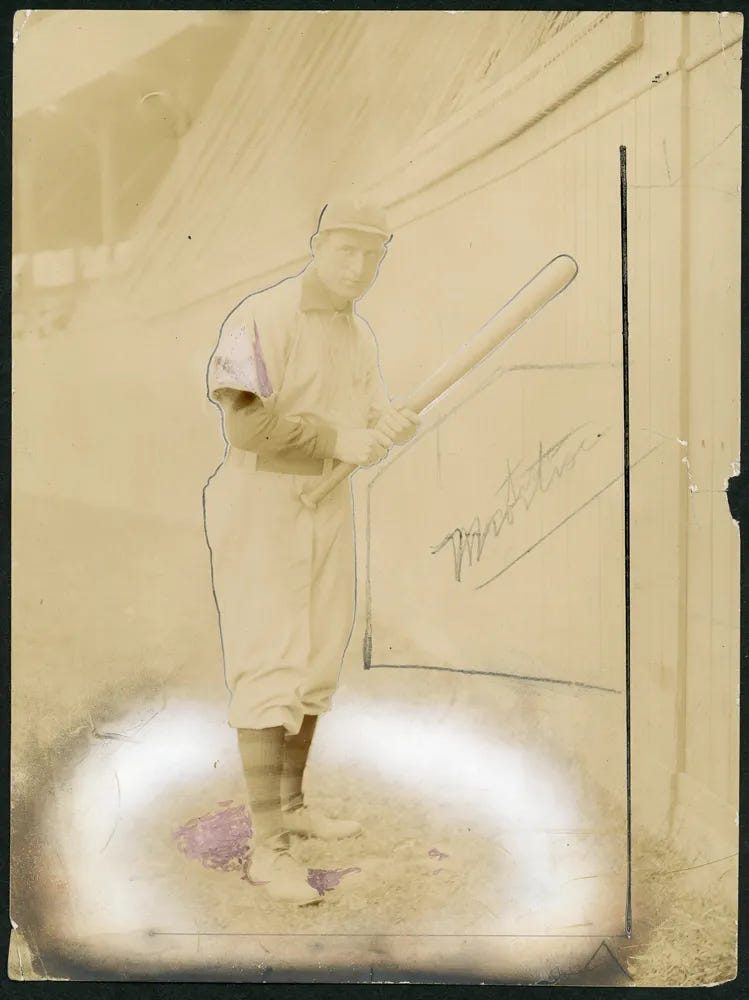
c. 1903
[…]
limit,f_auto,q_auto:good,fl_progressive:steep/https%3A%2F%2Fsubstack-post-media.s3.amazonaws.com%2Fpublic%2Fimages%2Fc1804367-b271-4124-a4fb-6c583266364e_2400x3000.jpeg" * MERGEFORMATINET
Tris Speaker, 1916 by Charles Conlon.
HYPERLINK "https://substackcdn.com/image/fetch/$s_!8ZyU!,f_auto,q_auto:good,fl_progressive:steep/https%3A%2F
[…]
3A%2F%2Fsubstack-post-media.s3.amazonaws.com%2Fpublic%2Fimages%2Fa1c79b4d-d01c-4d30-b952-dd2a339ddc25_946x750.jpeg" * MERGEFORMATINET
Photographic image capture of Nap Lajoie on field for the Cleveland Indians, c. early 1900s.
HYPERLINK "https://substackcdn.com/image/fetch/$s_!TkKh!,f_auto,q_auto:good,fl_progressive:steep/https%3A%2F
[…]
3A%2F%2Fsubstack-post-media.s3.amazonaws.com%2Fpublic%2Fimages%2Fab0df3d3-2dfb-4a13-9b89-6a9ef38a9e45_5299x3740.jpeg" * MERGEFORMATINET
The spitballer and former miner Ed Walsh: photograph by Paul Thompson in 1911.HYPERLINK "https://substackcdn.com/image/fetch/$s_!CT94!,f_auto,q_auto:good,fl_progressive:steep/https%3A%2F%2Fsubstack
[…]
of the Medium of Early Baseball Photojournalism
HYPERLINK "https://substackcdn.com/image/fetch/$s_!EHXn!,f_auto,q_auto:good,fl_progressive:steep/https%3A%2F%2Fsubstack-post-media.s3.amazonaws.com%2Fpublic%2Fimages%2F17d3856d-f678-4d8b-9be3-d82f96e26bf9_950x785.png" \t "blank"
INCLUDEPICTURE "https://substackcdn.com/image/fetch/$s!EHXn!,w_1456,c_limit,f_auto,q_auto:good,fl_progressive:steep/https%3A%2F%2Fsubstack-post-media.s3.amazonaws.com%2Fpublic%2Fimages%2F17d3856d-f678-4d8b-9be3-d82f96e26bf9_950x785.png" * MERGEFORMATINET
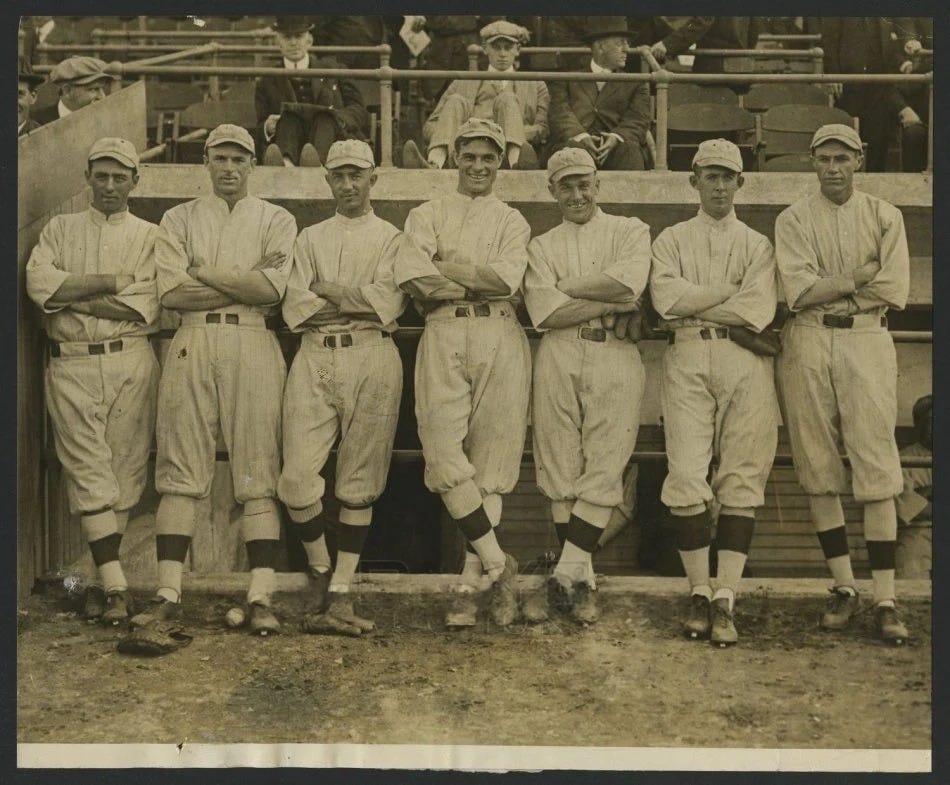
Underwood & Underwood news photograph of the pennant winning (and eventual World Series victor) 1916 Boston Red Sox infield.
HYPERLINK "https://substackcdn.com/image/fetch/$s_!xWJp!,f_auto,q_auto:good,fl_progressive:steep/https%3A%2F%2Fsubstack-post-media.s3.amazonaws.com%2Fpublic%2Fimages%2F3e1127d2-83ca-4bc9-a04c-c13640bf9526_950x786.webp" \t "blank"
INCLUDEPICTURE "https://substackcdn.com/image/fetch/$s!xWJp!,w_1456,c_limit,f_auto,q_auto:good,fl_progressive:steep/https%3A%2F%2Fsubstack-post-media.s3.amazonaws.com%2Fpublic%2Fimages%2F3e1127d2-83ca-4bc9-a04c-c13640bf9526_950x786.webp" * MERGEFORMATINET
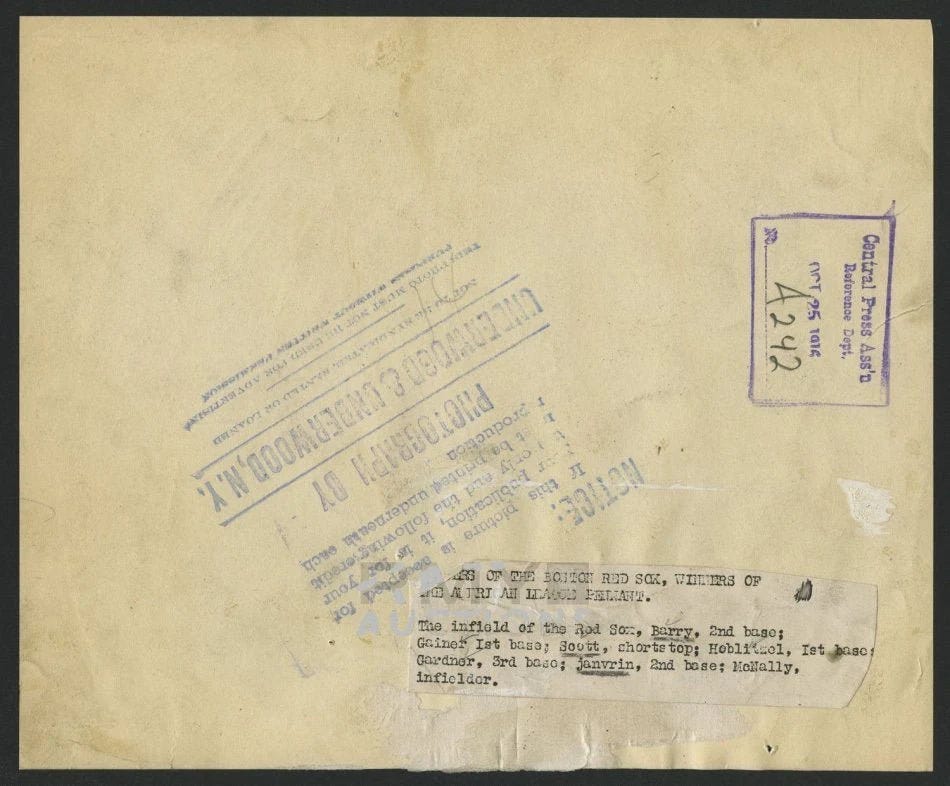
Verso of the aforementioned photo.
The beauty of the foundational and
[…]
register which is dead to the modern world; utterly alien and unknown to it.
HYPERLINK "https://substackcdn.com/image/fetch/$s_!dlfa!,f_auto,q_auto:good,fl_progressive:steep/https%3A%2F%2Fsubstack-post-media.s3.amazonaws.com%2Fpublic%2Fimages%2F65afe235-ccd8-4311-81b7-4c7054e50add_952x1262.png" \t "blank"
INCLUDEPICTURE "https://substackcdn.com/image/fetch/$s!dlfa!,w_1456,c_limit,f_auto,q_auto:good,fl_progressive:steep/https%3A%2F%2Fsubstack-post-media.s3.amazonaws.com%2Fpublic%2Fimages%2F65afe235-ccd8-4311-81b7-4c7054e50add_952x1262.png" * MERGEFORMATINET
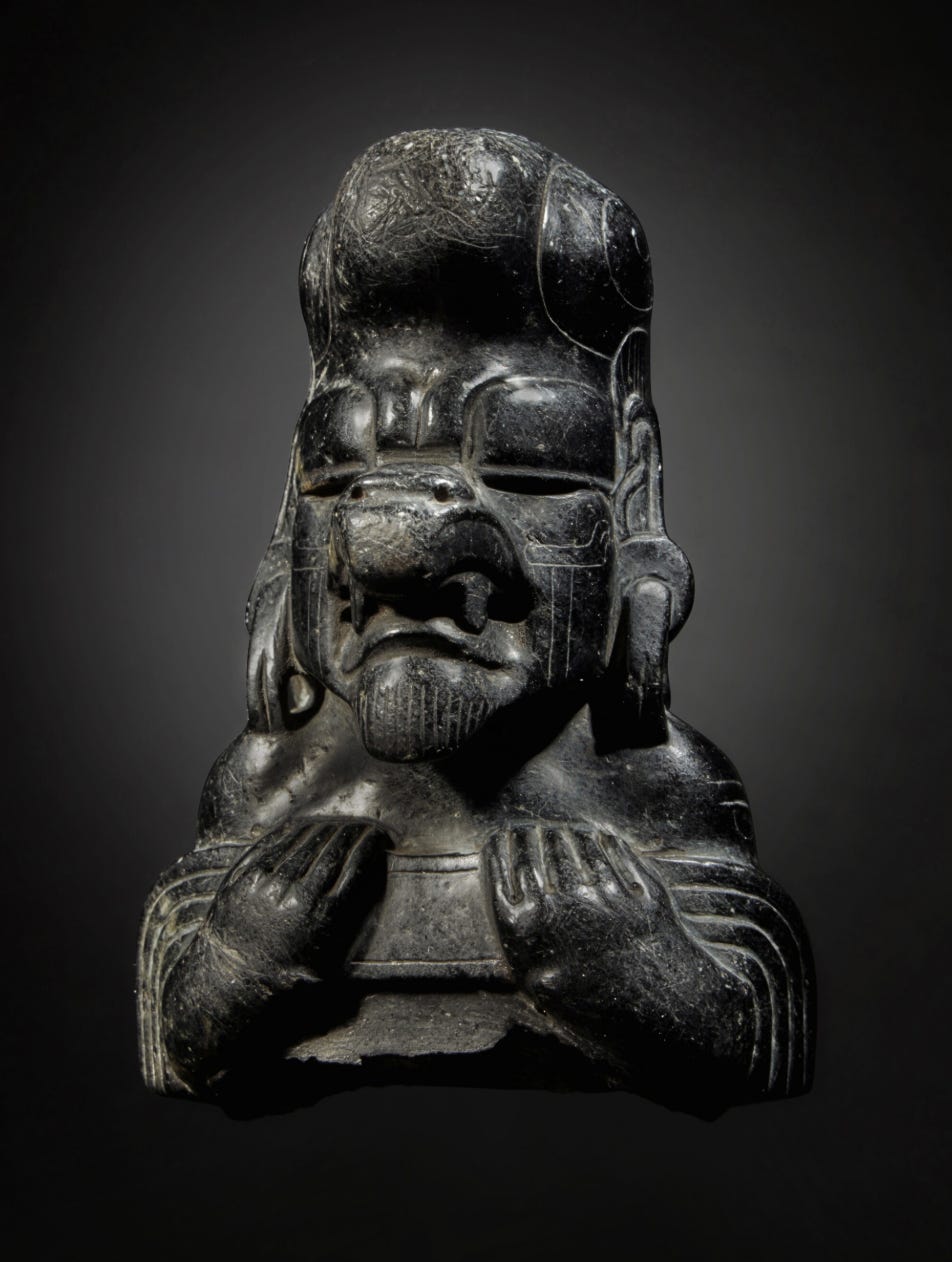
The Guennol Olmec Figure of a Deity, Middle Preclassic
[…]
incarnate American joy in sweat, blood, dirt, and body — the old Yankee Stadium itself.
HYPERLINK "https://substackcdn.com/image/fetch/$s_!7DtW!,f_auto,q_auto:good,fl_progressive:steep/https%3A%2F%2Fsubstack-post-media.s3.amazonaws.com%2Fpublic%2Fimages%2F38ffc792-b3f2-487a-8d72-2bacd16520dd_1200x825.jpeg" \t "blank"
INCLUDEPICTURE "https://substackcdn.com/image/fetch/$s!7DtW!,w_1456,c_limit,f_auto,q_auto:good,fl_progressive:steep/https%3A%2F%2Fsubstack-post-media.s3.amazonaws.com%2Fpublic%2Fimages%2F38ffc792-b3f2-487a-8d72-2bacd16520dd_1200x825.jpeg" * MERGEFORMATINET
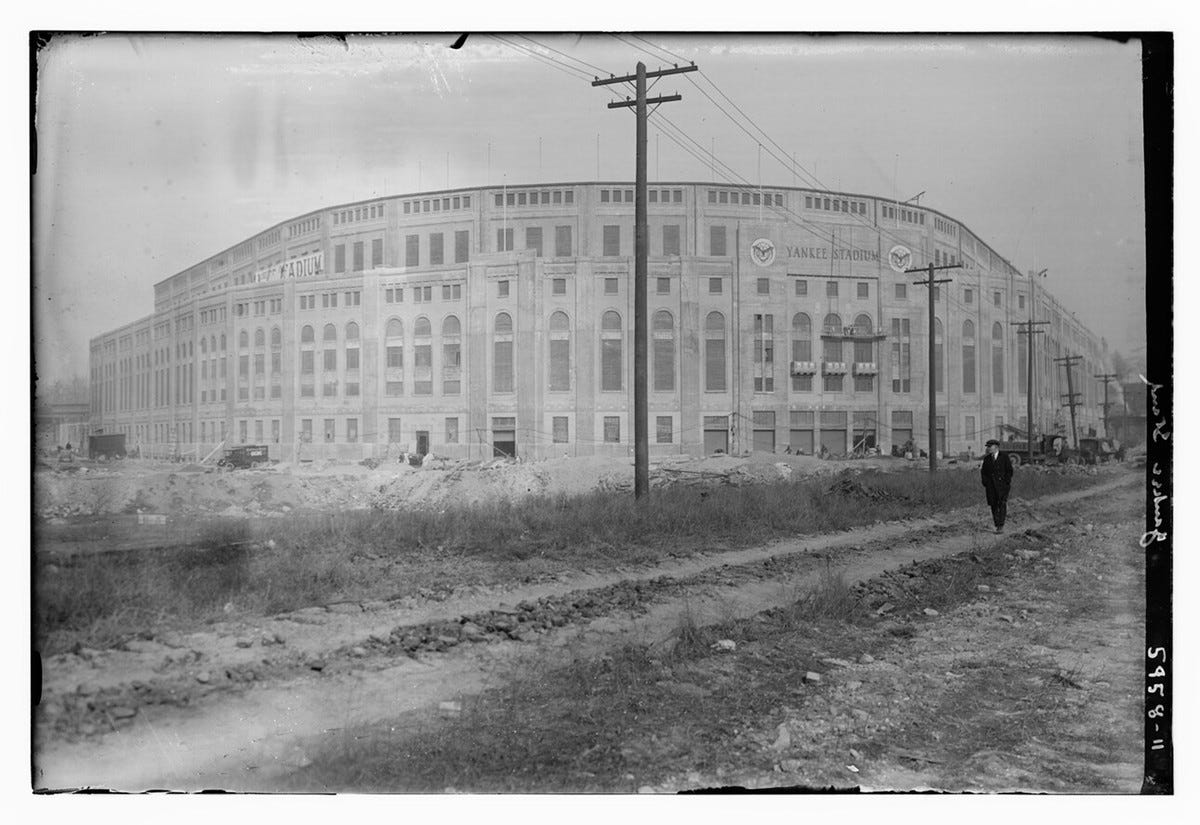
Yankee Stadium, 1923.
In ancient history, we are
[…]
speaking and seeing the earth and the world.
HYPERLINK "https://substackcdn.com/image/fetch/$s_!uYzC!,f_auto,q_auto:good,fl_progressive:steep/https%3A%2F%2Fsubstack-post-media.s3.amazonaws.com%2Fpublic%2Fimages%2F6b0c3624-4fc6-4956-b22c-d26661c73ac6_1000x326.jpeg" \t "blank"
INCLUDEPICTURE "https://substackcdn.com/image/fetch/$s!uYzC!,w_1456,c_limit,f_auto,q_auto:good,fl_progressive:steep/https%3A%2F%2Fsubstack-post-media.s3.amazonaws.com%2Fpublic%2Fimages%2F6b0c3624-4fc6-4956-b22c-d26661c73ac6_1000x326.jpeg" * MERGEFORMATINET
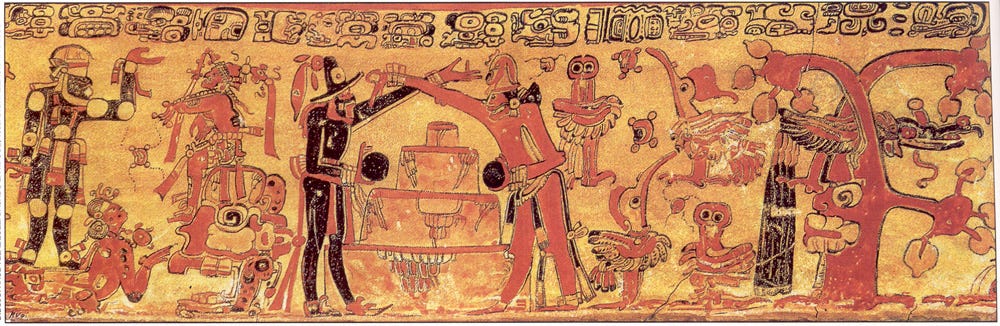
The Mayan hero twins of the ballgame in the Popul Vuh.
Baseball provides America
[…]
rhythm of the ancient mind.
The Grit
HYPERLINK "https://substackcdn.com/image/fetch/$s_!oLXy!,f_auto,q_auto:good,fl_progressive:steep/https%3A%2F%2Fsubstack-post-media.s3.amazonaws.com%2Fpublic%2Fimages%2Facf8ca08-48c4-413c-a895-fc470034a8b8_722x891.jpeg" \t "blank"
INCLUDEPICTURE "https://substackcdn.com/image/fetch/$s!oLXy!,w_1456,c_limit,f_auto,q_auto:good,fl_progressive:steep/https%3A%2F%2Fsubstack-post-media.s3.amazonaws.com%2Fpublic%2Fimages%2Facf8ca08-48c4-413c-a895-fc470034a8b8_722x891.jpeg" * MERGEFORMATINET

Stan Coveleski, 1925.
The punctum of this work is the face of the miner, staring
[…]
2Fimages%2Ffaa87b82-8c5a-43bf-ae35-63a037517afc_944x1200.jpeg" \t "blank"
INCLUDEPICTURE "https://substackcdn.com/image/fetch/$s!38gb!,w_1456,c_limit,f_auto,q_auto:good,fl_progressive:steep/https%3A%2F%2Fsubstack-post-media.s3.amazonaws.com%2Fpublic%2Fimages%2Ffaa87b82-8c5a-43bf-ae35-63a037517afc_944x1200.jpeg" * MERGEFORMATINET
Nap Lajoie, former child millworker
Enfolded: The Traces (2025-12-08; formerly entry P-the-traces-0bd7fc8d)
Audit note (2026-10-19): this work was 100.0% present in this manuscript at passage level and has been enfolded here. All of its passages were already present here.
Enfolded: The Grit (2025-12-08; formerly entry P-the-grit-9ae472c4)
Audit note (2026-10-19): this work was 100.0% present in this manuscript at passage level and has been enfolded here. All of its passages were already present here.