An American Indictment: Josh Gibson; the History and Cost of America
An American Indictment: Josh Gibson; the History and Cost of America
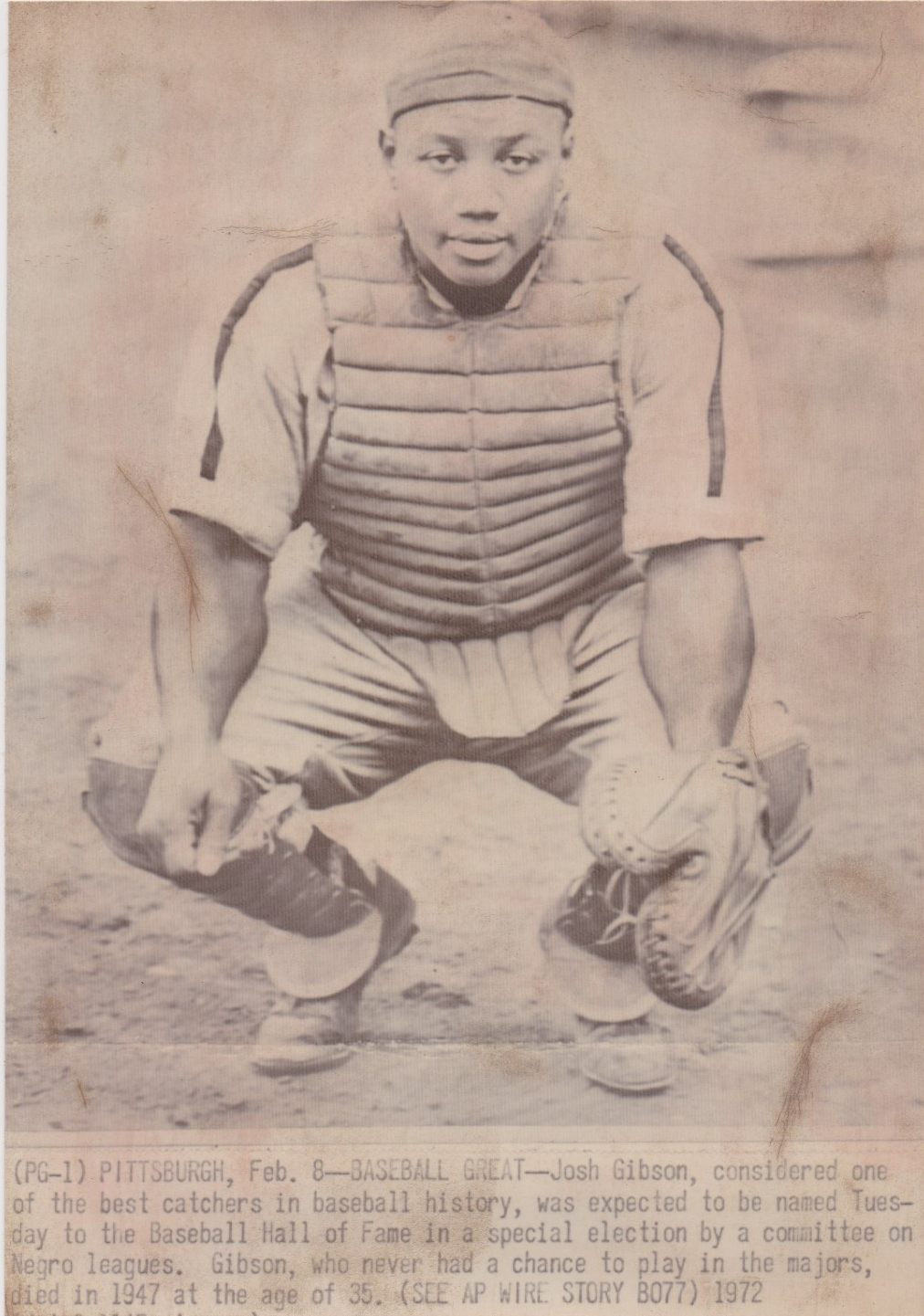
A summation of my baseball work perhaps best comes with, typically, an artifact: this 1972 Baseball Hall of Fame AP Wire Story photograph for the induction of Josh Gibson, Negro Leagues catcher, to the Baseball Hall of Fame in Cooperstown, New York. Gibson stands at the summit of a dark and darkened past; the pinnacle of a muted, forgotten, and silenced terrain which is black American baseball; in unison, early Cuban baseball history. Gibson himself played in Cuba at the tail end of the 1930s; in the Mexican and Dominican Leagues besides.
Josh Gibson’s story is the story of America; the underbelly of the heroic story America likes to tell itself about its history and ascension to world political power. Born to a poor family in Georgia amidst Jim Crow, Gibson’s father moved to Pittsburgh to find work in steel when Josh was still a young boy. Preparing for the life of an electrician; working as an elevator operator, Gibson became perhaps the greatest baseball player of all time.
The loss of counting statistics for the Negro and Cuban leagues is the shadow upon the surface of this historical pool; deeper therein is the loss of everything : the historical memory of the interdimensional richness of black life in baseball; the potential artifacts, photographs, baseball cards; stories and archives. And yet, paradoxically, it is this loss that endows the exiled black baseball history with a power that far surpasses the legible history of white baseball in the United States. This fraught tension is intertwined with the foundations of discrimination and oppression in American history as a history of Western empire; furthermore, intertwined with how history, or lack thereof, functions to create mythology.
The experience of Gibson, Paige, Bell, Charleston, Suttles — this is an experience that has been all but forgotten and erased; acknowledged if only in lip service by extremely delayed Hall of Fame induction; introduction of Negro League counting stats to baseball history. This is a primary historical violence of lived reality and time that is shored up only in death — with Gibson auspiciously inducted in the decade after the assassinations of both Malcolm X and Martin Luther King Jr. The political struggle for black rights in America is the story from which Gibson emerges; as does Aaron, Mays, Bell — young black men born and raised in the American South amidst Jim Crow.
The elimination and coordinated destruction and suppression of black life is the story of American history primarily — as it is what allowed for the American South to cultivate first order wealth through plantation riches: riches that were first to American history before the industrial, child labor ridden labor boom of the late 19th and early 20th centuries. In the scrying mirror of baseball, we see America: first in what suppression, oppression, and exile from institutional, national resources does and can do to a group of people.
Without access to the stabilizing infrastructure of major league baseball — an infrastructure powered by the emergent industrial wealth of the monied class of early modern American elites — black baseball players were forced to eat, sleep, and play perpetually on the road: driving through highly segregated and racially violent towns; kicked out of restaurants, barred from hotels; often resorting to sleeping on buses and benches. This political statelessness directly emerged — as documented by the sociologist and political thinker W.E.B. Du Bois — from the failure of the Emancipation Proclamation and subsequent Reconstruction to actually secure rights and citizenship privileges for black people in America.
Critically, the history of the Negro Leagues and early American baseball must be primarily observed as a mass structural and institutional failure to secure excellence and humanity as a collective climate in and for baseball as a cultural pursuit which permeated racial and ethnic enclaves the country over. From cultural presumption and ideological civilization level belief system — passed generations over as a group nervous system status quo — came tumbling down the intergenerational effects: the death of Rube Foster, son of slaves, in an asylum; Josh Gibson’s death mere months before Jackie Robinson debuted on the field for the Brooklyn Dodgers in 1947.
This mass enforced sacrifice of potential political possibility and cultural shared excellence came tumbling down from the ancestors of our great ballplayers: Moses “Fleet” Walker; Buck O’Neil; countless others. This primary historical violence of chattel slavery — the very institution which founded the possibility of “richness” upon American soil through enforced labor cut with rape, abuse, and murder: is itself the institution which forms the sweep of difference that built Yankee Stadium; forced Satchel Paige to play upon that very field as a member of the Black Yankees.
This was, in the conscious and unconscious mind of early American civilization, a necessary and possible sacrifice of an entire group of people to a profound and prolonged period of enforced trauma in order to enrich a select few colonists. Alongside the genocide of the indigenous American peoples — who were then subsequently socialized in American conversion schools, which included baseball in their curriculum — America’s destiny was carved out by the skeleton which it drew in the bloody dirt: one of mass killing and mass enslavement to build the temples of empire which today are glorified and presented as a shining beacon of freedom and possibility.
Josh Gibson stands in the face of this narrative; his delayed induction into the Hall of Fame; the conditions of his life and death in the silence of black oppression in American history tell the tale of America’s greatest failures and failings as a nation. If the game’s greatest player — to whom Babe Ruth was “the white Josh Gibson” — could not play a single game as a member of the country’s unified front of professional baseball excellence, what does this say about a nation which champions freedom, equality, and greatness?
To this day, we witness the pillars and icons of American society; the supposed principals of American excellence and possibility: that these very pillars are poisoned with the root of power at all costs, manipulation; political violence to achieve ends. This is called victory or genius in the American civil constitution — wherein it is nothing more than brutishness at the cost of the possibility of greatness to emerge from the most unlikely places among our ranks: a poor black child working as an elevator operator in a Gimbels Department Store in Pittsburgh in the onset of the Great Depression. Playing for the Gimbels team is where Gibson first made his name.
We evaluate greatness, talent, and genius as it is presented to us by the American political and industrial machine; find ourselves confronted rather with gluttony, greed, and lust for power. It is those who will exert the most violence and the most force who will rise to the top of the American political and cultural machinery: who will shout the loudest; most clearly debase the other. This legacy shines through at the root of what was done to the black people of America; the indigenous peoples of America. It was the most violent, hostile, and inhuman act which raised a whole class of peoples to power of landowning; resource owning; machine owning force and control. And this legacy to this day still determines the course and trajectory of American social governance — as these are the very individuals who lobby and purchase and control media in order to determine what is said, done; subsequently, possible in this country.
What we lose and have lost — every day that this organ of political cowardice progresses — is the greatness that is beaten underfoot by pure power and violence of force. Gibson, it was known, enjoyed nothing more than playing baseball and eating ice cream. The loss of his wife in 1930 while giving birth to their twins, broke Josh’s heart. He was just 18 years old.
We do not see these men in the history of our country — men with good hearts, men who fought: not only for themselves in improbable and desperate conditions, but for the possibility and good of others. Men such as the great Jackie Robinson, who championed, “a life is not important except in the impact it has on other lives”. O’Neil as a force of education; Foster as a foundational architect of possible black institutional model of culture and community built, maintained, and communicated a historical, intergenerational community of black life amidst mass cultural and sociological suppression. It is no mistake that men such as Foster, Robinson, and Gibson died young. The weight of compound resource deprivation, discrimination, and everyday political, racial, violence is a toll upon the body.
What the story of the Negro Leagues and Josh Gibson shows us is alternative models of possibility — outside the hegemonic systems and switches of power and control which poison and foundationally operate human life in American civilization and elsewhere: systems in which the most violent, aggressive, and inhuman approaches of conquering and control seemingly dictate political possibility. Alternative models of possibility which involve community, music, communication, sharing; a heritage of real connection and relationship which makes life possible through perennial exchange and existential understanding.
The failure to accomplish this method; furthermore, its brutal opposite through the foundation and establishment of America, establishes its trajectory, demise, and failure as an attempt to create a corrective civilization based on the principles based on its founding creed: “All men are created equal” — written by Thomas Jefferson, who owned slaves and formed a second family with an abused girl under his control, Sally Hemmings, pregnant with Jefferson’s child at the age of 16.
We can quite clearly see these histories repeat themselves: all under the premise of seemingly meaningful words spoken by individuals whose intentions and actions indicate and express that which is patently otherwise. It is, perhaps coincidentally, seemingly always that these individuals seek first power; from seeking power declare true intention; all the while manipulate and abuse in the darkness, away from the light of day. What history also shows is that time always catches up to ill action; that, in the case of Gibson and many others, truth is restored — even if truth is sorely late. This has been the case for great exiled figures the world over: from Spinoza to Dante. What bars greatness from our world; the potential of greatness is not that it does not exist, but the greed, self seeking, envy, and jealousy of those hateful and scornful of what light genius can bring to this earth.
White ballplayers, managers, owners; even Ban Johnson, President of the American League — well understood this principle. That the emergence of black greatness in figures such as Jose Mendez or Josh Gibson posed a vital threat to the supposed nature of white supremacy in baseball; that the white professional league was the great league; no black or mixed race player was capable of succeeding or excelling in it. It was a closed circle, claimed to be elite — but really upheld by the violence of mediocrity — in its swell, nothing more or less than a gate held up against an entire race and demographic of peoples so as to preserve the illusion of fell excellence.
Surely, players such as Walter Johnson and Ruth were among the true greats; a sign of Ruth’s greatness was that he even sought out barnstorming competition in Cuba and among the black teams — a champion, like Giants manager John McGraw, of integration and the establishment of true equity in play and field by hiring and playing alongside black stars. It was, however, the vitriol of players like Ben Chapman and the power and status seeking of figures such as Ban Johnson which defines the opposite and opposing force of hatred which pressed down against and barred Paige, Charleston, Suttles, and Gibson from their rightful places in the unified institutional clarity of the game of American baseball.
To interrogate this hatred is to interrogate the true, deep roots of human suffering and egoic misery: Chapman’s own desire to be seen as the greatest; Robinson’s excelling in the face of Chapman’s mediocrity and lack of success on the field. He, like many others, could not stand to see a black man succeed on America’s greatest stage — and seeking to take his success from him, taunted and berated him in hopes of seeing him fall. This basic human schadenfreude and call to catalytic destruction is the primary delimiter and failure not only of the segregated baseball leagues but of a possible world order of human collaboration, respect, and continuity across racial and ethnic lines. Beneath all supposed ideological grounds for difference, one thing stands between mankind and collectivity: the self seeking, desirous of power, the greed and lust for success and the standing to be, ever so briefly, king of the hill of skeletal entropy.
In this ossuary of bones lies Josh Gibson, perhaps America’s greatest baseball player of all time. Little of this can be known outside the stories and tales. We cannot garner true statistics for him, nor can we piece together the totality of the history of his life and times which has been banished by America’s failure to recognize the possible greatness and importance in black life, culture, and sport. And in doing so, we as a nation experience profound, first order existential loss of the possibilities of what it means to be human — clinging only to the empty life raft of political power and wealth as a potential condition to elevate ourselves out of the slum of profound lack of community: in the face of the violence wrought by mass self seeking, greed, envy, and avarice.