Babe Ruth: Avataric Will and the Supraordinate Realization of the Totalizing Powers of Being on the Field of the Everyday; in the Field of the Human
Video
Babe Ruth: Avataric Will and the Supraordinate Realization of the Totalizing Powers of Being on the Field of the Everyday; in the Field of the Human
00:01
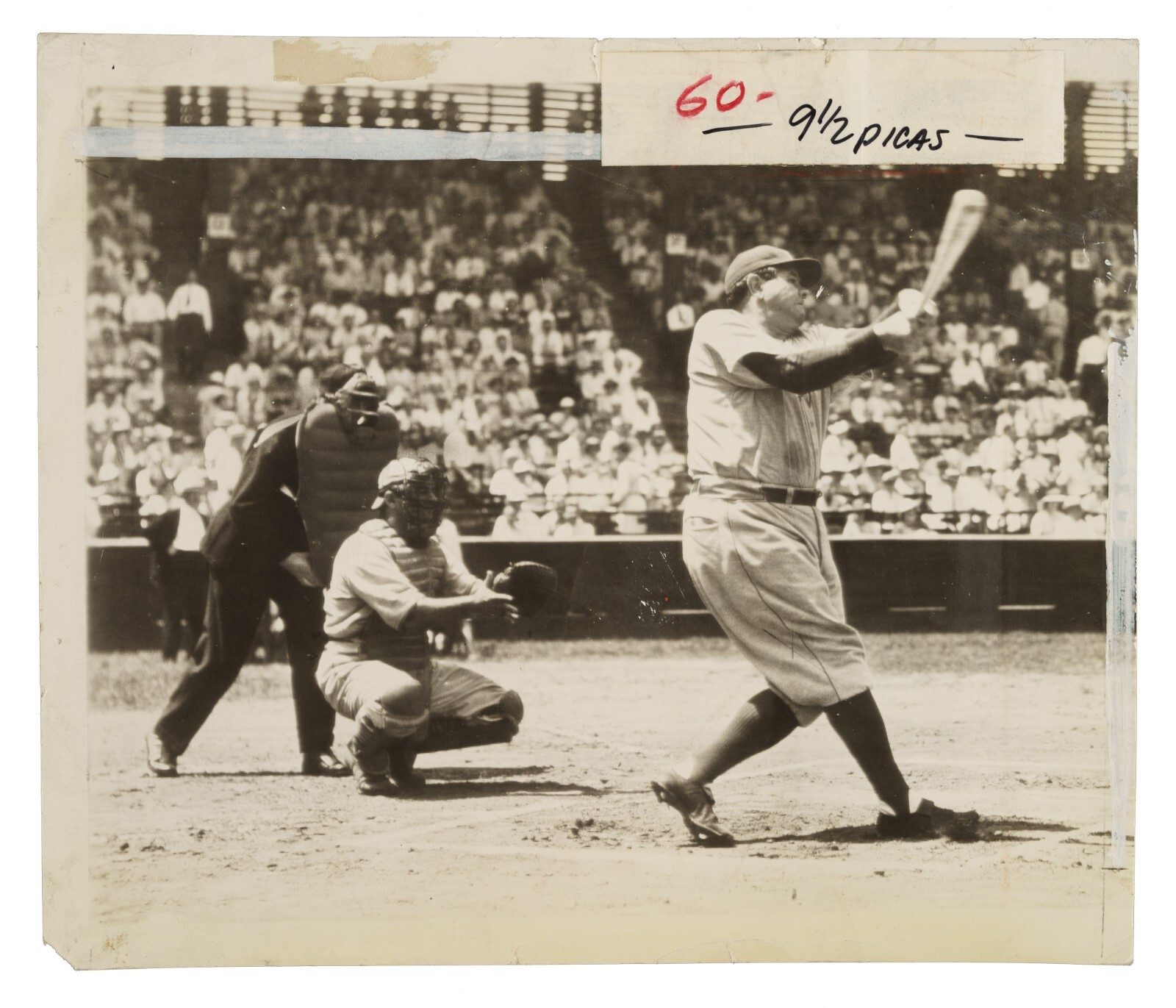
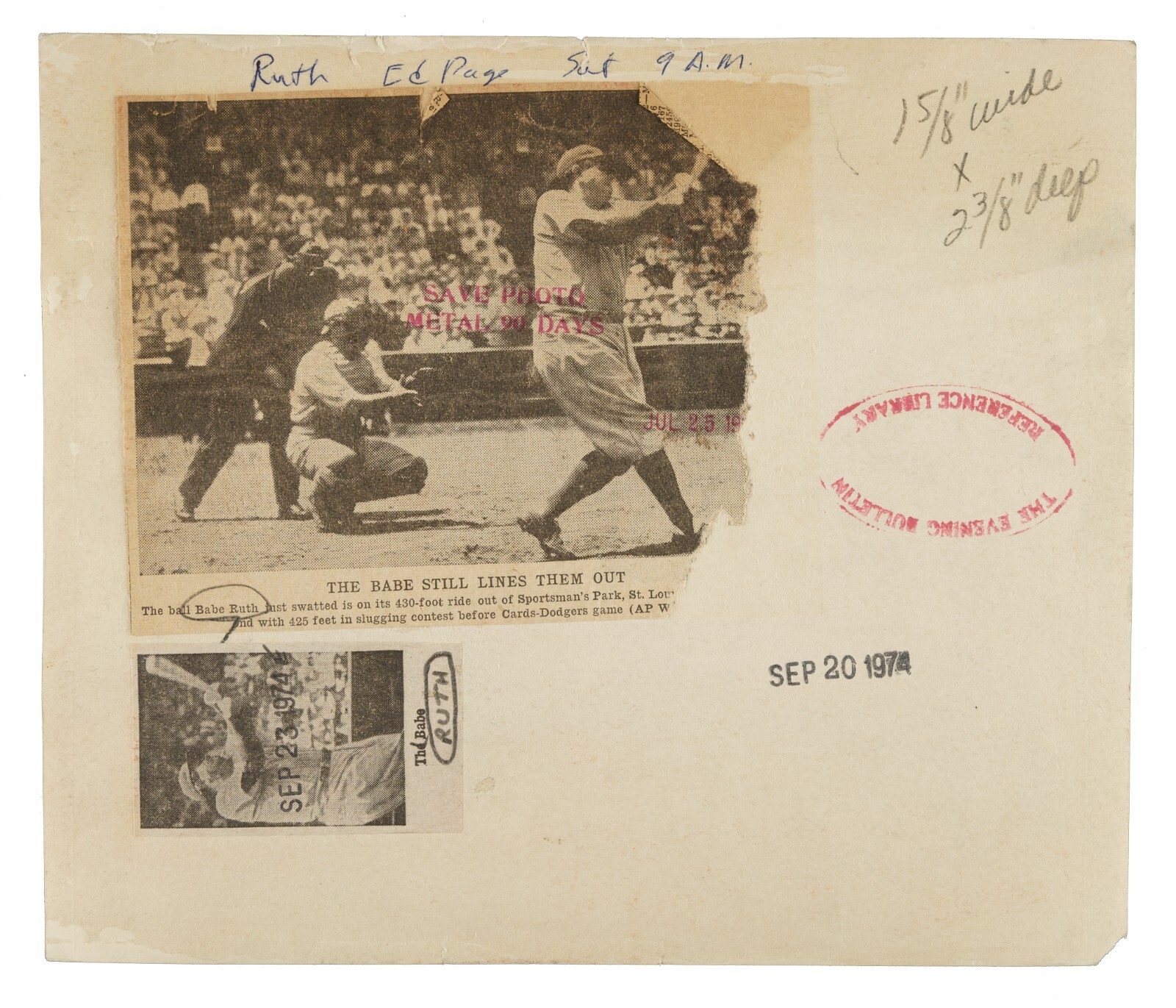
So I had been wondering what my archive was about… and I didn’t really understand until I laid the last stone. This here is a picture, 1938. It’s a wire photo of Babe Ruth, who was then, very briefly… for one year… he was a coach, a first base coach for the Brooklyn Dodgers.
And during this period of time, he would actually participate in these kind of exhibition matches or exhibition moments. Like a slugging contest, so to speak, before games. And he would still hit these mammoth home runs.
01:38
At this point, he was 43. So he’d been out of the game proper since that period with the Boston Braves in 1935. Since age 40. And he would die 10 years after this one year with the Brooklyn Dodgers as a first base coach.
I had to ask myself, because... there are some ways in which this archive is about the political revolutionary qualities of baseball, which is something that I think is important, especially as it pertains to Cuba, in terms of political liberatory possibilities through the vehicle of culture. That’s one aspect of it. But there’s a deeper existential aspect hidden within that question.
And I had to ask myself, there’s four essential nodes. There’s the node of Roger Maris and the chase for 61 — which was a huge node. There’s the node of Jackie Robinson’s integration and his years with the Brooklyn Dodgers, which was another huge node. There’s the node of Satchel Paige and his later career — specifically in the 60s into the 1970s, which forms the epilogue, so to speak, of the archival story, the mythic story. And then there is this node of Babe Ruth, which is something that I haven’t really touched on at all in these essays or this conversation or this dialogue.
03:01
But I saw this piece and I started to understand at deeper level — the existential power and question at work… specifically as it pertains to this: the will, the will as an aperture that’s revealed through the sport of baseball.
So the way that I would kind of couch that is to say that with all four of those figures, right, again, the archive, the modern archive really begins and situates itself with Cuba and the rise of a political and cultural revolution through the vehicle of baseball and the culture of baseball in Cuba as a way of constituting early national identity in the midst of the war against the Spanish colonial government. Culture as a political force of collective will and self-making; self determination. Self realization and representation at a communal-national scale through revolutionary consciousness.
But then the archive shifts lenses as we head into the 1900s. And I think there… is more of an existential philosophical dilemma that the archive is working with, particularly as it pertains to time, force, energy, and space.
04:10
And so then it really does open up into this square or this four-pointed movement that really is sprung by Ruth in the early 1920s with the onset of his power hitting ability. I touch on the 1916 World Series a bit, but it is primarily around the early 1920s matchups against the New York Giants, then into 1927. And then there is this piece here, which is 1938. The final stone in the cathedral, so to speak.
This is this kind of exhibition pre-game home run style event that fans are gathering to see Ruth in… and take really his last swings. It is a show, out of the context of the game itself with its rules and regulations. It is a pure show of the Ruthian power and might — the quality that defined him in his early Yankee days; revolutionized the sport forever in the public eye.
And then there’s that final event in 1942, which is a relief fund exhibition between him and a then aging Walter Johnson in this final moments… of this collision of these two mythic all time greats, right? These two absolute inner circle Hall of Famers. One last time on the baseball diamond for this, this war relief effort. There’s Ruth.
05:10
Which then of course naturally progresses from ‘42 into Jackie Robinson’s integration: 47 to 55 and 56; his final years, too, with the Brooklyn Dodgers; retirement. And there’s several different aspects that are touched on there. Different artifacts and documents of Robinson’s integration into the myth culture and image culture of baseball history and institution as an empirical force and form of cultural production as representation.
And then from there it goes to Maris’ chase. It really does zero in on 1961; then the fallout of that chase in terms of the force of will and presence of will and presence of mind that’s exerted by Maris to accomplish this mythic feat — which is to break the most cherished and valued record in baseball history as an outsider to the New York Yankees (a traded player; a Croatian from the upper Midwest whose name, coincidentally or not, is also altered — from Maras to Maris) as a New York Yankee, right? Again, this most cherished legendary figure of Ruth; the greatest record in baseball, the single season home run record.
And then just after Maris, there’s this epilogue, which is the end of Satchel Paige’s career. His last barnstorming rides, his Kansas City Athletics appearances in 1965, and then his induction into the Hall of Fame in 1971, and the archive ends.
06:20
What this is talking about in so many different ways, and why I find this particular image of Ruth to be more powerful really than anything... you could say 1927 with Murderer’s Row, his 60 home runs, or Babe Ruth as a pitcher in the 1910s. I do like those images as well. Especially the onset of his career.
But really we’re talking about… again, with the moment of Robinson’s integration — which is integrally different than his time with the Kansas City Monarchs. We’re talking about Maris in 1961 and then the fallout of that. Specifically that moment; then ‘62, ‘63… his final years with the Yankees before he moves on to the Cardinals. Satchel Paige — the very end of his career where he finally becomes canonized… really as a baseball saint, so to speak. The greatest pitcher of all time in so many words, in so many ways. He pitched professionally until he was 60, at least according to a rough approximation of his best (and multiple) birth records.
And this period of Ruth’s career, which is to say it’s post his career, ending with the 1935 images with the Boston Braves… into ‘38 with the Dodgers and then ‘42 with the relief game appearance… is that we’re looking at these feats of will.
07:43
These, I would say — these feats of spiritual passion in participation with the game and sport of baseball, where Ruth’s identity itself is around baseball and constituted by baseball. We discussed this a bit in prior essays, but we’re really going to air it out here in its full metaphysical force, gravity, and thrust.
And in so many ways, he constitutes America’s cultural identity through this mythic merging of the force of his life and his existence — the so often quoted larger than life persona of Babe Ruth and all of the deep trauma and wounding and loss and violation in his early childhood life.
So much of Babe Ruth’s story, just as much as it is the story of America and the story of baseball in its greatest figures, are stories of trauma, alienation, isolation, slavery, violence, rupture. And from these ruptures and from these fragmentations spring the mythic presences that themselves become the legends of the game or the essential immortal fabrics which are gestured towards to this day as the superstructure of baseball itself. The icons and the memories of baseball history and its most powerful moments — where it not only became an indelible part of the fabric of American culture and American history, but spoke deeply to something existentially true about humanity and human life… and not only humanity and human life, but existence itself in a metaphysical sense.
09:04
So when we look at a photo like this, the most apt comparison to me is Satchel Paige’s agelessness. It’s his perennial attempt to return to the game — and often successfully, very successfully — to continue to achieve and perform and experience this unity with the sport and the game of baseball. And through the craft of pitching — which is something that he cultivates as a very young child and finds this in throwing rocks. It’s actually a way that he protects himself as a young child in the early American South as a poor black child who’s effectively stateless in the sense that he doesn’t exist on the census, his family name changes, et cetera.
This is very similar, I think, archetypally — to the way that Ruth constructs himself at St. Mary’s, the reformatory school… where he undergoes this profound spiritual evolution of self… and Satchel Paige also goes to a school for troubled black children, which is informed philosophically and culturally by Booker T. Washington, interestingly enough.
10:22
Ruth’s essence, his identity, the locus of his being, right, the force of his will — it’s not found in his familial relationship, it’s not found in his marital relationship, it’s not found in the public sphere, it’s not something that he finds through the various different forms of indulgences that he participates in… whether it’s partying or gluttony with food.
His... the locus of his will, it’s something that is almost spiritually stewarded and dedicated as in a spiritual passion towards the game of baseball. And what’s interesting to me about Ruth along with Paige — we’ll get to Maris and we’ll get to Robinson — is that the force of the identity or the locus of the personality is so consecrated and constellated and established and founded in the game itself that there is a sort of primordial unity of identity.
And we see this in terms of both Paige and Ruth’s legend in the game. It’s an indelible mark that is made from a total dedication of passion. And so again, when I think about this, I think about spiritual aspiration or sainthood or the idea or the concept of a monk. And this is something that to me is so closely allied to the way in which Ruth and Paige experienced the game — but also how we experience Ruth and Paige through the game of baseball, through the aperture of baseball and through the history of baseball.
As these figures who, as you can see here, Ruth has clearly aged and his swing looks almost just as awkward and effortless as it ever did. And this, this home run that’s being remarked upon here in this photo was 430 feet in Sportsman’s Park in St. Louis. This is a man who has perfected the craft and the technique and is participating in this cosmic artistry of the physical act of hitting a baseball — which is so often considered one of the hardest things to do, if not the hardest thing to do in all of sports and all of physical or athletic achievement… in terms of the presence of mind and presence of body, the reaction time necessary and the ability to read and understand and interpret information by the millisecond and to react to it with a very fluent architecture and archaeology of the body. The muscle memory required to respond to that incoming impulse, that incoming sensory information.
13:12
All of that is to say that when we look at Ruth, not just so much in the pop cultural referential way of the home run king or the guy who brought power to baseball… I’m talking more about Ruth as this man whose entire identity is subsumed in the game and the passion of baseball. And you see him in ‘35, ‘38, and then again in ‘42 — go on these series of last rides, which to me are symbolic of the power of the primordial will, the a priori will before creation. Before space, before time.
The force of the will in the face of the entropic decline of the human form… these rides which themselves are a testament to the passion — which again is the spiritual force of will behind the apparent phenomenological movement and force of baseball itself. Where again, participation in the act of baseball is an inherently aesthetic act. It’s not something that is dedicated toward the typical drives of the human being or the animal or the organism toward the perpetuation of survival or reproductive drive, for instance.
This is a passion that has been subsumed… and the metabolic structure of the organism — it’s almost like there’s been a transference or transformation of the essential identity of the organism into a spiritual identification with this high aesthetic craft, this practice, this technique.
14:35
And so you see this transformation of identity, common to both Ruth and Paige, which is that their life is within baseball. They’ve almost ceased to become citizens of this evolutionary biological organism, which you would call the human species, and they’ve entered into this monk-like devotional relationship with the fundamental energetic force and power and thrust of existence itself, which you would just simply call the essential will.
The dormant latent will of the cosmos beneath and before biology. And this cultural ritual or this cultural rite of baseball has allowed them to enter into that, and as such, they’ve entered into the realm and the dimension of the mythic, the legendary… and then the cultural ritual architecture of baseball and American history and American culture as essentially intertwined with baseball responds to that entrance into mythic time and space and being with canonization, which again is why the archive ends with Satchel Paige’s Hall of Fame induction.
This is a canonization of a black man in America… and even as he’s canonized, he’s put in a separate wing for Negro Leagues players — and he expresses his frustration at this very clearly.
15:51
But to connect this with the ancillary — but no less important — other two figures in this quadratic equation, so to speak… Robinson and Maris. The force of Robinson is a boundary breaking integrative thrust, which is again an expression of primordial will, revolutionary will through the cultural aperture of baseball to revolutionize that aperture structurally as a depiction of the presence of the real as in inclusion, similar to the way that Paige invents his pitches or travels outside of baseball as a griot or a storyteller who actually tells baseball better than it tells itself… or Ruth revolutionizes the home run swing or power hitting in baseball as a techne, or a revelation of power which is integral to America’s industrial age — which then becomes the spectacle or the theater of baseball headed into its golden age. Its defining physical trait and characteristic and culminatory act of thrust, force, power.
We again are talking about a devotional force and thrust of will through the cultural aperture and apparatus and theater of baseball, which is symbolic. It’s representational. Occurring in so many ways, this devotional force and thrust of will via that apparatus… which again is essential to culture and the meaning and reason and power and existential force behind culture — is that it’s a representational devotional act which, as enabled toward expression and realization as such by culture and the architecture of cultural means — symbolizes a underlying or dormant psychic, necessary psychic revolution or evolution that needs to occur in the larger, more fundamental political framework of the culture or the civilization or the species at large.
It’s a symbolic act… a symbolic revolutionary act of the spirit or of the soul or of the self — much in the way that you could describe Nietzsche’s philosophy as a spiritual symbolic act of leaping into a new version of humanity… a version of humanity which is no longer human, it’s become something ulterior as in a transformation of the man, of the human and of the man.
17:45
This expression is the fundamental expression of the universal will — to gesture to something beyond the current existing cultural, political, social, even biological… conditions of humanity by way of a boundary breaking symbolic representational act in the theater of culture — which then forces an ontological shift in the breach of humanity itself and forces a conscious recognition, an expansion of and with the powers that be in this reckoning.
Which is to say Jackie Robinson — a black man integrating America’s foremost cultural artifact on the theatrical stage of its existence… it’s Jackie Robinson stepping into and onto the stage of black political inclusion in the utter foundation and fabric and framework of American culture and civilization as an equal — as one of the Brooklyn Nine, one of the most important teams in American history… not just for Robinson’s integration, but for its importance in the capital of American cultural history, economic history, and baseball history — which is to say New York City, especially during the 1950s.
19:07
So you have that with Robinson. Then you also have Maris, especially the relationship of Maris to Ruth, which in itself is fascinating. Because again, this conceivably… a Yankee breaking the greatest Yankee of all time’s record — it should be something that’s celebrated, right? That a Yankee would do it. In the pinstripes. In Yankee Stadium. But instead, at every turn, he is fought back against by his very own.
His very own fans, his very own home team and home base. They want the record to stand forevermore. So he’s facing this paradoxical contradictory predicament and condition. No one wants him to break this most hallowed record of 60 home runs in a single season.
You see this… it’s almost like Maris ages 50 years in the span of a couple of months while he and Mickey Mantle go back and forth, back and forth — pushing for the title. Mantle gets injured a little later on in the season and Maris pulls definitively ahead and finishes with the home run record.
20:23
You can see this ontological tension at the fabric and the foundation of baseball here — much like with Robinson, but in a more existential sense with Maris. Less of a political, cultural and racial sense as with Robinson. The existential ontological tension of... this, the most hallowed record, the most hallowed historical mark in all of baseball history that is symbolic of the legacy of the man who is considered to be the most beloved Yankee of all time and the most important figure in baseball of all time at that point — Babe Ruth.
For Maris to attempt to break that in Ruth’s old uniform and Ruth’s old stadium while all of the fans in the community of the Yankees are rooting against him to break this record... to do so as the tension increasingly… game after game, as he inches closer and closer ratcheting up in the extremity of approaching this landmark which no one considered or thought then to really be approached or approachable. Hank Greenberg and Jimmy Fox came close to it in the 1930s at one point. This was not considered to be a record that would be broken.
And the experience that Maris has psychologically in and through this process is again, this force of will — which in all of these instances, this is not necessarily about victory. This is not about Ruth becoming the champion of the home run hitters. This is not about Paige becoming the greatest pitcher of all time. This is not about Robinson achieving some sort of cultural victory, although it is in many ways, right, in the sense of responsibility that he clearly articulates to the black community at large. Nor is it actually about Maris breaking this home run record.
This is about something deeper. This is about the expression of the primordial will, the essence of the primordial will emerging through cultural rite and making itself clear and apparent phenomenologically through this cultural rite.
22:49
It’s the intercession and occlusion of myth and legend into the world of the real. Into the space of the real — so much as you would say that… I use the word occlusion just to speak of something like the eclipse of the sun. It’s the moment where an ulterior reality intercedes upon the everyday and makes apparent something deeper, more dormant, more fundamental into the world of the real. Something hid, yet true at the sacral core of existence and the essence of being itself.
It’s the apparatus of realization of the deeper substratum of existence itself proper. And so when we’re talking about this, we’re talking about the avataric emergence in baseball history.
So we’re really actually tracing the avataric emergence of existential reality through the aperture and lens of the everyday human and baseball itself being a stadium… a social, cultural, and political rite that makes these grounds fertile, possible, available through its architecture, through its superstructure. Through the skeleton of its form then is mythically charged and revelated through the force of the nature of being interceding in upon it and filling out the flesh of its history with necessarily emergent powers which revelate the dormant totality of the powers of the transpersonal human and the cosmological whole in and upon history through the mirror of culture like a psychic reflection.
And then through the participation in that superstructure, the readily available rules, regulations, conditions, uniforms… the stadiums, the sedimentary development of its legends and its history — the flesh and clothes that fill out upon the years of its change and challenges… which then are played upon — such as with Maris or Robinson’s breaking the uh color barrier — which didn’t actually exist until later in the 1800s. There were black baseball players in professional baseball in its early days. They were not well tolerated or well liked at all, but they did exist — such as Fleet Walker and Bud Fowler.
24:10
This is a cultural theater… it is presenting the fertile architectural conditions for the possibility of the superordinate or the super real, or even in a Nietzschean sense — the ubermensch-ian to emerge out from under the framework and the underpinnings of humanity by way of utilization of the metabolic architecture of the biochemical and hormonal architecture of the organism.
You see, this is a framework of life which exists in a purely natural… as I would call it, the way of natura — that it exists in this purely natural, fertile, physically present and enveloped in the subconscious, ecosystemic life of this greater universal organism. That is, it’s a fertile and lush garden or field in which the brain is actually being grown in evolutionary conditions through the recombination of biology, genetics, chemicals, the neural networks and architecture of the nervous system of the organism.
This is the process of this kind of fattening in the uterine architecture of the cosmos and space and time itself in a universal sense. This is a sort of awaiting, a gesturing midnight, which is seeking to find day, as in the utilization of these dormant latent powers towards creative emergence of the expression and realization of the essential creative powers of the universe itself. The revelation and the emergence of the universal personality with the universal powers of existence proper. Revelated through the emergent architecture of being itself.
26:18
So again, this is a utilization of the will through this dormant primordial fabric and framework of existence itself — even in terms of the steel undergirdings of a stadium, or the grass and dirt of a baseball field, or the wool of a baseball uniform, right? These are all different ways of repurposing through technique, through prosthetic rearrangement of the elemental and chemical terms and conditions of existence itself to create a vast, complex, interdisciplinary cultural fabric through which to express something which is simultaneously essential to nature and the cosmos and the universal order — which is the will itself — through something that is unnatural, right?
In the sense that it’s a repurposing of nature through architecture, through architectonics… to realize the essential hid within the natural, to realize the essential hid within the jungle of consciousness, so to speak, or the jungle of the real — this kind of foreboding, forbidding ancient ancestral history, which has been evolutionarily progressing for hundreds of thousands and millions of years, to the point of which it can be realized, harnessed, incorporated… into this incredibly rich, fertile cultural mythology which takes that essential evolutionary energy, that essential packaged and packeted will within the literal latent genetic constructs of humanity, access it, realize it, and direct it towards this high aesthetic art of the total realization of the spiritual self and the spiritual soul in space and in time.
28:03
When we look at baseball history, there are several different figures who just so deeply symbolize this because they are the avataric presence in baseball. And so when I say avatar, I’m saying Buddha or Krishna or Christ or Muhammad. They are the prophets or the realizations of a sub-stratic consciousness, evolutionary potential… which is latent within humanity — but they’re realizing it through the architecture of humanity.
Pulling it out into expression and holding it out and up and saying, this is the real, and here is the real, beyond the phenomenological appearance of the real, right? And that’s what’s so critical. And this is what’s so important about baseball and baseball history, is that... this is a realization of the real — not in the method of prophecy or prophet in the sense that there is this individual, this latent evolutionary genius or this avatar, this metaphysician who is presenting these universal cosmological truths in the form of a parable or in the form of a religious sect or a unified field or a cosmology.
It’s that the architecture and the cultural history of baseball as a demos, right, as a democratic participation, as a theater, a revolutionary theater and a device of this expression… is that it makes clear and it reveals the essential force of the will as a, really an extraterrestrial phenomenon — which again is precisely the captivation and the metaphysical spectacle of baseball. It emerges through the terra, the alien substratum of consciousness and being proper. It emerges from within the breadth and evolutionary leagues of depth, darkness, and abyss which form and constitute the appearance of the human. It is a reaching back into the ur-text of the species proper and pulling out the metaphysical root of the appearance of the will itself and revelating the formless power of the will itself unto the light of day and the eye and spectacle of being in the stadium of revelation.
Through the clothes, the garments, the rituals, the devices which humanity is weaving like a twine to make this expressible — through the physical act of baseball, whether that’s pitching, hitting, fielding, catching, a home run. And so when you have these mythical statuses, such as the captivation of a figure like Babe Ruth — who effectively in so many ways invents the home run as we know it in modern terms today — you’re witnessing the emergence of this revolutionary technological device which is the appearance of a new reality upon and within the field itself of consciousness proper (a field symbolized by the stadium and redoubled by it as a witness of thousands of eyes in real time) as a revelation of the powers of being as in the manifest force of the existential will beneath and from within hid the garments of humanity — the extraterrestrial, cosmological will… the cosmos itself — as a way of saying, here is the essence of the will: as in this emergence of a new form of power, a new way of being through this existential cultural striving. The stadium and the techne of baseball and the historical grounds of the culture which it lays as a sundial, or a measure of time keeping and documentation of revelation in the demos through the architecture of spectacle… allows and reaffirms this — once through existential striving as in the force of will proper; twice upon its redoubling back into the field of history itself; the encounter with the mythic depths that it itself founds unto itself. Here we have the dialectical tension of Ruth and Maris.
30:49
This organism, who we are calling Babe Ruth — revolutionizes the cultural device of baseball in this new way of being. The spectacle of power of the home run. Again, Jackie Robinson, this is the same principle, right? Satchel Paige, the same principle, with his pitching and his styles of pitching and his way of telling the story of baseball. They are expanding the scope of the cultural vision; the apparatus of the possible through feat and force of will as a staying power and presence and prime mover in the sun, the stars; in Robinson and Maris’ (and Greenberg’s) case in particular — in the face of the collective psychic weight of emotive force.
Maris — he’s interacting with this antecedent in baseball history, this avataric figure of Babe Ruth… and there is a discourse going on. This is a historical phenomenon unfolding. There’s a dialectical tension between the foundational mythology of the golden age of baseball and this challenger who emerges from within to don the clothes of the greatest record of all time within the house and the cultural mythology of its birth and birthright. So you see these archetypal dynamics. The black man who — really fifteen years before the civil rights movement gains much power or thrust or force within American politics at large — steps onto the baseball diamond and not only proves himself to be an equal in a cultural, civilizational sense in American history, but proves himself to be one of the best, if not the best player on the diamond for the years that he remains to play in the professional leagues… American professional leagues with the Brooklyn Dodgers.
32:38
So when you have figures, I think again, like Babe Ruth or Paige… Babe Ruth being this deeply troubled child who enters into St. Mary’s. He rarely sees his family.
He learns how to play baseball with one of the brothers who run the academy. And he’s trained in this craft and he increasingly devotes himself to this practice and becomes more and more and more indelibly a part of it, and it a part of him. And there is this spiritual aspirational quality of realization that occurs… again, from the most mote, the most humble, the most desolate or misfortuned… this youth who was essentially lost to time and lost to history in Baltimore, Maryland and who goes on to become the most important pop cultural figure in baseball history. Perhaps in American early modern cultural history.
And even as he does so, there is this force of will being expressed through him to the point of which I think it overwhelms him. And you can see that… as it occurs in his life, he’s dealing with this intense weight of this early childhood trauma just as much as he isn’t dealing with these increased pressures of fame and fortune. This is effectively a troubled young boy who is rapidly catapulted and rocketed into pop cultural fame; social fame for his really devotional skill and ability on the baseball diamond. The applied force of his will.
34:15
To me with Ruth — I think this is something that’s different than Robinson or Paige or Maris — because I think Ruth becomes a transpersonal figure in the sense that the will that is being expressed through him overwhelms or is necessarily beyond him. It’s massive and he wears it on his body. In his, quite literally, ‘outsize’ persona and behaviors. I think he’s struggling to grapple with the entirety of the force of that will, especially through his appetites.
This is someone who never, never fully becomes assimilated into the everyday mechanism of cultural life. Someone who almost seems destined for this liminal territory of archetypal figure who expresses this revolutionary American political, civilizational force and might — which is to say, the power of a home run. A literalization and a realization of the collective transformative power and force and thrust of a zeitgeist realized through its most predominant, mythic, and epic figure and aperture. The lens of its culture manifest through an individual.
Again, this is a literal force of will, if you were going to gesture towards it purely in scientific terms.
35:16
This is phenomenological. This is something that can actually be measured. The force and thrust of will as in the generative power of a tape measure home run — a cultural signifier which is now common parlance in the cultural lexicon.
35:22
This revolution of Ruth in and through baseball, I think in so many ways — is the cultural representation of American modern industrial power… which itself is a revolutionary form and way of being historically, being reflected and mirrored through the cultural apparatus of baseball. And Ruth is the avatar that is delivering this phenomenological representation.
And to stay with him in particular is to consider the outsize, metaphysical force of will that’s moving through him. An incarnate representation of this larger delivery of metaphysical power archetypally across an entire lexical community — whose cultural grammar and spiritual theatre of realization of force is baseball.
36:38
Again, if you look at his biography, his family life, his personal life, it’s a... radical force that’s moving through him that’s being expressed on physical phenomenological terms through the power of hitting a baseball. Again, 430 feet at the age of almost 50 here. It’s a force that’s being expressed through him, which is never fully assimilated into being human. And its a force that’s being expressed representationally through and within the devotional apparatus of his aspiration in the space and time accordingly… which is baseball in America in the 1920s and 30s. This is a charge to an outlet.
In terms of how we conceive it in a modern context, in terms of... cultural life, social life, political life, domestic life… these are things that never really achieve true ground and footing in Ruth, in the being of Ruth. He’s attempting to fit this outsized power and force and nature of will into the human form in a human cultural societal sense, I think pretty consistently, and you can see his frustration at the attempts to do so.
37:35
But you see it most clearly here. Manifest in full force and expression in the cultural mode which not only allows for the realization of his being and the arc of his metabolic time — but for the realization of the representational mirror of an entire age.
And this is why, again, I think he continues to return to the diamond. And the American culture at large seeks to see him participate in and on the diamond, because what he is showing is he is showing something that’s superordinate, something that’s superhuman — and something that is indelibly a part of the fabric of the collective human experience emergent through a cultural phenomenon as representation of that ontological unfolding of the spirit proper in that precise, exact moment of space and time. He is realizing the transpersonal shift and rift of consciousness in and at the exact time of his incarnation through the precise aperture of the time and place of his incarnation through revealing a hidden possibility of power and force and magnitude and essence of will within its very framework. Hid within its architecture of being. And this — again — mirrors and is the revolution and revelation of the primordial will within man.
He is showing the superhuman capacity and force of will, which is being ontologically actually presented and shown and depicted.
38:04
He’s bringing something into the field to express it.
38:18
And I think that’s what’s so powerful about him as a figure. Because again, it’s a cultural representation, right? A cultural representation of the dominant mass political social thrust that is apparent within everything and yet resides unarticulated yet mass experienced. Where is the language for the ontological thrust of industrial and technological revolution and mass globalization within a decade, two blinks of an eye? World War? The car, the aeroplane? The lightbulb? Hitler? Power! This is something that is politically a wildfire of awakening; a rising in awareness — yet nowhere is it reflected and mirrored in the demos of mass culture as an avataric representation of the purity of this innate stature of being… but in the childlike innocence and awkward swing and crack of the bat; the joy of the blast — of Babe Ruth’s iconic and immortal home run.
39:02
… Of this power drive that is rising through industrialization, globalization, and modernization. Which again, this is something that’s being realized in and through America and around the world to various different degrees, but particularly through America.
And what Ruth is doing is he’s giving a cultural phenomenological language through the apparatus of his physical body to this rising of this larger massive collective phenomenon, which is occurring and is being realized in the field of consciousness itself — which is to say the ecosystem of the species field of humanity. Flesh to spiritual revelation of a force that is everywhere and nowhere all at once.
From everything to the skyscrapers in New York City, which again, I don’t think it’s any coincidence that Ruth is located there as the main power center, media center, cultural center, economic empire of America at this period of time… from the skyscrapers to the factories. To the building of modern cities, whether that’s London, what have you.
40:08
So to not get too drawn into that aspect of this… is to say that when you have this avataric presence of Ruth, right, you have someone who’s, again, this is kind of a superhuman heroic figure who is participating in this cultural artifact of baseball. And through the cultural artifact of baseball — this is the critical aspect of this — he’s realizing a potential of the will which again is superhuman or supra-human in the sense that it is beyond human. It is the latent capacity within the human and within the field of consciousness retrieved through the skeleton of the cultural form proper.
He’s bringing it into the field of humanity to be expressed, witnessed, observed phenomenologically — as a gesture into and toward the beyond of the current existing metaphysical order and status of the species at large. And as a gesture toward that which is a current state of metaphysical, psychic unfolding of a new revolutionary ontology in humanity — a new ordinance of industrial technological power; the sides of extremity that emerge from that… genocidal, fascistic political machinery; quantum mechanics unto the atom bomb; rapid wire and into wireless information ages of image transformation and sense translation.
It is humanity uncovering a hitherto obscured techne in power that was latent within its very being. And the mirroring of that in its cultural artifacts… and the existential dilemma of its unfolding — the loss of the old paradigmatic ways (here, small-ball baseball or the deadball era; agrarian spiritual and communal architectures and enclaves); the void or abyss and the magnitude and might of the alighting of the exponential powers and forces and thrusts of the birth of the will of the new. And the responsibility and the power alighting the flesh therein…
41:06
So to have a figure like this and to relate him back to Maris and Robinson and Paige... is to say that we have these figures of forces of will manifest on the cultural stage. This is not a myth. This is not a theater. This is the creation of a theatrical architecture in which to express humanity directly, but it’s not a symbolism. These are, again, real lives who are expressing through the aperture of limited biological organismic humanity — mirroring latent and emergent potentials in the architecture of consciousness vis-a-vis the will as a mechanism of revolutionizing… existentially and dialectically upon the grounds of humanity and culture and polis as sedimentary histories… the utterly new as an expansion and retrieval of hidden potentialities and forces from beneath the sphere of the flesh — beneath the human and into the ontological epicenter of being which is the powers, forces, and thrusts of the will proper — a retrieval of these powers which then is, in its essence, necessarily super or supra-human.
41:35
The human organism — which has an entropic date and time stamp on it, which is working with musculature, which is working with organs, which is working with veins and a nervous system, synapses and senses… working within this framework, an entire natural order — which has been reconstructed and reconfigured through culture to achieve a supremacy of the will as in a reordering of the sensate as in the emergence of the primordial, supraordinate powers of the will within the skeletal, architectural and architectonic frame of the human proper. This is an emergence of the powers of being into and upon the field of the everyday human; a revolutionizing and revolutionization of humanity proper by way of and through the revelation of that which it is beneath which it appears to be — the surface level drives and dictates toward which the will is somnambulistically programmatically orientated towards as in and by way of the natural slumber of the organism and the march and glacial progression of animal evolution by the progressive, revolutionary, timely dictates of nature itself. A species — to crawl and revelate.
42:02
Again, the development of a stadium, the development of the rules of baseball, the equipment, the uniforms, the bats, the balls, the gloves… as you can see in this picture, the stands, the lights — all of these different ways that nature has been reorganized to make possible for this field of superordinate presentation and representation of the force of the will, the essential will emergent out from under and from within. To set the stage for awakening of this latent humanity — and to express the extraterrestrial, superhuman, to express this quality of the will, which is the Plutonic transformative essence of existence, the underpinnings of all life — and to make this visible and apparent as in an apparition, as in a manifestation or revelation of this force of will in real life.
As a rupture from everyday life, which again, it’s a movement from within humanity into a revolutionary evolutionary perception of the will itself and a realization of that. But there needs to be the one who holds the stone, so to speak, or the one who moves the stone or moves the rock, which again would be Sisyphus or Atlas… insert your mythological figure here, or Hercules. There needs to be the figure who performs this act, who brings this elemental existential life force into being and represents it teleologically as a whole thing, as something that is simultaneously encompassing of humanity, inclusive of humanity and beyond it and above it as in elemental superordinates, existentially total.
44:00
And… that is really it, I think.
44:18
So when you see that force of Ruth — Ruth here being almost 45 years old, hitting another 430 foot home run…
We’re talking about this force of will that is within him, that is manifest and emergent from him in the devotional aspirant quality of being this person whose entire life is devoted to baseball. From these early days in his childhood and the St. Mary’s reformatory as a child… this stateless man in his own right who has entered into this metaphysical relationship with the sport and practice and discipline of baseball, and through that sport, practice and discipline of baseball, has realized this essential phenomenological representation of the force of will… which is extraterrestrial in the sense that it is the power behind humanity, behind reproduction, behind consumption, behind metabolism, behind entropy, behind the appearance of the human, behind the evolution of the human, behind the genetic code of the human… the force of the will itself in the universal cosmological whole.
Realizing it through the body and as such making it present, making it representational, making it physical, making it embodied and making it then thus realizable at the level of the demos, right? Making it whole and reunifying humanity itself; his humanity and the humanity of the demos with the cosmos within and before him and them. The bridge of the powers; the ontological bridge of the powers in and as being human. The human transcending and transcendent of humanity to become something ulterior — something more cosmologically allied to the source and force of the will proper — while still retaining this appearance of being something earthly and among.
At the level of the democratic perception of the ontological real — which is the purpose of the stadium. Which is the purpose of the metaphysical act of baseball.
45:55
To not only realize it within oneself, but to make it existentially, iconically visible to the world. And as such, to reveal the essential truth, the language of truth, to speak the language of truth.
46:13
Even here… without words in so many ways.
Because this image itself is the language of truth that is unspoken, but it is present. And that’s the key. So thank you very much. That’s what I got for this one.