Baseball as World Revolutionizing Technology; Revealing the Archive
Video
Baseball as World Revolutionizing Technology; Revealing the Archive
00:01
So this essay is about the redemptive mode. You're looking at history as a system or network of nodes. So in an overarching sense, we're looking at the development and cultivation of the craft, technique, and technology of baseball, specifically as it pertains to the Western hemisphere. And then beyond that, we're looking at the full gravity of how this system or network, which is the foundation and technology of baseball, unfolds as a political, social, and cultural device in various different historical communities.
So this is the added nuance, the added layer, which turns baseball from its technically and traditionally signified history of American baseball as a professional entity, which is formed with the National and American leagues and then at the turn of the 20th century just increasingly industrializes and professionalizes into the modern day. Instead, really what we have is a hemispheric technology which has its relationship in a multiplicity of different cultural and linguistic contexts, a multiplicity of different religious, ethnic, racial contexts.
So it's actually a very fertile and holistic medium, which is the technology of baseball. And so you actually uncover these highly professionalized or professionalizing systems that occur within certain racial and ethnic groups that is the real context of baseball, far beyond the traditional kind of American ethnocentric, white-centric identity, identity of whiteness, which is technically traditionally constructed as the history of baseball.
You have an institutional level, this very, very slow, glacial realization of the gravity of the reality of baseball, the historical reality of baseball, which has its roots at the turn of the century in the foundation of modernity in an extreme multitude and multiplicity of different cultural contexts.
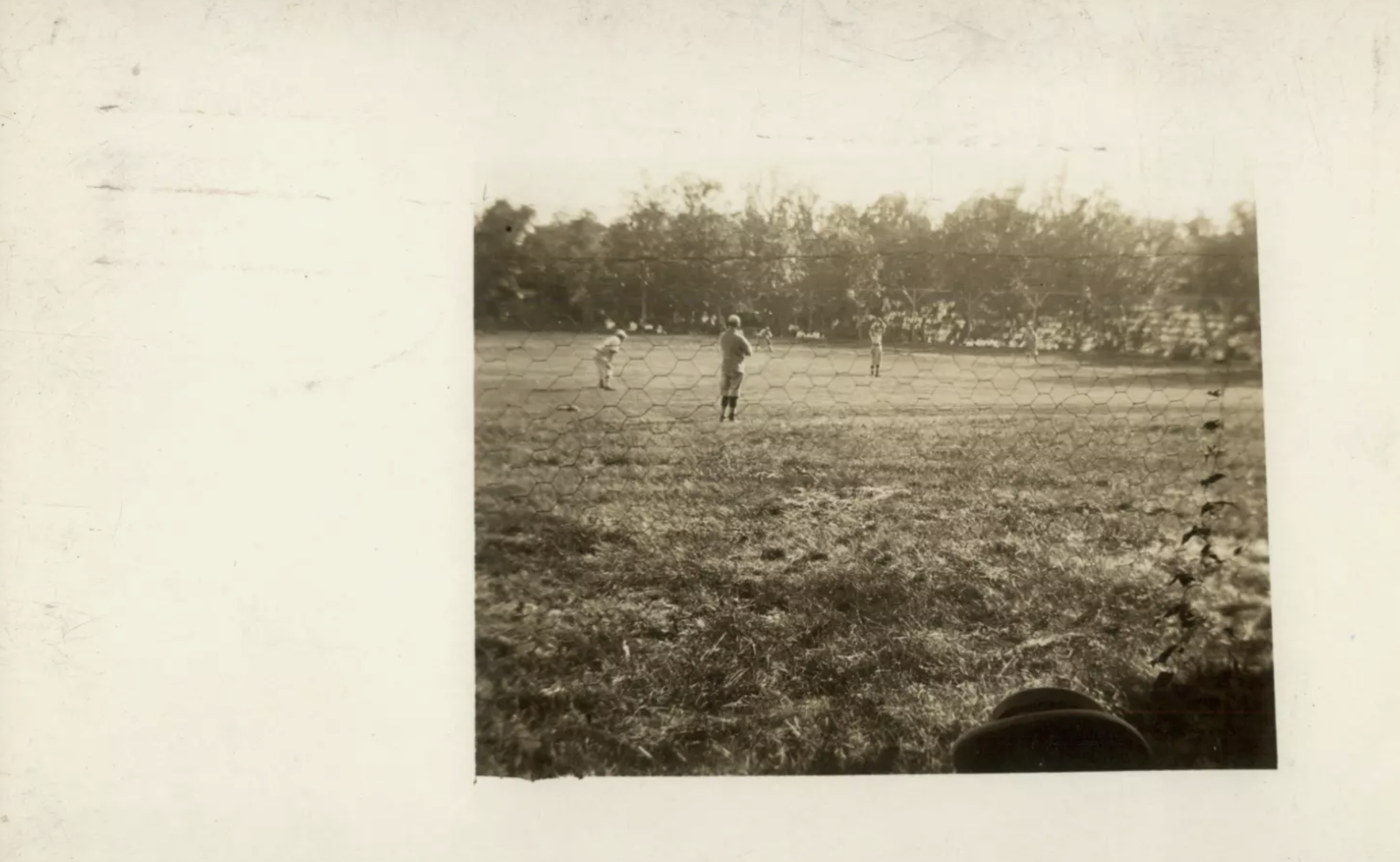
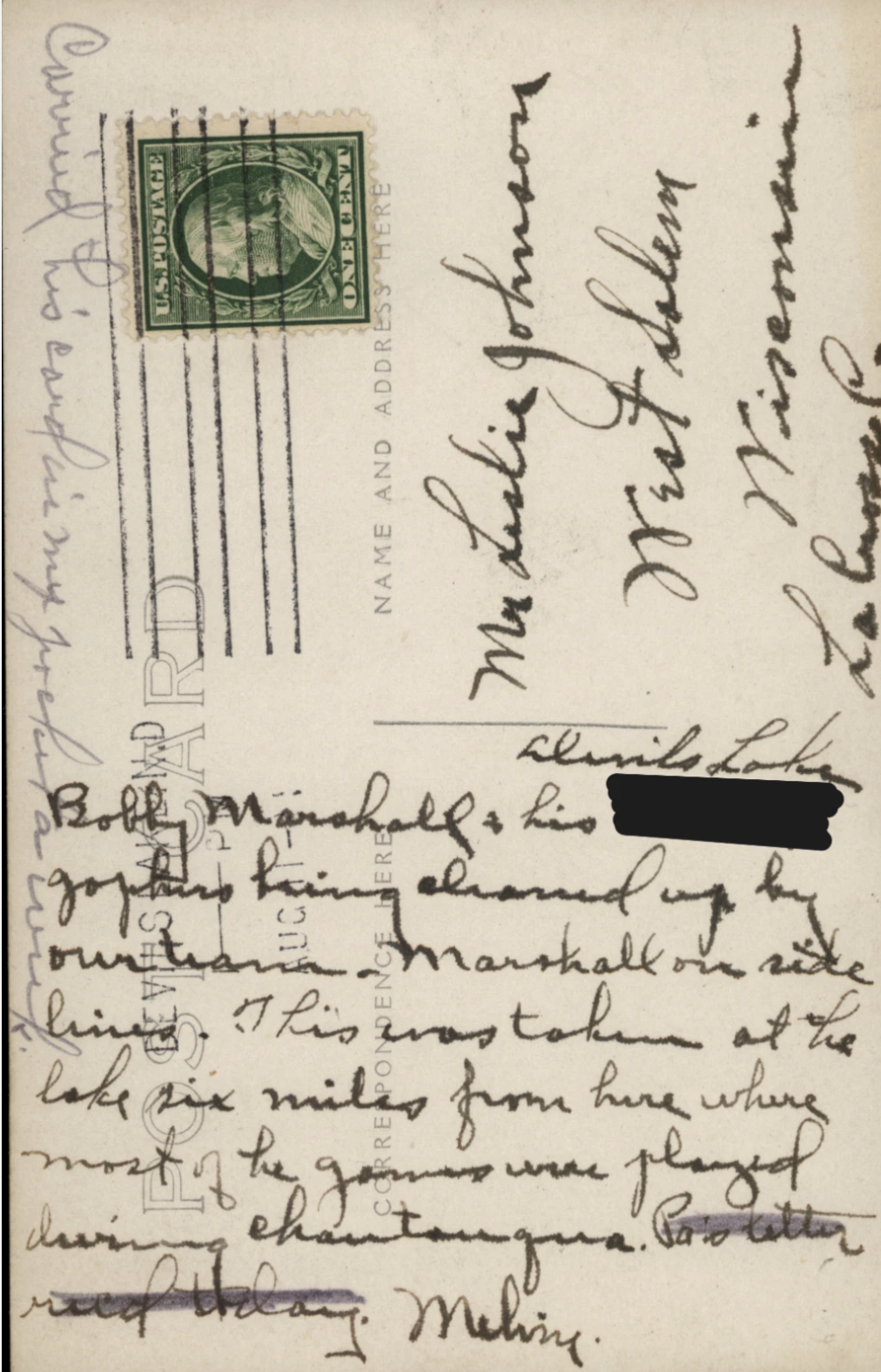
So you're looking at here (images 1A and 1B), you're looking at a postcard from 1911, the St. Paul Colored Gophers, a barnstorming team that was incredibly proficient and skilled, defeated the Leland Giants — the most powerful independent black baseball team at the time — in 1909.
02:56
This is a part of a Black American barnstorming history that in their skill put significant pressure on the desegregation of industrial institutional baseball, just specifically because of just how talented the team itself was. And so when you're looking at this postcard, you're looking at historical documentation of this team in terms of an image record.
But furthermore, when you look at the backside of the postcard, there's actually details about a very famous, actually multi-sport black star of the time, Bobby Marshall, participating in this event. And the event itself is being documented in real time by a historical observer. This is the power of historical postcards. We went over this a little bit with the Tosca postcards from Cuba in terms of the historian Garcia making record of the specific games that the real photograph postcards were taken from.
The postcard says, “Devil's Lake, Bobby Marshall and his Gophers being showed up by our team. Marshall on the sidelines. This was taken at the lake six miles from here where most of our games were played during Chautauqua. Pa’s letter received today, Meline”; postmarked — August 11th, 1911, Devil's Lake, North Dakota.
This is a upper Midwest political and cultural phenomenon of extremely talented black baseball, which usually is considered to be a primarily East Coast phenomenon, extending into Chicago, of course, with the Leland Giants and Chicago American Giants.
05:07
So looking at this postcard, this is a node. It's a historical node. It's a place in a moment in time that's being documented as an artifact that exists in a wildly dislocated context. This recovered from an antique postcard and paper-works seller.
The idea is returning that dislocated context to the real complex, culturally diverse full map spectrum and scale of the historical power of modern baseball. A recovery, a restoration. This is a culturally radical move — wherein the dominant economic and ideological system and method is consumption by way of metabolism of fire, hunger, emptiness, and the present being a gaping void or a longing. To return to this level and discourse of history is to recover, in a Dionysian sense, the limbs and fragments of the past to restore the present to its true wholeness. It is a remediation of modernity; a healing of the wound of modernity. A healingness is returning the archive.
Returns this document to the nodal network by way of its association with other documents in the archive and other artifacts in the archive proper. This is the great body; the great work of the body recovering, recovered.
06:05
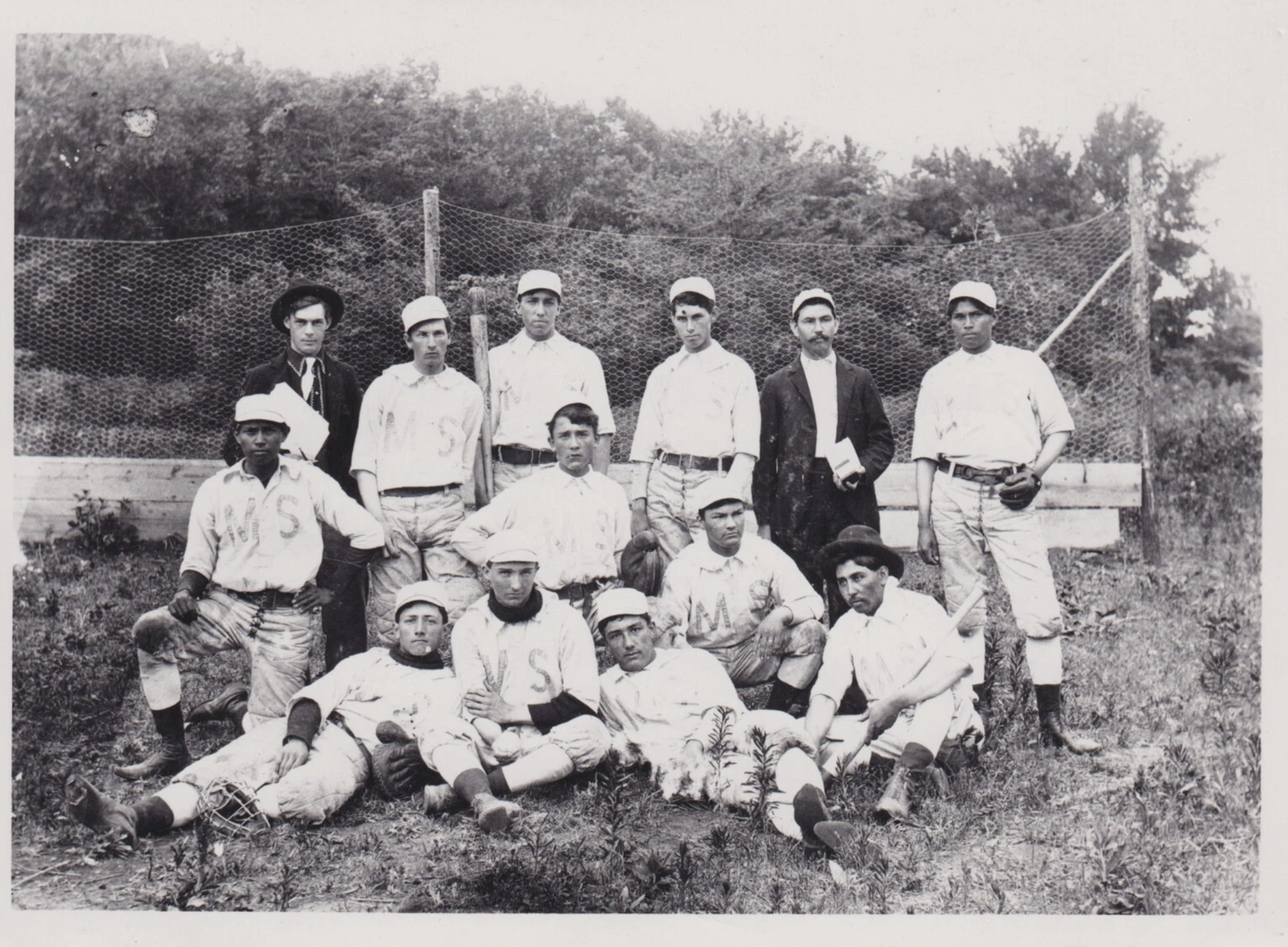
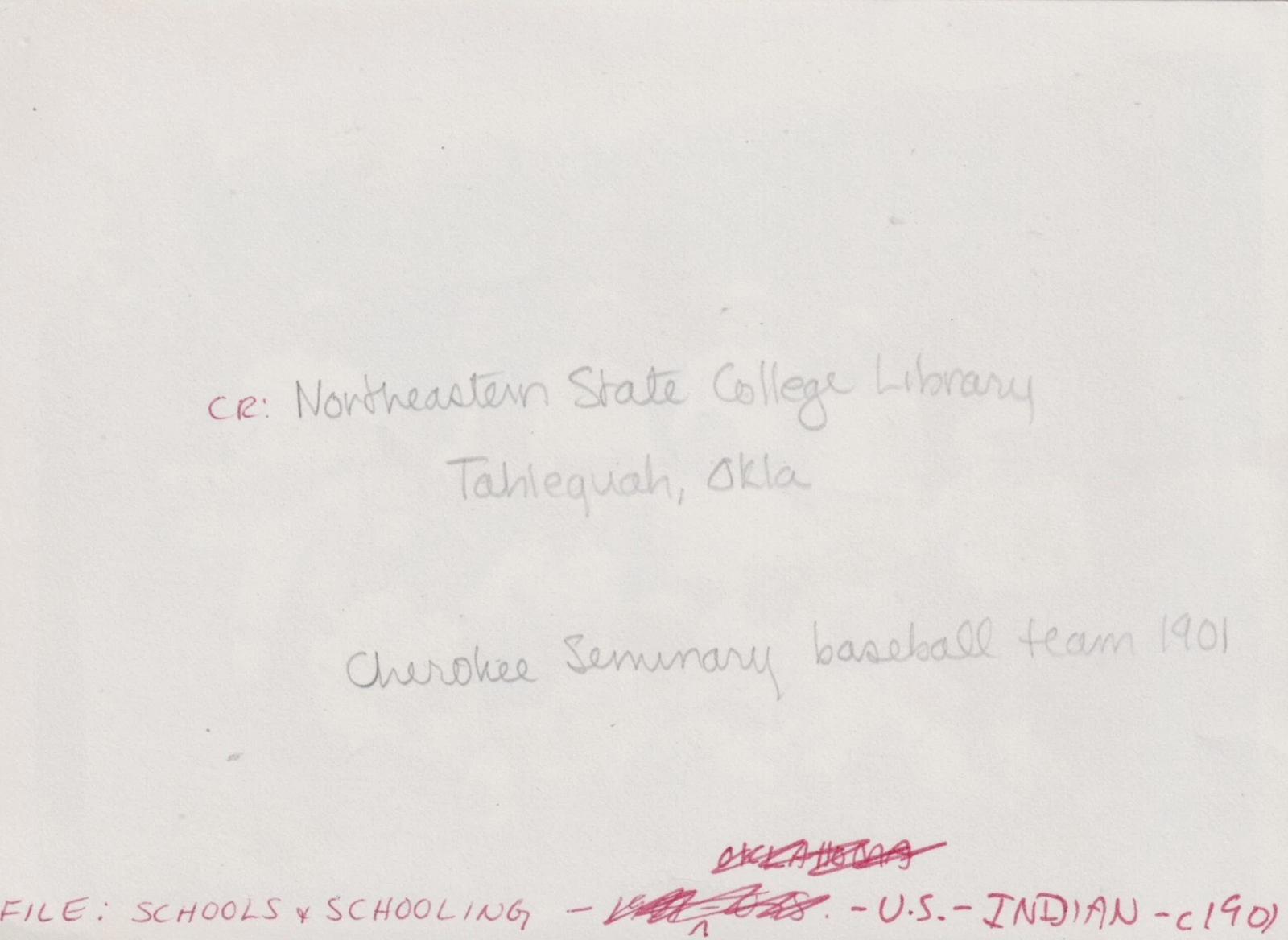
So then here furthermore, we have a reproduced photograph from likely the 1960s or early 70s of the Cherokee Seminary baseball team (images 2A and 2B). The negative circa 1901 on a silver gel print. This is from the American Heritage Picture Collection. And this was actually cataloged by Northeastern State College Library in Tahlequa, Oklahoma. Filed in “schools and schooling”, which documents the Cherokee people being introduced to the technology of baseball as well as to this very complex process of indoctrination into American culture proper; forced indoctrination into American culture by way of removal from their communities and homes and introduction into school systems that attempted to ‘Americanize’ them.
This is a very fraught political topic and political moment through which baseball is a cultural technology which is functioning within that educational context in terms of the Cherokee Seminary baseball team.
07:09
So this is another node, right? And so when we're talking about meaning and meaning making in a historical context, you can see how the added complexity disrupts and compounds and details the real richness of historical modernity — not only in America, but in the Western hemisphere and how baseball actually illuminates the complexity of globalization as a phenomenon as it's occurring in that period of time.
And the role of America in the United States of America as an exclusionary or an inclusionary force in that gradually, rapidly developing modern global context. So the Marshall postcard with the Colored Gophers, as well as the Cherokee Seminary team picture, what we're looking at, these are not just isolated artifacts, right? And this goes back to... the concept of nodal history and nodal time — is that we're looking to actually restore a full spectrum archive of the meaning and power of baseball as it emerges out from and into the modern.
So that's, it's a really actually short period of time, maybe a hundred years between 1850 and 1950, but even a more contracted space, 1864 and 65 with the foundation of baseball in Cuba all the way up to perhaps the mid to late 1930s with the establishment of the East West All-Star game in the Negro Leagues. This is the institutionalization of the Negro Leagues in and from a grassroots context. It's the building of black baseball into a significant institutional entity which competes with and even overcomes the institutionalized professional entity of American white baseball, particularly in the mid to late 1930s with — in large part due to the establishment of this East West All-Star game.
We talked about this a little bit. The power of that game, 40,000 fans attending. This is held every year at Comiskey Park in Chicago as one of the most significant cultural events in America, period, whenever it's held because it's a culmination of the efforts year in and year out of the Negro League as a professionalizing and professional entity.
So we go back to this Colored Gophers postcard from St. Paul, Minnesota. This is such an emblematic moment in terms of the grassroots political archive of black barnstorming baseball as it emerges as an extremely powerful force, including the encounter with this — of this team just two years prior with the Chicago Leland Giants. Again, the pressure that's being put on professional baseball in these exhibitions of extremely talented black barnstorming teams. This is a political and cultural force that's moving forward that includes Rube Foster's time in Cuba with the professional leagues there that are integrated in 1900.
And that movement is a... progressively building force that hits a massive turning point with the establishment of the Negro Leagues in the 1920s with Rube Foster at the YMCA.
10:41
So that in itself is a political movement. It's an ontological thrust into a complexified future of baseball. It's a predictive movement that is continually culminating in further and further integration and complexity and compounding of baseball as a cultural technology, as a way of being.
So then additionally, you have this Cherokee Seminary photograph, which I think very importantly is reproduced in the 60s and or 70s, again in this very — this moment of critical change as it pertains to the American political consciousness in terms of race and ethnicity, exclusion and inclusion, but also as being archived again by a college library. We talked about these regional forces. This is a small college, Northeastern State College Library in Tahlequah, Oklahoma.
And this is from the American Heritage Picture Collection. You have these forces which are almost conspiring through time, grassroots, local, regional forces as a preservation instinct and preservation impulse for political and historical and cultural moments which previously and hitherto have been excluded from the archive proper.
12:06
What this work is in terms of modern baseball history, specifically as it pertains to the Western hemisphere… this is a very specific archive that is localizing a moment in time and a place in time to recover in the truest sense and form the meaning of baseball as a technology of being together, gathering together, and creating historical and political legacy, which ultimately contributes really in a full spectrum sense to the utter changing of the concept of the human being: what it is to be human; who is included in that definition of human as the 1900s and the 20th century progress.
So what we're kind of positioning here in terms of this recovery project and the nodes that contribute to it is a total revaluation of humanity and the meaning of what it is to be human through the technology of baseball as a radically integrative, radically communalizing force that emerges as a technology in the mid to late 1800s globally.
It's rapidly branching out in a Western hemispheric sense from the United States to Cuba to the Caribbean, Mexico, Venezuela. This is a rapidly adopted cultural phenomenon. And so what these nodes show is the spreading of that, the spreading of that root system out from the original founding of the sport of baseball itself as a roughly sketched outline of rules, regulations, conducts, and codes of play into a transformational kind of literary linguistic device that is a force that you see present in many, many, different cultural and racial and ethnic contexts very quickly.
Its a historical force, thrust, and movement to the development of vein and neurological systems of blood and synaptic impulse down through and across the skeletal, bone and outline construct and structure of the original marrow, root, and bone of the invention and subconscious mind ideation and sketch of baseball as a technology of movement — with patterns of movement.
It rapidly becomes a language that transcends speech or text or even cultural context.
14:22
Baseball actually becomes abstracted from the strictly traditional kind of American sense of culture and becomes a hyper human technology, which doesn't really have any political ground other than in the fact that it's been institutionalized in America in a way that it hasn't been institutionalized in other spaces yet. But when you see the emergence of something like the Veracruz team in Mexico in the thirties and forties, or the emergence of the Habana team in Cuba in the early 1900s and even the late 1800s, what you're seeing are rapidly professionalizing emerging contexts in different cultural, racial and ethnic spaces that show baseball as a solidifying cultural force and linchpin in the way that other spaces move and function and change and transform.
So actually developing and displaying and portraying and enacting that root system requires the recovery of all of these different artifacts from different contexts. And those different contexts, interestingly enough, have different meanings and reasons for why artifacts are meaningful, right? It's not so simple to say, this is a photograph from this specific moment, or this is a artifact from this specific moment. In fact, a lot of the time what it is, is it will be a postcard that has been classified as a antique paper good, or it will be a photograph that's been reproduced 50 or even 60 years later from the late 1800s or 1901 to 1910 by a small institutional or communal, collective cultural archive to preserve the negative, which otherwise has been unretrievable — or to publicize the negative or that historical moment in a way that requires a historical revaluation.
So again, this… I keep coming back to this because it's actually pretty important talking about Cuba and Venezuela and the way that the national magazines, particularly Sport Grafico and Bohemia — Sport Grafico in Venezuela and Bohemia in Cuba — functioned to recover cultural memory, civilizational memory, and national memory, as a racial or regional phenomenon.
So when we're talking about non-institutional historical forces, what we don't have, again, is this kind of primary source archive that just asserts this was made in a specific moment and this is exactly, it's from this time, it is this time.
17:2
Instead, in this recovery project, what we have are these pieces of memory that function across time as a way of preserving the image or preserving the historical moment as it perpetually crumbles because it's not being protected or institutionalized as a civilizational or cultural empire level narrative of culture. So this recovery project is again, it's a revolutionary device because the attempt is to actually restore history. To restore the full body. The root systems of the blood, the veins, the neurological impulses which constructed history across the full earthen and earthly body proper; the deep marrow of the impulses and psychology which communed and communed with it.
It's not to narrativize history to create a sort of victors and the fallen perspective. And again, right, the history being the story that is being told by a class or a group of people that have conquered or created dominion and established a institutional archive of memory that is being asserted as truth.
So a real, a real ontological recovery of the full device and movement of the history of baseball as it pertains to modernity is going to require the inclusion of the disjected, not only in terms of political forces of those who have been excluded from the historical institutional archive, but also the disjected as it pertains to historical artifacts and documents and pieces of memory that again, do not function in the same way that an institutional archive does.
The seminary photo here I think is the best example to focus in on, as well as we talked about the Harrisburg Giants photograph that was reproduced in the 50s from 1909, 1910, 1911, the original negative.
When we look at that force, right, as the purpose of reproduction and how reproduction occurs, especially when it occurs in that mid-century modern context, 30s, 40s, 50s, 60s — we're looking at the period of critical revaluation of early 20th century historical phenomena, which actually created the push toward modernity. Baseball as a technology being a part of that, as well as factory, as well as globalization — as a force which changed national, regional, ethnic, and religious and racial identities. It complexified them. It compounded them into forces that had to encounter difference and thus change. That period of time was a period of revaluation of what had happened and why and how.
So there's this movement, especially from...
20:09
smaller grassroots institutions of digging back into that state level or regional level or local level history, such as Lefty Grove and Lonaconing, as we discussed earlier in these works. He is still remembered to this day with monuments, as well as Spots Pole in Winchester, Virginia. He is remembered today with parks and monuments. It's a local level recovery of the ontology of being that complexified and changed the dynamics of these small local level spaces or even community or cultural level spaces with this rapidly diversifying, complexifying force that was modernity — and the role that baseball played in spreading information, spreading culture and creating communities that intersected with one another and thus change their perspective and outlook.
This again, Cuba, Venezuela. Mexico. Baseball as it functioned in the United States with black barnstorming teams, which often played against white barnstorming teams… and Cherokee barnstorming teams, such as the Cherokee Seminary here, which played against white and black barnstorming teams.
You're having — the function of baseball as a cultural device is actually a globalizing force in the sense that it is bringing together communities that don't even speak the same language, nonetheless have the same cultural beliefs or ideological constructs.
21:34
And then baseball itself is this force that is merging them into this global modernity of inclusion by way of not only proximity, but shared space in a psychic sense, right, in terms of information technology, in terms of cultural technology, in terms of the different ways that literacy forms — especially in a digital environment, as we perceive it 100 years after this photo was taken today.
So we're witnessing this historical phenomenon of the thrust of modernity and the thrust of globalization occur when you localize it in the Western hemisphere, especially as it pertains to baseball… you're looking at a, it's like a cultural import-export environment with speed and the information technology is baseball, as opposed to maybe a hundred years later, the information technology is digital pixels. We went over that a little bit with the concept of the first modern cell phone as a baseball card, so to speak, in terms of the pixelization technology in early modern lithography and mass production of images through the dot matrix lithography of early baseball cards.
What we're talking about here is the technology of modernity in the Western hemisphere, which actually enables the fruit and the fruits of globalization and modernity to make themselves known, to actually aggregate and culminate and collaborate in a world historical communal sense — through the exchange of the event and the phenomenon of baseball, which is a political force in that it is desegregating and integrating these disparate communities which formerly existed in silos. And there were these ethnic or ethnocentric beliefs or ideological systems of greater and lesser good and evil, so on and so forth.
But baseball itself as a cultural communal event is penetrating through these narratives and it itself is a sort of vanguard of the integration of these formerly regionalized, socialized, segregated nations or communities or tribes as constructs. And it is pushing and pulling them forward into this new world of modernity in which we now stand — which is the highly complexified world, international environment where concepts such as borders or cultural difference and belief systems are being confronted and there's this incredible conflict and confusion around how to navigate that world. And baseball itself becomes this critical tool and technology for doing so.
24:42
So these artifacts, right, what they do and what they're doing, especially when they're brought back together in the archive, is giving us that full nodal system, the full constellation. So when we look at this kind of flashbulb popping star system of different clusters of baseball cultures in relation, you can see the full picture, the full scale and full scope of what is occurring and how and why it pertains to even the foundations of modernity in Western civilization as a rapidly including globalizing, connective and connecting force — the connective tissue of the world and baseball itself being as almost like a sort of precursor to the internet in the sense that it's a way of creating a language that's being spoken across borders, barriers, and bounds, which ultimately is bringing people together.
And as such, creating revelation at a human level, in terms of what is meaningful, what is human, what is the true force that exists beneath all of these different belief systems and disparate codes and appearances of things as they are.
And in that way, it's a sort of esoteric force of revelation.
25:56
A way of finding what is truly human beneath all of the different cultural belief systems that function actually in a in kaleidoscopic way, in a fractal way — that when you put all of these pieces together as a stained glass window, so to speak, the image emerges of the compound truth beneath all of the different truths that are being communicated and expressed through the linguistic and the language and the technology of baseball itself.
So it's kind of hard to overstate the importance of baseball in this sense, because it is that modernizing technology. Some people would say it's war, but again, war is that… it's the struggle to reconcile the separative impulse between these cultures and civilizations and belief systems. But baseball as a unifying, creative, communalizing force, right? It's almost the exact opposite. It functions almost in total contrast to war as a sense that it's a physically active cultural event that includes food and music in many different contexts and is itself the creation of a physical language that goes beyond speech. It’s creative. Recovering. Restoring humanity. Not consumptive of it in violent destruction.
And it's moving through space and through time rapidly as the 1900s approach. And we move into the 1900s and you see how in the black American context, barnstorming teams quickly become the professionalized Negro leagues with Rube Foster, especially in the relationship to Cuba, right? His experiences in Cuba and then black professional baseball players going to Cuba to play with native Cubans.
And then you see that again here in relation to this Cherokee Seminary team and the Cherokee barnstorming teams. So there's multiple different cultural, ethnic, national, and racial contexts in which baseball is emerging as a communicative device in these various different spots on the map, and they all ultimately are converging and communicating and interacting — such as this St. Paul Colored Gophers postcard and the relationship between the Colored Gophers and the Leland Giants, as well as these early Cherokee teams… including the school teams, such as the Cherokee Seminary Team.
28:17
As well as the independent teams… — this rich culture of Native American baseball ultimately becomes a huge part of early professional American integration movement in the quote unquote white professional baseball league with players like Bender or Jack Meyers, the catcher for Christy Mathewson on the New York Giants.
So you're you're witnessing baseball as being a mirror to this phenomenon of modernity — and not only a mirror, but a leading charge and a vanguard movement through the creation of a cultural technological power, which is not, it's not nationalized in the way that many people think it is in terms of American nationalism. It's globalized in the way that it is taken and run with as a template for community and the creation of event and physical phenomenon as a movement, a physical movement.
Beyond being a mirror, baseball is a chief if not primary force of globalization and communalization — interconnection and exchange of culture, meaning, and humanity as in the power, force, and thrust of radically integrative modernity as an unprecendented, revolutionary movement in and through the 20th century. It is the power of global, shared, communal culture as group participation and play and joy; passion in being and becoming together incarnate.
Across borders and bounds, languages and religions and cultures, in such a way that it actually is, again, a vanguard primary force of the global thrust toward the revolution of a truly human context — through, including, and beyond all of these disparate historical, national, and cultural movements of different people in different places who look different, who believe in different things and emerge from different wellsprings of cultures and religions. What is human? Where and what is our humanity? Our true root and essence? Baseball is one of the first and most powerful cultural impulses of information technology in modern human history that helps guide us to this place. This is a very powerful technology.
And that'll do it. I'll see you on the next one.