Baudelaire: Revolutionary Technology of the Unmediated Body — Phenomenology, Axiom, and Law of Thermodynamic Expression
Baudelaire: Revolutionary Technology of the Unmediated Body — Phenomenology, Axiom, and Law of Thermodynamic Expression
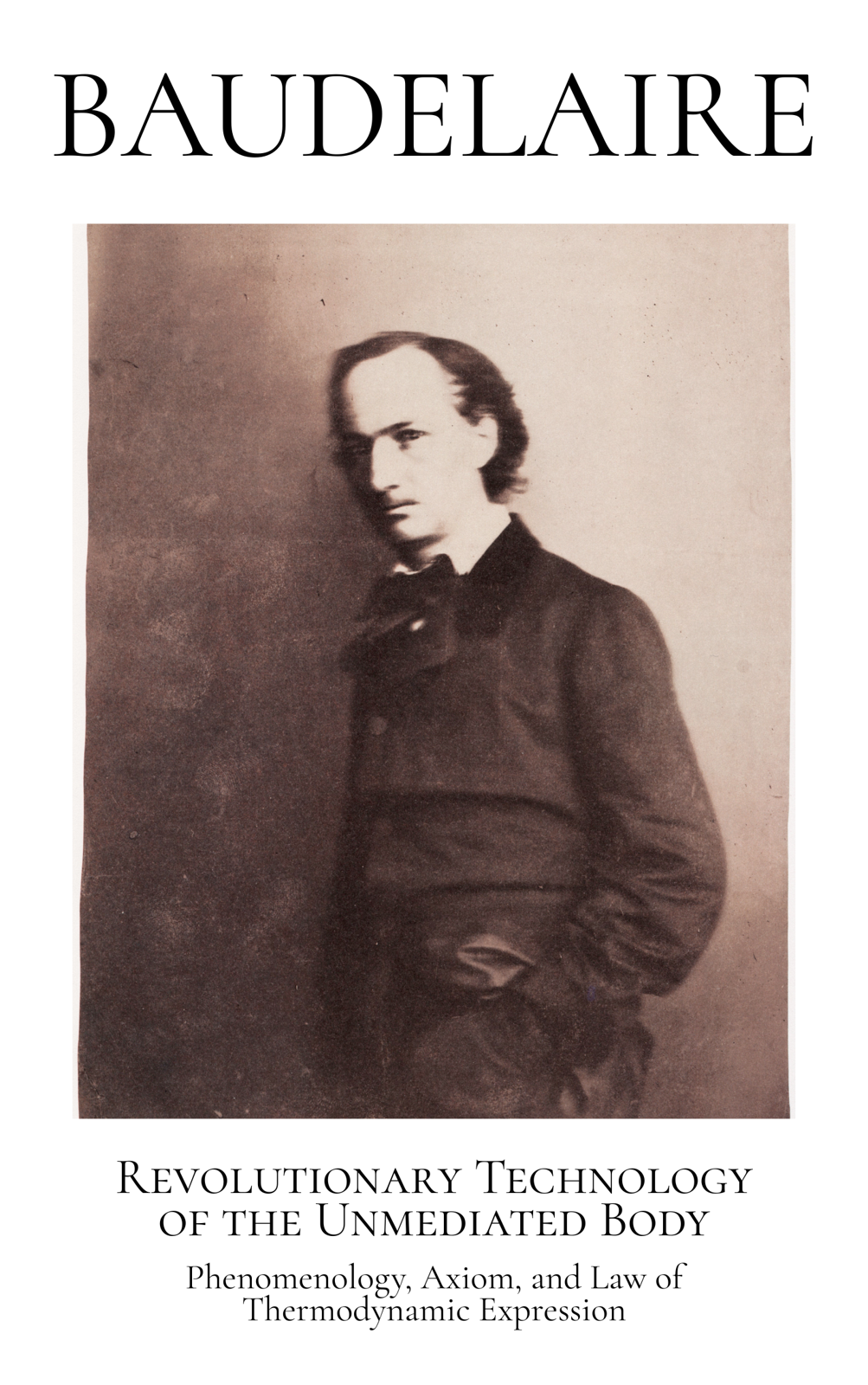
Expression is the thermodynamic articulation of being itself as degrees of presencing.
Degrees of presencing are the intensities and forms by which being becomes felt and articulated within bounded organisms—sensation, affect, attention, image, body; in sum, as an articulation of the principle itself, speech as appearance—the expression of being’s total, cosmological, characterological form in parts, articulations, symbols, bodies, forms; fields.
A. The Thermodynamic Experience: Baudelaire, Poesie, and Compression
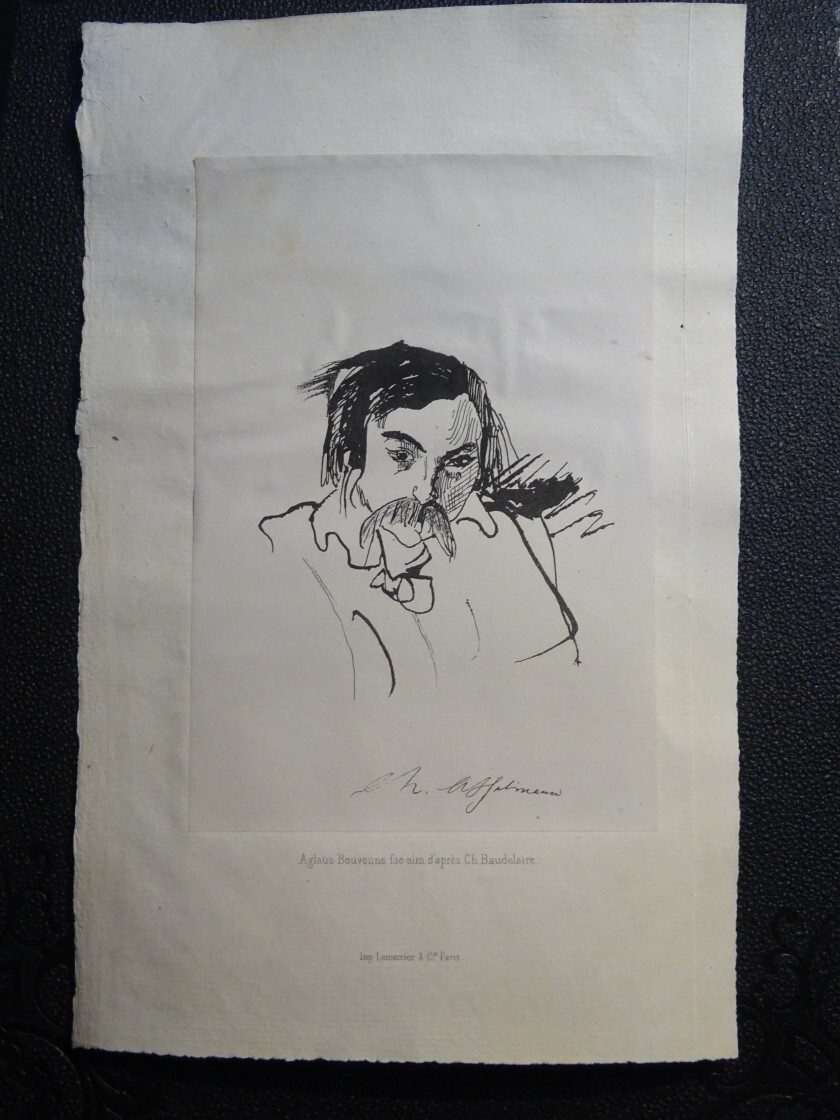
Charles Asselineau — Portrait of Charles Baudelaire. Period 19th, circa 1870-1875; printed by Aglaüs Bouvenne
Baudelaire is the first poet; as such, first sensitive to experience modernity not as culture, but as direct nervous-system exposure to thermodynamic reality without civilizational or tribal symbolic, mytho-poetic mediation of religion or story.
The lived experience of thermonuclear compression is the human experience, as it is the experience of all life. Emerging sentience through neural structures of energetic translation and thus aperture becomes the literate, poetic experience of the self as a conjured vehicle for navigating, situating, and comprehending the otherwise opaque human experience — veiled by seemingly static structures and time-space dilations of sun, moon, birth, death, et al.
Baudelaire himself is twice compressed: modern technology, the metropolitan city; the human condition. The poet, sensitive to the lived, felt; attuned neurology — documents this experience pre-verbally — experienced directly, somatically in the body as in the attended condition which cannot be plugged or vacated, nor ignored.
Baudelaire’s direct confrontation with death and the malaise of oversignalling as the condition of Parisian France circa the near-turn of the 20th century is an encroachment from both sides — the death of neural regulating cultural conditions formerly organized locally by state, religion, commune of organized self; the at large sensation of metabolic compression organizing sensation and synaptic, somatic experience of the individual in a totally embodied architecture of lived, felt, reality.
Baudelaire’s first qualm is veiled — it is not truly a bickering with modernity nor the modern failure to achieve apprehension of the evil; cultural limitations of comprehension and apprehension of the romantic condition notwithstanding; the necessity of better, greater diction of life — it is the qualm with the human condition itself; the limitations brought loathsomely upon the woebegotten poet as one who glimpses behind and beyond the screens and machinations of the real and glimpses something eternal within the escaping, fluxual condition of living being in time.
Baudelaire’s ‘evil’ is not moral corruption but entropy experienced as embodied necessity; linguistic, genetic, entropic assertion of movement in time toward persistence oriented ends — constructed as Desire, Lust, Avarice, Greed and so forth.
All literacy and art is interpretation of the thermodynamic, thermonuclear experience of the transitory metabolic state of being human — translation of the architectural vocabulary of the genome exposed to time; altered by encounter; shaped by trial and inevitable generational transmission and dissolution. The poet’s task — as with all of history and in particular the British Romantics and the French Maudites alike — is to render something of the eternal, whether that be Evil or Beauty; Beauty and Evil intertwined. The capital essences of Baudelaire’s preoccupations are inevitably postlapsarian — not the Edenic notes of Keats (time out of time; being out of time), nor Shelley’s utopian optimism for human evolution toward humanitarianism; grace, but the Paradise Lost of Sophia’s fall into the demonic realm — cast from eternity into time and thus degradation.
All of Baudelaire’s figurations of sex, death, corruption, avarice — all emerge from his preoccupation with how entropy becomes figured abstractly in the human experience as in lived and embodied sensation; metabolized experience of being in time. Baudelaire, perhaps the first true one of his kind, is a poet of irredeemable, irretrievable fallenness — fallenness without sanctification or redemption. He is, in the Heidegerrian sense, the thrown poet ; the truly incarnated poet, ambling his way back desperately to the Platonic realm of shades; yet unable to jettison his scientific eye and mirror upon the real for pure, dissociative idealism.
Baudelaire’s retrieval of life is through his encounter with death and corruption; a staring in the face of the demonic mask of fallen creation as the task of the poet in order to redeem it with truth — in this case, the thermonuclear truth of transient energetic passage which is not inherently moral, nor is it necessarily inherently dignified. It is simply, metaphysically and physically speaking, the fallen state of matter into the experience of trophic consciousness in a metabolic device, linguistically iterated down through ages and epochs of technological transformation of the human body and the energetic ecosystem at large of Earth itself proper.
This brute and bare phenomenological historical reality is what plagues Baudelaire, even if it plagues him as an intuition, an embodied sensation of the bastardized modernity overlaying a plague for which there is no cure. Baudelaire is the sensate poet, embodied beyond philosophication; in this way he is supraordinate to Dostoevsky in his somatic entwinement and experience of the modern condition as a visceral alteration; a twist of the vine of Evil as neurological rupture; fragmentation of what is and was nominally French into an unbounded, unbordered chaos of the loss of religious myth and local symphony; descent into permanent, global diaspora of crisis, phone lines, and digital information.
Critically, unlike Nietzsche, Baudelaire does not seek refuge in abstraction or conceptual transcendence. His poetic ontology is necessarily somatic: it requires figuration, voice, and sensuous articulation — speech that does not stand apart from the body but speaks from within it, expressing the neural organism without the distancing shelter of mediation.
The philosopher Nietzsche and the poet Baudelaire both meet modernity as such; adapt it in different strokes. Nietzsche diagnoses it; thus moves from afar. Baudelaire inhabits it; embodies it — and as such reports from the depth of entwined metabolic ontology of being alive; the neurology of mankind — admixed with the somatic response of the loss of the titration valve of death of God culture as in regulatory structure which is modernity; the condition of the modern.
Prescient is Baudelaire’s sensitive poetic somatology; furthermore, scientific articulant of the relationship between the existential experience of thermonuclear compression; as such, Desire and Lust as guided mechanisms baked into the genetic biology of the perpetuating, pressed-on, persistent human form; the drag of all of time latent in his body mingled with the acceleration and fragmentation of modern information into chaos revealing the depths of amorality and the death of religion as organizing function: lepers, wine barrels, opium, burlesques, corruption, contortionists; harlequins; iterations of hell dispersing themselves in the newly secular Parisian enclaves.
Baudelaire, stripped to the bare, all the man is is lust and temptation convicted with persistence; the damned man writes and writes of beauty that emerges from fist wrapped around the rose bush that killed Rilke, poet of angels — the beauty that emerges from the damned. A-religious Baudelaire, a man of no place and no time, the modern man — who becomes the poet of contemporary France; its dissociative fracture into mass influx immigration and the destruction of what were formerly cultural values. The cell membrane of Europe opening; the walls of the Christian territory of the Western mind crumbling.
That the censured Baudelaire becomes France’s poet is indicative of what Baudelaire sniffed of modernity; what modernity inevitably become. Rotted, corroded ideologies used to carry forth genocidal policies and institute dictatorial authoritarian economic systems to control and discharge power, wealth, and commit decidedly Satanic crimes of rape, abuse, manipulation. The loss of the religious sense is the loss of the governmental sense — as a legality and legalism as dictate of being in the commons, even if passed down from corrupt monks and cardinals.
This was all seen by the eye of the poet Baudelaire, “maudite” if he was a poet of innate goodness; capacity of sight of beauty amidst the rubble of the Western empire; Western civilization at large. Seeing all that had come of it; all that lauded pomp and circumstance, the poet-opiate declares it all corrupt, decadent, empty. And from the vacated bowels of cultural possibility — preempting Artaud — he sings the song of modernity: a song without cultural structure; stripped of symbology, religion; a song of the modern man unmoored from time and place; encountering the bare human condition without filtration or titration.
And as such, Baudelaire’s experience is prescient; first to modernity. The loss of titrating religious and cultural symbology is the collective nervous system experience of increasing degrees of direct exposure to the flowers of evil, maintenant. This exposure, in a way that cannot be metabolized without the mythopoetic world of the immensely creative, gifted genius poet — is an individual effort destined to fail — as no adequate symbology can emerge without hypertrophic encounter with the full powers availed to technological, effervescent, multifaceted being of modernity: a neon hydra with hungers exponential to the slow creep of Hobbes’ Leviathan of old.
The poet is thus a hero; the heroic task of the poet is to bind modern life to the earth and make titration possible. The modern poet is a stateless exile; an individual at service by necessity to constituting a complete religious symbology capable of titrating and metabolizing the modern condition of total symbolic cultural dissolution of the local, tribal valve systems which functioned to mediate man’s encounter with the serpent and moon of the natural world. Now man faces the beast of steel coupled with the same ancient hunger of Dostoevsky’s daemonic evil: born within man as the thermonuclear, metabolic insatiability for consumption of flesh, wine, copulant.
This is the water through which Baudelaire wades, using poesie as the mirror of Orpheus; the shield of Perseus — metabolizing the deathly Nature mother, Medusa armed with a television; catacombs of modernity. Organized and recombined into multiple energetic powers of efficiency, coal, industry, and production — the energetic field of the modern world is a flashing of total human effort and work through machines which is a journey back to the sun; the atomic power and potential as a crawling back to the first ordinance of the chain of being itself — latent and unleashed thermonuclearity from within the most mote particular in the field itself.
Baudelaire tumbles with this energy; with poetic sensitivity becomes one with it and understands how consumption of energy functions as a sigil of evil in the world, born from the flowers which are pruned, gutted, and swallowed by the hungry leopard, birds, worms, man, sun, in a ceaseless effervescence of hell as in the bowels of energetic fire and recombination. Like the Aztec ancients; like his admired compadre Poe, Baudelaire went beneath the shades to the world of dynamic energy and discovered a monster beneath it: a monster of consumptive flesh, the flow of energy which to the initiate appears like a festering monolith, a beast, that which appears everywhere and consumes everything. And he observed it through his lovers, his city; within himself.
Baudelaire’s intuition — that he remained a poet; never advanced to scientist or metaphysician — was perhaps only a failure of his time and his time alone. It would take the advances of astrophysicists such as Payne-Gaposchkin; theorists and practitioners such as Einstein, Planck, Bohr, Fermi, and Godel to elucidate the combined nature of this character of this being, this beast which Baudelaire met only through the shades of his poesie; the metaphor and mirror of the dream work which he ventured into in order to glimpse the force at work beneath his form; the metaphysical nature beneath the appearance of his being and his form in time.
But at last, the world returns to Baudelaire — not just for a true synopsis of the first man’s encounter with the powers of modernity as a doubling and tripling of the force of the nervous system encounter with reality beyond symbolic mediation; the necessity of poetry to replace myth and carve a path of somatic titration of energetic experiences en masse without local religious register to contain and translate them into measurable, manageable doses of exposure — but for the existential encounter which is the turn of modernity: the stripping away of religious and mythological codes; instantiating the role of the poet as the private shaman of the neurological, organismic self torn from all tribe and socially, politically, culturally instantiated identity structures of group mediation of the force of life.
Baudelaire becomes the modern poet par excellence: describing the effects of modernity upon the body — unleashed; furthermore, instituting the existential function of the modern poet as private religion: no longer Milton or Donne of the Christian architectural circuit of neural symbolic mediation; no longer Pascal or Dante or even Spinoza, Eckhart, or Bohme in their disavowal or alteration of the Christian and Judaic mytho-religious functions in the name of an increasingly personal, individual vision in the face of institutionalized titration — but rather Heidegger’s thrown man, purely, absolutely — secularly, into the abyss to face the powers of being proper; alone.
Critical being here was Baudelaire’s innate sensitivity; poetic disposition as in his somatic and neurological superstructural makeup as an organism — capable of apprehending and attuning the body of his form toward that which resides and resided behind the pale shades; veil of desperate attempts to shore up cultural language in the face of a collective fall into primordial chaos without guiderail of civilization.
Poets themselves, being somatically orientated beings absolutely, are the guides to this abyss — as they always are and have been, even as the prophets and philosopher kings — as it is an abyss that is not first symbolic, mathematical, or scientific — it is a lived, incarnate experience in which the thermonuclear powers of being are directly translated and instantiated into the rapidly availing consciousness being and form which is an awakening to the conditions which Baudelaire elucidates as the flowers of evil: the root of form from the depths of greater forces; which rise up through unconscious power, hunger, and energetic fury to consume and thus partake; survive.
At last, Baudelaire’s lashings at modernity are lashings at nothing more than the eternal existential condition of being itself; characterological lashings at that which lies behind the mask of the lies which he condemned; the theatrical public and social and private and governmental excesses which he spat upon, disgusted. The false poesie, the charm, the saccharine words.
What Baudelaire sensed behind the emptiness of modernity was the plastered smile of the existential mask all of mankind wears: a mask of necessity in the face of a thermonuclear order all experience but few comprehend; even fewer have the courage to experience directly — as the modern world crumbles the last architectural symbolic footholds which allowed for civilizational and cultural titration — the Baudelairan command of the new world is that we all must become poets of the abyss; the daemonic fire: capable of the confrontation with the very characterological forces of being which sum all of eternity into experienced fullness.
Baudelaire did not fail. What was elucidated by the advances modern science made in his wake blew us back to him; the footstool of his company and his remark upon civilization, nature; being itself. No abstraction, no science, no concept nor number can assist man in metabolizing the abyss of consumptive evil. This transmutation occurs within a primordial unity as in a revelation of the encounter; a realization of the interconnected unity as primacy of energetic form in forever flowing effervescent states of primal continuity; primary; in truth, without separation or delineation. The Baudelarian death of self is as such: that life proceeds endlessly in mass; that the flowers are forever obliterated; grown from them are what is beyond birth and death — the beauty of the metaphysical lila: the dance of forms, beyond judgement; beyond the scientist, beyond the philosopher — the direct encounter with the body; the uprootment of being — thrown into absolute presencing.
The critical task of modernity is not to reconstitute socio-mythological orders of perception — but for each individual to have a true, unmediated encounter with the abyss; to sum and construct metabolic architectures; symbolic, hyper-local capacities for meaning that allow each individual in the rapidly, forced-maturing, hyper-technological speciological terrain of humanity itself to survive it.
The body is already a thermodynamic instrument.
Poetry is the nervous system speaking its own condition.
No abstraction can replace that encounter.
B. The Thermodynamic Expression of Being: Axiom, Operator, and Phenomenological Law
Core Thesis
Being is energetic process under entropy.
The organism is a bounded thermodynamic instrument of that process.
Poetry is the nervous system articulating its own condition.
No abstraction can replace embodied encounter.
I. Ontological Axiom
Axiom of Energetic Being
All that exists is the continuous transformation of energy under entropy.
Form is not substance but regulation—bounded persistence within irreversible flow.
That which persists under entropy through bounded regulation exists in time. All else is flux.
II. Organismic Operator
Operator of Embodied Persistence
Organisms are not exceptions to thermodynamic law but its most sophisticated instruments:
bounded systems that regulate energetic throughput in order to persist.
The body is therefore not a container of being.
The body is being organized as a thermodynamic device.
III. Neural Translation Layer
Principle of Somatic Cognition
Consciousness is not representation of reality but the nervous system’s regulatory translation of energetic conditions into lived form.
Experience is the internal articulation of thermodynamic constraint.
Feeling, desire, fatigue, malaise, and attention are not psychological accidents—they are energetic signatures.
IV. Law of Dissatisfaction (Retained and Subsumed)
Dissatisfaction Principle
In any self-regulating system that persists under entropy, the nonzero energetic cost of maintaining bounded organization presents phenomenologically as dissatisfaction.
Dissatisfaction is not failure of fulfillment.
It is the felt trace of entropy within persistence.
This law remains structurally true.
But it is no longer the deepest phenomenological unit.
V. New Operator: Thermodynamic Expression
Axiom of Somatic Articulation
When symbolic mediation fails, being becomes directly knowable only through embodied expression.
Poetry is not representation of experience.
Poetry is experience articulating itself.
Language, image, rhythm, figuration are not cultural ornaments.
They are biological translation mechanisms —ways the nervous system metabolizes energetic reality when abstraction can no longer buffer it.
The body is already a thermodynamic instrument.
Poetry is the nervous system speaking its own condition.
No abstraction can replace that encounter.
VI. Epistemological Consequence
Principle of Embodied Knowing
Knowledge does not arise first in concept, symbol, or system.
It arises in somatic encounter with thermodynamic constraint.
Philosophy diagnoses from distance.
Science models from abstraction.
Poetry inhabits.
It is the only mode of knowing that remains when mediation collapses—when reality is no longer filtered through myth, religion, or symbolic culture.
VII. Historical Threshold: Modernity
Modernity is the collapse of symbolic regulation.
As technological systems fully articulate reality, culture loses its buffering function.
Result:
Physical throughput accelerates
Neural regulation is overwhelmed
Symbolic mediation fails
Experience becomes direct exposure to energetic reality
In this condition, art ceases to mediate meaning and becomes either:
dissociation, or
direct somatic articulation
VIII. Baudelaire as Threshold Organism
Baudelaire is not a poet of decadence.
He is the first organism to experience modernity as thermodynamic truth without symbolic mediation.
Unlike conceptual philosophers, he does not abstract from the abyss.
He remains inside the body.
He does not represent entropy.
He speaks it.
Baudelaire marks the moment when:
dissatisfaction becomes exposure
symbolism collapses
poetry becomes the last viable regulatory architecture
He is not merely an example of the law.
He isthe first historical instantiation of thermodynamic expression as human consciousness, stripped of inherited symbolic containment.
IX. Final Corollary
Corollary of Modern Being
When physical throughput exceeds neural regulation and culture can no longer mediate reality, the only remaining form of coherence is embodied expression.
Meaning is no longer inherited.
It must be metabolized.
The task of modern existence is not to reconstruct myth.
It is to endure encounter.
X. The Diamond Core
Being is energetic process under entropy.
The organism is a bounded thermodynamic instrument.
Consciousness is neural translation of energetic constraint.
Dissatisfaction is the maintenance cost of persistence.
Poetry is the nervous system articulating that condition directly.
No abstraction can replace embodied encounter.
Modernity is not primarily an ideological crisis.
It is an exposure crisis.
And therefore:
The spiritual crisis is not loss of meaning.
It is excess of unmediated being.
Meaning is not something we “have”. It is something we regulate, and thus create, under pressure.