Beyond the Ceiling: How Baseball Escaped the Limits of the Contact Game
Beyond the Ceiling: How Baseball Escaped the Limits of the Contact Game
Beyond the Ceiling: How Baseball Escaped the Limits of the Contact Game
In the previous essay we observed that the greatest contact hitters in baseball history converge within an extremely narrow statistical band. When measured by hits per game , the elite contact hitters of the late nineteenth and early twentieth centuries cluster between roughly 1.36 and 1.42 hits per game. Within this range appear many of the most revered hitters of the era:

The striking feature of this list is not the identity of the players but the tightness of the distribution. The difference between the highest and lowest values among the elite hitters is only a few hundredths of a hit per game.
This is not coincidence. It reveals something fundamental about the structure of baseball itself.
The Structural Limit of Contact Offense
Hits per game is governed by a simple identity:

Where:
BA = batting average
AB/G = at-bats per game
Both variables are constrained by the architecture of baseball.
Even the greatest contact hitters rarely sustain career batting averages above roughly .360 , and the structure of the game—three outs per inning, lineup cycling, and limited offensive opportunities—restricts most everyday players to approximately four at-bats per game.
Multiplying these limits produces a natural ceiling:

In practice, sustained career performance tends to cluster slightly below this limit, creating the narrow band observed among the great contact hitters.
The implication is profound: contact hitting cannot separate widely across players. The geometry of the game compresses the distribution.
Players such as Cobb, Burkett, Delahanty, and Orr are not separated by vast statistical distances because they are all operating very near the structural ceiling of the contact paradigm.
The Contact System at Equilibrium
By the early twentieth century, the offensive system of baseball had essentially reached equilibrium.
The greatest hitters had already discovered how to maximize the contact model of offense:
frequent balls in play
high batting averages
minimal strikeouts
relentless pressure on the defense
Within this paradigm, additional separation became increasingly difficult. Once a hitter approached the upper boundary of batting average and opportunity, there was simply little room left for further statistical expansion.
In other words, the contact system had become efficient but saturated.
This is precisely what the clustering of hit density reveals.
The Discovery of a New Dimension
The equilibrium of the contact era was broken by a transformation in the geometry of offense.
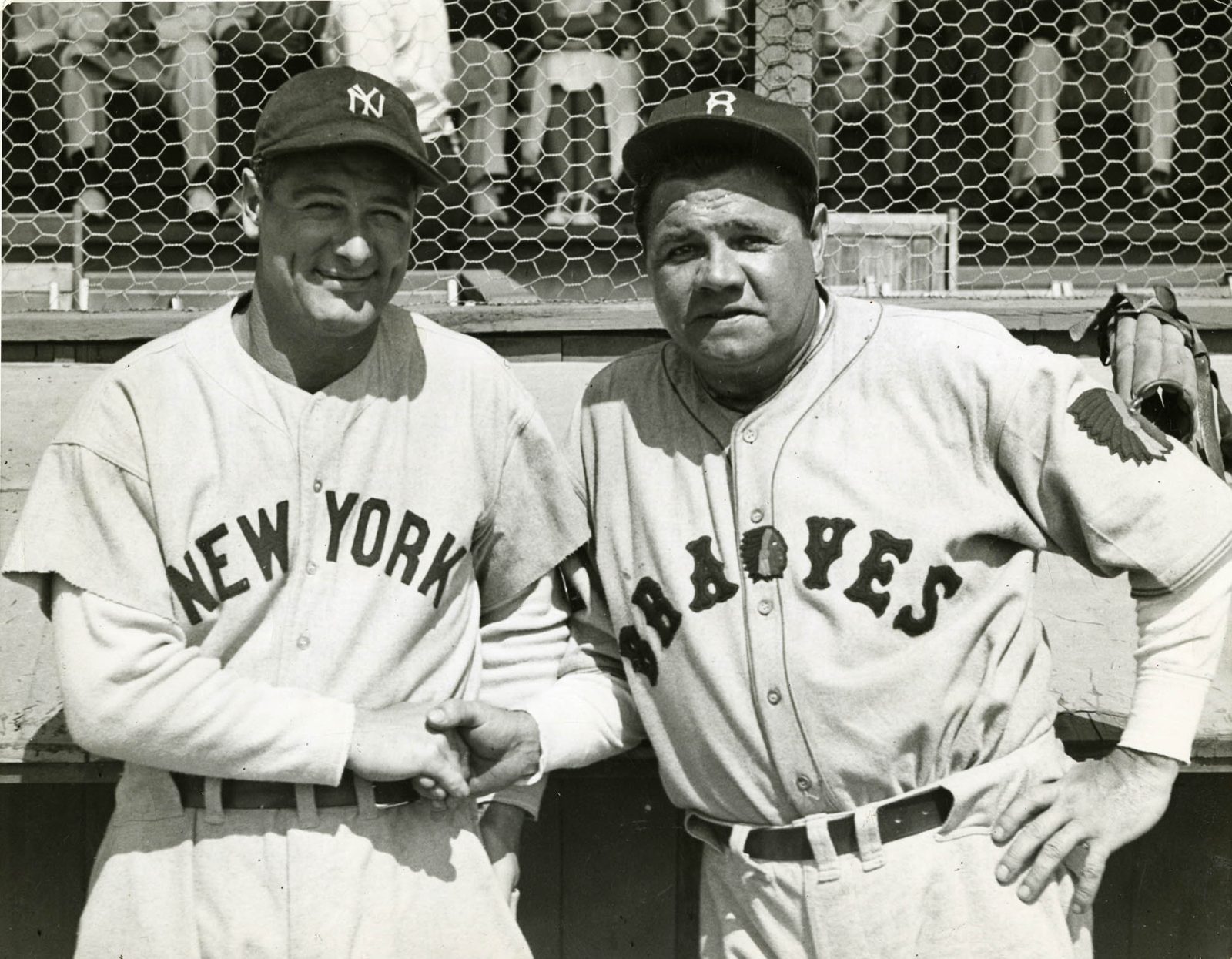
That transformation is inseparable from the emergence of Babe Ruth.
Prior to Ruth, the dominant strategy of the game was to string together multiple contact events in order to produce runs. A single advanced runners incrementally; a sequence of hits and stolen bases eventually produced scoring.
Ruth introduced a fundamentally different mechanism.
A home run collapses the entire basepath into a single event. One swing accomplishes what previously required several successful contacts.
The result is an offensive event whose value is not constrained by the same structural limits that govern batting average.
Power therefore opened a new axis of separation.
Why Power Creates Larger Gaps
Contact offense is constrained by two limits:
Batting average ceilings
Finite opportunities within a game
Power hitting, by contrast, depends on a different set of variables:
bat speed
strength
ball flight
swing mechanics
These factors allow certain hitters to create much larger statistical gaps.
Ruth’s home run production illustrates this vividly. While most players of his era hit fewer than twenty home runs in a season, Ruth routinely exceeded fifty. The magnitude of this difference dwarfed anything seen within the contact system.
Power did not merely increase offensive output; it expanded the possible range of performance.
The Evolution of the Game
Once the power paradigm appeared, baseball reorganized around it.
Teams recognized that home runs produced greater run value and required fewer sequential events than contact-based offense. Strategies evolved accordingly:
hitters began to swing for power
strikeouts became more tolerable
slugging percentage gained importance
The offensive philosophy of the sport shifted from frequency of success to magnitude of success.
What had once been a game of constant contact gradually became a game of explosive outcomes.
Contact Greatness in Historical Perspective
The great contact hitters remain extraordinary players. Their ability to sustain batting averages above .330 while producing hits in nearly every game represents one of the most refined offensive skills in baseball history.
Yet the statistical compression revealed by hit density shows that these hitters were all operating within the same narrow structural band. Their differences, while real, are modest compared to the vast separations later produced by power hitters.
In this sense, players such as Cobb, Burkett, and Delahanty represent the apex of the contact era , while Ruth represents the beginning of a new offensive universe.
Conclusion
The clustering of hit density among the greatest contact hitters reveals that the early offensive system of baseball was approaching its structural limit. Batting average and opportunity constrained how frequently hits could occur within the rhythm of the game, compressing the distribution of elite performers.
The introduction of power hitting broke that equilibrium. By collapsing multiple offensive actions into a single event, the home run created a new dimension of separation and fundamentally altered the geometry of offense.
Baseball evolved not because contact hitters failed, but because they had already reached the boundary of what the contact system could produce. Power offered a path beyond that boundary, and the game followed it.
The transition from the contact era to the power era therefore represents not merely a stylistic change, but a structural transformation in the possibilities of offensive performance.