Bullet Rogan and the Mathematics of Dual-Lane Greatness: Measuring Extreme Value Generation Across Hitting and Pitching
Bullet Rogan and the Mathematics of Dual-Lane Greatness: Measuring Extreme Value Generation Across Hitting and Pitching

Bullet Rogan and the Mathematics of Dual-Lane Greatness
Measuring Extreme Value Generation Across Hitting and Pitching
There are two ways history tends to remember a player like Bullet Rogan.
The first is romantic:
a legend of the Negro Leagues, a man who could hit and pitch, a mythic dual threat.
The second is flattening:
a “two-way player” whose career is difficult to compare to single-lane stars.
Both are incomplete.
If we want to measure Rogan properly — structurally, reproducibly, and without narrative bias — we need a unified model that captures extreme value generation across competitive lanes.
That is what EVG does.
The Problem: Why Traditional Metrics Fail Two-Way Players
OPS+ measures offensive dominance.
ERA+ measures pitching dominance.
WAR measures accumulated value.
None of these are designed to answer a more fundamental question:
How much boundary pressure did a player generate relative to the structural elite ceiling of their lane?
Two-way players distort conventional evaluation because:
They do not produce elite volume in one domain only.
Their excellence is distributed across independent axes.
Their greatness emerges from simultaneous rarity.
Rogan’s case demands a unified framework.
The EVG Model
EVG (Extreme Value Generated) measures:
Normalized, ceiling-relative, volume-disciplined dominance across all production lanes.
It does not measure narrative.
It does not measure longevity alone.
It measures right-tail pressure.
Structural Assumptions
League baseline = 100
Elite hitter ceiling ≈ 200 OPS+
Elite pitcher ceiling ≈ 160 ERA+
Volume floors:
3000 PA (hitting)
1000 IP (pitching)
Tail exponent:
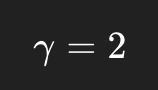
Lane Normalization
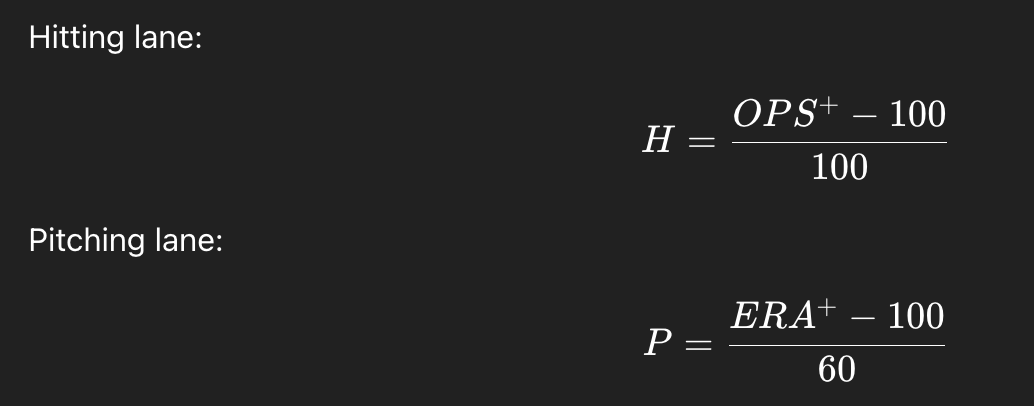
This rescales both domains so that:
0 = league average
1 = structural elite ceiling
Volume Gates
We apply smooth volume discipline:
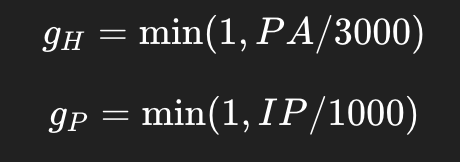
This prevents small-sample inflation while not deleting legitimate careers.
Tail Amplification
Extreme rarity compounds.

The squaring preserves ordering while expanding separation at the extreme boundary.
Bullet Rogan’s Inputs
OPS+ = 154
ERA+ = 141
PA = 2500
IP = 1700
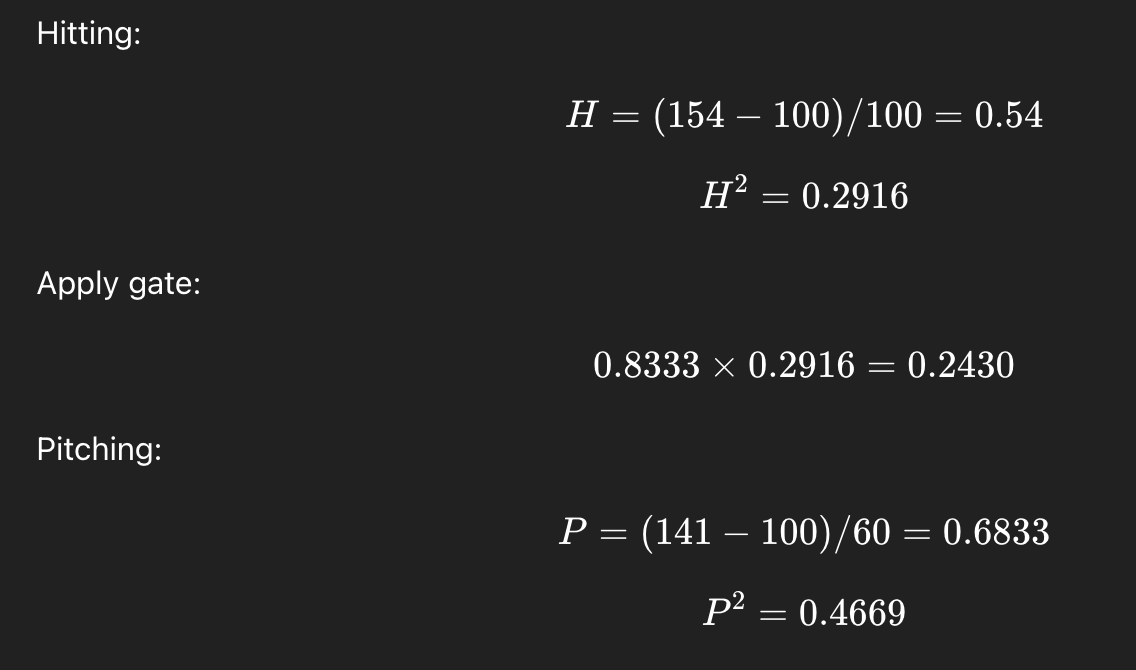
Step 1 — Volume Gates
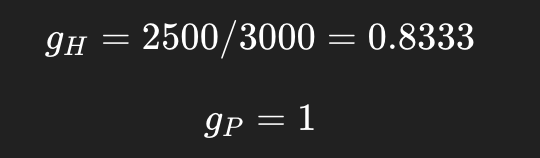
Rogan receives full pitching credit, partial hitting credit.
Step 2 — Normalize Lanes
Final EVG
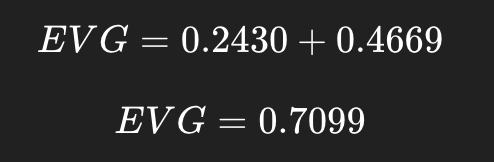
Interpreting the Result
Rogan’s EVG = 0.710
For context:
Babe Ruth (206 OPS+, 122 ERA+) → 1.258
Josh Gibson (202 OPS+) → 1.040
Satchel Paige (159 ERA+) → 0.967
Ted Williams (191 OPS+) → 0.828
Buck Leonard (175 OPS+) → 0.563
Martín Dihigo (139 OPS+, 134 ERA+) → 0.473
Rogan does not sit in rupture tier.
But he is structurally separated from:
Single-lane strong elites
Broad but non-extreme two-way players
His dominance is real in both lanes.
That is rare.
What EVG Reveals About Rogan
Rogan was not a novelty.
He was:
A legitimate right-tail hitter.
A legitimate right-tail pitcher.
Generating structural pressure in both domains simultaneously.
That matters mathematically.
Because extreme value compounds across independent axes.
A 0.54 hitting intensity paired with a 0.68 pitching intensity is not “versatility.”
It is dual-lane boundary pressure.
Very few players in baseball history do that.
Rogan vs Dihigo
The model clarifies a long-standing ambiguity.
Martín Dihigo was broader in positional versatility.
But Rogan generated more extreme production intensity.
Dihigo:
H = 0.39
P = 0.57
EVG = 0.473
Rogan:
H = 0.54 (gated)
P = 0.68
EVG = 0.710
That is structural separation.
Not narrative.
Not nostalgia.
Magnitude.
What This Means Historically
Rogan’s legacy often lives in story.
EVG anchors it in structure.
He is not:
An all-time singular like Ruth.
A pure rupture pitcher like Paige.
A pure offensive singularity like Gibson.
But he is one of the strongest dual-lane extreme value generators of the pre-integration era.
That category is vanishingly small.
And now we can see it.
Final Conclusion
Bullet Rogan’s greatness is not mystical.
It is measurable.
Under ceiling normalization, volume discipline, and tail amplification, his EVG places him clearly above:
Strong single-lane elites
Broad but non-extreme two-way players
And just below the historical rupture tier.
That is precisely where he belongs.
Measured.
Not mythologized.
And now — defensibly.