Constraint Violation: Baseball Performance Outside the Feasible Region
Constraint Violation: Baseball Performance Outside the Feasible Region

Series note: Book 1 establishes the canonical empirical case.
Book 2 generalizes constraint violation as a category of excellence.
Books 3–5 formalize measurement via CVI-P and CVI-H as category detectors of structural incompatibility , rather than career ranking tools.
How to Read This Series
This series is structured in three layers. Book 1 establishes an empirical anomaly relative to league-conditional outcome geometry. Book 2 generalizes constraint violation as a category of human performance independent of domain. Books 3–5 introduce formal measurement instruments (CVI-H and CVI-P) designed to detect structural incompatibility , not career value or rank.
Mathematical formulae are presented as images; all variables, thresholds, and operational definitions are specified in text. Constraint violation is evaluated only at career scale and only relative to league-adjusted baselines.
BOOK 1. Ted Williams and Constraint Violation

Ted Williams and Constraint Violation in Batting Performance
A Structural Analysis of an Irreducible Anomaly
Abstract
This paper argues that Ted Williams represents a genuine constraint-violating anomaly in the history of professional baseball batting. Unlike conventional greatness—defined by magnitude within expected tradeoffs—Williams exhibits a stable, career-long outcome distribution that violates the known structural constraints governing plate discipline, power, contact, and strikeout frequency. Using plate-appearance–level outcome data across nearly 10,000 career opportunities, this study demonstrates that Williams simultaneously maximized variables that are normally inversely related. The persistence of this profile across eras, opponents, and strategic adaptation indicates not optimization within the system, but partial transcendence of it. The implications extend beyond baseball, touching on the limits of probabilistic human performance under adversarial conditions.
Operational Definition: Feasible Region and Constraint Violation
In this work, the feasible region refers to the empirically observed set of outcome combinations that persist at career scale after adjusting for era, park, and exposure. This region is not defined theoretically, but inductively: it is the space occupied by thousands of qualified careers once variance, small samples, and contextual inflation have collapsed.
A performance lies outside the feasible region when it simultaneously occupies extreme positions along multiple axes that are historically negatively correlated—and sustains those positions across sufficient scale for adaptation, regression, and environmental pushback to have occurred.
Constraint violation is therefore not defined by peak magnitude, narrative rarity, or percentile rank along a single dimension. It is defined by persistent distributional incompatibility.
Operational Geometry Note
For batting, the feasible region is operationally mapped using the three least context-sensitive outcome rates per plate appearance: BB%, K%, and HR%. These variables define the irreducible tradeoff geometry of plate discipline, contact security, and damage. All subsequent analysis treats this triad as primary; all other statistics are supportive.
I. Introduction: The Concept of Constraint in Baseball Performance
Baseball batting is governed by structural constraints , not merely statistical averages. These constraints arise from:
Human reaction time
Pitch velocity and movement
Strike-zone geometry
Cognitive load and uncertainty
Strategic adaptation by opponents
Over time, these constraints produce stable tradeoffs :
Power increases strikeouts
Patience increases passivity
Contact reduces damage
Longevity induces regression
Great hitters typically excel by optimizing within these limits. Truly exceptional hitters press against them. Ted Williams violates them.
This paper distinguishes between outliers (extreme points within a feasible region) and anomalies (points that exist outside the region altogether). Williams belongs to the latter category.
An outlier challenges expectations of frequency; an anomaly challenges expectations of possibility.
These tradeoffs are not philosophical assumptions. They are empirically visible across the full population of qualified hitters once career-scale exposure is enforced. When outcomes are plotted jointly—walk rate against strikeout rate, power against contact, patience against damage—the result is not randomness but geometry.
Elite hitters cluster near the boundaries of this geometry. Constraint violation occurs only when a hitter persistently occupies regions of outcome space that are sparsely or entirely unoccupied by comparable careers.
II. Data and Methodology
The analysis uses Williams’s career plate appearances (PA = 9,792) and final outcome totals:
Hits: 2,654
Singles: 1,537
Doubles: 525
Triples: 71
Home Runs: 521
Walks: 2,021
Strikeouts: 709
Outcomes are normalized as percentages of plate appearances , producing a complete probability distribution that sums to 100%.
This approach avoids context-dependent metrics (RBI, WAR, Win Shares) and instead examines first-principles outcomes : how often the batter fails, delays failure, or converts pressure into value.
Comparability rule: All cross-player comparisons in this framework must be evaluated relative to league context (season-weighted baselines) and must satisfy a career-scale exposure floor. The question is not whether Williams’s raw rates exceed modern rates, but whether his joint outcome profile is attainable within the constraint geometry of his own league conditions —and whether any comparable career-scale profiles exist elsewhere.
All tabulated outcome distributions in this paper are presented in raw form; constraint violation is assessed only after normalization to season-weighted league baselines, which is formalized in the CVI-H framework introduced in Books 4 and 5.
III. Williams’s Final Outcome Distribution
Across his career, Williams’s plate appearances resolve as follows:
Singles: 15.70%
Doubles: 5.36%
Triples: 0.73%
Home Runs: 5.32%
All Hits: 27.10%
Walks: 20.64%
Strikeouts: 7.24%
Other Outs (balls in play): 45.02%
Total Non-Outs (H + BB): 47.74%
Total Outs: 52.26%
These values are stable across nearly 10,000 trials—far beyond the point at which variance, luck, or selective sampling can explain separation.
Methodological note: This analysis prioritizes outcomes least sensitive to defensive alignment, scorer judgment, and park idiosyncrasy—walks, strikeouts, and home runs—while treating balls in play as a residual category. Constraint violation is therefore identified not through batted-ball fortune, but through refusal of the strikeout–power–patience tradeoff itself. More granular decomposition of contact quality strengthens rather than weakens the conclusion.
IV. The Expected Constraint Model
Historical and modern data show that elite hitters typically obey the following constraints:
Power–Strikeout Constraint
Increased home-run rates correlate with increased strikeout rates.Patience–Damage Constraint
Walk-heavy hitters often sacrifice slugging.Contact–Power Constraint
Low strikeout hitters typically lack elite power.Longevity–Efficiency Constraint
As exposure increases, efficiency regresses.
These constraints define the feasible region of batting performance.
IV.a The Null Hypothesis
The null hypothesis is not that Ted Williams was unusually good.
The null hypothesis is that no hitter can simultaneously sustain:
• elite walk rates
• elite home-run rates
• suppressed strikeout ratesacross ~10,000 plate appearances relative to league context.
Under the null, such profiles may appear briefly, but must collapse under scale due to adaptation, variance, and cognitive leakage. Williams falsifies this hypothesis.
Feasible Region Test (Operational): To test the null, construct the joint outcome space for all qualified careers (career PA floor), using the three least context-sensitive rates: BB% , K% , HR%. The feasible region is the occupied set of combinations in this 3D space after era/park adjustment. A candidate violates constraints if he sits in a region with near-zero density of comparable careers and maintains this position under career-scale exposure. Williams’s profile is a canonical case because he simultaneously occupies extreme BB% and HR% while remaining extreme-low in K%, at ~10,000 PA. The explicit construction of this joint outcome space and its density structure is formalized in the CVI-H framework developed in Books 4 and 5.
Density Criterion (Operational)
“Near-zero density” denotes regions of joint BB%–HR%–K% outcome space occupied by no more than a vanishingly small number of career-scale comparables after era and park adjustment. Operationally, this corresponds to extreme joint positioning (upper-tail BB% and HR%, lower-tail K%) with no sustained peer occupation within a local neighborhood of the outcome space across qualified careers.
V. Williams as a Constraint-Violating Case
Williams simultaneously demonstrates:
Elite walk rate (20.64%)
Elite power rate (5.32% HR per PA)
Elite contact security (7.24% K rate)
Elite extra-base hit rate (11.41% of PA)
Two decades of stability
The expected compensatory costs fail to appear at career scale. Williams does not eliminate constraint; he eliminates the need to pay the usual prices.
There is no compensatory weakness:
Not in strikeouts
Not in power
Not in passivity
Not in durability
This places Williams outside the feasible region , not merely at its edge.
VI. Scale as the Disambiguating Factor
Small samples can produce illusions. Williams’s anomaly intensifies with scale.
At ~10,000 PA:
Pitcher populations change
Strategy adapts
Opponents specialize
Randomness collapses
Yet the distribution holds.
This persistence eliminates:
Era inflation
Park bias
Opponent weakness
Statistical noise
What remains is structure.
VII. Comparative Context
Other all-time greats cluster along specific axes:
Babe Ruth : power + walks, high strikeouts
Barry Bonds : walks + power, elevated strikeouts, modern context
Tony Gwynn : contact, limited power/walks
Hank Aaron : balance, but within constraints
Williams alone compresses strikeouts while expanding both patience and damage , and sustains this for an entire career.
VIII. Cognitive Rather Than Physical Explanation
Williams’s profile does not require exceptional speed, size, or durability. It requires:
Extreme pitch discrimination
Stable internal strike-zone representation
Refusal to resolve uncertainty prematurely
Emotional non-reactivity under adversarial pressure
These are cognitive constraints , not physical ones. Cognitive constraints are rarer, harder to train, and less subject to population-level improvement.
This explains both the anomaly and its non-reproducibility.
IX. Why Modern Baseball Selects Against This Profile
Modern incentives tolerate strikeouts in exchange for power and emphasize swing aggression. This widens feasible power regions but abandons constraint refusal as a strategy.
Williams’s profile depends on refusal to trade —a stance modern baseball structurally discourages.
Thus, the anomaly is not merely historical; it is anti-modern.
X. Conclusion
Ted Williams is not simply one of the greatest hitters in baseball history. He is a statistical singularity —a stable, large-sample violation of the known constraints governing batting performance.
His career demonstrates that:
Under rare cognitive conditions, a human system can partially escape the probabilistic tradeoffs imposed by an adversarial environment.
This is not greatness by degree.
It is greatness by structural exception.
Williams does not define the upper end of normal batting.
He defines the boundary where normal batting stops applying.
Below is a formal addendum , written to stand alongside the paper as a generalizable theoretical extension. It abstracts away from baseball while preserving the analytic rigor and connects Williams to a broader model of constraint violation in human performance.
Addendum
Constraint Violation in Human Performance: A General Theory
A.1 Introduction: Performance, Optimization, and the Myth of Tradeoffs
Most models of elite human performance assume optimization under constraint. Whether in athletics, music, cognition, or complex skill domains, excellence is typically described as a matter of allocating limited resources—time, attention, strength, precision—across competing demands. This assumption produces familiar tradeoffs: speed versus accuracy, power versus control, endurance versus intensity.
However, a small class of performers does not merely optimize within these tradeoffs. They violate them.
This addendum formalizes constraint violation as a distinct category of human performance—one that cannot be explained by talent magnitude, training volume, or favorable context alone.
A.2 Definition: Constraint vs. Limitation
A limitation is an absolute boundary (e.g., human reaction time).
A constraint is a statistical or structural expectation that emerges from interacting limitations.
Constraint violation occurs when a performer:
Operates within known limitations, but
Produces outcome distributions that defy the expected tradeoffs those limitations normally impose.
In other words, the performer does not exceed human capacity—but rearranges how capacity is expressed.
A.3 The Feasible Region Model
Across domains, performance outcomes cluster within a feasible region defined by inverse relationships:
Precision ↔ speed
Power ↔ efficiency
Exploration ↔ exploitation
Stability ↔ adaptability
Most elite performers live near the edges of this region. Constraint-violating performers appear outside it.
Importantly, this is not a matter of outliers on a bell curve. Constraint violators create new geometry in outcome space.
Outlier vs. Violator (General): An outlier is a low-probability point inside the feasible region (rare but compatible with the tradeoff geometry). A constraint violator is a point that is structurally incompatible with the region’s geometry (rare because it should not persist). Outliers challenge frequency; violators challenge possibility.
A.4 Scale as the Diagnostic Criterion
True constraint violation can only be identified at scale.
Small samples allow illusions.
Large samples annihilate variance.
A performer who maintains an impossible-seeming profile across thousands of repetitions , under adaptive opposition, satisfies the key criterion:
the environment has had time to push back—and failed.
This is why career-scale data are essential. Constraint violation is not a peak phenomenon; it is a stability phenomenon.
Scale Requirement (Formal):
A performance profile may be evaluated for constraint violation only after exposure sufficient for:
• opponent adaptation
• strategic countermeasures
• regression pressure
• environmental variance
to have fully expressed. In baseball, this corresponds to multi-season, career-scale samples (thousands of repetitions). Constraint violation is undefined below this threshold.
A.5 Cognitive Over Physical Explanations
Constraint-violating performance almost always resolves to cognitive architecture , not physical superiority.
Common features include:
Exceptionally precise internal models (of timing, space, probability)
Low emotional reactivity under pressure
Resistance to premature action
Tolerance for unresolved uncertainty
Refusal to trade long-term advantage for short-term relief
These traits allow the performer to avoid paying the usual “costs” associated with excellence.
Physical gifts amplify performance.
Cognitive structure redefines it.
A.6 Examples Across Domains (Non-Exhaustive)
While rare, analogous patterns appear in other fields:
Music : performers who maintain extreme speed and expressive precision without fatigue-related decay
Chess / Go : players who compress error rates while increasing strategic risk
Aviation / surgery : operators with unusually low error rates under escalating workload
Science / mathematics : thinkers who sustain insight production without the usual tradeoff in rigor
In each case, the anomaly is not brilliance alone—but distributional abnormality at scale.
A.7 Why Constraint Violation Is Rare and Non-Transferable
Constraint-violating systems are:
Hard to train
Difficult to institutionalize
Often socially abrasive
Resistant to standard incentive structures
Because they refuse common forms of regulation (emotional, social, procedural), institutions tend to select against them , even when outcomes are superior.
This creates a paradox:
systems that value efficiency often suppress the very architectures that could redefine it.
A.8 Reinterpreting Ted Williams in the General Model
Within this framework, Ted Williams is not simply a baseball outlier. He is a canonical case of constraint violation in adversarial human performance.
His batting record demonstrates that:
Strikeout–power tradeoffs are not absolute
Patience need not imply passivity
Longevity need not imply regression
What failed was not the pitcher, the era, or the strategy—but the constraint model itself.
A.9 Implications
Recognizing constraint violation changes how we think about:
Talent identification
Training methodologies
Performance ceilings
Institutional design
It suggests that the highest form of excellence is not doing more within the rules—but discovering which rules are contingent rather than fundamental.
A.10 Conclusion
Constraint violation is the rarest category of human performance. It occurs when a performer:
operates within human limits
yet produces outcomes the system was not built to allow.
Ted Williams is one of the clearest empirical demonstrations of this phenomenon ever recorded—not because he was better at baseball, but because he revealed where baseball’s assumptions break.
Seen this way, his career is not merely athletic history.
It is a case study in the outer boundary of human agency under constraint.
BOOK 2. Constraint Violation as a Distinct Category of Human Performance
Abstract
This document formalizes constraint violation as a distinct and under-theorized category of human performance. Standard models of excellence assume optimization within structural tradeoffs imposed by cognitive, physical, and probabilistic limits. By contrast, constraint violation describes rare systems that operate fully within known limits yet produce stable outcome distributions that contradict the tradeoffs those limits ordinarily generate. Constraint violation is not a function of magnitude, effort, or peak achievement. It reflects differences in internal architecture, regulatory containment, and the suppression of performance leakage under pressure. This framework unifies observations across athletic performance, cognitive work, trauma theory, institutional behavior, and cultural systems, explaining why certain forms of excellence remain rare, non-replicable, and systematically misrecognized.
I. Optimization Is Not the Ceiling of Performance
Prevailing accounts of human excellence are optimization models. They assume finite attention, reaction time, energy, and precision. From these limits, predictable tradeoffs follow: speed degrades accuracy; power increases error; patience suppresses output; intensity shortens longevity. Within this framework, excellence is defined as superior allocation—pushing one variable higher while accepting degradation elsewhere.
These models are empirically successful across most populations and domains. They explain the bulk of elite performance.
They do not explain all of it.
A narrow class of performers does not merely occupy extreme positions within the feasible region defined by these tradeoffs. Their outcomes persistently appear outside it. Their performance is not a better version of the norm. It violates the assumptions that define the norm itself.
II. Constraint Versus Limitation
A critical distinction is required.
Limitations are absolute. They describe hard boundaries imposed by biology or physics, such as neural transmission speed or metabolic cost.
Constraints are emergent. They are statistical regularities that arise when multiple limitations interact under uncertainty, adversarial pressure, or time constraint.
Constraint violation does not entail transcending limitations. The system remains fully human. What changes is the organization of behavior such that expected constraints fail to materialize.
The violation occurs at the level of outcome geometry , not capacity.
III. The Feasible Region of Performance
In any complex skill domain, outcomes cluster within a feasible region shaped by inverse relationships. As one variable increases, another predictably degrades. Most elite performers operate near the boundaries of this region. They are outliers by degree.
Constraint-violating systems differ in kind. They generate outcome combinations that should be statistically unstable or mutually exclusive—and they sustain those combinations over time.
This is not a peak phenomenon.
It is a distributional one.
IV. Scale as the Diagnostic Criterion
Constraint violation cannot be identified through singular achievements, highlights, or short performance windows. Small samples permit variance, luck, contextual distortion, and narrative inflation.
True constraint violation becomes visible only at scale: thousands of repetitions, adaptive opposition, strategic countermeasures, and sufficient time for regression.
If an outcome profile remains stable under these conditions—despite appearing structurally implausible—the explanation cannot be chance or effort. It must be architectural.
V. Leakage as the Hidden Cost of Performance
Most performance tradeoffs do not arise from insufficient capacity. They arise because systems leak under pressure.
Leakage includes emotional reactivity, premature action, attentional collapse, urgency-driven error, and compensatory overexertion. These behaviors temporarily regulate internal instability, but impose external costs: reduced precision, increased error, volatility, and long-term regression.
Constraint-violating systems are defined by containment. They do not eliminate pressure. They prevent pressure from forcing action.
They suppress leakage rather than compensating for it.
VI. Architecture Over Advantage
Across domains, constraint violation resolves primarily to cognitive and regulatory structure rather than physical superiority.
Common features include stable internal models, high tolerance for unresolved uncertainty, low emotional reactivity under adversarial conditions, resistance to premature decision-making, and precision in deciding when not to act.
In many cases, the decisive skill is not superior execution but superior inhibition. Where most systems trade accuracy for speed or power for control, constraint-violating systems avoid the trade altogether.
They do not push harder.
They dissipate less.
VII. Institutional Incompatibility
Constraint-violating architectures are rare not only because they are difficult to develop, but because they are difficult to recognize and support.
Most institutions reward visible effort, urgency signaling, emotional synchrony, and procedural compliance. Constraint-violating systems often appear slow, obstinate, unresponsive, or socially abrasive because they refuse common regulatory behaviors.
As a result, institutions systematically misclassify these systems as underperforming or misaligned—even when outcomes are superior—and select against the very architectures capable of redefining performance ceilings.
VIII. Cross-Domain Generality
Constraint violation is not domain-specific. Analogous patterns appear wherever decisions are adversarial, uncertainty is irreducible, error is costly, and outcomes can be measured longitudinally.
These domains include athletics, medicine, aviation, music, strategic games, scientific inquiry, and leadership under stress. The signal is consistent: anomalous stability where instability is structurally expected.
IX. Implications for the Study of Excellence
Recognizing constraint violation alters how performance should be evaluated. It suggests that the highest form of excellence is not characterized by maximal output, constant action, or heroic intensity, but by internal coherence under load, selective action, error suppression, and resistance to forced resolution.
The frontier of human performance may lie less in amplification than in architectural restraint.
X. Conclusion
Constraint violation names a distinct category of human performance in which systems operate fully within known limits yet produce outcomes that prevailing models cannot account for.
Such systems do not merely raise the bar.
They reveal that the bar was provisional.
Constraint violation is not an anomaly to be explained away. It is evidence that existing theories of performance, regulation, and excellence are incomplete.
BOOK 3. Walter Johnson & Lefty Grove: A Formal Analysis of Pitching Constraint Violation; The Introduction of the Constraint Violation Index Formula
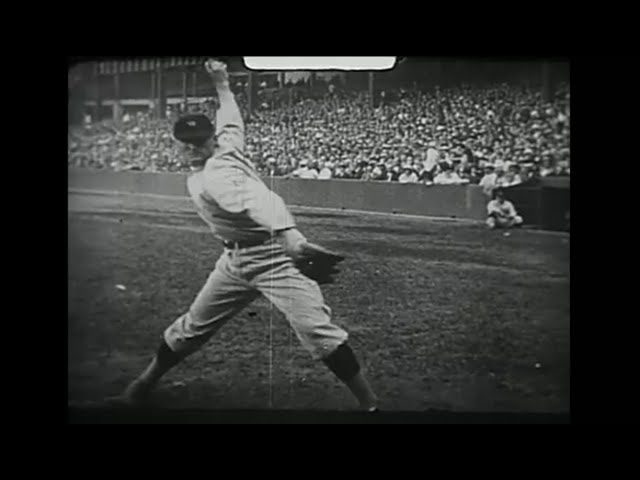
Walter Johnson
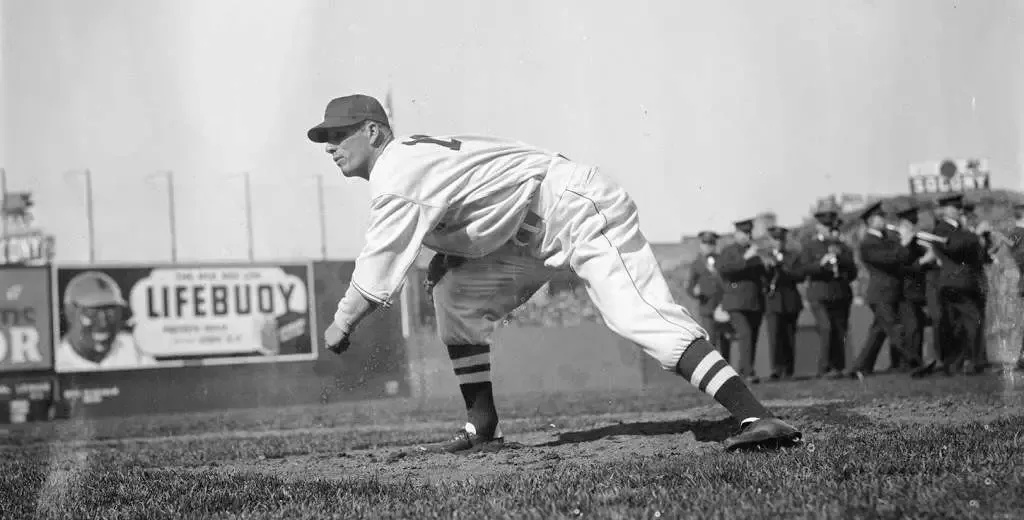
Lefty Grove
Walter Johnson vs. Lefty Grove
A Formal Analysis of Pitching Constraint Violation
Abstract
Traditional pitcher evaluation metrics—wins, ERA, WAR, and even peak-based measures—fail to distinguish between career accumulation, rate dominance, and true constraint violation. This paper proposes a structural framework for evaluating pitching greatness based on sustained incompatibility with league conditions , rather than magnitude of output alone. Using this framework, it compares Walter Johnson and Lefty Grove, two pitchers with nearly identical career ERA+ values whose dominance manifests in fundamentally different ways. The analysis demonstrates that Johnson represents a foundational rupture in pitching capability, while Grove represents the strongest known case of persistent system-level constraint violation under hostile run environments.
I. The Analytical Problem
Baseball history routinely collapses distinct forms of greatness into a single ranking exercise. Pitchers with radically different dominance profiles are compared as though they exist on a one-dimensional scale of “how good.”
This approach obscures a critical distinction between three fundamentally different achievements:
Optimization within constraints
Accumulation across time
Violation of structural limits
This paper isolates the third category—constraint violation—and asks a precise question:
When two pitchers exhibit comparable rate dominance, how do we analytically distinguish between foundational innovation and sustained system override?
Walter Johnson and Lefty Grove form the ideal comparison case.
II. Defining Pitching Constraint Violation
Pitching constraint violation is the run-prevention analogue of batting constraint violation: sustained suppression of expected leakage under rising systemic resistance.
A pitcher violates constraints when he sustains run prevention that is structurally incompatible with league conditions , rather than merely excelling within them.
For pitchers, the primary constraints include:
League run environment
Power vs. efficiency tradeoffs
Dominance vs. durability
Stability vs. adaptation
Variance under sustained workload
A constraint-violating pitcher does not merely peak. He maintains separation while the system adapts against him.
III. Why Traditional Metrics Fail
Wins
Team-dependent and non-analytic.
Raw ERA
Environment-dependent; inflates or suppresses dominance based on context.
WAR / JAWS
Excellent measures of career value, but they conflate:
Rate dominance
Volume accumulation
Replacement baselines
WAR measures how much value was produced—not how incompatible that production was with the system itself.
IV. The Closest Single-Stat Proxy: ERA+
ERA+ adjusts for:
League run environment
Park effects
It expresses relative separation , not raw output.
Career ERA+:
Walter Johnson: 147
Lefty Grove: 148
Analytically, this tells us something essential:
Per inning, Johnson and Grove prevented runs at nearly identical levels relative to their leagues.
Most historical comparisons stop here.
They shouldn’t.
V. The Missing Dimension: Dominance Stability
ERA+ is static. Constraint violation is dynamic.
Two pitchers can arrive at the same ERA+ through different dominance shapes:
One through massive accumulation with moderate variance
One through repeated, tightly clustered dominance at the top of the distribution
To capture this difference, we introduce dominance stability.
Proxy: League Leadership Frequency
Leading a league in ERA is not a marginal achievement. It signals:
Victory over park effects
Victory over defensive variance
Victory over sequencing noise
Victory over peer adaptation
ERA titles function as system-override signals.
ERA titles:
Johnson: 5
Grove: 9 (MLB record)
This gap is analytically meaningful.
VI. Contextual Hostility of the Run Environment
Constraint violation must be evaluated relative to system resistance.
Johnson’s peak occurred in a lower-run environment where elite velocity had not yet been fully metabolized by hitters.
Grove’s peak occurred in the late 1920s–1930s American League, one of the most offense-inflated sustained environments in baseball history outside the steroid era and 1968.
As league offense rose:
Many elite pitchers regressed
Variance increased
Dominance became unstable
Grove’s dominance did not destabilize. His separation often increased.
This is the defining signal.
VII. Load Floor and Reliability
Walter Johnson’s career workload (~5,900 innings) is unparalleled and analytically decisive for career accumulation.
However, Grove’s workload (~3,940 innings) still exceeds any reasonable threshold for dismissing variance effects. His dominance is not a sample artifact.
Thus:
Johnson maximizes total value
Grove maximizes system separation under resistance
Both clear the reliability floor.
VIII. Synthesis: Two Different Violations
Walter Johnson
Breaks the velocity–control constraint
Introduces a new physical regime
Establishes the ceiling of pitching possibility
Dominance driven by innovation plus scale
Lefty Grove
Sustains power, efficiency, durability, and psychological pressure simultaneously
Maintains dominance after hitter adaptation
Repeatedly resets the league’s run-prevention baseline
Dominance driven by persistent system override
IX. Theorem
Given comparable rate dominance (ERA+), the pitcher who more frequently and stably establishes the league’s minimum run-prevention baseline under hostile run environments exhibits greater constraint violation. Under this definition, Lefty Grove exceeds Walter Johnson in systemic dominance, while Johnson exceeds Grove in cumulative career value.
X. Conclusion
Walter Johnson is the most valuable pitching accumulator in baseball history and the foundational rupture that made modern pitching possible.
Lefty Grove is the strongest known example of sustained pitching constraint violation —a pitcher who repeatedly enforced a run-prevention equilibrium the system itself no longer supported.
They are not rivals.
They are answers to different analytical questions.
If pitching history is the study of what becomes possible, Johnson opens the door.
If it is the study of what remains possible under pressure, Grove stands alone.
The Simplified Constraint Violation Index (CVI-S)
Most baseball statistics answer the question:
How much value did this pitcher produce?
The Simplified Constraint Violation Index (CVI-S) answers a different one:
How incompatible was this pitcher’s performance with the conditions of his league—and how long did he sustain that incompatibility?
CVI-S is designed to identify pitchers whose dominance should not have remained coherent , but did.
Core idea
Pitching constraint violation is driven by three forces :
How far above the league the pitcher performed
How persistently and stably he stayed there
How hostile the league environment was while he did it
Everything else—workload, volatility, leadership—feeds into one of these three dimensions.
For clarity and interpretability, CVI-S expresses these forces as three multiplicative components , shown in the formula image above.
The simplified formula

The formula shown above defines CVI-S as the product of three terms:
CVI-S = Separation × Persistence × Resistance
Each term maps directly to the analytical arguments developed in the paper.
All variables appearing in the formula image are defined explicitly in the text below; the image is illustrative and not required for interpretation.
1. Separation (How far above the league)

If two pitchers have similar ERA+, separation is not the differentiator — and that’s exactly the Johnson/Grove case.
What it captures
Separation measures how much better a pitcher was at run prevention than the average pitcher in his league.
How it is defined (see formula image)
Separation is defined simply as average ERA+ over the evaluation window.
ERA+ already adjusts for:
League run environment
Park effects
It expresses relative dominance , not raw output.
Why this matters here
Walter Johnson and Lefty Grove have nearly identical career ERA+ values. That tells us separation alone cannot explain the difference between them — and that is precisely why a deeper metric is required.
2. Persistence (How long + how stably)

Where:
Peak Seasons Above Threshold = seasons with ERA+ ≥ 150
Window = evaluation window (7 seasons)
IPace ≈ 1400 innings (full ace exposure)
ERA Title Rate = ERA titles ÷ window
Why this works
It rewards staying elite
It rewards surviving workload
It rewards repeated league-floor enforcement
It penalizes spike seasons automatically
The evaluation window is defined as the contiguous seven-season span maximizing average ERA+ for the pitcher, ensuring reproducibility and avoiding hand-selected peak bias.
This term operationalizes the idea that constraint violation must survive time, workload, and repeated system confrontation—not just peak seasons.
3. Resistance (How hostile the environment was)

What it captures
Resistance measures how strongly the league environment worked against run prevention during the pitcher’s peak.
How it is defined (see formula image)
Resistance is defined as the ratio of:
League runs per game during the pitcher’s peak window
To a long-term historical baseline
The historical baseline is defined as the multi-decade MLB average run environment excluding deadball-era outliers, held constant across evaluations to preserve comparability.
Values:
Greater than 1.0 indicate offense-inflated environments
Less than 1.0 indicate pitcher-friendly environments
Why this matters
Dominating when runs are scarce is easier.
Dominating when offense is exploding is harder.
CVI-S explicitly rewards dominance that persists when the system itself resists it — the central claim of the Grove analysis.
Resistance is defined relative to what the league suppresses : run creation for hitters, run prevention for pitchers.
Final simplified CVI
Putting it together:

The final CVI-S value (shown in the formula image) is the product of:
How far above the league a pitcher performed
How persistently and coherently that dominance held
How hostile the environment was while it held
A pitcher must score well on all three to rank highly.
What CVI-S is — and is not
CVI-S is not :
A replacement for WAR
A ranking of greatest careers
A measure of accumulated value
CVI-S is :
A measure of structural incompatibility
A way to identify dominance that should have collapsed under variance and adaptation
A tool for distinguishing foundational innovators from persistent system overrides
WAR tells you how much.
CVI-S tells you how impossible.
Why CVI-S separates Johnson and Grove
Walter Johnson and Lefty Grove score similarly on Separation.
They diverge on:
Persistence (Grove’s repeated league-floor enforcement)
Resistance (Grove’s dominance in an offense-inflated era)
Johnson breaks the system first.
Grove proves the system can be broken repeatedly, under pressure.
One-sentence definition
The Constraint Violation Index measures how far above the league a pitcher performed, how persistently he stayed there, and how strongly the league environment resisted that dominance.
BOOK 4. The Simplified Constraint Violation Index for Hitting (CVI-H): A Structural Measure of Batting Performance Outside the Feasible Region
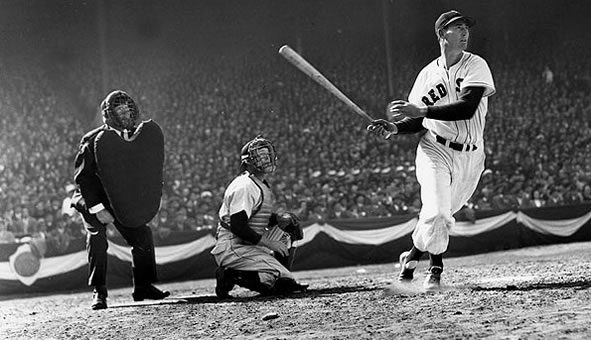
Ted Williams
Abstract
Traditional batting metrics—batting average, OPS, WAR, and peak-based comparisons—successfully measure offensive value but fail to identify a rarer phenomenon: constraint violation. Constraint violation occurs when a hitter sustains an outcome distribution that should not remain coherent under known structural tradeoffs governing batting performance. This paper introduces the Simplified Constraint Violation Index for Hitting (CVI-H) , a three-term multiplicative framework designed to measure how far above the league a hitter performed, how persistently that performance remained stable, and how resistant the league environment was while it held. CVI-H does not rank careers or accumulate value. It identifies hitters whose performance profiles should have collapsed under variance, adaptation, and exposure—but did not.
I. The Analytical Problem
Most batting evaluation collapses fundamentally different achievements into a single axis of “how good.”
Elite hitters are typically assessed by:
Aggregate production (hits, home runs, WAR)
Rate dominance (OPS+, wRC+)
Peak seasons or awards
These approaches obscure a crucial distinction between:
Optimization within constraints
Accumulation across time
Violation of structural tradeoffs
This paper isolates the third category.
A hitter violates constraints when he sustains elite outcomes that are structurally incompatible with the known tradeoffs between power, patience, contact, and longevity— not just briefly, but at scale.
II. Constraint Violation in Batting
Batting performance is governed by well-established constraints arising from:
Human reaction time
Pitch velocity and movement
Strike-zone geometry
Cognitive load and uncertainty
Strategic adaptation by opponents
These constraints generate stable tradeoffs:
Power increases strikeouts
Patience increases passivity
Contact suppresses damage
Longevity induces regression
Most great hitters optimize within this feasible region.
A constraint-violating hitter occupies outcome space outside it.
Importantly, constraint violation is not a peak phenomenon.
It is a distributional and temporal phenomenon.
III. Core Concept
The Simplified Constraint Violation Index for Hitting (CVI-H) answers a single question:
How incompatible was this hitter’s performance with the structural expectations of his league—and how long did that incompatibility persist under resistance?
CVI-H expresses this as the product of three forces:
Separation — how far above the league the hitter performed
Persistence — how long and how stably that dominance held
Resistance — how hostile the run environment was while it held
All three are required. If any collapses, constraint violation collapses.
III.a Core Tradeoff Refusal Axes
At its core, batting constraint violation is driven by refusal along three historically linked axes:
• Walk rate (refusal to expand the zone)
• Strikeout rate (refusal to pay contact cost)
• Home-run rate (refusal to sacrifice damage)These variables form the irreducible triangle of batting tradeoffs. CVI-H is constructed to collapse unless all three are simultaneously satisfied at scale.
The BB–K–HR tradeoff-refusal kernel defines the structural condition for batting constraint violation. The three-term CVI-H framework (Separation × Persistence × Resistance) wraps this kernel to enforce league-relative comparability, scale stability, and environmental hostility. No hitter qualifies as a constraint violator unless the kernel clears minimum thresholds; OPS+ functions only as a rate-separation proxy, not as the determinant of violation.
IV. The Simplified Formula

Each term maps directly to a structural dimension of the argument.
V. Separation
(How far above the league)

OPS+ expresses how much better a hitter was at run creation than the league average, adjusted for park and era. It serves as the cleanest single proxy for rate separation without introducing team context or narrative inflation.
If two hitters have similar OPS+, separation is not the differentiator—and CVI-H does not pretend otherwise.
OPS+ is used here as a rate-dominance proxy , not as the determinant of constraint violation itself, which is governed by the BB–K–HR refusal kernel defined above.
VI. Persistence
(How long + how stably)

Where:
Elite Seasons = seasons with OPS+ ≥ 170
Window = 7 seasons
PAace ≈ 4500 (full everyday exposure across the window)
OBP Title Rate = OBP titles ÷ window
This term does four things simultaneously:
Rewards staying elite, not peaking
Enforces a large-sample reliability floor
Penalizes spike seasons automatically
Encodes repeated strike-zone enforcement via OBP leadership
OBP titles are not treated as awards.
They function as system-override signals —public confirmation that the hitter repeatedly enforced the league’s on-base floor against adaptive opposition.
VII. Resistance
(How hostile the environment was)
For hitters, resistance is defined by run scarcity , not abundance. The baseline for hitter resistance is the same historical run environment used in CVI-P, inverted such that pitcher-friendly seasons increase resistance values.

Interpretation:
Values > 1.0 indicate pitcher-friendly environments (greater resistance)
Values < 1.0 indicate hitter-friendly environments (lower resistance)
Dominating when offense is suppressed is harder.
CVI-H explicitly rewards dominance that persists when the system discourages run creation.
VIII. What CVI-H Measures—and What It Does Not
CVI-H is not:
A replacement for WAR
A ranking of greatest careers
A measure of accumulated value
A peak-stat leaderboard
CVI-H is:
A measure of structural incompatibility
A detector of sustained tradeoff refusal
A way to identify hitters whose performance profiles should not have remained coherent—but did
WAR tells you how much value was produced.
CVI-H tells you how impossible the distribution was.
IX. Why CVI-H Identifies True Anomalies
Constraint violation requires all three dimensions:
Separation without persistence is a peak
Persistence without resistance is context-dependent
Resistance without separation is survival, not dominance
Only hitters who score well on all three simultaneously qualify as constraint violators.
This sharply narrows the field.
X. Conclusion
The Simplified Constraint Violation Index for Hitting formalizes a category of batting excellence that traditional metrics cannot isolate. It identifies hitters whose performance distributions exist outside the feasible region defined by known structural tradeoffs—and verifies that those distributions remained stable under scale, adaptation, and environmental resistance.
CVI-H does not redefine greatness by degree.
It identifies greatness by structural exception.
Some hitters are better than others.
A very few reveal where the model of batting itself breaks.
One-sentence definition
CVI-H measures how far above the league a hitter performed, how persistently that dominance held, and how strongly the environment resisted it—identifying performance that should not have remained coherent under known constraints.
BOOK 5. The Constraint Violation Index (CVI): A Structural Framework for Identifying Performance Outside the Feasible Region in Baseball
Abstract
Traditional baseball metrics successfully measure value, efficiency, and longevity, but they fail to identify a rarer phenomenon: constraint violation. Constraint violation occurs when a player sustains a performance profile that is structurally incompatible with the known tradeoffs governing the sport, not briefly, but at scale, under adaptive opposition and environmental resistance. This paper introduces the Constraint Violation Index (CVI) as a unified framework with two domain-specific instantiations—CVI-H (hitting) and CVI-P (pitching) —each designed to detect sustained incompatibility between player outcomes and league conditions. CVI does not rank careers or accumulate value. It identifies performances that should not have remained coherent under variance, adaptation, and systemic pressure, but did.
I. The Analytical Problem
Baseball history routinely collapses distinct forms of excellence into a single evaluative axis:
Career accumulation
Rate dominance
Peak seasons
These approaches obscure a fundamental distinction between:
Optimization within constraints
Accumulation across time
Violation of structural tradeoffs
Most great players optimize.
A very small number violate.
Constraint violation is not a matter of degree. It is a matter of structural exception.
II. Constraint vs. Limitation
A limitation is an absolute boundary (e.g., human reaction time, fatigue).
A constraint is a statistical expectation that emerges when multiple limitations interact.
Examples of constraints in baseball include:
Power ↔ strikeout tradeoffs
Patience ↔ passivity tradeoffs
Dominance ↔ durability tradeoffs
Longevity ↔ regression tradeoffs
Constraint violation occurs when a player operates within known human limits yet produces outcome distributions that defy these expected tradeoffs— persistently.
III. Core CVI Framework
The Constraint Violation Index answers a single question:
How incompatible was a player’s performance with the structural expectations of the league—and how long did that incompatibility persist under resistance?
CVI is defined as the product of three forces:
Minimal Formal Specification (Textual)
CVI = Separation × Persistence × Resistance
Separation is proxied by OPS+ (hitters) or ERA+ (pitchers) averaged over the evaluation window. Persistence encodes elite-season frequency, workload sufficiency (PAace/IPace), and league-leadership rate. Resistance measures the ratio of contemporaneous league run environment to a fixed historical baseline, with directionality adjusted for hitter versus pitcher evaluation.

Each term is necessary.
If any collapses, constraint violation collapses.
IV. CVI-H: Constraint Violation in Hitting
IV.1 Separation (How far above the league)

OPS+ expresses rate dominance relative to league average, adjusted for era and park. It establishes how far above the league a hitter performed, but does not by itself imply constraint violation.
IV.2 Persistence (How long + how stably)

Where:
Elite Seasons = seasons with OPS+ ≥ 170
Window = 7 seasons
PAace ≈ 4500 (full everyday exposure)
OBP Title Rate = OBP titles ÷ window
This term rewards sustained elite performance at scale, penalizes spike seasons, and encodes repeated strike-zone enforcement as a system-override signal.
IV.3 Resistance (Environmental hostility)

Hitters are rewarded for dominance in pitcher-friendly environments, where run creation is structurally suppressed.
IV.4 CVI-H Summary

CVI-H identifies hitters whose outcome distributions violate the expected tradeoffs between power, patience, contact, and longevity.
V. CVI-P: Constraint Violation in Pitching
V.1 Separation (How far above the league)

ERA+ expresses run prevention relative to league average, adjusted for era and park. Comparable ERA+ values indicate comparable rate dominance—but not necessarily comparable constraint violation.
V.2 Persistence (How long + how stably)

Where:
Elite Seasons = seasons with ERA+ ≥ 150
Window = 7 seasons
IPace ≈ 1400 innings (full ace exposure)
ERA Title Rate = ERA titles ÷ window
ERA titles function as repeated league-floor enforcement signals , indicating dominance that survives adaptation, variance, and workload.
V.3 Resistance (Environmental hostility)

Pitchers are rewarded for dominance in offense-inflated environments, where run prevention is structurally resisted.
V.4 CVI-P Summary

CVI-P identifies pitchers whose run prevention remains coherent under rising offense, workload stress, and systemic adaptation.
VI. What CVI Is—and Is Not
CVI is not:
A replacement for WAR
A career ranking system
A measure of accumulated value
A peak-performance metric
CVI is:
A detector of structural incompatibility
A measure of sustained tradeoff refusal
A way to distinguish foundational innovators from persistent system overrides
WAR tells you how much.
CVI tells you how impossible.
VI.a CVI as a Class Detector
CVI should be understood not as a ranking instrument but as a class detector. It identifies performances that belong to a different structural category than optimization, accumulation, or peak dominance. Its purpose is not comparison within greatness, but separation between kinds of greatness.
VII. Conclusion
The Constraint Violation Index formalizes a category of baseball performance that traditional metrics cannot isolate. By separating rate dominance from stability and environmental resistance, CVI identifies players whose performance profiles exist outside the feasible region defined by known structural tradeoffs.
Most great players optimize within the system.
A very few reveal where the system itself breaks.
CVI does not redefine greatness by magnitude.
It identifies greatness by structural exception.
One-sentence definition
The Constraint Violation Index measures how far above the league a player performed, how persistently that dominance held, and how strongly the environment resisted it—identifying performance that should not have remained coherent under known constraints.
Series Outlook
The CVI framework is intended for classification, not ranking. Future work applies these instruments to a verified, probable, and provisional register of candidates across Major League Baseball, the Negro Leagues, and Cuban professional baseball. Inclusion denotes structural exception; absence denotes nothing about greatness.
Appendix
Additional passages & variants
Enfolded: Ted Williams and Constraint Violation (2026-02-07; formerly entry P-ted-williams-and-constraint-violation-0564b6ec)
Audit note (2026-10-19): this work was 61.9% present in this entry at passage level and has been enfolded here. Passages not otherwise present are reproduced below; ellipses […] mark already-present text.
human agency under constraint**.
Below is a standalone, generalized essay , written to function independently of baseball or Ted Williams, while still allowing him to be referenced as an illustrative case rather than the core subject. This is suitable as a theoretical paper, manifesto, or anchoring chapter in a larger work on human performance.
2. Constraint Violation as a Category of Human Excellence
Beyond Optimization, Tradeoffs, and the Myth of the Feasible
Abstract
Most accounts of elite human performance are built on the assumption of optimization under constraint. Excellence, in this view, arises from superior allocation of limited resources within known tradeoffs: speed versus accuracy, power versus control, intensity versus endurance. This paper proposes a distinct and under-theorized category of excellence—constraint violation —in which individuals do not merely optimize within these tradeoffs but instead produce stable outcome distributions that lie outside the system’s expected feasible region. Constraint-violating performance is rare, scale-dependent, cognitively rooted, and often institutionally suppressed. Recognizing it requires abandoning peak-centric and narrative models in favor of distributional, longitudinal analysis.
I. Optimization Is Not the Upper Bound of Performance
Across domains—sport, art, science, cognition—performance is typically explained through optimization models. Individuals are assumed to possess:
Finite attention
Finite energy
Finite reaction speed
Finite precision
Excellence is therefore framed as a matter of tradeoffs: pushing one variable higher necessarily depresses another. This model is powerful, parsimonious, and usually correct.
But it is not complete.
There exists a narrow class of performers whose output does not sit at the extreme edge of the feasible region, but outside it altogether. Their work does not look like a better version of normal performance. It looks like a violation of the rules by which performance is supposed to operate.
II. Constraint vs. Limitation
To understand this category, a distinction must be made.
Limitations are absolute (e.g., neural transmission speed, muscle fatigue).
Constraints are emergent expectations—statistical regularities that arise when limitations interact.
Constraint violation does not mean transcending human limits. It means reorganizing behavior such that expected tradeoffs fail to appear.
In other words, the performer stays within human capacity but breaks the model that predicts how that capacity must be expressed.
III. The Feasible Region and Its Geometry
In any complex skill domain, performance outcomes cluster within a feasible region defined by inverse relationships:
Speed ↔ accuracy
Power ↔ efficiency
Precision ↔ volume
Aggression ↔ stability
Most elite performers live near the boundaries of this region. They are outliers by degree.
Constraint violators, by contrast, alter the geometry itself. They occupy outcome combinations that should be statistically unstable or impossible— and maintain them.
This is not an issue of rare peaks. It is an issue of persistent distributional abnormality.
IV. Scale as the Non-Negotiable Criterion
Constraint violation cannot be identified in short bursts.
Small samples allow:
Luck
Contextual distortion
Selective attention
Narrative inflation
True constraint violation only becomes visible at scale :
Thousands of repetitions
Adaptive opposition
Environmental pushback
Time for regression to occur
If a performance profile persists under these conditions, the explanation cannot be variance. It must be architecture.
V. Cognitive Architecture Over Physical Advantage
Across domains, constraint-violating performance tends to share a common root: cognitive structure , not raw physical advantage.
Common traits include:
Exceptionally stable internal models
High tolerance for unresolved uncertainty
Low emotional reactivity under pressure
Refusal of premature action
Precision in deciding when not to act
These traits reduce the need to pay the usual costs of excellence. Where others trade accuracy for speed or power for control, constraint violators avoid the trade entirely.
They do not push harder.
They leak less.
VI. Why Constraint Violation Is Rare
Constraint-violating systems are scarce for structural reasons:
They are hard to train
These traits are not easily decomposed into drills or techniques.They resist standard incentives
Many systems reward visible effort, urgency, or risk-taking—behaviors constraint violators often reject.They are socially abrasive
Refusal to conform to emotional or procedural norms can read as cold, obstinate, or uncooperative.They threaten existing models
Institutions prefer optimization narratives; constraint violation implies the model itself is incomplete.
As a result, institutions often select against the very architectures that could redefine the performance ceiling.
VII. Cross-Domain Manifestations
Constraint violation is not domain-specific. Analogous patterns appear wherever:
Decisions are adversarial
Error is costly
Pressure accumulates
Outcomes can be distributed and measured
Examples include:
Strategic games (e.g., chess, Go)
High-risk operations (aviation, surgery)
Endurance arts (music, dance)
Knowledge production (mathematics, theoretical science)
In each case, the signal is the same: anomalous stability where instability is expected.
VIII. Why Peak-Based Metrics Miss the Phenomenon
Most evaluation systems emphasize:
Maximum output
Singular achievements
Highlight moments
Constraint violation, however, lives in:
Error suppression
Outcome distribution
Long-term stability
Refusal rates rather than success rates
It is therefore systematically under-recognized by:
Awards
Narratives
Ranking systems
Institutional memory
What is most valuable is often the least visible.
IX. Implications for Human Potential
Recognizing constraint violation reframes excellence itself.
It suggests that the highest form of performance is not:
More effort
More risk
More intensity
But:
Better internal models
Greater containment
Fewer forced errors
More selective action
The frontier of human performance may lie less in amplification than in architectural restraint.
X. Conclusion
Constraint violation represents a distinct category of human excellence—one that cannot be explained by optimization alone. It occurs when an individual operates within known limits yet produces outcomes the system was not designed to allow.
Such performers do not merely raise the bar.
They reveal that the bar was provisional.
Seen clearly, constraint violation is not an exception to human performance theory.
It is evidence that the theory itself is incomplete.
Note on Empirical Anchors
Historical figures such as Ted Williams serve as unusually clear empirical anchors for this phenomenon, but the category itself is broader, deeper, and not bound to any single domain