Declaring the Skies: Tim Keefe, Kid Nichols, and the Proof of the Moving Atmosphere
Declaring the Skies: Tim Keefe, Kid Nichols, and the Proof of the Moving Atmosphere
Declaring the Skies
Tim Keefe, Kid Nichols, and the Proof of the Moving Atmosphere
Baseball’s scoring environment is not a constant. It expands. It compresses. It ruptures. It stabilizes.
The late 19th century makes this visible with unusual clarity:
1880s plateau : ~5.0–5.5 runs per game
1890–1892 compression : ~4.6
1894–1895 expansion spike : 7.0+
Late 1890s stabilization : ~5.3
These are not storytelling “eras.”
They are atmospheric states.
Once the sky is declared, performance can be measured against it.
The Instrument
To measure pitching dominance within a declared scoring climate, use:

Where:
RE = league average runs per game (the sky)
ERA = pitcher’s earned runs allowed per nine innings
This expresses the fraction of the scoring atmosphere erased while the pitcher is on the mound.
It does not measure distance from league average.
It measures resistance against the climate itself.
Tim Keefe — The 1880s Sky
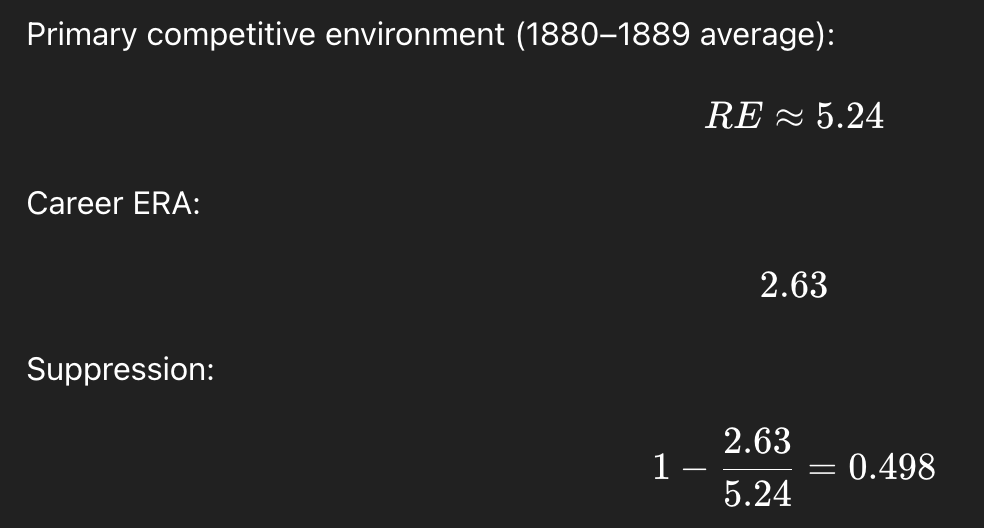
≈ 49.8% atmospheric suppression
Keefe erased roughly half of a moderately wide 1880s sky.
His greatness is not merely low ERA.
It is the structural magnitude of what he suppressed.
Kid Nichols — Across the Rupture
Nichols does something rarer.
He spans three atmospheric states — including the most violent scoring expansion of the century.
Phase A — Pre-Distance Compression (1890–1892)
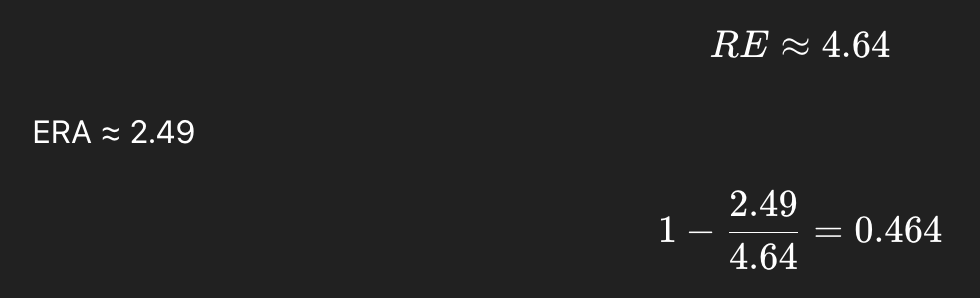
≈ 46.4% suppression
A compressed sky.
Strong atmospheric erasure.
Phase B — Distance Shock (1893–1896)
(The mound was moved back to 60’6” in 1893.)
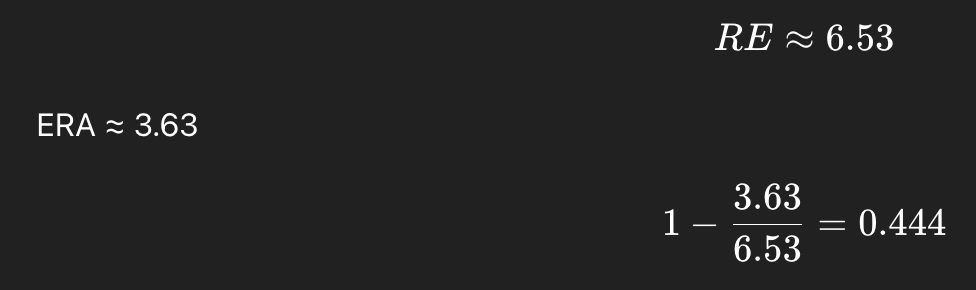
≈ 44.4% suppression
The sky explodes toward 7 RE in 1894–95 — the widest environment of the 19th century.
Nichols’ ERA rises.
But suppression remains near the mid-40% band.
The sky moved.
The arm did not collapse.
Phase C — Stabilization (1897–1899)
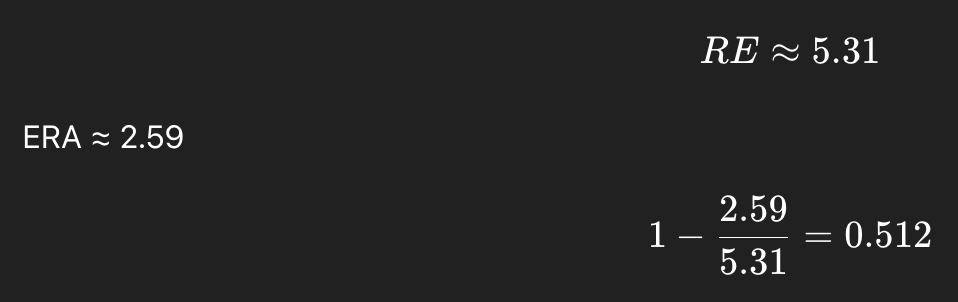
≈ 51.2% suppression
Post-shock hardening.
The ecosystem recalibrates.
Nichols erases over half the atmosphere again.
Structural Result
Keefe (1880s plateau sky): ~49–50% suppression
Nichols (across rupture and stabilization): ~44–51% depending on phase
Raw ERA alone obscures this.
Suppression relative to RE clarifies it.
What This Proves
The mid-1890s were the widest sky of the 19th century (~7 RE).
Nichols’ ERA spike was environmental, not decline.
Keefe never pitched in a sky that wide.
Once RE is declared precisely, cross-era comparison stabilizes.
The distortion disappears.
The Core Confirmation
The graph shows the sky moving.
The calculations show suppression remains coherent when measured against that sky.
The moving atmosphere is real.
Performance must be measured against it.