Disconsolate Modernity: The Diagnosis of Species Level Somatic Dysregulation Through Image Compression
Disconsolate Modernity: The Diagnosis of Species Level Somatic Dysregulation Through Image Compression
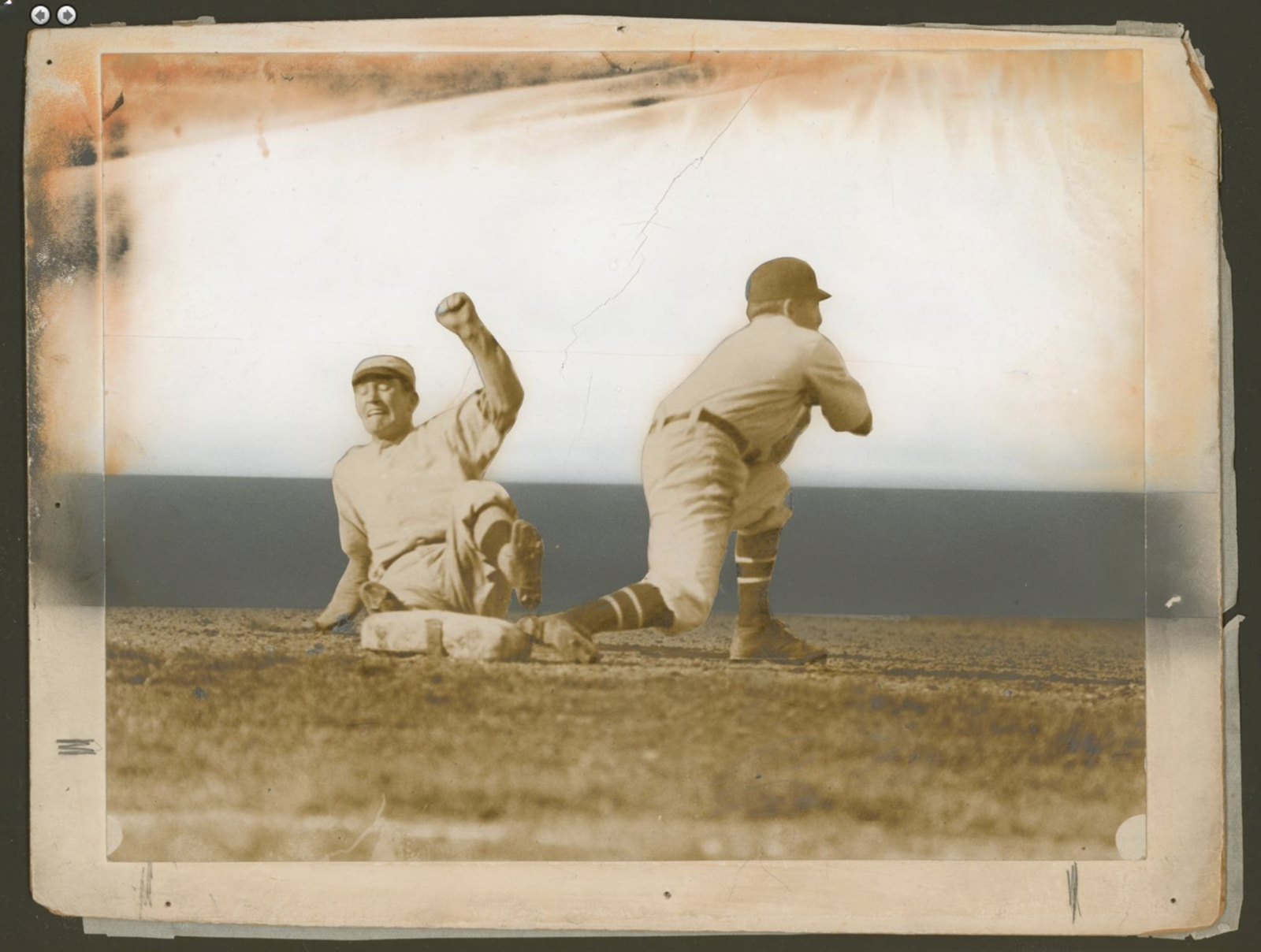
Al Bridwell sliding, 1910: Police Gazette photographic editing and paint.
The images of disconsolate modernity are a radical transformation and stripping away of the natural, ecosystemic scene of being in time. Replaced with walls, props, studio sets for cabinet photographs; airbrushed, painted, hand cut and collaged method to translate physical image for print, the historical image had begun the ultimate transition to digital, pixelated immaterial space; a space in which the image would be absolutely rent from humanity and human hands with the introduction of image generation.
The break of the image is the diagnostic control of modernity. It is the chief lens through which to view the transformation of the real, in that the image is the primary symbolic mechanism of mankind; preceding and ancestral to the typographic letter. The visual sign is based fundamentally in the hieroglyphic transformation of space — the condensation of physical reality into mimickry in sign.
Modernity’s evolution is an evolution of necessity with the birth of technology which advances image capacity and obliterates the necessity of the language sign; into a direct collapse of reality by the reproduction of reality ad verbatim. The image itself becomes an imminent mirror of ritual experience in the human body; as such, the necessity of a symbolic chain which translates experience or dimensional space into the sign is eliminated. Total compression of reality is achieved.
Therein, the photographic image becomes sign — sign which is not nor does it have to be ritualized into a typographic order of reproducible, broken symbols which must collaborate — a la the number or the letter as English functions; mathematical functions. The irreducible direct human experience can now be conveyed via dimensional compression without interpretation, simply direct transposition of light into preservable, portable two dimensional space upon the thin tether of paper in the third dimension. This canvas then becomes a preservational arrow of time, as in the book or the scroll or the painting — an arrow which condenses experience into the informational carrier externalized from the genome as in the lived, felt, expressed experience which is indelibly encoded genomically — albeit hidden from direct translation as in symbolization.
The genome is veiled; opaque; not open for interpretation. It is a direct immediacy; therein, history is a lived, felt experience of the incarnate body carrying forth ancient ancestral experience. The way back into history comprehensibly is through the sign history of mankind; the detritus, the remains; the charnel house of evidence and experience and documentation. The photograph clarifies beyond expression into environs capture; subject within environs. And just as this medium is established, by its own inventive and revolutionary literacy of compression, it is rent to conform to channels of distribution. The production of the photograph as a compression medium enables reality to become systematically erased — reality being the interface of the human hand; by and large, the hand of nature working in and through the human hand.
Press editing, as in the Police Gazette photograph above; stage setting and drapery as is common in the early studio photography of the late 1800s and early 1900s reveals the psychological and neurological function of the photographic evolution as it seated itself in the global collective consciousness and understanding. The photograph itself as transportable and transposable symbology which took from life itself — and thus constantly invented new symbolic literatures; scenes, and gestures with increasing speed of shutter and production — was able to replace editorial depiction and the literary function to directly document and record history and experience without the intercedence of the human hand and the human voice.
This de-mediation is the creation of a direct technological linkage between image and reality; death of mankind as interpretive intermediary of production and reproduction of the real as in psychological experience and interpretation and dexterity of production typical of painting, illustration, the novel, et cetera. This creative function was primary to rendering space and time realities with physical limitations of presence for depiction and circulation — advanced most formally by the creation of the Gutenberg press of mid-15th century Germany.
Mankind therein had a function to interpret reality through a lens, the lens of mankind’s experience as an essential cognitive ancillary to the project of existence proper. The early history of mankind is a prophetic Job-ism, a record of the experience of life as a scientific, psychological, and technological process of rendering the image of being. From monk to philosopher, the chief function of the highest social orders of man were to reveal the experience of being in a way that could be reproduced, understood, and circulated.
To bring this project four hundred years forward is to evoke the onset of aggressively, exponentially evolving machine technology capable of increasingly rendering and simplifying reality; furthermore, moving from capture and reduction to pure production of the image of the real — as in artificial intelligence image generation; moving image generation with increasing conviction to the human sensorium.
Mankind becomes increasingly less involved in mediating this image transformation; accordingly, in symbolic compression of the real. This is directly correlated with the loss of the religious function as a mediating device of symbolic images which function as organizing narrative devices orientating human consciousness toward natural and synthesized powers and orders of being alike.
The symbolic bridge built by mankind was being shattered by the creation of technology capable of compressing symbolization into singularization — the necessity of interpretation to evoke space time qualities to the elimination of human expression in the name of reduction: a drawing down of the human codex by ever more efficient devices, drawing out technical details which simultaneously trick, defy, and alter the human sensorium by recombining human historical inputs into transcendental orders outside of human logic chain capacities.
This 1910 Police Gazette moment is a chief functional indicator of what is and was at work in the world psyche with the introduction of progressively integrated photographic news media in just the span of one decade. Aggressive image alteration reduced backgrounds, simplified figures and characters; rendered down the fat of three dimensional light captured and distilled reality in silver gelatin physical photographic image into signifiers and signs — compressed human forms in reduced space: the basic and fundamental historical function of sign making — to make transmission and transformation of reality into portable signature possible. This Police Gazette image, much like the Carl Horner T206 studio portraits, thus became an infinitely reducible and draw-down-able template for grafting the newly created symbolic lexicon into new, reproducible media.
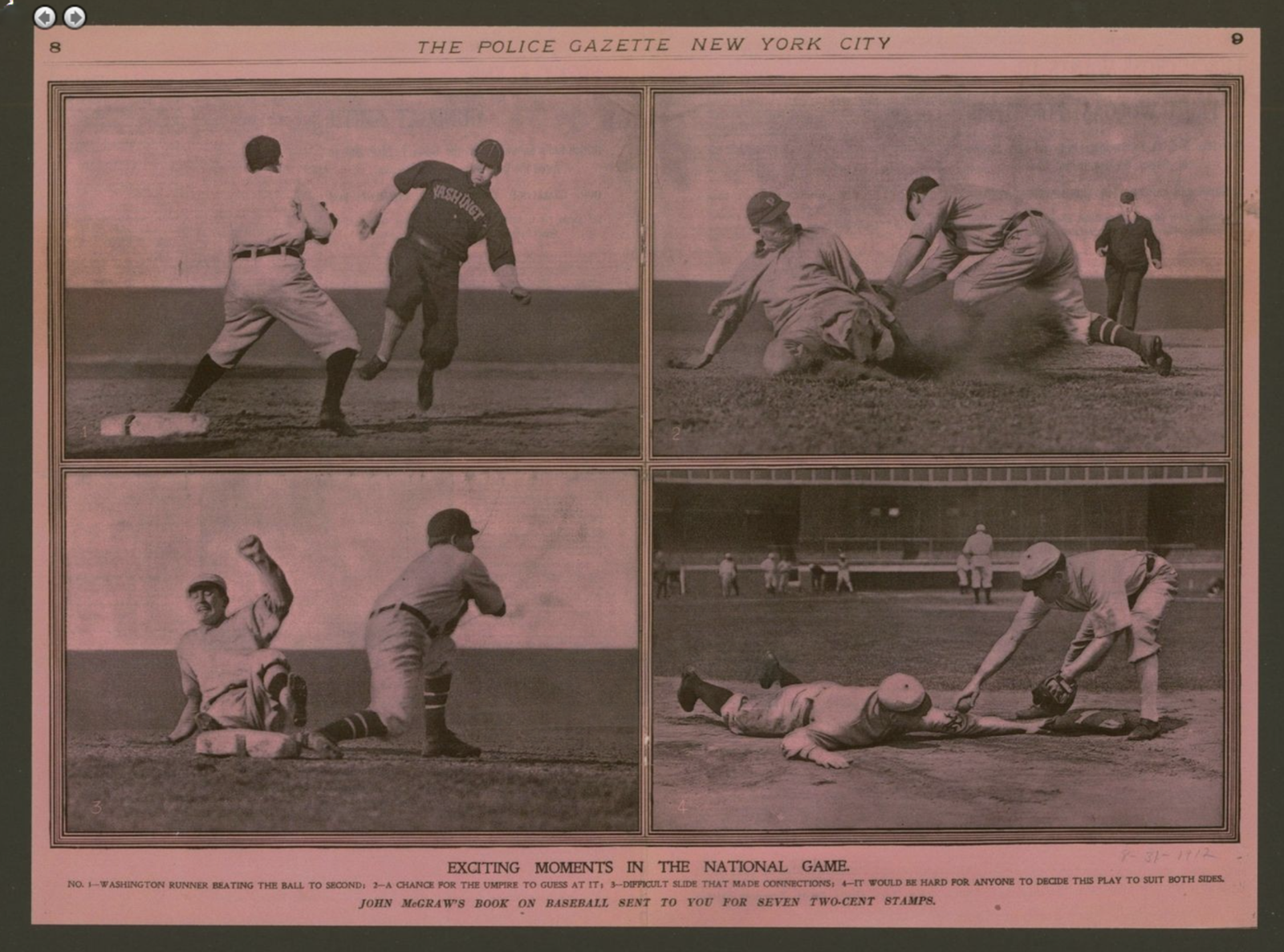
The finished product image, produced in the lower left hand panel of the Gazette.

A Carl Horner studio cabinet photograph of Detroit’s Ty Cobb.

The machine lithographically reproduced aforementioned Horner Cobb image for American Tobacco’s T206 tobacco card set of 1909-1911. The use of dot matrix, colored ink overlays directly anticipates sophisticated digital screen pixelation grids.
This drawing down of the image into industrial media compression situations such as the machine lithographic mode of capital reproduction of the T206 cards; halftone transpositions of the Bridwell photograph reveal the essence of reduction — chief quality of the Modernism movement across all fields and medium — necessary in order to create a lexicon of simplified, easy to translate and transfer photographic image technology as the new linguistic function of modernity. This chief transformation is, again, the compression of the formerly sophisticating linguistic function of the letter and the number into a de-symbolization. The photograph, industrially reproducible, therein doing a work of un-mediating over fifteen thousand years of human symbolic information as driver toward decomplexification.
The symbol was reduced and produced to collapse life into a capacity to recreate life. And therein, it necessarily complexified into such forms as Tolstoy’s War and Peace ; Hugo’s Les Miserables — world making projects capable of holding massive amounts of disparate pieces of information; diverse and multiple. This world-re-holding process of recreating, remaking, and thus rebinding the world through symbology was a global human project of myth, religion, literature, painting, philosophy, science — a total transdisciplinary search for the holy method: a method that came through the creation of the machine; a machine capable of directly capturing; infinitely reproducing; then directly creating reality beyond human powers, even the greatest Renaissance painters and literary masters.
The loss of the symbol is and was the loss of human purpose; furthermore, that which ultimately kept humanity at an abstract distance from the powers of reality proper. The creation of the function of symbolic mediation as a creative practice and human endeavor preoccupied epochs and empires of human experience; generations of human life in wild imaginal pursuits of salvation and purgation; myth cycles and poets; mystics and madmen.
That the symbolic function be collapsed by sophisticating man-made machines reveals one chief aspect: the powers of mankind acting directly upon nature and harvesting mineral and chemical foundation to create instruments capable of surpassing man; with progressively less human input. Mankind’s quest was a quest for essential symbol — a quest with dignity and purpose as in the condensation of eternity; the most noble impulses of mankind to sacralize existence through direct expression and the primary, fundamental impulse of creation which runs thermonuclearly through existence proper; thus metabolically and synaptically through man.
These instruments are not reality proximal devices, nor are they symbolic processes. They are sexually generated and generative devices: womb level ontological creations from the species mind; a form of accelerant human reproduction which bypasses the necessary genetic code of man as an evolutionary molasses; a capacity which evolves in recombinant leaps generationally and ancestrally; in rarified species level movements and developments of paradigm shifting technological iteration of components: neural, brain, body, sensorium.
The movement of the photograph, the lithograph, the printing press — these are progressive ontological iterations of symbolic compression: culminating in the advent of artificial intelligence as a compression device of mankind’s absolute history of archival creation, interpretation; demonstration — and furthermore, a recombinative device of this genetic scroll of the digital Alexandria of mankind. Rapid recombination is the sacral keyword of nature; a breaking of the timebound genetic limitation of human evolutionary history and past — a limitation which has historically safeguarded mankind from oblivion; toddling into extinction with powers mankind cannot metabolize within himself due to rapid onset. This is a muscular and neural adaptation to the introduction of time bound stress, as it is a genetic one. Stress must be titrated for millennia in order for the growth of a sustainable, intelligently evolved faculty to emerge.
However, technology, a direct consequence of the forebrain, allowed mankind to bypass this historical function by way of the use of the forebrain to discern chemical and elemental components and details within microscopic and macroscopic nature; leverage those components to become at play with light and energy in the latent codex of nature itself. This capacity removed and redistributed energy directly from the Earth: a chief technological component of fossil fuel.
Energetic recombination is the potentiality to induce and produce rapid acceleration of systems and functions, just as it is the potentiality to rapidly destabilize those systems in the process; collapse them. As is seen in the press photograph; the cabinet studio photograph, man’s psyche is wide and bare to the technological possibilities of breaking space and time and reproducing synthetic realities which rapidly decode mankind’s somatic architecture into abstracted and dissociated spaces — industrial clock time — outside of the natural rhythms which are now being gutted and harvested for energetic material at exponential levels: from agrarian log cabins of the Mayflower and Lincoln to the razing of the Amazon rainforest by corporate technological power and fuel powered force of might.
This rapid acceleration not only impacted ecological conditions of mankind — one aspect of somatic stabilization; ritualization and co-regulation of mankind with natural rhythms in predictability of locality, harvest, flora and fauna, et al — but the immediate psychological conditions of mankind as a situation of the species proper within space-time; the former designations of the hormonal, bacterial, and reproductive and metabolic functions as at work and work of mankind in space and in time with a regularity of use and dispersion.
This tearing asunder is represented subconsciously; unconsciously in the collective industrial ritual of breaking the symbolic image — both in art and literature — into abstracted space; the tearing apart of the complexified symbolic language (perhaps decadent, but critically functional) of portrait and landscape painting; the fully fruited and fruiting novel of Austen; Dickens, into the fragmented smokestack schizophrenia of Woolf, the decomposition and fragmentation of the self in both Dalloway and Picasso; the shattering of the somatic, ritual field of the human self pre-introduction of industrial time: a time which regulated itself through the process of the making and reception and digestion of man made symbolic chains of the representation of reality and experience.
The death of the chain, broken by industrial technology and autopsied and funerealized by artificial intelligence, is committed in a slow one hundred years of human assistance by way of midwifing now apt technological mediation of the factory and the photograph into the condensation of archival and linguistically and pixelatedly recombinative artificial intelligence. The slow movement of modernity functioned to create a bridge between man and machine, only fully synthesized with the final global birth of artificial intelligence from decades of pangs and private revolutions in the third decade of the 21st century.
Humanity’s function in modernity was that of a factory worker, one who — in the words of Marx in Grundrisse — made love to the machine; both birthed and seeded the machine with human evolutionary technological force of the genome; the forebear of the forebrain, in order to decreasingly withdraw human labor from the field of reality creation. The image itself therein was a brief interlocution — from painting to the collapse of the representational field of painting with photography — as the image of reality was always destined (as it was seeded thus in painting) to be replaced by the creation of the image of reality which is no longer, strictly speaking, a manifest representation of the real : but rather hyper-real to such an extent that the image of the real is replaced by a transcendental mirror of recombinate powers which break the image of the real as functional mediation.
This is a critical crisis of perception to the order of the death of mankind’s sensorium as the ordering force and faculty of objectivity; an inversion of nature and the objective as an attempted synthesis of reality as symbolized in image, letter; number — science, philosophy, art — into an infinitely broken open field of the extraction of the essential metabolic energy of nature itself proper: symbolized historically by the creation of the atom bomb — no longer officiated by the appearance of any specific form at any level of granularity or maximalization of appearance. The rapid technological revolution of mankind has made both precious metals harvestable on asteroids; chemical dissection. This breakdown at the level of the seeming representative, phenomenological field of nature is mirrored psychologically and somatically in the collective breakdown of the regulatory systems of mankind. This revolution is simultaneous; has both somatic and ideological effect.
The shattering of the symbolic mirror is a breakdown of the self experienced at the level of identity, but synthesized and actually functional at the level of the nervous system; the incompatibility of the human genome with the artifically synthesized environs mankind has created around it. Mankind is the only principle that has not evolved in its cascading breakthrough and breaking forth of the atomic and energetic capacities of nature; as such, it has been thrust into an absolute futurity which it cannot reach or achieve. It is the equivalent of thrusting a small dinosaur into a robotic empire which functions using a language which is outside of the former small mouth noise hosted in a hostile atmosphere — where biological functions are increasingly unsustainable and precarious due to technological runoff; the sheer fact of ecosystemic incompatibility with the former biology.
This crisis is scriptural; has absolute foundation in the neurology and the endocrine; therein, mankind is actually, functionally outmoded by the increasing emergence of these devices it has rapidly midwifed over the course of just one century. In the span of just five generations, man has gone from holding cameras to capture images, to capture moving images; to having the reality in which these images were captured as breakthrough mirrors of experiential human life in space and time with increasingly instantaneous production — eliminated by total recombination at force of sense perception; the fabric of natural light and energy.
There is no somatic possibility to regain this foothold — rather, the artificially created environment must be stripped back, or else mankind radically evolved forward to be in accord with a hostile, metallic dimension which no longer holds human code nor codex requisite therein. The robust sophistication of technological function with artificial intelligence rapidly approaches domain where human input is no longer needed to generate output; accordingly, it is the evolution of the Ford factory or the sausage factory to transcendental means — no longer machine toward human measure, but machine toward machine measure; ungirded by human nature, function, or ecology. Even the creation of industry toward human ecology proved to be a robust improvement of human life in regards to energetic convenience; energetic production and consumption, but an utter failure when it came to human somatic regulation; the necessary field of presence and regularity; synthesis of the human genome with its environs necessary for flourishing at the level of human biology.
This tradeoff was the tradeoff of industrialization; with it, mankind reaped the destabilization not only of its environment with maximalizing energetic harvesting of the ecosystem, but the destabilization of its central self — inducing myriad social effects, including increase of violence, poverty, asociality, exploitation; other such latent psychological factors resurgent across history in deregulated states and atmospheres. Man is historically torn between the sabertoothed tiger, the Crusades; artificial intelligence: planes and terrains in which what hangs in the balance is the medium between imminent physical danger and protracted somatic dysregulation. This template, naturally, is encoded in the human genome and directly experienced as a perennial contradiction in mankind’s seeking to resolve the fundamental question of flourishing and wellbeing in any given century of recorded history; pre-history besides.
Technology, therein, is an infrastructure; a grid that can be created and destroyed depending on how and whether it truly enriches the human constituent and population. Analysis and inquiry into its effects, as retroactive data reconstruction and interrogation; historically current reformist measures in the period of early modern industrialization of the 20th century — are critical; choices must be possible and not considered snowballing impossibilities to alter courses of technological movement and distribution as enrichment devices of geopolitical capital and power.
The early effects of the generation of machine which shapeshifted with immense historical compression to consolidate symbol and mankind are immediately visible in the symbolic violence of compression of subjectivity, experience, and self into void and signifier in the early industrial photographic and image translation profession as a global phenomenon of the ushering in of the photographic age of language; literary communication of life. Increasingly stripped of man’s interlocution, the historical function of the symbol was called into radical question. However, the symbol was never meant to depict the direct image of reality. It was meant to regulate mankind’s encounter with the real.
This is why, fundamentally, symbolic de-compression and elimination of human mediation of the vision and creation of the real is dysfunctional and catastrophically destructive. The purpose was never consolidation of the real; the abstracted, technological and scientific drive to evolve sophisticated solutions and deconstructions of the real into terra-bytes of information; fragmentations of even atomization — but rather, it was to undergird human thriving as a communal, ritual practice of co-regulation of the collective nervous system. The symbol, perennially misinterpreted, was never oriented toward the real but as an ambition — ambitions which were sacralized by status oriented societies: the real as an image of knowledge-power; consequently, pursuit of the real as pursuit of power.
The function of symbolic regulation actually, neurologically, tends toward experience; the elucidation of human experience in stages of breakdown, awakening; suffering as a form of primary communication which does not and cannot rely at all whatsoever on technical and technological revolution at all whatsoever. Somatic communication and internal coherence of self are experiential processes which hold no relationship to machines, devices, or modes of production — but are rather states of being which are presences of integral architecture, not proximities mediated by symbols. The symbols themselves may be outputs — but the state of coherence as in state of being is fundamental to flourishing. There is no technological epoch or abstract symbolization that can replace the function of the presence of coherence and space and time as it relates to the oldest, most primordial and ancestral function of existence itself: isness. The presence of that which is; again, unmediated. The only possible function of importance in existence, as mediated by human experience; genetic unfolding of nervous systems themselves — is embodied, somatic regulation.