Experiencing the Self Architectonically: The Evolutionary Architecture of Subjectivity (Lecture -- 11/9/26)
Video
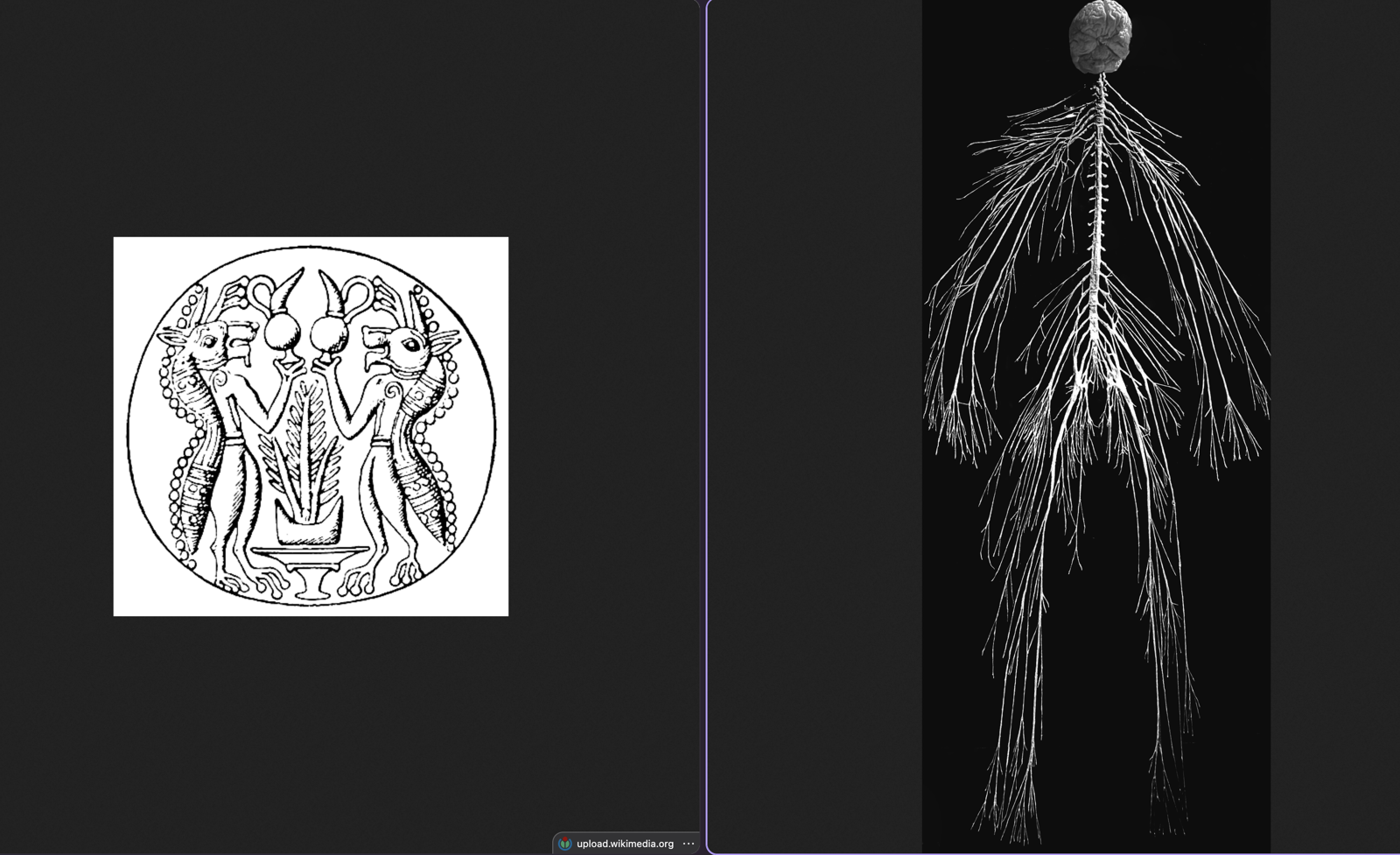
All right, so I want to talk about experiencing the self architectonically.
We are not creating the self; we’re discovering the self. We are in the process of self-creation in a cosmological sense.
So what I’m talking about is that these great literary works gesture toward a lineage of subjectivity. In a moment, we’ll go from Augustine to Montaigne, to Rousseau, Goethe, Byron, Shelley, Lermontov, and we’ll get into Dostoevsky, Turgenev, Goncharov, Chekhov, the superfluous man tradition, into Baudelaire, Rimbaud, Proust, Joyce, Woolf, Kafka, Sartre, Camus, Beckett, and Lispector.
This is a lineage I’ve long been propagating and expounding upon, specifically in the existentialist tradition itself. Because when we’re talking about existentialism, the question is what it is to be. And what it is to be is ultimately a question of the experiencing subject, the one who is experiencing life itself.
And so what we’re touching on now is that the self is being discovered in the process of living.
There’s the saying, right? “It’s my first time being alive,” and that’s, I think, a pretty common sentiment among most people.
And so we have these experiences. We could talk about developmental psychology and children. We could talk about the process of the maturation of the body, from childhood to adolescence to adulthood. We can talk about the hormones. We can talk about the synaptic architecture of the brain.
The vast majority of the human experience is shared, with the exception of general intelligence.
So the figures I just remarked upon are, at a consensus level, perceived to be some of the most monumental figures of the Western philosophical and literary tradition approaching and throughout modernity. Obviously, some are older, as in Augustine.
So what the exploration here is, is that the encounter with subjectivity, or the encounter with the subject, is very much like the encounter in a Hellenic and ancient Greek sense, as in Plato and Socrates, the encounter with the daimon.
And the daimon, historically, was considered to be the god or the divine power at work. You see this throughout Homer, throughout Plato. The beings who bridge the gap between heaven and earth, carrying human prayers up to the gods and divine messages back down. Socrates famously spoke of such an internal divine sign or voice that warned him against making mistakes.
We already talked about the voice of the gods in Homer and the emergence of consciousness, which would be the interiority of the self.
What we’re talking about is the informational-technological revolution of being itself.
We’re talking, on the grand cosmological scale, about the birth of the universe, stellar and intergalactic systems, et cetera, and the consequences therein in the birth of mankind as a species or a force within that natural continuum, and in the jungle of Earth, with its various different metabolic continua and organisms which are competing or working for energy, which is to say, to persist against constraint, as in energetic systems and subsystems, such as cells, plants, animals, et cetera, all working with the thermonuclear energy of stars, namely, in the solar system, the sun. And of course, intergalactically, there are other stars and star systems which have an effect upon the Earth and our local galaxy and solar system.
So what I’m talking about with the daimon is that this evolves into the demon in a Christian theological sense, an evil identity or the satanic identity, so to speak.
No interest in that. We’ve already discussed this in my other lectures, the theological components of this and how it contributes to a severance of the self in modernity. But no need. That’s not where we’re going here.
The daimon is the figure which we meet and wrestle with in being, so to speak, and Nietzsche experiences this, I think, to an extreme height of sensitivity and suffering and awareness.
So the figures that I have brought up here in this lineage—their primordial subject is selfhood or subjectivity.
When Goethe is conducting the experiment of Faust, or Shelley is writing Mont Blanc or Prometheus Unbound, or the Byronic hero or Byronic subject, in terms of, you could say, critical rebellion, which leads into Lermontov’s A Hero of Our Time and the psychological study of Pechorin, which, of course, anticipates the entire Russian superfluous man tradition—Turgenev, Goncharov, Dostoevsky, and Chekhov, and the figures therein—these are philosophical and psychological studies of the being itself.
Studies of selfhood.
And we have to understand, because I think this is very easily skimmed over, and this is where Carl Jung’s work becomes critical, especially The Red Book, that the self is not a given.
The self is an experiential interiority, in large part a byproduct of cosmological, evolutionary, and technological processes.
The self is an emergent phenomenon, which we experience through being itself, through the incarnation.
So within the incarnation, we have a series of architectonic systems which are working in collaboration: the digestive system, nervous system, the brain and its various different component architectures, the circulatory system.
This is a technological apparatus for persistence against constraint in the regulational mode.
We’ve already discussed regulation and configuration—let’s say, star, man, and stone.
It must regulate, create homeostasis. It must regulate energy, must regulate its nervous system in order to persist in space and time as an entity or a form, without dissolution or disassembly.
So what these literary figures that we’ve discussed here, everyone from Joyce to Augustine, are doing is inquiring into the dimensions of this most interior experience, which is the human being architecture, which we could simply call the existential experience of being human.
And so this is really to revolutionize our understanding of literature, philosophy, and psychology, for that matter, especially when all three combine, as they do in figures such as Dostoevsky or Kierkegaard.
This inquiry, or commute, for that matter, is really an inquiry into the unknown, as we do not really know the technological status of true interiority, which is to say, the experience of being human.
The architectural similarities and differences which occur across time, and specifically in high-intelligence-quotient or high-general-intelligence individuals, perceptual states which are non-normative, as we discussed with Percy Shelley and metacognition: a near-permanent state of metacognition, in which these figures themselves are, in fact, inhabiting an entirely different terrain of experience and existence itself.
They’re not living within the survive-and-reproduce architecture, which is to say, the predominantly hindbrain-dictated world, which constitutes the vast majority of the human experience.
Metacognition is available to all via forebrain technology, of course, but not every nervous system and not every synaptic system of the human organism is wired toward the same proclivity and capacity, which is why we’re talking about brain measurements of cognitive performance.
Sustained metacognition, this high functioning of abstraction and critical thought, et cetera, as well as trained and scholastically improved or practiced sustained metacognition, as in Shelley’s studies of Plato and at Eton, and in his tutelage and his private study, et cetera, further this capacity, this genetic proclivity, which is an inbound and innate nervous system architecture.
So we’re talking about access to a realm or a dimension of experience which makes possible dialectical redoubling, as Kierkegaard says, or makes possible the Jobian condition of turning about-face to God or nature and inquiring into the mechanism at hand: how, who, what, where, and why.
These essential questions primarily dictate the human religious experience and the human religious inquiry, just the same as they play a fundamental role in metacognition itself proper.
So whether we’re talking about Heraclitus or Shelley or Goethe, they are asking the same question.
And at this level of human cognitive performance and perception, which is to say sustained metacognition, the questions themselves are the same, but the way in which those questions are experienced and articulated is different.
And this is where we come into high-performance cognition and the diversity in that field or that territory, that terrain, that plane of existence, which has to do in large part with the specificities and intricacies of not only the architecture of that specific being, but furthermore, the larger cultural, civilizational, social milieu, historical, political, cultural, and familial circumstances which give rise to that being’s inquiry into itself.
Which is why in A Season in Hell, we have such a sustained speech on the French and the Gauls and Rimbaud’s heritage, just as in Shelley, the questions that are asked are in relation to, let’s say, the British Empire.
The social, political, and historical conditions of the subject are bound up within the linguistic models which these individuals are using, which then are, let’s say, symptomatic or representative of the condition of the neural architecture of the cognating being at hand.
So when we’re looking at Shelley, we’re looking at the British Empire, we’re looking at Eton. We’re looking at his entire biology, as well as his reading list and his library, interlocuting with his specific neural architecture in relation to the language that he is producing.
So this is a symbolic order which is reflective of the condition which is hidden or obscured, but intimately experienced, as in Shelley’s interiority itself.
So exploring inwardness itself is a problem of space and time and available energy, and the system’s capacity to access that plane of information.
Which is to say, it’s a non-phenomenological, reflectory or refractory domain in which the mind is gazing back in upon itself to ascertain the character of its perception, and then, furthermore, the origination of the character of its perception, architecturally, historically, cosmologically, et cetera.
So this, in short, really is self-reflection, and this is the terrain that we’re speaking of when we’re speaking of metacognition in the forebrain in terms of logic, rationality, critical thought, et cetera.
So we’ve already discussed my thesis here, that these individuals are a rather prescient form of paradigm-specific evolution occurring within the forebrain epoch.
Which is to say, individuals who are so sufficiently developed and ingrained into forebrain cognition, both by birth, genomically, and by trade or by practice, that the hindbrain processes recede into the background in relation to their experience, and metaphysical and metacognitive questions, inquiries, experiments, and experiences become the foreground of life.
And this is what we would call maybe the intellectual, philosophical, or ontological life, which produces our Rimbauds, our Dostoevskys, our Becketts, et cetera, our Lermontovs and our Goethes, da Vincis, et cetera.
So this process here, when we get to the art of literature and symbolic translation of this internal state of being, the compulsory aspect of it is fascinating, because what you really have is a technology which is articulating itself to itself in order to understand the position in and at which it is situated.
And the vast majority of the figures we’ve just mentioned here occupied exceptional societal statuses, whether that’s the outlaw or the exile, as in Shelley, or the high-level bureaucratic official and, let’s say, intellectual champion of his age, as in Goethe.
These positions, of course, are in large part due to the architecture of these beings themselves. Lermontov is also a fantastic example.
And accordingly, that displacement of the neural architecture of these individuals creates a secondary pressure.
There’s already the pressure of the experience of this mind being predominantly the most interesting thing at hand, and this is Lermontov in relationship to Pechorin, both biographically and literarily.
But also, furthermore, the alienation from the historical and social world, which may be the Russian aristocracy, military service, social hierarchies, imperial expansion into the Caucasus, et cetera.
So this high level of self-consciousness and self-awareness, which is to say really a high level of metacognition, the capacity to think about thinking, and then furthermore, the inhabitation of this state of being as really itself the grounds of perception.
Again, not experiencing perception from the level of, let’s say, the dying organism, but instead from an intuition of metaphysical totality.
We have the emergence of the superfluous man tradition, I’d say most prominently in Goncharov, with Oblomov, as well as Notes from Underground.
The experience of this displacement becoming a further pressure into the examination of interiority and self-consciousness, to various effect.
So what I’m describing here is something that I would say fundamentally is an impersonal process, and I kind of want to cut this off here just to finish lunch.
It is a fundamentally impersonal process which is producing the greatest works of art and literature in Western civilizational history.
The development of the individual out from, let’s say, the religious and regional and local covering of collective thought and experience of premodernity, thrust into the modern, where we have Proust or Joyce or Woolf, Rimbaud and Baudelaire, and Shelley, really one of the first moderns.
We have the emergence of the full expression of the individual consciousness that is inhabiting this metacognitive architectural state of being, which is really using language as a bridge to reveal its structural mechanism, which is to say, its way of seeing.
And these themselves become scientific documents of this evolutionary process in terms of humanity’s relation to its newest and most substantial epochal technology, which is the forebrain.
And that’s really our great intersection here between science and art in this fashion.
So it is not necessarily what, again, it’s not necessarily what these figures are saying, but rather what they’re saying reveals about their architectural circumstances, in the sense of the human species itself as a specimen in the process of this technological unfolding, where sufficient neurological capacity makes available this terrain of experience and cognition which turns the mind about and within upon itself, and away from this outward-looking into the world to survive and, let’s say, primordially accumulate to reproduce, et cetera.
This turning back within is almost, in a way, a turning away from traditionally historical mankind.
And in these situations, where we are in this new solution space of metacognition, the self is in relationship to the self and attempting to uncover the nature therein of being itself.
So this is the at-large ontological project of humanity as a byproduct of forebrain evolution.
And then we have these exceptional neurosynaptic architectures which have the capacity to access this plane of experience, which is understood even, again, in the Hellenic sense, as the realm of having access to the evolutionary history of mankind, the daimon of energy or the daimon of passions, which tosses and throws the history of mankind into brief periods of chaos and order, where this state is tamed by law or else let loose into its passions.
And again, this is a big part of what is depicted in The Picture of Dorian Gray at the turn of the century, the edge of the twentieth century.
So this is a critical interrogation of what is within, in an architectural and technological sense.
And so what we’re having here is an excavation which is not adverse to scientific materialism, but rather is a critical component of the scientific procedure of excavating consciousness or awareness or cognition.
Because what is happening is, this is not something that can be quantified or dug, in terms of an organ, out of the body. You might be able to examine the brain, and even examine the brain in action.
But the experience of the subjective realm is the critical factor in understanding this evolutionary paradigm, because it is the being coming into awareness of itself, beyond, beneath, and behind the cultural, the personal, the familial, these guises within which there’s a larger creational energy at work in a cosmological sense.
And the human being steps into this terrain upon birth and encounters this wellspring or this well of dark information, and the metacognitive eye turns back upon that, let’s say, that demonic figure or the depths of the technological experience of being human, and inquires into the state of the subject or the state of the self.
This is an incredibly valuable scientific and cosmological process.
And I’ll leave that there. Thanks.