Field-Relative Performance Modeling: Baseball as Run-Climate Climatology
Field-Relative Performance Modeling: Baseball as Run-Climate Climatology
Field-Relative Performance Modeling
Baseball as Run-Climate Climatology
Abstract
This paper formalizes a general modeling mechanism for evaluating agents operating within variable environmental intensity. Rather than measuring raw output or deviation from peer averages, performance is defined as proportional impact relative to environmental field intensity.
Baseball provides a clean applied example: the scoring climate (runs per game) constitutes the environmental field, while pitchers and hitters function as mitigation and production agents within that field. The model, however, generalizes to any closed competitive or ecological system.
I. Structural Premise
In any closed system:
There exists a measurable environmental baseline (field intensity).
Agents operate within that field.
Output derives meaning only relative to that field.
Raw output alone is structurally incomplete. Meaning arises through proportional normalization.
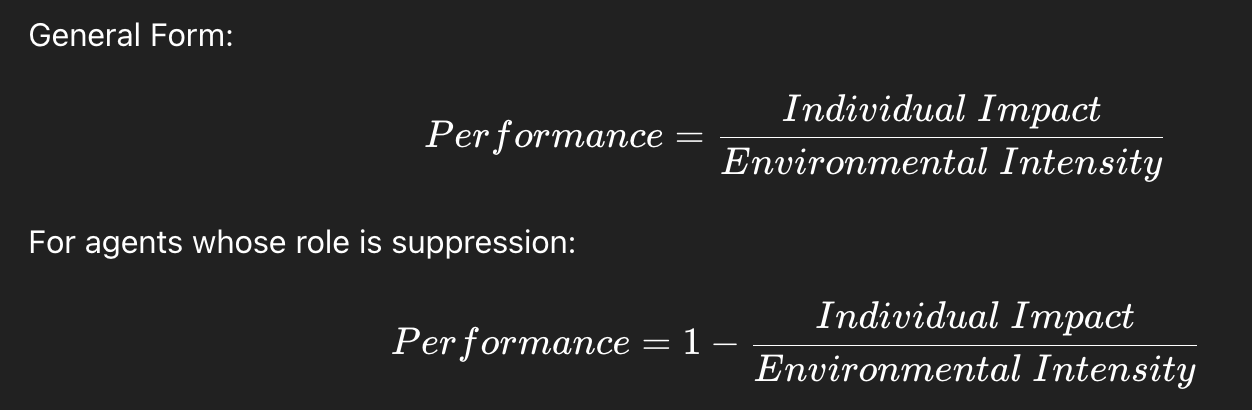
This defines field-relative performance.
II. The Environmental Field
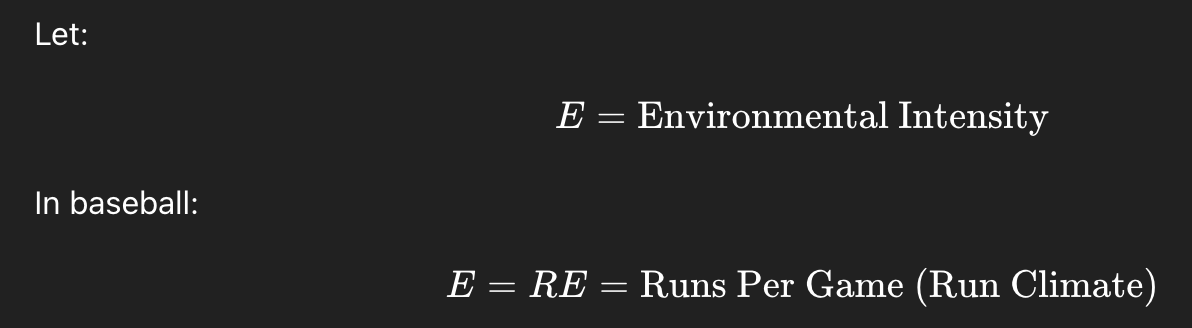
Run climate is not narrative. It is structural background pressure.
It captures:
Scoring density
Offensive baseline
Systemic volatility
Difficulty is endogenous to the climate.
III. Agent Roles in a Closed System
Two primary agent classes exist:
Production Agents — increase system output.
Mitigation Agents — decrease system output.
Both are evaluated relative to the same environmental baseline.
IV. Baseball Application
A. Production (Hitters)

Where:
(RC/G) = Runs Created per game
(RE) = Run Climate
Interpretation:
Share of environmental scoring generated.
B. Mitigation (Pitchers)

Where:
- (RA9) = Runs Allowed per 9 innings
Interpretation:
Share of environmental scoring suppressed.
V. Structural Properties
1. Scale Invariance
Normalization eliminates raw scale distortion.
Three runs in a low-density environment is structurally different from three runs in a high-density environment.
Field-relative ratios preserve comparability across regimes.
2. Closed-System Consistency
The model assumes:
Finite environmental intensity
Finite output space
Agent influence occurs within a bounded system
Comparisons across regimes remain coherent because normalization is internal to each climate.
3. Climate as Difficulty
Difficulty is not added externally.
If environmental intensity rises:
Mitigation becomes harder (higher denominator).
Production becomes harder to dominate (larger field share required).
Climate itself encodes structural difficulty.
4. Asymmetry of Roles
Mitigation agents often influence the entire environmental field during participation.
Production agents typically occupy fractional participation within the field.
Magnitude asymmetry is structural, not evaluative bias.
VI. Generalization Beyond Baseball
The mechanism applies wherever:
Environmental intensity is measurable.
Agent impact modifies system output.
The system is bounded.
Examples:
Ecological predator efficiency relative to prey density
Market share relative to total market volume
Energy conversion efficiency relative to thermal load
Network throughput relative to bandwidth saturation
The generalized model:

VII. Conclusion
Field-relative modeling reframes performance as proportional deformation of environmental intensity.
In baseball, this becomes a climatology of runs:
Hitters produce within the climate.
Pitchers mitigate within the climate.
The model is intentionally minimal:
No percentile ranking
No peer-relative deviation
No narrative weighting
It measures only:
How much of the field did the agent control?
This mechanism is not specific to baseball. Baseball merely provides a clean instantiation of a more general structural principle: performance acquires meaning only relative to the intensity of the environment in which it occurs.