Genius on the Run-Environment Waveform: How Greatness Forms at Peaks, Troughs, and Inflection Points
Genius on the Run-Environment Waveform: How Greatness Forms at Peaks, Troughs, and Inflection Points
Genius on the Run-Environment Waveform
How Greatness Forms at Peaks, Troughs, and Inflection Points
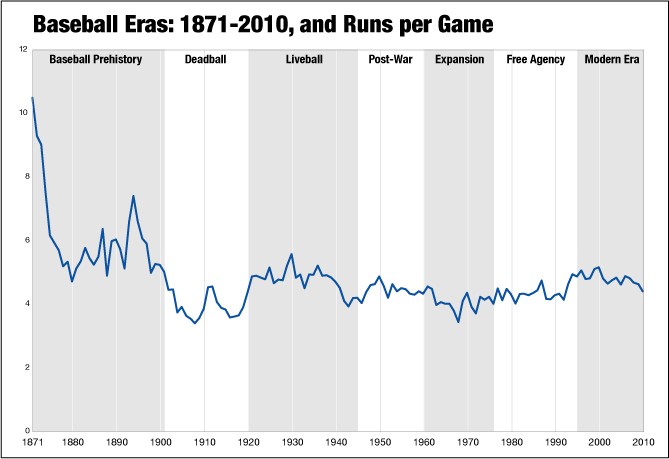
The graph is the skeleton key.
It is a waveform of baseball’s run environment :

That curve is not “context.”
It is the sport’s moving atmospheric geometry.
Once you accept the curve as the field, genius stops being a vague label and becomes a response type to a physical condition.
Greatness forms in three places on the waveform:
Peaks and troughs (extremes)
Plateaus (stable regimes)
Inflection points (ruptures)
I. Extremum Genius
Peaks and Troughs
Extremum genius appears where the curve hits its boundary values — the rare moments when the atmosphere becomes abnormally wide or abnormally tight.
Peak (maximum expansion): the 1894–95 surge (the tallest crest).
Here, suppression is proportionally hardest because the sky is largest.
- Amos Rusie (1894)
A pitcher who erased an enormous fraction of the widest sky.
Trough (maximum compression): the Deadball floor around 1908 (the deepest valley).
Here, production is proportionally hardest because the sky is smallest.
- Honus Wagner (1908)
A hitter who claimed an enormous fraction of the tightest sky.
Extremum genius is dominance at the boundary of the system.
II. Stable-Field Genius
Plateaus
Stable-field genius forms on the long flat stretches of the curve — regimes where the sky is relatively steady for years and the challenge is not adapting to movement but dominating inside fixed density.
High plateau (sustained expansion): the live-ball run plateau of the 1920s–early 30s.
Here, the sky is consistently wide; sustained suppression becomes the test.
- Lefty Grove
Elite suppression sustained across the wide-sky regime.
Low plateau (sustained compression): the Deadball era’s long compressed stretch.
Here, the sky is consistently tight; sustained production becomes the test.
Ty Cobb
Shoeless Joe Jackson
Stable-field genius is dominance inside a regime’s settled atmospheric density.
III. Transitional Genius
Inflection Points
Transitional genius forms at the steep slopes — the parts of the waveform where the atmosphere is changing rapidly and the system is reconstituting itself.
These are the true rupture zones.
Upward inflection (expansion shock): the 1893–95 lift into the super-sky.
To remain elite, a pitcher must suppress across:
pre-shock compression
shock expansion
post-shock recalibration
Kid Nichols
The pitcher who stays structurally elite through the biggest 19th-century expansion swing.
Downward inflection (compression collapse): the fall from the late-1890s into full Deadball suppression.
To remain elite, a hitter must produce as the sky tightens toward the floor.
Honus Wagner
The hitter who remains dominant while the atmosphere collapses.
Transitional genius is dominance that survives atmospheric change itself.
The Whole Map in One Line
Peaks/Troughs → Extremum Genius (Rusie 1894, Wagner 1908)
Plateaus → Stable-Field Genius (Grove in live-ball expansion; Cobb/Jackson in Deadball compression)
Inflections → Transitional Genius (Nichols through the 1893–95 spike; Wagner through the 1890s→Deadball drop)
One Final Clarifier
These are not tiers of greatness.
They are different stress tests produced by different regions of the same waveform.
A player can appear in more than one category.
That isn’t a flaw.
It is the signal.