Hall of Mirrors: The Fin de Siecle Studio Baseball Photograph
Hall of Mirrors: The Fin de Siecle Studio Baseball Photograph
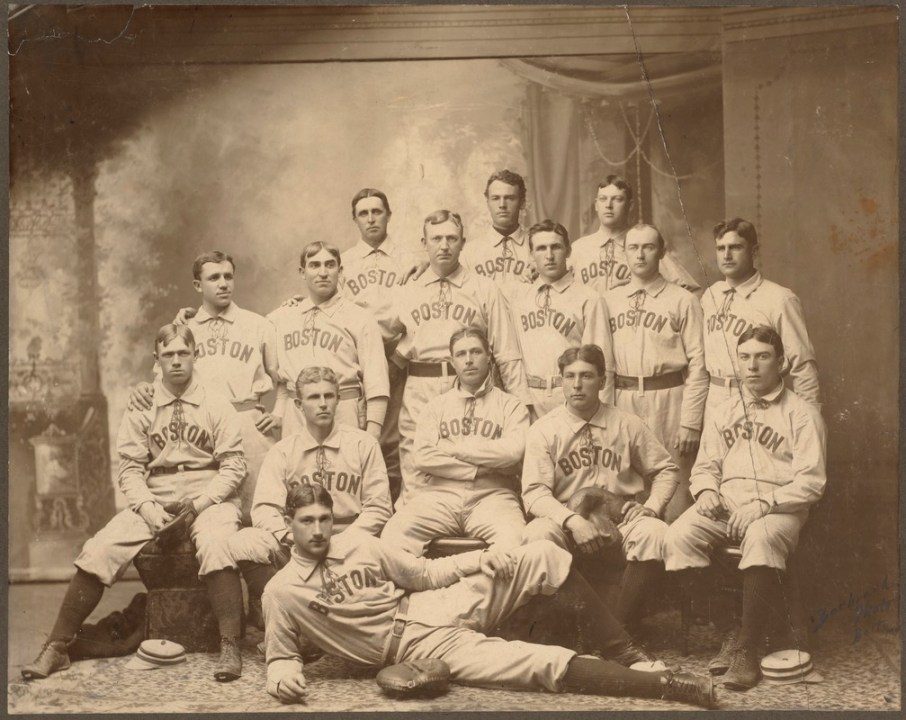
The players stand huddled in a hall of cracked mirrors; a boudoir of curtains; simulated Gothic and Victorian architecture — splayed out upon rugs and velvet seats.
This era of baseball photography is subliminal; it directly references the upside down world in the moment of change of modernity. It is a cracked image, a cracked glass of subjectivity — through which seeps the strangeness which is the human being in the imminent state of being changed by the throes of paradigmatic history as a phase change of the human psyche; the human soul.
Much like today’s era of artificial intelligence, the industrial consciousness of fin de siecle modernity was being terraformed by the massive emergent weight of factory and industrial reproduction. Gone were the agrarian townships; replaced by smokestacks; outside the cities, the mines which supplied them with fuel. Particular to this world is the epicenter of the American Northeast — Boston and New York in particular as industrial epicenters of burgeoning American machine capitalism.
Therein, were corridors of the same high strangeness one could and would find in the alleys of early modern Paris — expounded upon by Benjamin and Baudelaire alike. America would not find such a early modern voice of the breakdown of civic and existential consciousness in the face of clock time — but it did find baseball as the garments and dress of the ritual which would hold the collective consciousness and spirit together through the emergence of industrial modernity — like a snake molting its skin.
This is how America metabolized modernity — just as France metabolized it with opiates and Rimbaud. Photographers like Elmer Chickering draped the Boston American and National teams (referred to by historians like Bill James to be some of the greatest of all time, nonetheless their era) with studio scenery that recalled platonic history; outfit the photographic environs with what could only be described as a heavy air of a dead aeon — a time which had passed; yet the only time in which modernity could truly situate itself. It could not look back to anything but the gothic stolidity of a world which sought power but was dictated by the absence of the lightbulb; smoldered and festered in horse and carriage cobblestone pathways; masked its primordial violence with the stiff garb of antiquity and highfalutin language — most clearly captured in the great low art of William Shakespeare.
Early modern America is Dickens’ London with a mechanical eye, a camera, chimera furnace of rapidly coal and gas heating whirlwind movement — yet powered and impelled by the same awkward, a-technological illiteracy of humanity’s still early youth of the bumbling ape; the stumbling animal toward some sort of enlightenment — or death. Inefficient, plagued by bureaucracy and laziness; yet utterly self consumed, American and European individualism and egotism played itself out in everything from the squabbles of the industrial tycoon, to the gossiping court of the same anti-intellectual, simultaneously spiritually provincial and class posturing lifestyles depicted in the literary works of Charlotte Bronte to Virginia Woolf; Charles Dickens to Victor Hugo.
This is, in short, a tragedy of the common covered by gaslight converted to lightbulb; pastoral mansion of Victorian bureaucratic royalty; the gossip of Percy Shelley’s London to the emergent factory wealth of baseball’s owners like Charles Ebbets; profit towns surrounding early American industrial cities like Pittsburgh owned by figures such as Andrew Carnegie. It is a game, a sport, of the failing crown of the same spiritual crisis bemoaned in the far east by writers such as Tolstoy and Dostoevsky — a universal crisis of consciousness veiled only by the creeping advancement of technologies which made ‘distraction by distraction by distraction’ (in the words of the early modern American poet T.S. Eliot), all but easier to construct.
The ennui of the early 20th century and late 19th parlor photograph is the ennui of a collapse of two convergent models: a model which proposes technology as a solution; a model in which agrarian boredom, hardship, and struggle was the world norm. Humanity — stretched between two poles — the sectarian ‘wisdom’ of closed cultural belief systems and social functions; a wide, stretched out supra-urban metropolis of atomized, alienated political subjects — laboring only to keep the engine of civilization alive toward the march of oblivion. Neither solution — as is clear in the eyes of those present — seemed viable.