Hemingway's Baseball: America's True Idiom Beneath the Transpersonal Letter & Song of Our Civilization's History
Hemingway's Baseball: America's True Idiom Beneath the Transpersonal Letter & Song of Our Civilization's History
A Young Hemingway; His Fascination With Baseball
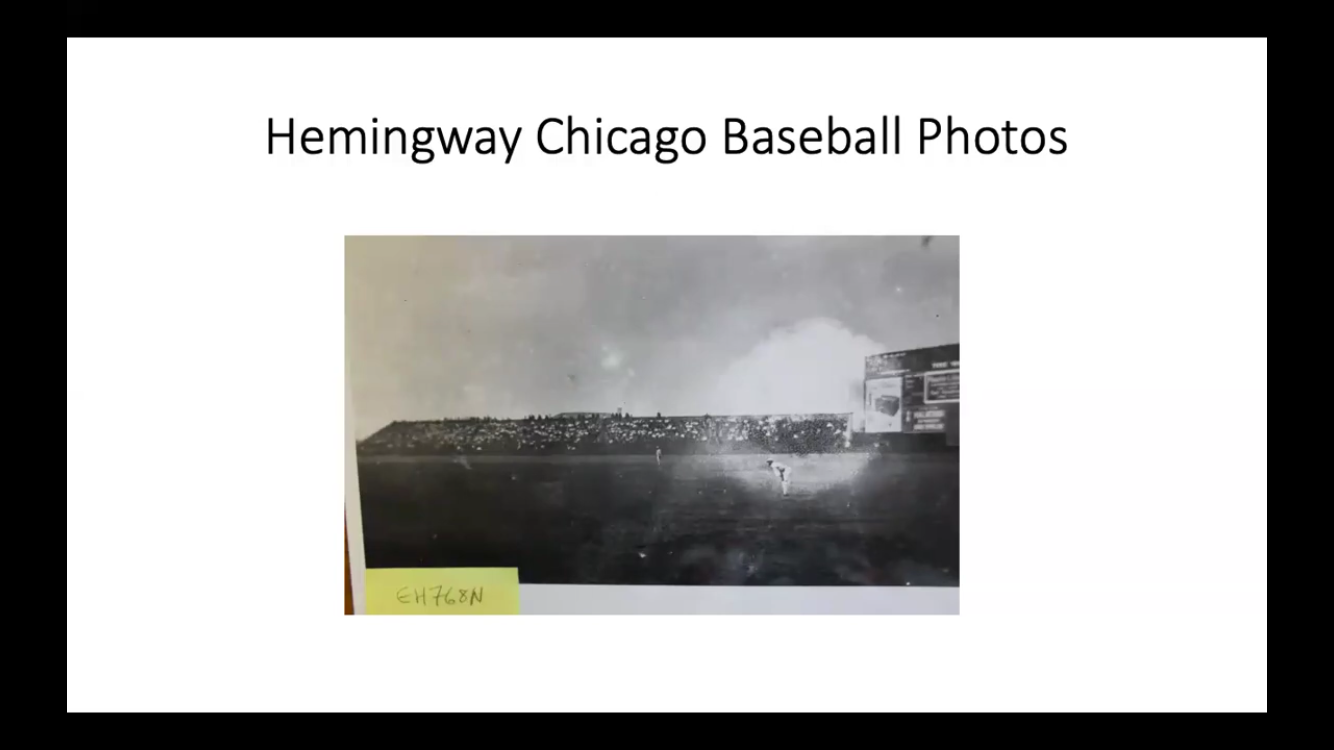
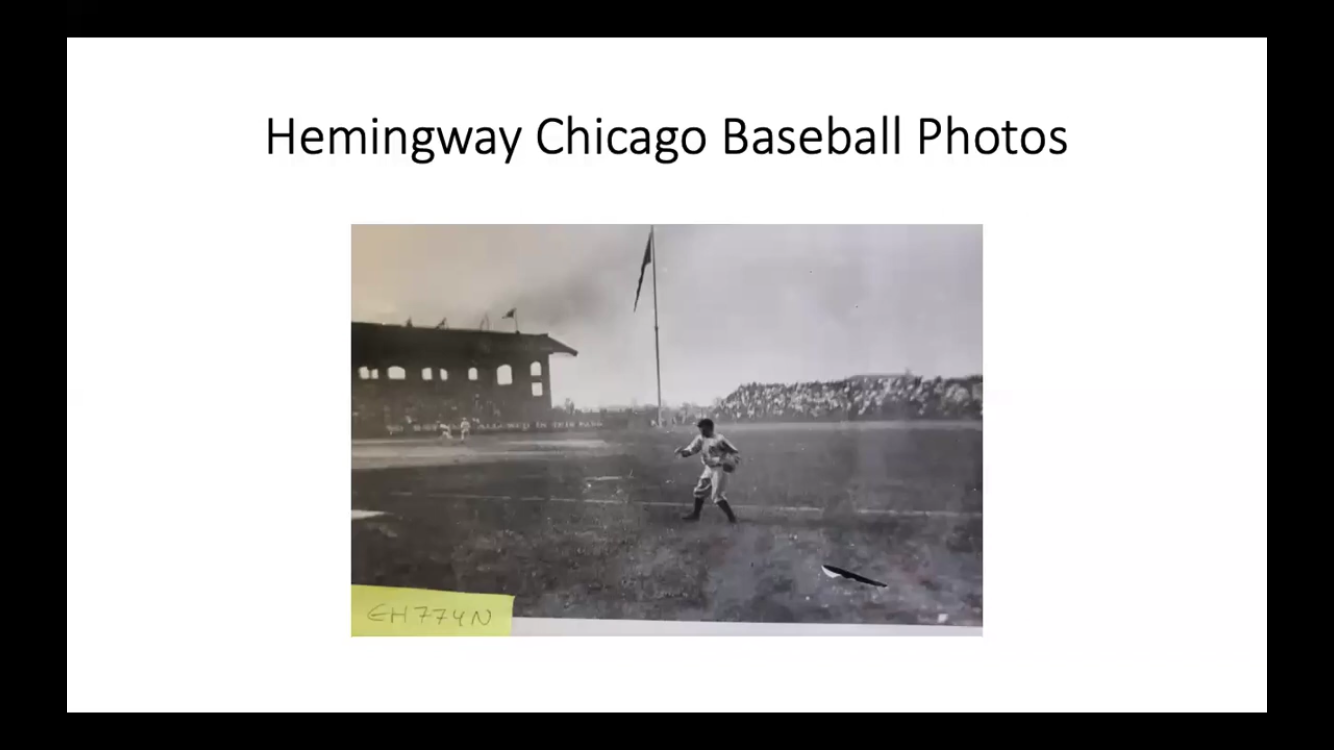
Depicted here are two photos taken by a young Hemingway and his father at a 1912-1915 Chicago White Sox game. Current, most extensive historical and archival documentation dates these photos to 1912; most likely in a game involving the Chicago White Sox vs. the Detroit Tigers at Comiskey Park — courtesy of Dr. Sharon Hamilton and the Hemingway Foundation.
Hamilton, in her lecture for the Hemingway Foundation titled Hemingway and Chicago Baseball , asserts that Hemingway’s prime, restated ethos of ‘grace under pressure’ was modeled from his early life; fascination with baseball as a child. As a youth, Hemingway read Pitching in a Pinch , a book by one of his all time baseball idols, Christy Mathewson. In the text, Mathewson describes the onus and tension of pitching on the mound in a big game.
This notable iconography of ‘pitcher in crisis’ was something that Hemingway carried forth in the assembly of his oeuvre — too taking note as a child of one of his other favorite pitchers, Mordecai “Three Finger” Brown. Brown lost two of the fingers on his pitching hand (hence the nickname) in an early farming accident; yet still went on to become one of the greatest baseball players of all time. Hamilton later speculates that perhaps, in 1916 in Chicago, Hemingway was able to attend the last twin billing of Brown and Mathewson — just before they both retired from the game; Mathewson suffered an early death from WWI, which impacted Hemingway greatly.
I’d like to get into this true interest and intersection here — of baseball photography; Hemingway’s noted association with baseball (from the ticket stub of a White Sox vs. Yankees game he took with him to war, to his noted coverage of the 1919 Black Sox Trial). This interest; with our existing threads on Whitman, Twain, even Thoreau… to bring in a figure such as Hemingway; include Fitzgerald’s lines, even Bob Dylan’s lines and personal history on the field — is to reveal a fundamental and essential dignity of baseball — being a lived, embodied, cultural force and thrust which manifests itself on the literary page of modern and early modern American history and civilization proper. A force that — beneath that very field of American space and American time — reveals itself to be the true and primary driver of American political, civil, and cultural consciousness.
The American Idiom Underground
This is the essential issue at hand: that baseball is the hotbed and underground of the democratic history which sacralizes everything from Baldwin on Jackie Robinson, Basie and Ellington, the Transcendentalists, Twain, the Jazz Age into the explosion of American protest culture in the 1960s. Hemingway takes DiMaggio as essential figure and force in Old Man and the Sea , just as Cab Calloway and Louis Armstrong formed barnstorming baseball teams.
It is, as we discussed in the last article and essay — the fundamental force at work and at hand that not only represents, but is at heart the American spirit of industrialization and modernization incarnate into the field of play. Twain and Whitman make this clear as conscious observers of baseball’s rise to prominence in the mid to late 19th century. Hemingway is in Cuba when Jackie Robinson and the Brooklyn Dodgers take their immortal Spring Training in 1947 — where he supplied a small ball field for the local children to play on.
Wherever we look, baseball is intertwined with the lingua franca of America, the cultural ethos that at heart and in body emerges the groundswell of the idiom which becomes entwined with Kerouac and Dizzy Gillespie’s metaphors for trumpet phrasing — “throwing curves“; “fastball high notes”. This is to suggest that baseball itself is the a priori central archetypal mechanism from and for which the linguistic mode of critical cultural Americana derives itself — the embodied, athletic, full body mechanism which is implicit in swing and the muscular, athletic movement of both the prose and poetry of Kerouac and Hemingway — noted, passionate baseball fans… as well as boxing for Hemingway; football for Kerouac, who played at Columbia — the alumnus of Lou Gehrig.
In baseball, we hear the sound of the literary and musical; even philosophical figures who document and serve as the sound and tongue for the American sound — the amalgamation and approximation of the total noise of emergent civilization. Each in their time, like Twain, Whitman, Hemingway, Gillespie… adding a note which is a total culminatory condensation of American genius: a genius which is a distillation of space and time into the experience of a Coltrane line or a moment of ecstatic prose — a moment which can and does act as a sum act and movement and motion of a generation of aspiration, work, churn, and street activity.
When taken as a whole grand network of the emergence of the early modern and modern American idiom as a cultural note, a symbol, a song, a sound, it is “buy me some peanuts and Cracker Jack” mixed with a Wheaties endorsement; a muffled radio dial static between Dizzy Dean’s Game One pitching mastery against the Detroit Tigers in the 1934 World Series and Duke Ellington’s It Don’t Mean a Thing (If It Ain’t Got That Swing).
To understand and hear the sound of the American note — it is a Ford car mixed with the sound of Ty Cobb’s ferocious slide into third, immortalized in glass negative by Charles Conlon; peppered by Langston Hughes’ pointed, unafraid poetic statement. Ellison’s invisible man entangled with Jackie Robinson and Satchel Paige — two men on the verge of immortality in the Kansas City Monarch dugout; Paige near starting a riot in the Dominican Republic with his showmanship and grandeur on the mound. We’re looking here for the note, the idiom of singularity; the compression of all of modern American life. The wellspring of American life. The single sound, the single note.
The Song of Civilization
The idiom crosses in both Dean’s unapologetic Southern slang on the radio (“slud”) and Red Barber’s poetic leap from the ordinary to the extraordinary — tearing baseball a literary page out of time (“Ball one” to “he’s in the catbird seat”) amidst the soothing chatter of the crowd and ball hitting mitt. It crosses in Gillespie’s noted visionary translation of baseball movement, motion, and play to jazz lettering, figuration, and note formation — which then is picked up on immediately in Kerouac’s sprawling, athletic prose… a prose of endurance, power, vision; indelibly, entwined with his imaginative relationship with baseball; his practical one as a player.
This practice was a passion shared with his fellow writer of revolutionary, beatific vision — Bob Dylan — whose father, Abe, played semi-professionally. Most visibly, it takes form in Fitzgerald’s Gatsby through reference to the 1919 World Series; in Hemingway’s treatment of DiMaggio and use of baseball terms such as “caught off base”. Baseball is, in slang and in sculpture of literary and musical energy and form, rhythmic drive, consistency and delivery… what is truly beneath the American voice as the source and sound of the American body from which the woodwind emerges. The song; the lyric.
Taken in whole, the American song has a permanent thru-line which penetrates every aspect of the cultural forms, devices, and mediums it takes to express the American spirit. The grandeur, the musculature, the striving and the statuesque leap the civilization took into industry from its earliest days on the disorganized; slowly self realizing Elysian Fields; the trials and tribulations of the American Civil War in the nation’s unbinding of itself from a civic life which did not and does not abide its Constitutional accedences. Baseball was present throughout the War; after the war as a method of cultivating civic unity. This too, holds true in baseball’s oldest civic stronghold — New York City — as a way of unifying community through and across ethnic difference.
The Transcendentalist Nature of the Spirit of Baseball
This true heart of baseball as a spirit of unifying mankind remained true throughout political turmoil and racial discrimination — from the unification of miners in towns from Pittsburgh to Baltimore on local teams which produced the likes of Lefty Grove, Babe Ruth, Stan Coveleski, and Ed Walsh… to the collision course of the great Negro Leagues with the American Major Leagues in the moment that Jackie Robinson set foot on the professional field with the Brooklyn Dodgers as a thunder strike in the Civil Rights Movement that would emerge in the decade and decades to come.
Baseball would unify beyond religion, beyond politics, beyond race. It would even stand, as with such figures as Jake Daubert — as one of the primary methods of elucidating America’s class consciousness and onus towards worker’s rights and union solidarity as a community; a fellowship. It stood and it stands as the explicitly American way of self overcoming: through competition, play, joy, and finding the human on the diamond.
It is the shared venues of the Negro Leagues with Howlin’ Wolf (who also played in his early days); Son House, who played levee-camp baseball — to Mississippi John Hurt, who was a semi-pro infielder in the 1910s. Hurt’s style was compared to his fielding style by locals “smooth and sure”. It is Muddy Waters playing at team banquets for the Chicago American Giants.
If we are to seek for the American idiom, we are to find it beneath the unified and unifying sound of swing, the back beat, the big beat, the band; the prose which wound its way up American history from Whitman and Twain to beatific modernity — in the diamond which tracked them all; ground them all in a rhythm through time. The shared song of Whitman’s ‘body electric’ — a song which found translation not only in the physical practice and language of American music, but the letters which formed the trail of its emergent, maturing consciousness. It is the organic music, the sound made through movement… which then became the inspiration for the unified, transpersonal form of America’s written scripture — of blues, jazz; the New York cab of America’s starry night.