Hit Density and the Structure of the Season: Jesse Burkett, Dave Orr, and the Meaning of the 200-Hit Milestone
Hit Density and the Structure of the Season: Jesse Burkett, Dave Orr, and the Meaning of the 200-Hit Milestone
Hit Density and the Structure of the Season
Jesse Burkett, Dave Orr, and the Meaning of the 200-Hit Milestone
Baseball history often evaluates great hitters through accumulation. Among the most famous benchmarks is the 200-hit season , a milestone widely associated with elite contact hitters such as Ichiro Suzuki, Tony Gwynn, and Pete Rose. Reaching 200 hits in a season has long been understood as the clearest sign of sustained contact excellence.
Yet the meaning of this milestone is not constant across baseball history. The length of the season has changed dramatically over time, and because of that, the statistical structure of offensive production changes as well. A 200-hit season in one era may represent a fundamentally different level of performance than the same total in another.
When this structural reality is examined carefully, two nineteenth-century hitters become especially instructive case studies:
Jesse Burkett
Dave Orr
Burkett is remembered as a Hall of Fame hitter who recorded multiple 200-hit seasons. Orr, by contrast, is largely forgotten and never reached the milestone at all. But when the structure of the schedules in which they played is examined more closely, the relationship between the two players becomes far more revealing.
The Structural Meaning of 200 Hits
The difficulty of reaching 200 hits depends heavily on the number of games in the season.

The shorter the schedule, the higher the required hit density.
A hitter producing 200 hits in a modern season averages roughly 1.23 hits per game.
In many nineteenth-century seasons, however, the required pace could approach 1.50 hits per game.
In other words, identical raw totals can represent very different levels of offensive intensity depending on the structure of the season.
Jesse Burkett and the Short-Season Leaderboard
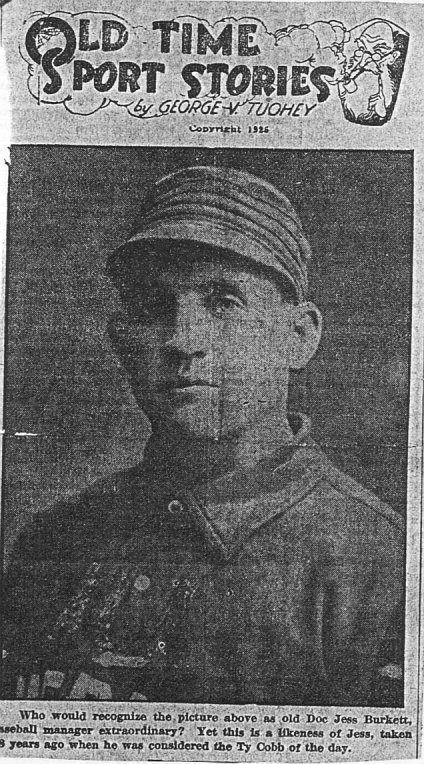
Within the 1890s environment, one hitter stands clearly above the rest in repeated high-volume seasons: Jesse Burkett.
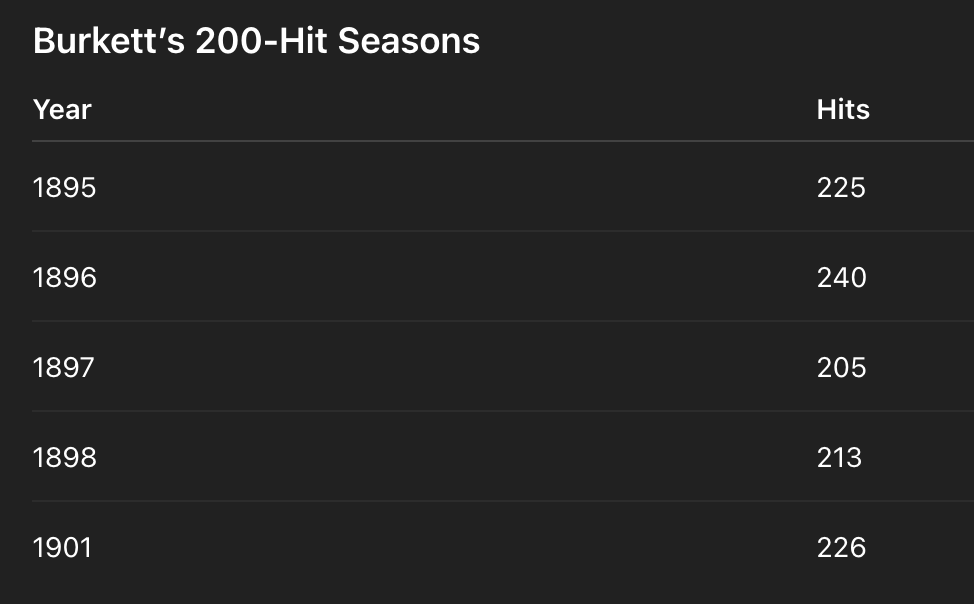
Burkett recorded five 200-hit seasons , the most among hitters whose careers occurred primarily during the short-schedule era of the late nineteenth century.
His peak season, 1896, produced 240 hits in 134 games , one of the highest hit totals ever achieved in a season of that length.
Burkett’s Career Profile
Burkett’s overall statistics confirm his status as one of the greatest contact hitters of early baseball.
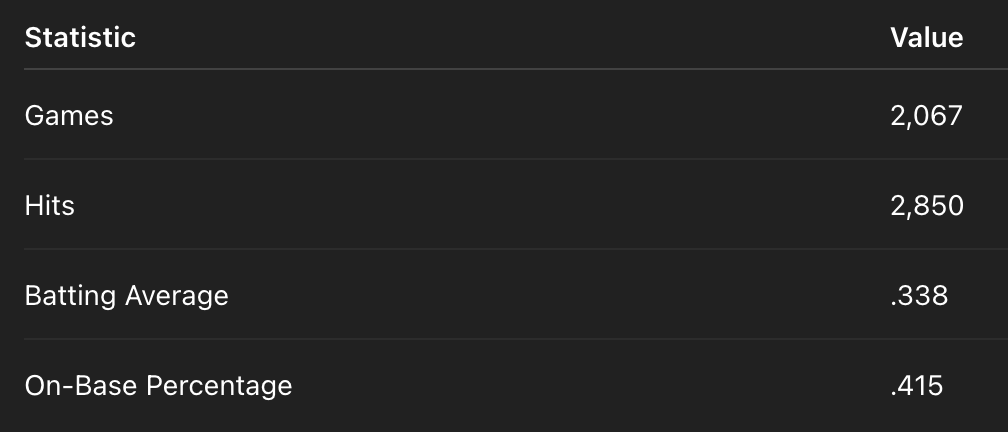
His career hit rate:
2850 ÷ 2067 = 1.379 hits per game
Burkett therefore averaged roughly 1.38 hits per game across his career , an extraordinary level of sustained contact production.
His offensive profile resembles later contact legends such as Ichiro Suzuki and Tony Gwynn: exceptional bat control, high on-base ability, and remarkable consistency across many seasons.
The Puzzle of Dave Orr
While Burkett accumulated multiple 200-hit seasons, another nineteenth-century hitter achieved an even higher rate of hit production , yet never reached the 200-hit milestone.
Dave Orr holds the highest career hits-per-game rate in Major League history.
Orr’s Career Totals

Hit rate:
1639 ÷ 1143 = 1.434 hits per game
Orr therefore averaged 1.43 hits per game , a slightly higher rate than both Burkett and many other legendary hitters.
Why Orr Never Reached 200 Hits
The explanation lies almost entirely in the structure of the schedule during Orr’s career.
Orr played primarily from 1883 to 1890 , when seasons were substantially shorter than those of the 1890s.
Typical schedules ranged from roughly 112 to 140 games , and several of Orr’s early seasons were shorter than that.
To reach 200 hits in such an environment required an extraordinary pace.

Even a hitter averaging 1.40 hits per game would struggle to reach 200 hits in many seasons of that length.
Orr’s Best Season
Orr’s closest approach to the milestone came in 1886.

Hit rate:
191 ÷ 140 = 1.36 hits per game
That season represents elite offensive production, but the shorter schedule prevented the accumulation milestone.
Rate Comparison
When normalized by games played, the relationship between Orr and Burkett becomes clearer.

By this measure, Orr produced hits slightly faster than both Burkett and Cobb.
Schedule Normalization
If Orr’s career hit rate is projected into later season structures, the implications become striking.
Projection to a 132-game season (common in Burkett’s era)
1.434 × 132 ≈ 189 hits
Projection to a 154-game season
1.434 × 154 ≈ 221 hits
In other words, Orr’s career hit density would likely have produced regular 200-hit seasons had he played in later eras with longer schedules.
Why Orr Is Often Forgotten
Several structural factors contributed to Orr’s relative obscurity:
Shorter early schedules limited accumulation statistics.
A career-ending injury at age 31 shortened his playing career.
Much of his career occurred in the American Association , which historically received less attention than the National League.
Because traditional evaluation often emphasizes cumulative totals, Orr’s extraordinary hit rate has been largely overlooked.
A Structural Lesson in Baseball History
Burkett and Orr illustrate a broader principle about the interpretation of baseball statistics.
Burkett represents the most frequent high-volume contact hitter of the short-schedule 1890s , repeatedly crossing the 200-hit threshold despite the structural difficulty of doing so.
Orr, by contrast, represents something even rarer: a hitter whose rate of hit generation may have been the highest in the history of the sport , but whose era prevented the accumulation milestones that later defined greatness.
Once the structure of the season is taken into account, both players emerge as two of the most efficient contact hitters in the early history of baseball.
The lesson is simple but profound: statistical milestones are not merely measures of talent. They are also reflections of the structure of the game itself.