Hornsby, Gehrig, Speaker: A Triptych of Transformation
Hornsby, Gehrig, Speaker: A Triptych of Transformation
I.
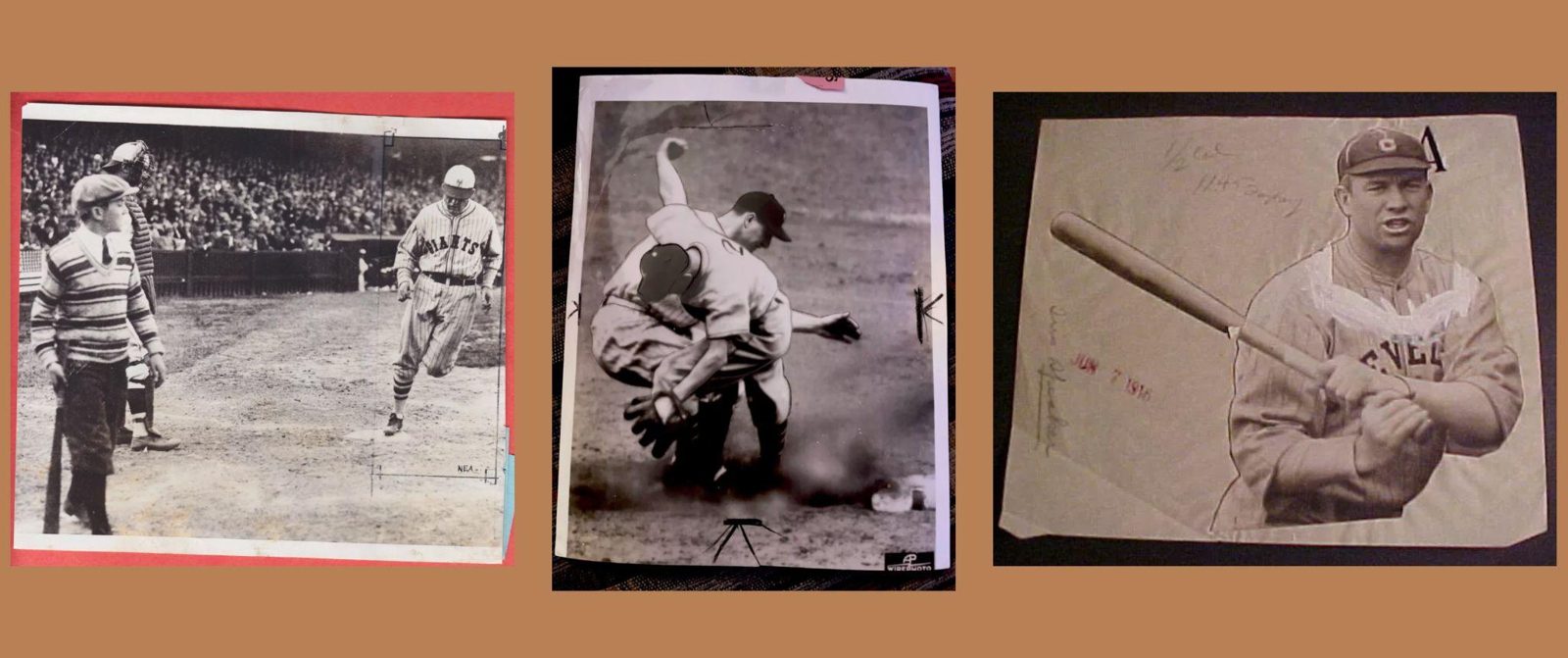
This essay is to directly regard a collection of three press photographic artifacts.
The first is a picture of Rogers Hornsby in the year 1927, just crossing the plate after hitting his first home run of the season on opening day in Philadelphia as a member of the New York Giants, as a batboy and the catcher for the opposing team look on.
The second is a picture of Lou Gehrig in a collision course on the base paths with New York Giants shortstop Dick Bartlett in game one of the 1937 World Series.
And the final picture is a 1916 press photo of Tris Speaker.
What these three pieces have in common, and precisely why they have been compiled and represent a collection of historical and artistic magnitude - is their multivalent and layered power. Each photographic piece is simultaneously a piece of photojournalistic editorial history, baseball history, and prescient modern art. Therein, each layer of these works will be deeply explored.
Each of these photographs is a type one photo, printed directly from the negative to be worked with and ‘manipulated’ by press editors the day after the event of its negative production. This immediate turnaround is manifest in the silver gel print quality of the Hornsby, the glossy Gehrig, and the cutout Speaker. These prints were used and manipulated - written upon, stamped, cut out, airbrushed, and delicately outlined and painted upon to prepare the photograph for eventual news press production - to be mass replicated in journals and editions regionally, nationally, and globally.
The power of these photos is explicitly represented in their in-medias-res state and nature as editorial process artifacts. Each mark and mark making made on, in, and through these photographs was for the explicit economic purpose of preparing them for news print. But in this process, and through this vital and clear necessity, these photos take and took on an entirety different aura altogether - that of genuine works of art which transcend ‘art’ in their ‘artlessness’.
II.
Each of these photographs is ‘artful in artlessness’ in a different way. The measured and economical image selection of the Hornsby figure in the first photograph with news outlet abbreviation ‘NEA’ works masterfully and minimally with the entire composition of the photograph - as Hornsby with his head down and almost out of the photograph altogether is simultaneously ‘centered and decentered’, as the batboy in his colorful striped wool sweater and early modern baseball outfit and the catcher look on. The early American sort of ‘picket fencing’ demarcating the crowd seats in the background; the rough grass of early baseball diamonds.
Then, there is the Gehrig World Series photo, on a collision course with the Giants’ shortstop. Each line and angle and figural form in the simultaneously focused and unfocused photograph has been delicately outlined and carved by the editorial hand of the writer, simultaneously animating the piece and suspending it in three dimensions. The blurry cloud of dust kicked up by the collision seems to draw itself up out of the page. Meanwhile, the rough frame markings delineate where the ‘cutting’ process of framing the photo for publication will occur. Some of these markings even dig into the paper themselves in their aggressiveness and definitiveness.
And finally, the Speaker photo with its front facing provenance - including red stamping toward the bottom left of the page marking it ‘Jun 7 1916’. Speaker’s name is written in cursive descending down the far left of the page; detail demarcations about the photographic quality and time of working are dispersed across the mid-upper left. The markmaking on this piece is particularly fascinating - with rough yet structured white paint wrapping around his lower clavicle; figural outline of the cutout piece of Speaker swinging made in black ink. And in the last touch, a large black typographical ‘A’ just behind the form of Speaker’s head - cut off by the emergence of the cutout photograph. The figure of Speaker is placed diagonally across the page slightly; with a directional diagonal cut of the photo off at his waist that orients the photo in unified directionality across the page.
III.
As it can be observed in the overview, description, and view of these artifacts as a unified collection, they span across an entire era of baseball - the emergence from the ‘dead ball’ era and times of the sport into the collective modernity known as ‘America’s Pasttime’ - spurred on by the emergence of players like Babe Ruth; the scandal of the 1919 Chicago Black Sox which swept the nation; teams like Connie Mack’s Philadelphia A’s, and the ‘Gashouse Gang’ St. Louis Cardinals, led by the sensation Dizzy Dean.
The artifacts themselves represent this era in a way that does not necessarily revel in the most mass and well known figures of the game of this era, but focuses on players who themselves form the inner circle of legendary quality of genius of this golden age: Speaker, Gehrig, and Hornsby - who remain as exemplars of the best to ever play, 100 years on. These are figures well understood by those who follow the sport to be greats of their time who transcend it; move across time in their remembrance.
This establishes them contemporarily as primary baseball artifacts of the highest regard - type one photographic examples of the game’s legends in a pre-World War II era of the sport, where it underwent changes into an explosion of offense, starpower, and recognition as the pastime of a nation that emerged, in the outset of this century, deeply into the world’s view. The layers that follow are layers which define these works beyond previous definition.
IV.
The quality of these legends and photographs and their provenance already well established, we proceed further into the manual mark making quality which distinguishes these photographs even from Type Ones - the unique editorial markings made by experts, even masters of the form - which render them primary examples of the transcendent quality and qualities of mixed media artistry. From the minimalism of the Hornsby editorial mark-making, to the complexity and full fledged emergence of the form in the Gehrig World Series photo, to the collage style modernist piece that is the Speaker, the entirety of the evolution of the form of photoeditorial process journalism and its emergence can be traced therein.
This manual mark making elevates these photographs - process pieces which were meant to be disposed of upon completion of the press ready-for-distribution photograph - into total works of art. And the way this is done is subtle. It is precisely because they were never intended to ‘be’ works of art that they become works of art in their pure economy. Done as part of a task based process of rendering, each and every mark made on these pieces is a signifier of, in, and through an extended process of refinement. By way of interminality of a finished product, these texts stand suspended, between solidification into news media and raw negative. And what distinguishes them is the subtlety to the complexity to the creativity of these preparatory editorial markings.
Simultaneously, then, these works are utterly temporal irreproducible one of one historical artifacts - made as such by their Type One photographic production in time; elevated far beyond that by their editorial hand made mark making and collage work at the hands of master news editors. And the fact that these marks were made ‘artlessly’ in a pure utilitarian way and method - elevates them beyond any ‘art with intention’ - as in, that which is most often and regularly considered to be ‘art and artistic’. They are no excess, and of no excess; pieces that astonishingly survived a process that they were not expressly or explicitly meant to survive; pieces that document creativity emergent from pure utilitarian process; pieces which document the history of a medium in transition, a field in transition, art in transition, and a game in transition - transitorially.