Human Physics: A Study of Mickey Mantle's Swing
Human Physics: A Study of Mickey Mantle's Swing
Human Physics: A Study of Mickey Mantle’s Swing
There are swings in baseball history that are beautiful.
There are swings that are correct.
And then there are swings that feel like natural law.
Mickey Mantle’s swing belongs to the last category.
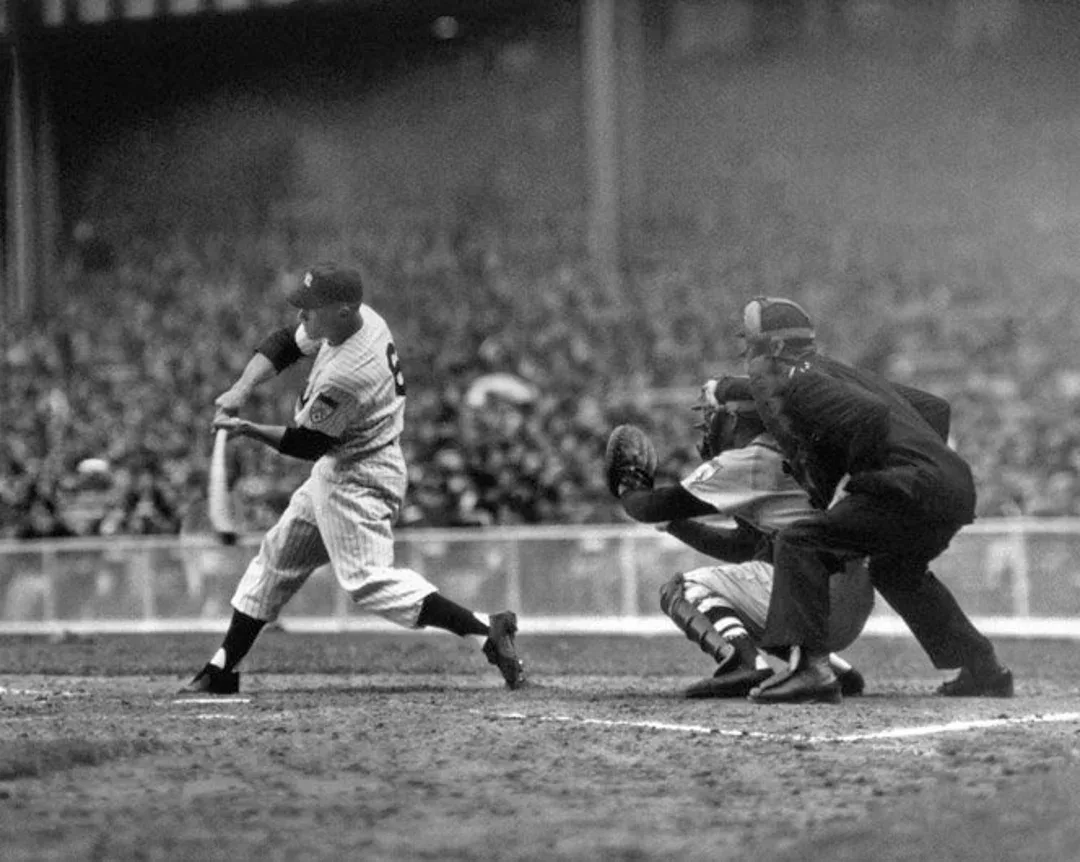
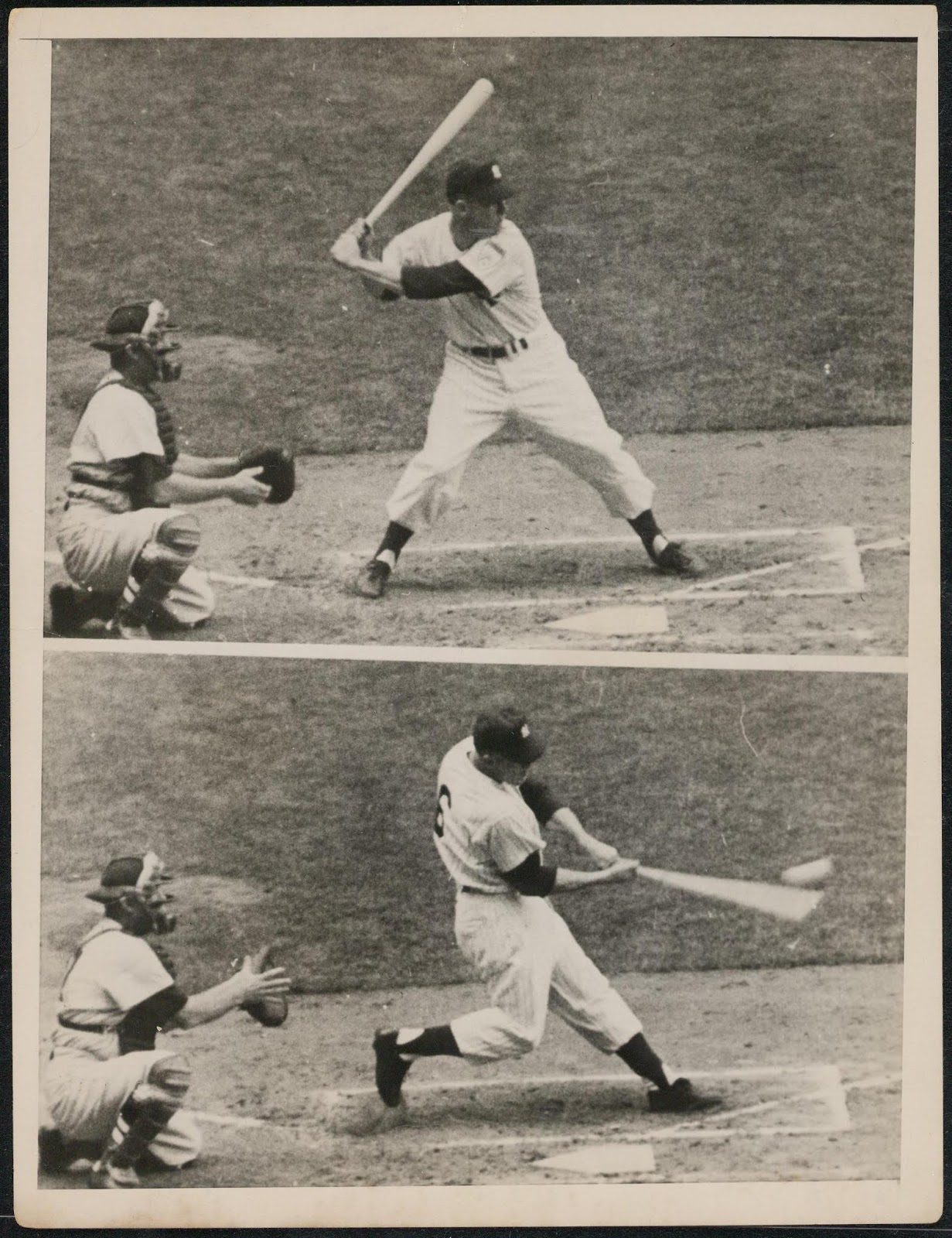
To watch it in a frozen frame — front foot planted, hips open, barrel entering the zone — is to witness not style, but force resolving itself through a human body. The photograph does not show a hitter attempting contact. It shows a body converting ground into rotational inevitability.
This is human physics.
I. The Ground as Origin
All force in elite hitting begins at the earth.
Mantle’s swing is not arm-driven, nor even shoulder-driven. It is earth-driven. His front foot, braced and anchored, halts forward momentum and converts it into rotational acceleration. Linear energy becomes torque.
This moment — front heel down, lead leg firm — is the hinge. The body stops drifting forward and instead rotates around a fixed axis. That axis is the lead leg. Without that brace, there is no violence. With it, the pelvis fires.
From there the chain unfolds:
Ground → ankle → knee → hip → torso → shoulder → hands → bat.
This is not metaphor. It is biomechanics.
Mantle’s hips open first. His shoulders remain fractionally closed. That separation — the delay between pelvis and torso — stores elastic energy in the obliques. It is a torsion spring wound tight.
When released, the barrel accelerates with extraordinary angular velocity.
The sound off his bat, by contemporary accounts, was different. Heavier. That difference is not romance. It is rotational acceleration transferring efficiently into the baseball’s center of mass.
Power in rotational systems increases with the square of angular velocity. Mantle possessed both mass and speed. The result was not just home runs. It was flight.
II. Compression, Not Ornament
Mantle’s swing is not decorative.
Compare him to Ted Williams, whose mechanics were architectural — clean plane geometry, precise strike mapping. Williams feels scientific.
Compare him to Babe Ruth, whose swing expanded with the exuberance of a new era discovering its own power.
Mantle is different.
His swing is compressed.
There is very little wasted motion. The hands stay tight to the body. The barrel trails slightly, then snaps through the zone in a violent arc. His head remains unnervingly still while the rest of his body detonates.
Everything unnecessary has been removed.
What remains is torque.
III. The Knee and the Redistribution of Force
In 1951, in the World Series at New York Yankees home park — Yankee Stadium — Mantle suffered catastrophic knee damage. The injury never truly healed. He played nearly his entire career on compromised legs.
And yet the power intensified.
When linear explosiveness diminishes, elite athletes compensate by optimizing rotational efficiency. Mantle’s swing, post-injury, relied even more heavily on hip clearance and core compression. The damaged lower half forced a redistribution of force upward.
The tragedy sharpened the mechanism.
His swing carries, in its later years, a kind of compressed desperation — not wildness, but intensified efficiency. The body, aware of its limits, becomes ruthlessly economical.
What you see in the photograph is not youthful athletic abundance. It is engineered violence.
IV. Bilateral Impossibility
Mantle did this from both sides of the plate.
Switch-hitting at an elite level requires rare neurological symmetry. Most hitters struggle to generate coordinated rotational force on one side. Mantle created tape-measure power as both a left-handed and right-handed batter.
That implies exceptional cross-lateral neural integration — motor cortex adaptability, cerebellar calibration, proprioceptive balance.
It is difficult enough to build one rotational engine. Mantle built two.
This alone places him in the extreme tier of human athletic architecture.
V. The Frame Itself
In the photograph, the catcher is folded inward. The umpire braces. The crowd dissolves into blur.
Mantle alone is expanding.
He is the only body in the frame generating outward force. Everything else reacts.
The composition mirrors the physics. The swing radiates. The environment absorbs.
This is why the image feels mythic. It is not posed heroism. It is mechanical inevitability captured at a split second of maximum transfer.
VI. The Physics of Impact
At contact, rotational systems behave according to simple principles:
Power ≈ ½ I ω²
Where I is rotational inertia, and ω is angular velocity.
Mantle’s broad shoulders, long levers, and powerful wrists increased inertia. His hip-shoulder separation increased angular velocity. The squared term amplifies output dramatically.
In modern measurement terms, his bat speed would likely sit in the upper elite range even today. His exit velocities, extrapolated conservatively, would rival contemporary power hitters — achieved with heavier bats, less refined equipment, and without modern strength training science.
But the numbers, while impressive, do not explain the feeling.
The feeling comes from conversion efficiency.
Very little of his energy leaks.
VII. The Era in the Body
Every great swing carries its historical moment.
Williams reflects wartime discipline and scientific rationality. Ruth reflects expansion and emergence.
Mantle reflects compression — postwar acceleration, atomic-age tension, industrial torque.
His swing feels like ignition.
It is rural muscle passing through an industrial frame at the height of the Cold War. It is the body of a damaged Oklahoma prodigy translating the ground of America into rotational fire.
There is nothing pastoral in it.
It is an atomic swing.
VIII. Why It Endures
Many players have hit more home runs. Many have possessed greater longevity. A few may have matched or exceeded raw output in modern conditions.
But Mantle’s swing remains singular because it embodies something elemental:
A damaged organism converting ground into myth in one violent arc.
The physics are measurable. The torque is calculable. The angular acceleration is explainable.
But what endures is the sensation that the swing is less an action than an event — a moment when force gathers, compresses, and resolves itself through a human frame.
It is not merely baseball mechanics.
It is the study of how matter, under constraint, becomes power.
And in that split second — front leg braced, hips cleared, barrel whipping through — Mickey Mantle becomes less a hitter than a law of motion made visible.