Marking Time: Baseball as a Ritual Cadence
Marking Time: Baseball as a Ritual Cadence
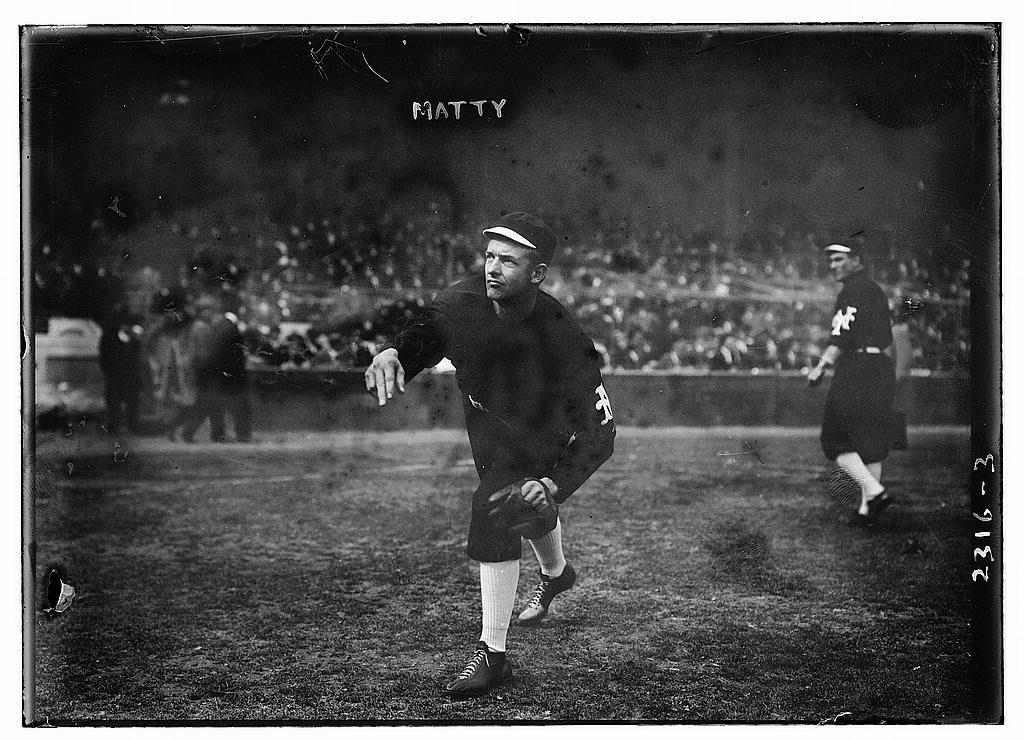
From batting practice to the warm-up, to Red Barber’s Gillette commercial with the chiming bell; SNY’s introductory music to Gary, Keith, and Ron — baseball has a long history of performing ritual time in American history. Time where, once kairotic, goes sideways in an instant into mythic time. It is a trance state, a fugue dimension, in which clock time disappears; the rhythm of body begins.
From the pitcher pacing around the mound; prior to the pitch clock, to the batter’s stepping out of the box, to the 18 inning marathon pitcher's duel of Mathewson, McGinnity, and Wiltse of old. The true heritage of baseball is the introduction of grounded, somatic time — a dimension in which the clock, or linear time, does not apply. The purpose of the old game, the true old game, is to remove humanity from the industrial rhythm of hours and the hammer of production — into animal time. The pacing, the tensile grip of Honus Wagner’s hands about the tree made bat; the persistence of deadball into darkness.
The induction of the tension and movement and discourse between batter and pitcher is relational; communicative. In this direct, immanent relationship, time as a concept is removed; what is introduced is the dance that breaks time, a dance of strategy, listening, focus, attention; the mutual disestablishment of the rhythmic strategy of the other as a state of play. Mathewson versus a young Rogers Hornsby; the audience or crowd that is present is filling the seats for the moment of two masteries pitting space and time as a jettisoned ball from fingertips (in Mathewson’s case, the screwball) versus the trained and attuned eye of the master chop hitter (as in the contact prowess of Hugh Duffy or Willie Keeler) or line drive or power hitter of the age of Ruth and Hornsby.
This removal from clock time is a salve; it is a salve of industrial modernity. It is the throwing of life into the metabolic heat and rhythm of the animal body; the introduction of the state of play particular and unique to baseball to the timeless — to the languid stretching out of the extra innings stalemate to the taut tension of a World Series Game Seven — where every moment in time acquires the dimension of fractal milliseconds. The mythic time of baseball stands in direct relation to the time of American factory; recalls the pastoral time of Walter Johnson’s farmland; yet, is neither of them. It stands outside of nature; refuses the rise and set of the sun; yet, also refuses the regimented workmanship of the linearity of the lightbulb and the indoor machine. It is a third space — a space of the somatic listening to the body; the introduction of the break in externalized time, whether dictated by environment or industry; instead, dictated by embodiment; the hearth of the body.
This ritual cadence is what is beneath baseball; its true cadence; the reason for its mythic resonance that pronounces itself throughout the past 150 years of American history. Because it is the introduction of truth between the breakpoint of pre- and post industrial America — neither of which are existential representations of the American spirit; the American soul. Neither is baseball particular to America — yet refined in it — as bat and ball sports appear the world over for millennia. And yet, the pastime is more fundamentally human than it is American, as it allows for the incurement of the ritualistic dimension: a dimension that is pure rapture; a rapture that is seen, felt, experienced as an atmosphere — a womb of communal participation; as such, an organic warmth which is generated by authentic, integral ritual: the accurate representation of mankind’s inmost impulses; free expression of somatic self and body; the communication of focus as relationship.
Entrance into the American state of trance is admission into the absolutely free state of the American soul; the ritual temples of Yankee Stadium, Ebbets Field, and The Polo Grounds hold it. They are containers — the necessary stone, Saturnian fields and architectural spaces; temples which can and make space for the possibility of the slippery dialectical relationship of chronos and kairos as entryway into mythic time. The transcendental dimension of American baseball: the loss of the clock, combined with the skeleton to hold timelessness through ritual repetition of behavior: structured by outs, balls and strikes; the dynamic between the pitcher, catcher, and batsman.
This is, in a primal and primordial sense — the animal body, withstanding natural cycles; the genetic and cellular memory of the animal body which allows for stable internal temperature, or homeostasis. The animal persists naturally; naturally seeks equilibrium outside time-space fluctuation. This bio-chemical rhythm of internal consistency is reproduced in the cultural mechanism of the rhythm of baseball as a free play — the free verse of Whitman incarnate in the dynamics of the stripping of the veil of time-bound and dictated motion which motorizes industrial and modern civilization; as is explicit in Whitman, this is a free verse of the primal, fundamental expression of the soul which is an answering of the call to fundamental, existential human liberation.
Baseball is unique in this sense, in its original form. It is the death of clock time in a world state of being which is utterly dictated by clock time as a mediator of event. The original baseball has a start time, which is the agreed upon convergence on the field of play, but outs, innings, and the game itself has no true end. It can, and often must stretch on forever and break the bounds; this is the secret desire of all of baseball and all of mankind. Eternal play as in immortality. And this notion is captured everywhere from Pre-Socratic intuitions of the universe, to the lila elucidated by the Vedic tradition.
This timelessness, unique to baseball, is the realm in which play can and does extend forever, solely dictated by the somatic body — most clearly in the discourse between pitcher and batter as a strategy of the rhythmic deployment of energy mediated alone by one’s own cultivation of skill, strategy, intuition, and subtle physics and psychology of the strikeout and home run. In this critical moment, which Mathewson calls ‘pitching in a pinch’, there is no time. There is only the imminence of the immediate spatial relationship in which the historical moment collapses; true relationship between individuals as a discourse is revealed. It is the moment of true, total, and absolute focus of opposing poles — pitcher and batter. This is the hinge upon which the entire ritual and notion of baseball is predicated, at last beyond all structural repetition of ball, strike, out, and the dimensions of feet and inches which standardize the field. All of these geometrical and quantitative mechanisms collapse into the pure, psychological, supra-somatic method of communicative witnessing: a pre-linguistic dialogue of unspoken personal language, gesture, and craft cultivated in skill over time — from boy to man to aged veteran. It is the very grand history not only of baseball, but of the cultivation of one’s practice that is deployed in this very moment of psyche revealing.
And this is what draws the fans; the implicit understanding in the American ritual, literary tradition of narrating the American psyche of the importance of baseball. That it is a collapse of the American civilization itself into the mud, bone, leather, and wood absolute fundamentals which provided human history and the dawn of mankind for all time a true notion and comprehension of the eternal — explicitly through the play of soma’s incarnate spiritual time. The rhythm, as Whitman would say, of mens’ souls.