Mickey Mantle and the Mid-Century Image of America
Mickey Mantle and the Mid-Century Image of America
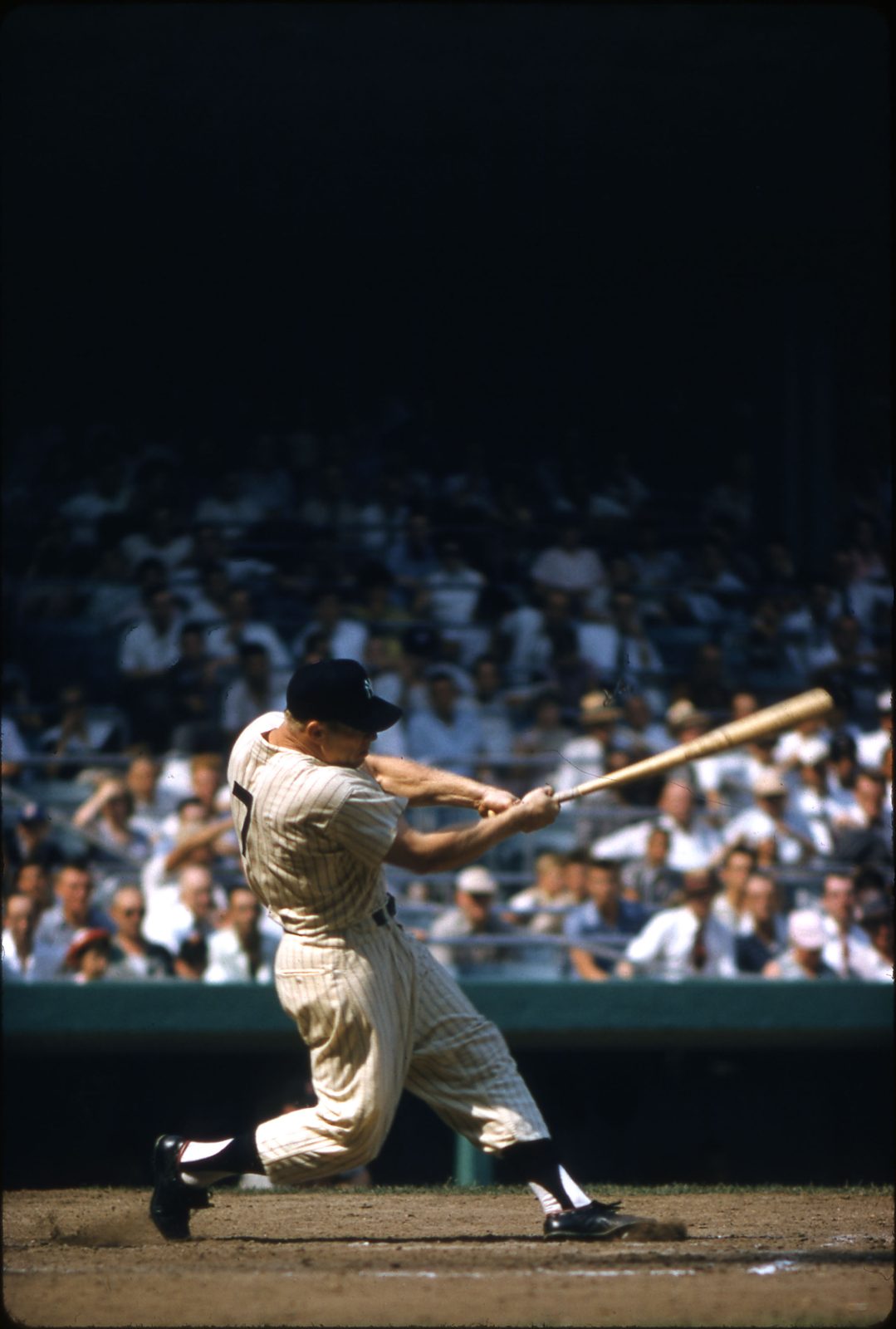
Mickey Mantle and the Mid-Century Image of America
A Composite Analysis
To understand Mickey Mantle as the defining athletic image of mid-twentieth-century America, one must move beyond biography. Mantle was not simply a Hall of Fame outfielder, nor merely a tragic figure whose personal struggles shadowed his brilliance. He emerged from a precise convergence of social, psychological, institutional, and technological forces.
The “scene” that forged Mantle was composite in nature: region, class, paternal expectation, bodily rupture, chronic pain, Cold War spectacle, the New York Yankees’ imperial stage, and the rise of national television. Together, these elements produced not only a superstar, but a symbolic figure who embodied the contradictions of American power at its peak.
I. Regional Formation: Industrial Masculinity and Performance Identity
Mantle grew up in rural Oklahoma—oil-field and mining country shaped by labor culture and economic precarity. In such environments:
The body is a tool for survival.
Pain is normalized.
Emotional expression is secondary to endurance.
Worth is measured through production.
This cultural architecture forms a performance-centered identity. Achievement becomes synonymous with legitimacy. The self is not cultivated inwardly; it is proven outwardly.
Mantle’s athletic development occurred within this ethos. From the outset, his body was understood as an instrument of value.
II. Paternal Expectation and the Compression of Time
Mantle’s father, Mutt Mantle, invested heavily—emotionally and aspirationally—in his son’s baseball future. In such circumstances, excellence can become intertwined with attachment. Achievement becomes not simply ambition but affirmation.
When Mutt died at a relatively young age, Mantle internalized a foreshortened horizon. He later expressed the belief that he too would die young. Whether literal or psychological, this sense of compressed time often produces heightened urgency. Individuals who believe their future is limited may operate at greater intensity and take greater risks.
Mantle’s early career brilliance—marked by extraordinary power and speed—unfolded under this compressed temporal psychology.
III. The Initiation Wound: The 1951 Knee Injury
In the 1951 World Series, at age nineteen, Mantle suffered a severe knee injury that permanently altered his biomechanics. Occurring before modern ligament reconstruction techniques, the damage became a lifelong condition.
This moment is central to understanding his composite identity. From that point forward, Mantle’s career was characterized by a paradox:
Exceptional athletic ceiling
paired with
permanent physical compromise.
He achieved dominance while visibly impaired. That duality—greatness under structural strain—became inseparable from his public image.
IV. Chronic Pain, Public Performance, and Private Strain
Mantle’s career unfolded amid recurring injuries and chronic discomfort. Chronic pain can reshape psychological functioning, narrowing focus and increasing vulnerability to coping mechanisms such as alcohol use. Mantle’s well-documented struggles with drinking must be understood within this broader context of physical and emotional strain.
Mid-century American culture offered limited frameworks for discussing psychological distress. Emotional difficulty was typically concealed rather than processed publicly. The result, in Mantle’s case, was a pronounced split:
A public self defined by October heroics and statistical milestones.
A private self grappling with shame, fatigue, and self-medication.
This visible disparity intensified his mythic tension. He was not invulnerable; he was visibly human.
V. Switch-Hitting as Structural Duality
Mantle’s status as the most powerful switch-hitter of his era is often treated as a technical distinction. Symbolically, however, it reinforces his composite duality. Two batting stances reflect a broader structural pattern in his life:
Power and fragility
Grace and damage
Public triumph and private strain
He embodied simultaneous opposites—an athlete capable of extraordinary output while physically compromised. This duality mirrored larger national tensions.
VI. The Yankees and the Architecture of Empire
The New York Yankees of the mid-century period functioned as more than a baseball club. They represented institutional dominance, continuity, and inevitability. Mantle inherited center field from Joe DiMaggio , who himself followed Babe Ruth.
To occupy that position in the 1950s was to assume national symbolic weight. Mantle did not merely play for a successful franchise; he stood at the focal point of an American sports dynasty during the height of U.S. geopolitical confidence.
VII. Television and National Coherence
Mantle’s prime years coincided with the consolidation of national television. Unlike earlier stars mediated primarily through radio and print, Mantle was experienced visually by a mass audience.
Television altered hero perception. Viewers could see:
The taped knee.
The altered stride.
The fatigue.
The towering home runs.
This visual intimacy humanized the hero. Mantle became the first fully televised American baseball idol—shared across a relatively unified cultural landscape of limited networks and common narratives.
VIII. Cold War Context and Atomic Imagery
Mantle’s career unfolded during the height of Cold War confidence and nuclear anxiety. Descriptions of his power frequently employed atomic language—“explosive,” “towering,” “devastating.” His athletic force resonated with an era fascinated by technological dominance and destructive capability.
In this sense, Mantle embodied mid-century America’s self-image:
Technologically advanced.
Physically powerful.
Globally dominant.
Yet shadowed by existential threat.
His chronic injury paralleled a nation projecting strength while navigating internal and external strain.
IX. Sacred Numerology and Ritual Milestones
Baseball’s culture of numerical milestones transforms athletic performance into ritual. Mantle’s achievements—536 career home runs, 18 World Series home runs, three MVP awards—became ceremonial markers within the sport’s arithmetic tradition.
His 500th home run in 1967 occurred amid growing national unrest. As American cultural cohesion began to fragment, Mantle visibly aged and declined. The hero’s physical erosion coincided with the nation’s loss of postwar certainty.
X. The Composite Image
When the full composite is assembled, Mantle emerges as more than an exceptional athlete. He becomes a mid-century emblem produced by the convergence of:
Industrial regional masculinity
Paternal expectation and early loss
Career-altering injury
Chronic pain and psychological strain
Institutional amplification via the Yankees
Cold War spectacle
Sacred statistical ritual
National television centralization
He embodied peak performance under accumulating entropy.
Conclusion: The Hinge Figure
Mantle stands between two American moments. Before him lay mythic abundance and confidence; after him, fragmentation and cultural multiplicity. He was perhaps the last sports figure to command a fully centralized national imagination.
He represented a nation at its most unified and most powerful—while simultaneously revealing its vulnerability.
In that sense, Mickey Mantle was not merely a baseball star. He was the mid-century image of America itself: brilliant, dominant, visually central, and already bearing the strain of its own intensity.
Addendum: Why This Is Important
The question is no longer whether Mickey Mantle was great.
It is not even whether he was tragic, or emblematic, or uniquely central.
The real question is:
Why does it matter to reconstruct the composite that forged him?
Why spend such effort mapping land, father, injury, pain, empire, television, and decline into a single figure?
Because Mantle is not simply an athlete in history.
He is a contained system through which an entire culture can be studied.
I. The Human Body as National Mirror
Societies do not understand themselves abstractly.
They project.
They project onto architecture, war, industry, and most powerfully—onto human bodies.
At mid-century, the American self-image was:
confident,
expansive,
technologically ascendant,
unified in narrative,
victorious in war,
dominant in industry.
Mantle’s body became the visible site of that projection.
He was:
explosive,
beautiful,
young,
powerful,
central.
But his body also revealed:
injury,
fatigue,
fragility,
self-medication,
visible strain.
The same body that embodied American dominance revealed its cost.
That dual revelation is culturally significant.
He allowed the nation to witness its own vulnerability without surrendering its myth.
II. The Last Unified Idol
Mantle’s prime coincided with the apex of national media coherence.
Three television networks.
One baseball cathedral.
One center fielder.
For perhaps the last time in American life, a single athletic figure could function as a shared symbolic anchor.
After the late 1960s, cultural narratives fracture:
political division intensifies,
media multiplies,
identity fragments,
heroes become contested.
Mantle stands at the final moment when one figure could hold the center.
That makes him historically important beyond statistics.
III. Greatness Under Entropy
Mantle is not important because he was perfect.
He is important because he was not.
He achieved extraordinary output under accumulating structural compromise:
a permanently damaged knee,
chronic pain,
internal shame,
national expectation,
addiction.
He did not represent invulnerability.
He represented power under visible strain.
That is a more modern image of heroism.
It anticipates the later cultural recognition that strength and fracture coexist.
IV. The Hinge in Consciousness
Before Mantle, American myth was largely triumphant and uncomplicated.
After Mantle, the culture increasingly acknowledges complexity, fracture, and internal contradiction.
He does not cause that shift.
He marks it.
He stands at the pivot where:
unified certainty begins to erode,
invincible heroism becomes visibly human,
empire recognizes its own limits.
This is why reconstructing his composite matters.
He is not merely remembered.
He reveals a transitional psychological moment in national life.
V. The Broader Significance
When you analyze Mantle at this level, you are not studying baseball.
You are studying how:
trauma can coexist with brilliance,
institutions amplify individuals into symbols,
media transforms athletes into national mirrors,
greatness can emerge from instability,
a culture encodes its self-understanding into a single body.
That is a civilizational inquiry.
Mantle becomes a case study in how power, vulnerability, and identity intertwine.
Conclusion
It matters because Mickey Mantle represents more than achievement.
He represents a moment when America could still believe in a single, centralized hero—while simultaneously beginning to see that hero limp.
In that image lies the transition from unquestioned dominance to self-awareness.
That is why the composite is important.
It shows how a nation sees itself—at its height, and at the first signs of strain.