Modernity -- from Pablo Picasso to Rimbaud, Poe, Woolf, and Artaud: The Human Nervous System in Organizational Chaos Grappling With Industrial Technological Revolution
Modernity -- from Pablo Picasso to Rimbaud, Poe, Woolf, and Artaud: The Human Nervous System in Organizational Chaos Grappling With Industrial Technological Revolution
00:00
So I’d like to sum up the literary advent of modernism and the fragmentation of Cubism and Surrealism. It’s actually quite simple.
It’s so much less about the works themselves or the authors and the artists as much as it is a phenomenon, which is the product of modernity itself — which is to say… technological fragmentation.
00:27
And the psychological effects of technological fragmentation — which is most manifest in the marks and markers of genius of the time, who were all diagnosed with some sort of mental illness or other.
And we could debate that in terms of the biochemical makeup of these individuals.
But what they all have in common… from Lawrence to Woolf to Poe to Picasso, to Wittgenstein — as a philosophical literary artifact in his primary language problem, which is a language problem that can only emerge in the industrial modern world — is that these are all individuals of vision, which is to say they have real insight into the current of time, the current of history and the movement of history as it intersects with the human experience.
And they are experiencing it viscerally — which is to say they have a neurological sensitivity, which is the interface between the human biology and the human genome, the biochemical makeup of the human… with the time or the age itself, which is a status of consciousness, a status of culture, technology, development, thought, religion. This is an experience of reality, an experience of the real which is hyper-attuned, hyper-sensitive to sensation and movement and energy and transference.
These are circumstances in relation with the human biome, which we would just describe blanket and enforce as epigenetics.
01:58
So all that modernism is and all that modernity is… is the fragmentation of technology and the necessary outcomes which occur psychologically through the different schisms of the biochemical and neurological make-ups of these historical figures — who themselves are the aperture through which modernity pours.
Modernity pours through them in visions and dreams and images.
But it is that they themselves are filtering the grand broadness of the time itself… which is the status of consciousness in uterine development and hyper acceleration — through the technological industrial age.
It is being poured through them like light and being refracted through them like light onto the canvas and onto the page and into the written word or the syllable.
02:56
And this is the fundamental characteristic of history and time as it pertains to the human being as a vessel or an aperture.
All that is real, that is experienced by humankind is a subjective filtration of circumstances, conditions, relationships, gravity, the grand cosmological phenomenality, the full total, which is experienced viscerally in and through and as the human body as an architecture of sensing — an architecture of synapses in a neurological system.
With sensate components… which create the total synthetic or synesthetic experience of being in touch and feel, which is the human being’s experience in the world proper.
03:55
So when such an innovation as industrial technology begins to hyperaccelerate at the outset of the 20th century, what you’re witnessing is a violent reaction and response in humanity’s most viscerally in touch — which is to say, sensitive — figures.
And their sensitivity is boiled down fundamentally to a hyper-attuned nervous system.
04:09
This is everything from pattern recognition in terms of the synaptic architecture of the brain… to the experience of the sensate, the experience of the sensing body.
04:25
In relationship to the neurological architecture — which is interpreting it, sensing it, filtering it, understanding it and processing it — which is fundamentally linguistic.
This is a drawing out of an entirely new order of human cognition through the machine, through steel, through metal, through technology — because it’s a response. It’s a feedback loop.
Mankind increasingly insurrects into nature, which is the cosmos.
04:54
This is everything from the astrophysics of Kepler and Galileo and Copernicus.
05:01
Into the splitting of the atom.
Into psychology, with Freud, Rank, and Jung.
05:17
When we’re talking about this insurrection of the material, the chemical, the elemental, there’s a feedback response in relationship to the human being’s neural architecture… digging into the regularity of nature. Digging into the regularity of the sleep of the genome through centuries, which has subsisted on the plowshare and spear and sword warfare and the hope of the wooden ship to cross an interminable sea, an unmapped universe.
Not only an unmapped universe, but an unmapped world. An unmapped body.
06:08
And as this mapping increasingly occurs, this is the human nervous system spreading out into the cosmos.
This is a reflection of mankind’s relationship to himself.
06:13
And as this hyper accelerates in modernity, this is an increase of vision — as we discussed with the camera; as we can also discuss with the microscope or atomic literature — which is in turn reflecting and refracting back… it is a fragmentation of the human psyche, which was formerly organized religiously and culturally in a tribe of unconscious ritual myth and storytelling.
This is an active limbic fracture, a nervous system fracture of the human psyche into the propelled hyper energetic chaos of modernity — fueled by the coal furnace, the light bulb, and electricity.
06:58
This is a shock to the limbic system and a shock to the nervous system of mankind, which is producing… through its most hypersensitive individuals who would formerly be the shamans or the medicine men and women. They would be the oracles.
They would be those who already have a propensity to reach into the psychic literature and framework of the cosmos, which is the intricacy of the interpretive framework of the nervous system and the biome in relation to the synaptic architecture, which is perceiving reality… interpreting it and processing it linguistically, symbolizing it as in the cave painting or the novel. And the profound unity therein between the genome and the synaptic and neural architecture of mankind — in, as, from, and before the cosmos itself… as in a witnessing.
07:37
So through these individuals, you have this — culture as a reaction.
Culture is a response to the real physical conditions that the human being experiences.
It’s the intersection and interfacing of the interpretive framework of the human being with the unfolding emergence of technological modernity. And this is a violent reaction. This is everything from Ezra Pound’s fascistic diatribes to D.H. Lawrence’s call back towards the warm sensuality of the human body and Virginia Woolf’s eventual suicide. Yeats’ prelapsarian Irish nationalism. Heidegger’s regretful allegiance to Hitler’s Germany.
It’s a madness that is brought on by the industrial technological architecture of modernity. All that which the individual subjective human being can do… is respond.
Because this new technology which has sprung up in the form of the tenement city and the factory and the steel mill, can only be responded to as in a reaction from the nervous system.
It’s a nervous system reaction and a response to stimuli, which is throwing the nervous system as, again, Hamlet would say — out of joint. This is, quite literally, an electric shock. An overloading of the nervous system of mankind in the face of genius — or, in this case, in the face of technological modernity. It is an energy that is profoundly in excess of what the nervous system is primed to hold and process concurrently as itself a deep, primordial genetic evolutionary process.
08:48
The world as it was and ever would be has been thrown out of joint by industrial technological modernity and could only be thrown back into the full thrust of what it was formerly, which was a somnambulistic architecture of the movement of the sun and the moon and the slow nervous system growth of nature as a vine based process. And when I mean vine, I mean the growth of the vine, the real time that it takes the growth of the vine.
To be thrown from this into the utilization of fossil fuels — deep from within the earth, the dead tissue of the earth which has been buried in the stone… to dig this up and burn it as a form of energy.
This is digging into the history of the earth and accelerating it through the consumption of its death, its dead flesh and blood and bone which has been consolidated and crystallized and distilled…
09:51
Into this form of coal energy and this form of then oil.
This is a very powerful ritualistic concept, even sacral — which is inborn into modernity… and the chaos that springs out of it is this encounter with profound death which is actually a profusion of life.
The splitting of the atom itself is indicative of mankind reaching into nature and destroying its former foundations and throwing its nervous system into utter chaos.
This is calamity.
10:21
Because it’s an absolute destruction of what the human being was and will be.
And now the human being is thrown into a new time, which is the atomic age, the time of radical hyper acceleration, which is part and parcel also the fascistic, culminatory nature and moment and vessel of capitalism itself. The historical maturation of capitalism in and through industrial information technology. From the slave ship to the data report and profit margin.
It’s the pure efficiency, the pure exponential efficiency that capitalism strives for in terms of endless production and endless acceleration and expansion.
10:51
This exponential nature of the theoretical hyper accelerated growth of industrial technology as it is paired necessarily with its economic device… which pulls and pulls and pulls it forward — as a force — is incompatible with the human nervous system. It’s unsustainable for the somatic human being — born to be in unity with the tides, the moon cycles, the harvests; the slow movement of the seasons. It is a body born in unity with the rhythms of the Earth. Not the eternal light of the lightbulb, the blue light screen; the endless day and electric consciousness of the industrial, technological furnace of perpetual, ceaseless production.
11:21
So when you have a figure like Virginia Woolf — who I think is so indicative of this… is a deeply cerebral, feeling, internal introspective interconnected work as in Mrs. Dalloway — is itself a communication of multiple different synaptic and neural frameworks. It’s a nuanced condensation of the deep internal lives of a multiplicity characteristic of her framework of modernity. The capacity to deeply illustrate and articulate the neural and psychological and synaptic characters of a multiplicity. This is a profound sensitivity characteristic of the greatest literary minds in history — from Chekhov to Dostoevsky. It’s a human sensitivity to being-sensing-feeling as a lived architecture. A sensate, incarnate state. And therein, human being and humanity itself.
There’s multiple different characters… that are centered in a network of communication across space and time. This is a profound system processing that Woolf is elucidating, which is part and parcel her own neural sensitivity. Her capacity to hold and have multiple lives. Sontag elucidates a similar principle and capacity in her decision to become a writer. Because it allowed her to live innumerable lives at once.
11:47
And so… what’s so fascinating about modernity is you have this high strangeness of the disbursement of everything from iambic pentameter to the traditional court-style portrait painting — because the world itself, through technological modernity, is being thrown into utter chaos… in which the linguistic precepts, as in the mythological and tribal methods of organizing time and nature and reality as a human concept, have been utterly fractured and destroyed.
So — language itself has been thrown into chaos and shuttered back into subjectivity and shuttered back into the individual psyche… in which the primary fragmentation, which is still experienced a hundred years later — is the loss of the framework and the ground of reality, which was supplied by unknowing and the political unconscious, in the face of absolutely local organization of the human being and an absolutely pre-technological organization of the human being, as in the fire or the word.
13:14
These being early aspects of industrial technology and precipitous of industrial technology, but themselves not hyper-accelerant in the way as the discovery of coal to power the industrial generators of mankind headed into the 20th century is.
Nor the light bulb… or the car or the airplane.
And these all come in rapid succession.
This is a code breaking which avails mankind of the chemical and elemental architecture, the atomic architecture of the natural — to reassemble and reconstruct and build an entirely new paradigm of existence in and under the augur of technology.
13:41
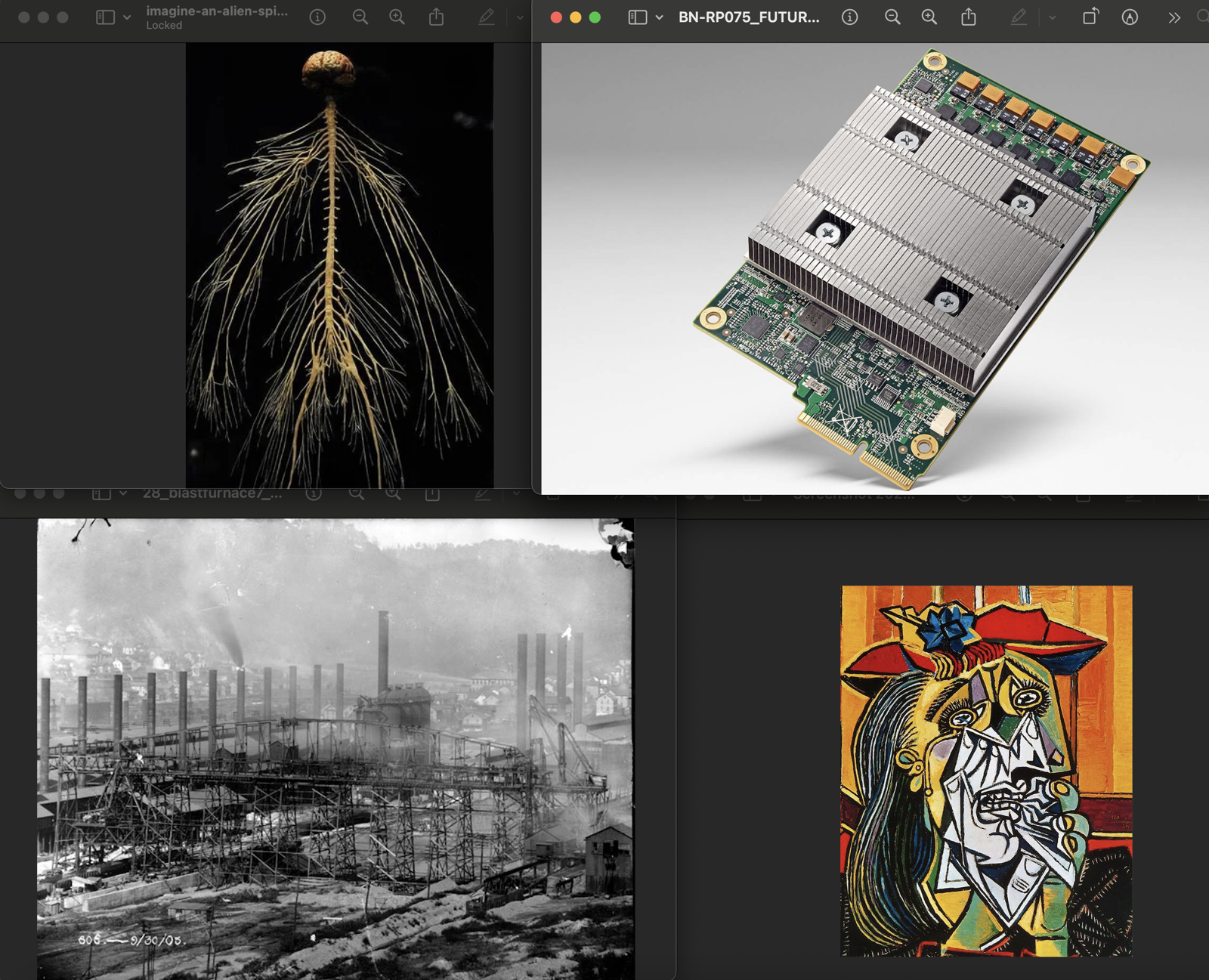
And so when we see Picasso, Picasso’s Weeping Woman, or when we see Nude Descending Stairs by Duchamp, we’re looking at the human psyche being fractured perceptually by the onset of industrial technology — which is now creating an entirely different mode and model of and for perception, which is also the breaking of the human nervous system… and the human nervous system being thrown into increasing degrees and orders of chaos… and being forced to hypertrophically adapt, which is to say break and resemble, then break and resemble with every exponential advance of space and time.
Increase of speed, condensation of time, that the human nervous system is being thrown into an evolutionary chaos, equivocal of a species level paradigm shift, state change, as in a potential — elucidating this now in the year 2025 — potential entire phase change of the order.
14:39
The genetic order, the evolutionary paradigm of the human being itself, through the epigenetic scaffolding of the neurology of the human being, as in the experience of industrial technological modernity, which is throwing humanity into a crisis.
And this is a literal limbic, synaptic, neurological crisis. It’s somatic, it’s physiological.
15:03
It’s not abstract.
And so — when you have the cultural disjecta from this moment, which we just call modernity, everyone from Samuel Beckett into Camus, which is to say the transformation from the early days of this industrial order, the early 1900s into the mid century…
This is all, it’s a refractory intellectual and creative interpretation. it’s a psychological projection, a symbolic experience writ and rifted from the neural architecture of humanity in direct epigenetic relation to the industrial technological explosion proper. It’s refracted imagery of the real experience of this real process happening and reorganizing in a millennially dormant genome. It’s catastrophically violent process, documented in real time through the cultural artifact of mankind’s most sensitive perceptive vessels, organisms, artisans of language, thought, image, word, and symbol.
15:33
It’s Wittgenstein’s linguistic problem… projected from the nervous system transformation as in the reaction of the human nervous system to this outstanding exceptional force which is technological modernity — as it continues to exponentially grow into the 1950s with the the dissection of the atom bomb as a phenomenon and an event.
It is a human nervous system response to the calamity of technological modernity.
16:02
So when Beckett says, I can’t go on, I must go on… and the profound confrontation, existential confrontation in Sartre and Camus — we’re talking about the sensitive, neurally attuned, embodied, experientially founded and based human being coming into relationship with the real technological architecture of modernity. This is an architecture conflict of orders of magnitude of incompatibility. This is an experience of the rocket ship afterburn in the face of a chimpanzee.
It’s an epigenetic experience of the circumstances of modern life.
16:36
Which is being transfigured and translated through the specific neural outcomes of the sensitive individual.
And this is what forms the art or the philosophy or the literature of modernity proper. Just as much as we could point to… as we did prior — to Mary Shelley or Edgar Allan Poe or Charles Baudelaire.
17:00
These are figures on the cusp of modernity that are experiencing this shift, much in the way that there is the animal sensitivity before a volcanic eruption. It’s anticipatory; emergent.
And this experience, this precipitation is being output in the product of this deep psychological unconscious sludge of the human psyche being brought to bear in the mirror image of the illuminatory light of technology, which is hyper accelerating humanity and projecting a spotlight onto the mask of its animal nature.
The mask of the great dirge of human history and unconscious, somnambulistic evolution and revolution, which has been fattening in a utero for millions of years and is reaching the point of hyperspace acceleration as in a technological rocket ship into modernity — which is throwing this slow growth of the nervous system into absolute primordial chaos on the verge of utter destruction.
18:13
And this tension and this tensile paradigm is no more apparent than the birth of modernity as a cultural artifact — because it’s a total splitting of the aspect and constancy of style.
Which is again anticipated by a figure such as Percy Shelley or Mary Shelley.
This is pre-revolutionary work, which is the splitting and fragmentation of style.
18:42
Into the modern age — with a figure like Mayakovsky or... figures as diverse as D.H. Lawrence. Because the architecture which held culture as a predictable subliminal form… of communal architecture, as in — whether that’s the genre or the form or the cultural artifact of the ideology that is being communicated, or the idea, the reasonable idea…
Is tied directly to a consensus experience of a consensus time, which necessarily binds the tribal cultural or civilizational unity together.
It’s a collective participation in a somatic architecture of being.
And this is what at a real neurological community is, or real neurological level is, the hormonal and chemical architecture of the community itself. It is not only a collective biological construct as in a species; therein coordinate synaptic architectures and speed-of-firing models as in cognitive intelligence or sensory acuity… but the way in which those pathways are ritualized through culture, religion; the patterns of life which cement behavioral expectations into the epigenetic code of the lived experience; which are then writ and grooved linguistically into the genome proper as in the organism’s expectation and experiential reality, world, and subjective architecture of the real.
19:55
Culture, civilization, community… as an organization… which is organized around co-regulation of the nervous system. This is down to the level of language and story. It is also genomic. This is everything from the mythology to the story to the craft as in beads or as in baskets or as in mosaics. This is the communication of a collective architecture of the culture, even the Greek fresco.
Even something like the pyramids of ancient Egypt. This is a collective cultural project. Understand… belonging is neurological.
20:27
A collective cultural project… which is a consensus distillation of values.
And that distillation of values is a psychological projection of the co-regulated nervous system of the community.
And when that’s fractured and that’s broken by the hyper acceleration of industrial technology and factory, which is an absolute shattering of the prior conditions down to the light bulb as a way of breaking space-time, breaking the light of the sun and the light of the moon and making day a constancy, day an eternity….
We’re talking about the neural and limbic architecture of the human being being thrown into absolute primordial chaos, first before civilization, first before culture and first before community. First before the genetic and story that bind the architecture of the human being to a sense of time, place, form, regulation, sensitivity; a sense of being in the world and being in the self as in being in the body.
That this architecture itself has been shattered down to the root of subjectivity — and that’s precisely where and why modernity makes its incursion.
21:25
At the fracturing of the Cubist perception, the subjective perception of the individual… because that is how deeply the human psyche has been fractured and fragmented neurologically.
And so when that fracture occurs, we’re talking — we’re going down to the level of pre-culture, pre-civilization, pre-ancestral, pre-familial, down into the direct experience of the organism being fundamentally ruptured from its habitat ecosystem and environment. The literal genetic language of nervous system regulation of the individual no longer computes. This is millions and millions of years of predictable codified architecture in a dormant natural world with tigers, undergrowth, wood, fire, script, story. It does not account for the rocket ship of technological modernity. It is the emergence of alien consciousness from within the undergrowth of a nigh un-disturbed technological jungle of sheer aeons. This is a code rupture experienced neurologically.
It’s a language… which has become outmoded by the very technology it has produced. And as such can no longer exist, in proper.
22:18
And this is the grand calamity of modernity, which is grappled with by each of the great modernists themselves across all forms. Because it’s a breaking of the bonds of the forms themselves as neuro-linguistic consensus realities. This is the creation formally of a disciplinary architecture as a cultural silo of ritual predictable linguistic terms, forms, architectures, jargons, et cetera.
And it’s been thrown and shuttered back onto subjectivity.
22:47
So this is the emergence of a thousand different genres, a thousand different themes and styles and architectures, which is the breaking of the bonds of the genre itself. Or the form itself. Because as Yeats says, the center will no longer hold. The center meaning the atom, the self, subjectivity, the civilizational hold, the castle, the central architecture of meaning as in the human being story. It is all rifted and collapsed by the hyperspace of modernity. It is a blasting off from the nervous terrain in a before and after cine-scope. A syncope of revelation which is a paradigm shifting shutter at the heart of human consciousness born from the human hand and mind unto a literal reorganization of its own register epigenetically. A technological hand which reaches back into man. This is unprecedented.
And it has no longer held — this center. And it’s thrown the individual back onto itself as civilization and culture and the neural architecture of co-regulatory community — those stories themselves have been dissolved by the radical awakening of industrial technology, which has expanded the borders and bounds of the world. It has broken the former co-regulatory bonds. Its a molecular dissolution of expected forms, revealing the field breach in and behind them as a phenomenological appearance of coordinates.
23:17
And this grappling with this loss… is everyone from Beckett to Woolf to Picasso to Duchamp.
It’s the grappling of the loss of the individual become isolated in the void of the death of culture.
23:39
Which is the death of co-regulation, the death of community, the death of civilization, the death of that which once held humanity together. It is even the death of the nervous system stability.
The dependable architecture of the nervous system stability in co-regulation with its natural habitat.
24:00
This is genetic.
24:04
The nervous system at birth is programmed genetically to seek certain stimuli, to seek certain responses. And when that the architecture of that genetic nervous system reality and construct of the human being is born into a world which is utterly unrecognizable…
It’s a problem of translation. The linguistic architecture of the human has been outmoded by technological modernity, and thus it must adapt or die.
24:44
And this is the problem of modernity. And this is what we see emerge as a psychological projection into the cultural image artifact.
24:57
And that is all in truth that modernity is.