Myth in History & Being in Time: Early Modernity and the Emergence of the Thanatonic Presence of Being
Video
Myth in History & Being in Time: Early Modernity and the Emergence of the Thanatonic Presence of Being
00:01
So I think the idea here is myth in history and being in time. And the way I kind of want to approach this is… we’ve really, really done a good job here establishing this sort of cellular architecture of being as it appears in history.
And the way to that and through that, perhaps in the most contradictory or surprising way, is through the contemporary American democratic cultural artifact as a historical material manifestation of these total spiritual powers which which emerged with, in my assessment and opinion — blinding clarity in modernity due to industrial production due to cultural production and the specific capitalistic powers of American civilization which are it is itself a machine of hyper production.
00:59
It’s a machine of the production of cultural images. It’s the machine of the production of a metaphysical system, which is becoming conscious of itself through its technological capacity, which again, this is everything from the telescope to nuclear fusion to the television to photography and the camera… to the news media machine, which is decoding and dispersing comic and superhero artifacts like Superman.
This is what we want to do in the work of history. And this is the beauty and the majesty and the sort of magic of history, so to speak, is it’s the appearance of the symbolic, the appearance of the revelatory, it’s the appearance of the archetypal in history through the cultural artifact — which helps us understand, retroactively, as a grand, cosmo-psychological species level process, what the human being is moving through in terms of ontological junctures in the grand journey of the revelation of being itself proper, which is the cosmological total, the totality, the logos, the whole, the superstructural… the essence and foundation and the character of the will itself, the characterological realization of the will as in being in time.
02:24
So we can think of this as stages and my next, my next notes, I was kind of thinking of this concept of Hercules and self overcoming and chasing the records such as maybe Joe DiMaggio’s hitting streak or Lou Gehrig’s game streak and talking about a purification of the will. But I want to turn this more toward… leave the cultural sub theme, let’s say — whether that sub theme is sports or whatever that theme is. And I want to turn it towards historical junctures, which is to say epochs, right?
And so what we understand very clearly with Hercules and what is understood very clearly in the ancient Greek… and again, it is no mistake that Hercules undergoes the 12 trials because the 12 trials symbolize the 12 segments of the historical zodiac. And of course, we understand now that the Greek and Roman names, this historiological concept of the mythical God or the mythological God, whether that’s Pluto or Jupiter or Mars or Saturn…
These conceptual archetypes of consciousness have been grafted upon the modern astronomical construct of being in time at a macrocosmic scale, which is to say the planets themselves and the large Kuiper belt objects such as Chiron that inhabit our solar system proper.
03:48
So we’re talking about… and this is the loss that we experience. It’s the dearth and the absence and the nihilistic cord cutting of the mythic thread of our ancestors, which is the ensouled wholeness of spirit, which is to say the entirety of cosmic time is wrapped in mythic time, which is to say the human experience of the psyche is inseparable from the grand cosmological spectrum of all of reality that we experience. And this is being in time.
So when you have this severance, it’s the severance of the heart of being, the essence of being, and so you have this sense of, again, as is so indicated in various different Abrahamic religions… it’s a replication of this ontological phenomenon.
We have been severed from this wholeness, this ensouledness of the cosmos.
04:40
And of course, what our modern science is doing now by way of a phenomenological physical analysis of the grounds of being, which is to say the characteristics of the human body or the solar system or the atom — it is undergoing a project which was already completed metaphysically in an ancient civilizational sense by the Indians, the Greeks, the Egyptians. You could even say the Mesoamerican civilizations… which was they already understood this primary foundational interconnectedness, which is a total ensouledness of being itself.
So we have left… I was talking to someone about this last night… it’s interesting that it comes up here again. We’ve left the Garden of Eden, so to speak, which is an ensouled cosmos. We have, we have vacated the seat of God, which is to say, to be totally surrounded by and within the powers of Being.
05:38
This was considered in the ancient Greek to be the breath, the numinous; the pneumenos. This is the psychic sphere, or as we could conceive of it in a modern scientific sense, the confluence of dark matter and plasma as the construction of the cosmos and the universe itself proper, as a ensouled checkerboard of phenomenological… that moment between life and death, which is the phenomenological overturning of that which appears to be.
And this is replicated at all scales. William James Sidis talks about this. And I want to talk about this moment in history because we’re talking about a radical break, which hilariously, really… is remembered while it is being forgotten in the astronomical terms of the way that modern science is a dissociative abstracted objected analysis of the terms of the being and cosmos and humanity and this loss of ensouledness which was signified by the great metaphysicians of our history such as da Vinci or Giordano Bruno.
The planets themselves astronomically have acquired the names of the ancient gods — and there’s a certain, there’s a certain… perhaps this is characteristic of the absurdity of modernity. There’s a certain just deep irony, which is self aware. And this is a sort of way of being or consciousness that always suggests to me an incompletion, a longing, a lack from that true source… that true force, which is the the authentic genuine unity of spirit in form.
07:34
And we have to ask, where does this ontological separation occur and how and why? And that’s a profound question. And I don’t necessarily know if that’s what this oration is attempting to answer right now. But I do want to situate this moment in human history, which is the early modern American civilization, the early 1900s to the mid 1900s, as a coming of age in a grand human species sense, thinking of American civilization as a… itself a radical ontology — oriented, however flawed in its foundations — towards an absolute liberation, a secular liberation, a free self determination.
And this itself, of course, being the myth or the dream or the ontos which is encoded into the American constitutional document, which then of course is replicated at all scales across all of America’s endeavors, processes, and its utilizations of different forms of absolute willing in terms of a radical renegade industrial capitalism, which regularly lapses into outright thievery… destruction, imperialism, colonialism — that America itself is the return of Rome, not only again in terms of the mapping or the grafting of the Roman gods upon the cosmos… which again, this is very specifically a Western colonial practice and process of grafting the Roman gods upon the cosmos, if you can understand this.
09:25
But also, in terms of the adoption of the Roman imperial and empirical method of absolute conquering and utter conquering, which to me is a distillation of the methods of Alexander the Great, who entirely, uncoincidentally, himself learns and is tutored by the great Aristotle, one of the first and most fundamental integrative and integral metaphysicians in human history insofar as we can remember it, Western civilizational history. Himself and his works being deeply remembered and encoded into the Western civilizational memory.
So we’re looking at, and this is something that of course, as is so characteristically important to this project… the common phrase or the idiom that America is a return of Rome, it’s a return of the Roman consciousness, updated and upgraded through quantum mechanics, sophisticated supply and distribution channels, which themselves are an expansion of the Silk Road historical archetype now mapped over the entire globe. It’s a method and mode of conquering where Hollywood and McDonald’s penetrate into the ancient civilizational mode of China or India…
And the tentacles of American capitalism as a process of the utter pursuit of profit as a way and form of completing a project of physical, historical, and material liberation, which is to say economic wealth as a political determination, a political... power mechanism.
11:28
This, itself goes deeply into what we discussed in the financialized nihilism essay and oration, which is to say that America — in its pursuit of this absolute total realization of the will, which is that the will towards freedom and liberation, even from the human being, even from life itself… this is a total, as Freud would term it, Thanatonic pursuit, which is a suicide mission or a mission of absolute destruction — unto a liberation, which is conceived of as creation.
And this is deeply metaphysical and this is deeply spiritually encoded into ancient civilizational rituals from the Mayans and Aztecs to the ancient Hindu. Even the most esoteric forms of Hinduism understand this as a profound rite.
And we see this replicated in modern history in ways which appear sublimely terrifying and catastrophic… because you can see the fundamental ontological project of the human will emerging itself from history through history to be revealed in time as a sublime second coming — which, as we discussed in the last oration, is Yeats’ second coming, which is that the march of the beast slouching towards Bethlehem.
The creature itself that emerges out from under the appearance of the human being willing doing, which is the ontos and the character and the force of will absolutely as an essence, which itself is super-human… necessarily proceeds and supersedes the human. The human is couched within it as a method and a mechanism of willing, production and the force of energetic recombination. Via genes, via the sexual act, that reproduces this slightly altered, glacially altered image or vessel. Or chink in the cavern of being itself refracted into form into time.
14:13
So this is a journey. This is a metaphysical journey. And this is why I brought up Hercules and the process of self-overcoming, chasing the record, so to speak, and a purification of the will. Because what history, is in its purest form… when you penetrate beyond... via the cultural object as a sort of hyperspace to understand and identify —
The cultural object is a production of the psychological condition, the metaphysical condition of the human being. It is the ontological orientation of the human being towards itself, peering through the veil of its own self formulation, which is to say its identity construct, its vision of being in time, its vision of self and world, its constructs — which are in large part informed by culture, which are also informed by experience, and which are also informed by the intersection of culture and experience, which is the actual bios, the biome and the organism itself and the genetic code which constructs it.
This is itself the aperture, the ceiling, the lens and the vision through which it peers to perceive reality.
15:01
And so what each human being is doing — and this is what’s encoded into the Greek mechanism and method of Hercules as the cosmic hero, is self overcoming toward and unto a purification of the will, which is a radical breach into metaphysical time.
Into the absolute, through space time as a process — and again Hercules is the action and the movement of the will through space and through time through trials. Trials themselves which are gates; gates which themselves are epochs — which are generative dimensions which are the coming about and facing of a specific ontological orientation symbolized and represented in the mythological and the myth mode —
Symbolized and represented in the mythological and myth mode as a coming about face to a specific archetypal form. Whether that’s the Sphinx with Oedipus, whether that’s the Hydra with Hercules, whether that’s the Nemean lion. We’re talking about, and this is what was so well understood archetypally in an ancient civilizational context — is that these gods and goddesses and stories of archetypal descent and return, as we discussed with Inanna or Orpheus... these are energetic dynamics at play in the human experience innately, again in an ontological sense.
16:45
We’re talking about pre and post history. History itself is the play of these archetypes as they are ordinated, as they are detonated… in the existing space-time field of being itself as it stands in this moment in time as a snapshot.
Of bodies in movement and bodies in motion, which are revolving, constellating, organizing themselves around the resolution and the resolve of these essential archetypal dilemma, which is space-time in relationship to the eternal.
17:22
So this is an organization most clearly elucidated, again, to use the Newtonian quote — Physics explains gravity, but it does not explain the one who is doing gravity or performing gravity. Newton was deeply Gnostic. Newton was deeply scientific. And we have to understand Gnosticism and science as the same thing, because Gnosticism itself is a epoch of metaphysics.
It’s the descent of metaphysics into history through the rupture of metaphysics from the wholeness of being, which is and was a total ontological project — into a disciplinary function, which is itself a control and power mechanism, which is necessary for civilization to perpetuate a vision of being. To narrativize a vision of being, and thus to attempt to obscure itself in the clothes and garments of what is brutally and deeply revealed in the early modern American and world civilizational conflict which culminates in World War II and the dropping of the atomic bomb — a total nihilism, which itself is the revelation that our myths themselves have failed.
And the reason that they have failed is not because they were ontologically or metaphysically incomplete… but that they were fractured.
And this fracturing is what is currently being resolved in human history.
If you can understand this, this is a moment in human history where all of the myths, which themselves of course are the same myth… because they are all a vision of being in time which is being processed through a civilizational or cultural architecture.
19:35
And all of these visions of being in time, and this is of course the great revelation out from under humanity… all of these visions of being in time are ultimately true, but they’re scalar. They’re at different levels of integration.
And this of course is the importance of the creation and advent of psychology as a formal discipline at the outset of the 1900s.
And this is what I want to explain and return to with Hercules and self-overcoming.
20:04
Because what we’re looking at with the self overcoming of Hercules is… we’re looking at a stature of being, we’re looking at a spiritual stature of being that — in these hard, phenomenological historical material conditions… this is a process. This is a sort of space time tunnel through which being itself is encountering and confronting the undigested unresolved historical time, grand genealogical material of its process through its becoming conscious.
And this is most clearly articulated in the evolution of the human being and evolutionary history of human being.
This is a confrontation of orders of magnitude in a descent into history. That fundamentally, as the being rises in a technological capacity to perceive the ontos, it is descending — it is falling into history to encounter the ancestral past.
21:16
And this is this is what is visualized and envisioned and scaffolded, staged — in the ancient Greek historical architecture of Hercules and the 12 trials of self-overcoming.
21:34
It is a purgation, an unlocking of the primordial will — purification of the primordial will, which is, again, as this descent into history happens as a total species level epoch, this ontos, this project of being in a Western civilizational sense — becomes esoteric Christianity.
It becomes Gnosticism. It becomes Alchemy.
This is an unbroken historical metaphysical project which is happening in real time… again in a historical material sense — but through alchemy or Gnosticism or ancient Greek philosophy or ancient Egyptian philosophy, theology and metaphysics, you have the conscious inquiry into this process.
Which in many ways this is why Hegel is so important. Because what Hegel is talking about and what Hegel is doing is providing the architectural backbone, laying this undeniable architectural stone into this project and declaring history itself is the movement of spirit in time, which is to declare — this is a evolutionary process of consciousness… coming to consciousness, awakening, revelation, which is clearly and deeply encoded into the modern poetics and modernist poetics of... we could say Eliot or Yeats.
Because what happens in a modern context, and this is why my focus is so clearly and strongly on this period of the early 1900s, specifically in Western civilization — is that there is the revelation of history.
And, phenomenologically, again, I will say that revelation is a culmination in the dropping of the atom bomb on Hiroshima and Nagasaki.
23:44
But I will also say that culturally it is a total revelation and it’s a total project. And we’re mapping this out in terms of a real resonance theory because you can understand perhaps clearer than ever before in Western civilization in the early 1900s… clearer than ever before, you can see this archetypal resonance of being becoming conscious of itself, which is to say a certain status of consciousness emerging.
This is in the philosophical work of Artaud, Camus, Heidegger, Sartre. This is in the Manhattan Project. This is in, as we discussed in the last oration, the creation of the Superman comic book. This is in the very real fraught architecture of Nazi Germany and the conflict that emerges from within Western civilization, which is the rearing of the head of the... absolutely sublime and terrifying force of will manifest in history.
25:00
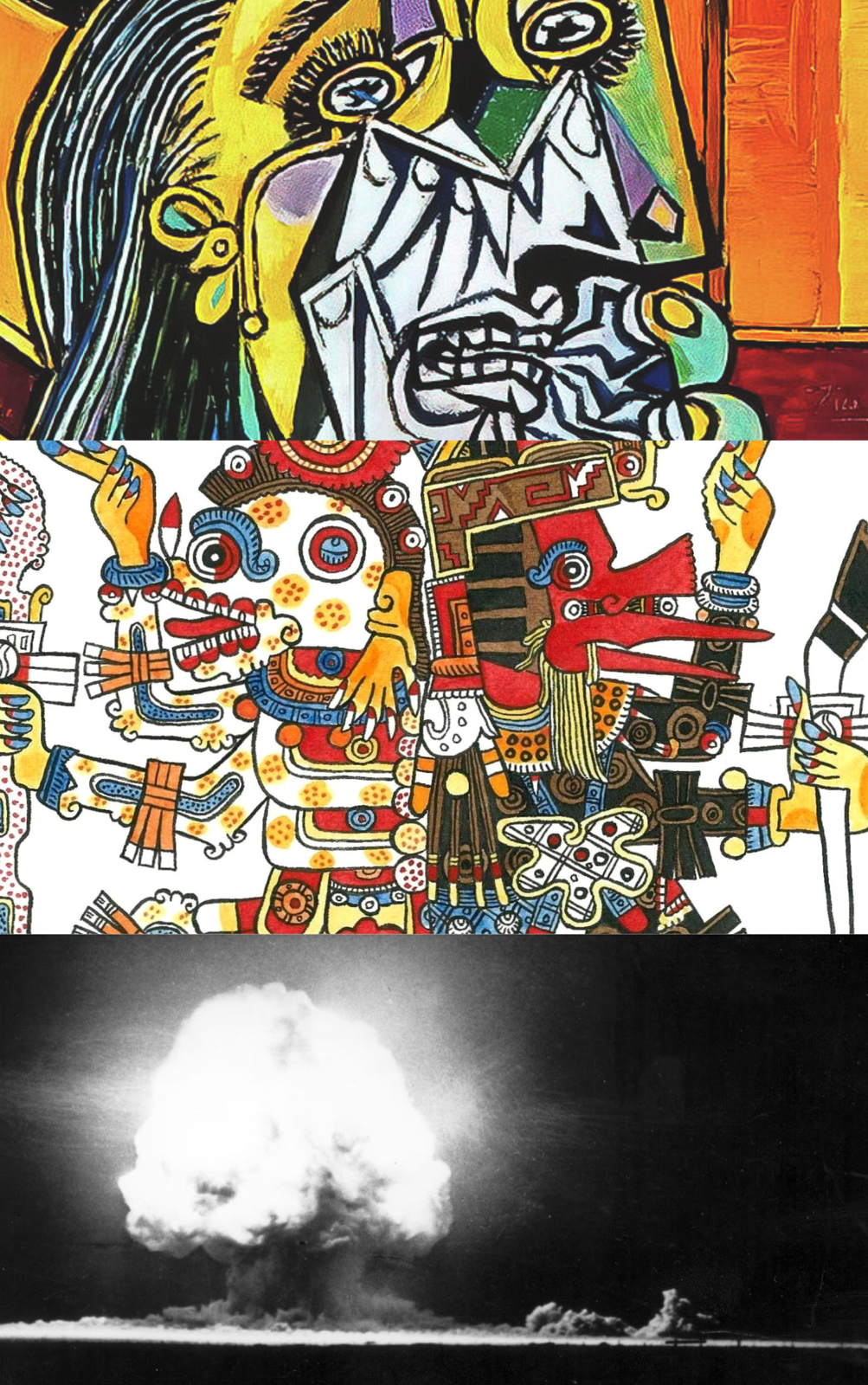
And so that’s really what we’re talking about when we’re talking about this period, which I’ll really say kind of culminates in the 30s and 40s, but is itself brewing all throughout 1900, 1910s, 1920s — which can be mapped culturally in terms of art, in terms of pop culture, in terms of Weimar Germany, in terms of painters like Otto Dix and the ruptures articulated by Picasso; the experimental modernist poetry of someone like Mina Loy. We can also discuss Virginia Woolf.
What I’m looking to articulate here and draw out and draw forth is a field. It’s a field and a psychological syntax. Again, Carl Jung, Otto Rank, Sigmund Freud. This is not, we are looking at this moment in time in human history where rather there’s a synchrony or synchronization of the species consciousness… and the emergence of an undeniable revelation — which as we articulated again in the last oration is the discovery of the primordial will, the emergence of the primordial will before there is or was a language to articulate it beyond the ancient mythological constructs, or in the case of Superman, the pop cultural democratic constructs as archetypal visions of the emergence of the terrifying sublime, which ritually reorders and reorganizes human consciousness and in many ways is an abolition of humanity itself.
27:12
And we’ve carried this revelation into what would be described today as the utterly contemporary moment of 2025. And this has been, this psychological architecture has been entirely incorporated into the American civilizational ethos.
This blind force of will has been utterly incorporated through the industrial and now hyper technological methods of organizing American civilization and society.
And this is something that is perhaps only closest to the Aztec or the Mayan cosmologies in a Mesoamerican sense. This is, in the most clear and coherent way, a Western hemispheric civilizational revelation.
Which if you understand the ancient Greek, you understand that the ancient Greek is indelibly linked to the ancient Indian and the ancient Egyptian. We’re looking at a splitting of the species brain mapped into cosmic time and onto the terra of the earth. This is a very sophisticated tectonics; an archetypal, architectural symbolism of human history manifest in the convergence of the East and West as metaphysical architectures and archetypal encounters of being and becoming and the minotaur that rests in the maze at and upon the movement of the ancient wheel of the cosmos; the cosmic horror of time in the face of eternity.
The cosmos or cosmology of horror as it is manifest in the foundational organizing myths of the Mayan, the Aztec, the Indian, and the Egyptian. And what these cosmologies of horror are is — through death, through the utter consumption, through the utter revelation of the will as a razing… as a Thanatonic presence out from under history — history itself, which is the attempt to propagate…
29:07
Again, when we talk about history, we’re not talking about time. We’re talking about an anthropomorphic vision of time. The experience of the anthropos as a force in time. This is not being in time. You understand this. Being in time is the metaphysical aperture of the totality of the essence of existence, manifest in all places in all times, through which the human being emerges as a sort of ontological brand.
A star itself within this grand star system, so to speak. With a much shorter half-life.
29:18
So this is humanity, as is so clearly articulated in the Mesoamerican architecture, coming to terms with this profound impermanence in this grand nature of the force of will, which necessarily has, again, the Janus-faced quality of the goddess Kali in the ancient Indian.
The Janus-faced quality, which is a total sort of... merciless destruction. But also this serene presence, which is the revelation, which is most clearly articulated in the Heraclitean axiom of the cosmos or the Aeon as a child that played with colored balls.
And to understand this is to the core of the psychological project of Western civilization as it emerges in the early 1900s, and what it is perennially negotiating — which is the human experience, the human desires, drives, and the architecture of its perception in the face of the superordinate will.
30:29
The superordinate will which is an absolute totality, which is refracted through and manifest as and clothed as the aperture of the human being, which is attempting to reach back up through itself toward the total ontos.
And this again is the project of all life because all life is a reflection or refraction of this grand will. And this is why in a Christian contemporary sense you hear man is made in the image of God.
31:07
So.
This confrontation, this is a confrontation that is far beyond mortality and even far beyond existentialism as a philosophical construct. This is a confrontation which is only historically clearly articulated in the esoteric Hindu, in my opinion, with the Smashans, the Smashan Tara, and the ancient Mesoamerican in its cosmology.
And the reason for this is its unabashed encounter with death. And the necessity, as clearly articulated in these two traditions, and I’ll add Egypt and the Tibetan here in this regard, the necessity of the encounter with death.
The total encounter with death, which is to say the ontos of death and the necessity of death in the approach of a true ontology, which is to say a total cosmology of the human being. And as such a revelation of the true powers of the human being. And this is why Superman is so important. We’ll get to that in a moment.
The emergence of the archetype in the archetypal form and force of death, particularly in this case, mass death or mass destruction or calamity or the apocalypse, which itself is shielded in a religious sense by the fear of such an occurrence. Here, we’re not talking about phenomenologically manifesting these conditions. We are talking about having the archetypal encounter with the beast or the demon or the daemon as it would be described in the ancient Greek.
32:56
And the reason that this terminology is so important is it is to reach back into and down through history to identify at the base level of the appearance of the form of the organism the ritual architecture of the will, which itself is survival, death and consumption. And this is why you have the importance of the snake as an archetypal form, as an energetic form in human history across different metaphysical, cultural and civilizational traditions, which are articulating this ontos.
This is the purpose of all myth, is it’s the religious civilizational mythology of the appearance of and the architecture of being in time, the attempt to elucidate this.
This is also the total primal animal in the grand architecture of the cosmos, intimately aware of the thermodynamic and metabolic fragility of its own presence in nature. The bare thread of the genetic code which holds it together and ultimately it is entirely programmed towards carrying forth into time.
34:11
And the Gnostics understood this as a prison constructed by the demiurge or a demiurge, a controlling God.
34:21
These are all attempts to reach back up through history and time, to perceive the current prism of the state of consciousness, the psyche of the human being or of humanity proper — to reach back up through time and identify the originating ontos, which is itself the total freedom and liberation of the human being into an entirely ulterior and superordinate architecture of the perception of reality. An entirely ulterior and superordinate perception of the true identity.
And again, this is the liberation project of all of life.
34:59
And so when we look at Superman, or when we look at the 1930s, when we look at existentialism, when we look at Picasso or Otto Dix or Weimar Germany, we’re looking at the explosion of modernist political projects out from the ground of agrarian history through mass industrialization, through hyper-technologization, through the hyper-drive of quantum mechanics… through nuclear fusion — unto the revelation of this entire psychic status of revelation into form with the atom bomb.
The appearance of this spiritual status and psychic revelation — which itself is equivalent to an apocalypse of consciousness if you can understand that… through modern industrial quantum utter upheaval unto the foundation of existence itself, which is the ground of nihilism, which is the ground of the abolition… the total of overturning of values, identities, visions of truth and reality to reveal the superordinate via the appearance of the sublime in space time, which is an abolition of the former… an abolition of the prior and the revelation of an utter abyss which humanity falls into in order to grasp the ontos within it.
And this is the spiritual project of the descent and return as it is an archetypal architecture of the human psyche. It is a total death of the being unto and until which the being itself grasps this profound and inherent embodied ontos within it. And this is Camus’ quote where he said in the midst of a eternal winter I found with me an invincible or undying summer.
37:04
This is a summation. It is a modernization in the same way that Beckett modernizes Shakespeare — it’s a condensation and distillation of the spiritual project of all of human history… which is to say the revelation of the ontos as an embodied totality. A presence of being.
Which is then itself as it is in uncovered internally — the entirety of the cosmos, revelated in all places, in all things. And this is as Bruno says, God is in every blade of grass.
37:44
This is a total emergent ontos… and necessarily in that revelation, there is a total overturning of the constitution of the human consciousness — in a revelation which is superordinate of the ego, which is the system of a, we’ll say a narrative homeostasis of the human body and a ritual project of telling the human story. Which again is manifest in every civilizational project.
It’s an overturning of that attempt into a total presence of the will.
38:26
Which itself necessarily is the Thanatonic presence in history itself, which is the attempt to ritually… and ritualized destruction, ritually destroy humanity, the cosmos, the earth to reveal that which is out from under it.
But this is a misplaced application of the will — because it’s to place Hercules in history. If you understand this, it’s to place Hercules into historical material space-time and to rearrange the tectonic architecture of the Earth or the solar system or the cosmos — as opposed to working with the force of being itself as it is manifest in the human life — which is to say the will, which is to say the psyche.
To work with that primordial material of awareness, to purify it at the forge.
And Marie-Louise von Franz says, sitting and roasting in hell is what produces the philosopher’s stone.
And this is really exactly what we’re talking about here.
39:49
So there is this overturning that is happening at this period of time that is utterly reshaping the terrain of consciousness, enforcing an alchemical primordial descent of the human being into a Mesoamerican consciousness.
And when I say Mesoamerican consciousness, I mean a descent into the death of humanity and a revelation of the birth of the will out from under it, which is necessarily a period of profound nihilism, loss and absence of meaning and value, which is itself a tunnel… a historical tunnel out from which emerges and will emerge the total ontological presence of the will, the force of the will — the cosmological entity, which is that which assembles the architecture of humanity through glacial history, genetically, biologically, chemically…
But is also that which is the architecture of humanity — constructed through the colored balls of the atomic and genetic architecture, the molecular architecture, cellular architecture of the human being and itself of the cosmos.
41:31
This returns us to the Newtonian axiom.
Physics explains gravity phenomenologically or describes gravity, but it does not tell us who that is. And this is the key that only scientific genius can elucidate… in the same way that we talk about Giordano Bruno, although he is much more historically forgotten, perhaps because he was more esoterically inclined… or more esoterically apparent than Newton’s work in the purely physical, purely material.
42:10
And this is the project of metaphysics, but it’s also the project of history. Right, and this, this returns us to our essential statement and the inquiry and the curiosity here, which I think is the most interesting project. It’s the revelation of being in time. And the revelation that history itself is really a codex. It’s really, it’s really a code of different objects, cultural objects, detritus. The charnel house of being, so to speak, or the ostraca of being — in which being itself has inscribed on the potsherd of history, this psychedelic psychological resonance. It’s a super structural resonance chamber through which humanity is intimately engaging and in each moment in space time, we’re witnessing a revelatory revolutionary movement toward the ontos.
Which is necessarily, I mean, you could visualize that phenomenologically as an apocalypse or the end of humanity and these various different calamities which are ritualized in culture or discussed religiously. And many people believe these things outright in a literal form.
You could say this is the end of humanity physically. I would say that this is the end of humanity psychologically.
43:34
And in the ritual revelation of history, which is the progressive overturning and underturning of being itself as the force of will which is super structural… as is represented both in Superman and in the Aztec cosmology, the Mayan cosmology — humanity is forced to and toward, progressively via scientific revelation, via experiential revelation, via historical revelation, such as the atom bomb.
Via the necessary modifications that humanity progressively makes in this navigation of that which is set out before it, this progressive revelation of the will.
The stripping away via increasing enhanced clarity of the true picture that it inhabits phenomenologically. It leads us to the Newtonian project.
Which is why… Newton is so absolutely important in so many ways, but which is why the character of Newton is so important — because in many ways he symbolizes the human project itself as it is located in early modern and modern Western civilization, which is to say the unity of the phenomenon of the appearance of being and the character of being itself.
The appearance of the beast slouching towards Bethlehem and the character beneath it.
45:08
And this is the necessary encounter with death. And the Indian Smashan, or the Mesoamerican genealogy and its subsequent implementation of traditions in the most literal and phenomenological form, which are the approach of terror.
This is the historical power in a very visceral physical embodied experiential sense of the eclipse or the sacrificial rite.
45:46
This is to be the revelation out from under — the appearance of life, the vision of death, which shatters and births a new ontology as an apocalyptic revelation of being itself.
And this is precisely what is experienced in everything from Picasso to World War II to the explosion of globalization, which is the shattering of cultural and civilizational architectures, which produces an immense amount of conflict and friction and tension.
As well as the atom bomb. It is the emergence of the total powers, as in the solar powers, as in the thermonuclear powers of being… the absolute essential chain of ontos that is, as it is manifest phenomenologically in a universal cosmological sense, upon the field of the everyday — and the explicit effects that it produces in history and in time.
46:50
The atom bomb itself is deeply psychological. It is itself the revelation of the psyche just insofar as it is the revelation of the cosmos. Because each are and is a product and a microcosmic and a macrocosmic manifestation of the universal mind.
And this universal mind is itself a resonance chamber, a revelation chamber… through historical phenomenological deep time conditions, their perpetual emergence and overturning as an experiential revelation encoded on earth in the genome unto and toward that which shatters, but also that which makes possible — absolute, absolute ontological liberation.
So that’s what I got. Catch you on the next one.