On Collecting and Curation as the Redemption of History and Time
Video
On Collecting and Curation as the Redemption of History and Time
00:00
So this is going to be on collecting, curating; the purpose of the museum. So as I see it, the ideal or the intersection of those three principles — collecting, curating, and the museum as a function — is the restoration of forgotten or underground or denied history.
So I see the museum as an institution… as, really, at its best… a grassroots organization or even an individual pursuit as in the creation of a museum as a way to restore through the function of an artifact which remembers the historical truth, the full body of the historical truth. So we know today museums as institutions with hegemonic imperatives. And what I mean by a hegemonic imperative is that it has a ideological or hierarchical method. It's a way of sorting and sorting through history to prioritize certain elements, moments, forces, factors, and parties and groups of individuals or political phenomenon or historical events.
The real function of a museum of truth or a museum of the scholarship of history of truth, so to speak, is to restore out from under these hegemonic narrative constructs of meaning, meaning, right? So it's to leave or remove from the institutional imperative, which is always either and or, donor-backed or public as in governmental — whether that's federal or state or whatever sort of governmental entity — pursuit of a collection which is attempting to explain or document a historical moment or a series of historical moments.
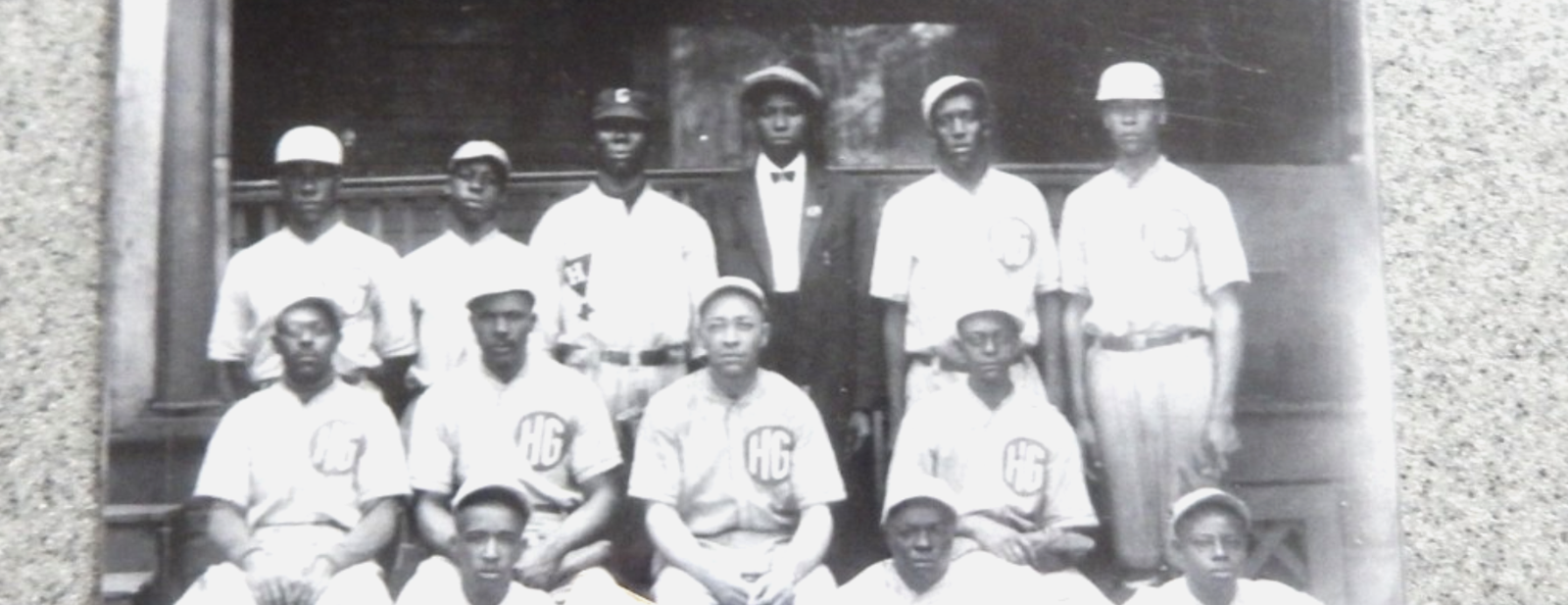
So what I have here is it's actually a reproduction later on in the 20th century, probably in 1950, of a photograph of the Harrisburg Giants from the early 1900s. We talked a little bit about Spot Poles already and the function of an artifact like this… is not even so much that it is a historical object proper, but rather that it restores a historical moment.
They're standing in front of what looks like a house. Casual posing in an outdoor environment. We're looking at the restoration of the entire historical body. So this is a project of the memory of the past or the recollection of the dead. And in order to thoroughly and fundamentally do so, there needs to be a counter narrative or an expulsion of the hegemonic constructs of the museum —both in terms of the priority of the historical object, as well as the priority of certain historical narratives — which function as dominant cultural and ideological narratives… to bring about the fullness of the body of the history through the disjected, through the abjected, and through the shadow of whichever sort of civilizational or historical cultural construct is being created in that moment in time.
So the museum is the functionary. It's the propagation of the ideological and cultural perspective that is dominant in the time. So it's the spirit of the age, so to speak, represented in the historical materialism of the objects that are collected, curated, and then the narrative or the expression or the idea that is being summoned through them.
04:10
So this is a way of speaking a nation or a civilization's past back to and through itself in the way that it imagines itself to be. Whenever there is an institutional narrative, especially in terms of a museum… because it's very easy to visualize the institutional narrative through the museum because it is made manifest in material objects.
The museum is a sort of theater of the accumulation of history, which itself is telling itself a story and then projecting that out into the public eye. The Smithsonian is a great example of this. And so the Smithsonian is always a contested ideological grounds because the Smithsonian itself is an arbiter and a propagator of stories — which stories are being told, which stories are not being told, and why, and what it means to the nation proper.
The Smithsonian as a specifically American institution. Housed, funded, donor-sponsored, publicly backed American institution. So when you have something like that, there's always an underground of it. And what I mean by an underground is a sort of ritual inversion of its meaning-making constructs. And that in itself is always already in reality the rich, dormant, subconscious soil of any sort of national or civilizational construct. It is the abjected, it is the refused, it is the beneath, the made underclass.
So in that way, a civilization is always already creating the death of history by way of exclusion. And that exclusion is a failure to include and encapsulate the full richness of the body of history.
And of course, that's a project that's always, always in construction because history is always accumulating the the charnel house of its existence, right? These objects, these historical memories, these images are always already being lost to time. And so then there is this process of perennial restoration, which is restoring the body of the past dead into the present day context, which is a remembering, which then, of course, informs us moving into the future because we have a better knowledge, a better idea, a more, fuller picture of the truth of the reality of where we came from and where we're going. Right? So this is crucial archival work.
06:45
So when we look at something like this, a 1950s reproduction of a 1906 to 1910s image of a historical black baseball team, the Harrisburg Giants, including this player member Spot Poles — who actually is from a town not too far from where I currently am, in Winchester, Virginia... what we're doing here is we're pulling this image. This is actually a pretty rarely seen image of the Harrisburg Giants. This image, which was reproduced from the original negative around sometime in the 1950s.
We're pulling this image back and we're... recovering it. And it doesn't necessarily even matter if it is a print from the original negative immediately, right, as in it was printed in 1910, as opposed to printed again in 1950. It perhaps even matters more that it was printed in 1950 because of the recovery effort of the historical memory and political consciousness of that time itself.
So you think about 1950, 1960 as the revolutionary lynchpin and the turning point in the American political consciousness as it pertains to race, racial constructs, exclusion, Jim Crow era segregation, and the massive political and ontological shift of the American identity through that aperture of revolutionary consciousness. This image is being summoned back. It's being brought back, summoned back through the original negative into that moment, into a new print context to remember.
08:18
This historical moment of the Harrisburg Giants as a moment of American black barnstorming, pre-Negro Leagues moments of independent grassroots organization of black American baseball teams. This is a, again, this is a perennial process of recovery. It's like a cyclical engine that moves through history and moves through time where we are always already attempting to recover the disjected, the denarrativized history, which has been otherwise excluded or removed from the collective social and political consciousness. Even the religious dream consciousness of a culture as a way of seeing; a way of being and being together. A way of remembering the birth of time; the genesis, the ontological genesis of humanity.
And so this is the real, to me, the real imperative of any historical, cultural, political project of ontological recovery of being. So ontological recovery of being is that these are already these narratives that have been propagated. There are already these narratives that have been restored. These are the dominant cultural or political stories of a civilizational identity. And that identity construct is always circulating as a popular mass context or construct or consciousness.
So what you're really doing then in this recovery project, both through the image that is printed again in the future, as well as a remembory (synthesized as a chamber of memory, or a laboratory or refactorialization of memory — a process occuring therein) of that… that's a good one — of that image primarily in just the fact that it exists again, it returns to exist again, and thus is recovered through this archival construct — which we talked about this in terms of Bohemia magazine and the return of half tones and prints that were made in the 30s and 40s as Cuba was reconfiguring its national identity and remembering this historical baseball past of its origins.
These were prints that were made 50 years into the future, which were recoveries of the original artifact, sometimes even photographs of the original artifact as it was decaying and was being lost to time actively.
10:12
So this is a national consciousness remembering itself, a political consciousness remembering itself, and thus restoring the agency of the past. And the agency of the past being the recovery of the image so we can commune with it actively. You have artifacts that are this function and are with this function. The fact that they remain or that they are lost or that they are disremembered from the larger political body… when you have a truly active, it's usually independent, grassroots, even in terms of like a single functionary who's performing this work. This is a — it's beneath the museum. So it's like an excavation of the museum, an excavation of the existing narrative propagations of the museum into a true political archaeology of history.
There is always, again, to refer to that base idea that I laid out… there's the museum, which is the light of day of historical and political consciousness. It's the dominant cultural narratives. You could call the museum popular consciousness proper. And then there's what's beneath the museum, which is the historical darkness or the unconsciousness of a population which has been disjected and forgotten and even refused in a violent way.
So these are the things that are actually deeply imperative to recover and restore to the light of day. So it's an exhuming, a political exhuming of the dead. There's such a high importance to that. And you can see that there's these different, especially magazines in the southern Western hemisphere or independent local libraries that are performing this work.
12:14
It usually actually is libraries or smaller local institutions such as like the Cleveland Historical Society — that are reprinting these artifacts from the original negatives in various different points in time in history. So when you look at that, again, this is a much smaller, more regionally active recovery of a local history. And that local history... I think in many ways can actually afford to be more inclusive because we're covering much less ground. It's such a specificity. So when I focus, for instance, on early modern baseball, specifically in the Western hemisphere, between the periods of time of roughly 1860 to the late 1930s, right, even if I expand that timeline, as I just did.
My normal focus is early 1900 to like 1916. Even if I expand that timeline, I'm still working within a very narrow aperture, which allows me to move much closer to the interconnected humanity, right? To look at that local network where images and figures and contexts appear again and again in relationship to each other within that very narrow aperture, a sort of genre or theme — a basic theorem of history and to just zoom in on that particular moment allows you to exhume a great deal.
So when you're spinning the web of a civilizational or cultural narrative that spans hundreds if not thousands of years and involves a wide context and a wide berth of different cultural phenomenon that are happening at the same time — as such is often the task of museums — you lose the thread of humanity by widening the aperture in an attempt to tell a story. The lens or the network becomes too wide and you risk falling into deep abstraction and worse perhaps you risk falling into a narrative political theology, which is an ideological construct, a belief system of how history functions.
This same principle functions in an expanding nuclear/nucleus sense in regards to civilizations and empirical constructs at large. They expand and thus fracture in the depth of scope; the inevitable loss of perspective which comes with the consumption of far too much in the pursuit of political power, control, dominion; the abstraction or digitization of unification. This is how empires and cultures and civilizations traditionally fall. They are abstracted from the local, grassroots origins, which is the direct intimacy of individual humanity and ecosystems and organizations at scale. It is far too difficult to define all jungles or wooded areas as a whole of the wildness of nature. But if you focus on a specific river basin or the Appalachian in the mid-Atlantic region, you might be surprised at the richness of death you can commune with in that process of deep specificity and material, local perspective and experience of vision and sensorium.
When you focus on a specific moment in time, in terms of just maybe the span of a couple of decades, even in a hemispheric context in relationship to one cultural phenomenon, the root system appears much more clear or more clearly in that narrow framework. And through that root system, you're actually grasping more macrocosmic, social and cultural phenomenon in that moment — through that moment, through the aperture of one specific cultural phenomenon, such as baseball.
So when we look at modernity in terms of the massive outgrowth of globalization, industrialization, et cetera, it's tempting to attempt to approach that from a wide span abstract perspective and try to understand it globally first. My argument would be this is something that you actually want to understand at the deepest most contextual local level and see how the root network spins out through a specific cultural or social or political phenomenon where you can find other examples of it littered across different regional moments and movements.
So it's like the connection of a synapse or a neuron. The neuron is looking locally and immediately to establish a connection. And we're using that same microbiotic context in a historical and cultural sense to establish real grounding and real narrative.
15:55
So this sort of, this real historical cultural project of the exhuming of history, which again is done, usually done so locally in terms of it's usually just one person. I was thinking a little bit about Walter Benjamin when I was doing this in terms of his theory and his work on collecting… is that you, when we are recovering and exhuming history, what we really are doing is we're informing our humanity. We’re working with the raw grounds of our humanity.
We're informing our humanity through the recovery of something that was otherwise lost to time and thus in exhuming it and bringing it to light; we are remembering it and in remembering it, we are restoring it to our narrative consciousness. So that creates a wider aperture, incrementally wider aperture of our understanding of where we came from and where we're going and the ontology of what it is to be human or what it is to be a being proper in a larger cosmological sense.
Myself, I'm always looking for the deepest, most forgotten, most unexhumed, the darkest part of history to bring it to light. Then thus to say, this is a part of this whole here, this is a part of the whole picture. And so there's even in a psychological sense, what we're talking about is the personal subconscious, the collective subconscious, and then even maybe a galactic subconscious of the psyche — which is the forgotten element of history.
Let's say even in an evolutionary sense, the furthest, darkest moment in the oceans, so to speak, from a human biological transference of information over time. You're looking at a genetic ladder or thread or a linguistic that's being woven across space time. And then what you're doing is you're going back into that and communing with it. You are seeking out the real historical experience of that moment and communing with it in a way that is deeply empathetic and compassion and bringing that, exhuming that back into the light of day and saying this moment then is also this moment now in the sense that history itself is never forgotten. It's just rather incorporated into the increasingly complex and compound body of the present.
18:15
Again, this goes back to what we discussed in terms of chemicals, elements, and the fusionary process of stars. This is a metabolism of history that through the ashes that are exhumed and digested and born again into the present moment — we're working with the same information biologically, genetically, and chemically that we were working with hundreds of thousands, even millions of years ago. But it's an information that is changing form over time. The aperture in the lens is shifting. We're experiencing these same compounds, but in new admixtures. So to recover these historical moments then is to restore the historical body of time proper into something that evermore closely resembles the truth of the infinite. So that time itself is a fragmentation and what is lost to time is never truly lost. It's just lost to memory.
So this is something that is a change of perspective and that to reincorporate the exhumed body of the dead or the disjected is rather to restore the wholeness of history and present a real image perspective and essence of the truth of the wholeness of being to the present. And so much of this does come back to images. It comes back to materials. It comes back to artifacts and objects because this is a way of communing back. It's a way of experiencing back in a literal sense, in a physical sense, in a sensorial sense — as opposed to just an abstract theorem or a remembrance that occurs specifically in a imaginal sense. Or metaphysically, or through a symbolic number or regenerated sign that is meant to symbolize the presence of a body or a form, or a theorem or formulae.
So we could understand, factually, a part of history, but without being faced with it — whether that's through an image incarnate or an object or an artifact, it becomes very difficult to actually understand the ontological weight in the body and the history of time. It becomes very difficult to immediately contextualize and experience the reality and weight and the true force and thrust of the spirit and essence of the ontology of being.
20:12
And this is what we discussed in the essence of time through Cuban photography essay — is that through the image itself, through the creation, the production, and even the reproduction of the image as a way of historical memory and preservation by archives and magazines and small independent museums, or even historians themselves, right, who are reproducing from these negatives to regenerate and rebirth the image…
Through that process we are given and renewed the body of history and time where otherwise it would be lost. So even when there is a flattening in terms of an image sense, the creation and production of an image as a light compound or emulsion on photographic paper, even when there is that reproduction, which is a flattening of the three-dimensional space-time reality of these figures that are organized in this place, in this time, in front of this house, et cetera.
Even when there is a flattening of that context and even a loss of the context in terms of which house there is, maybe there's a certain person that we don't — it's very hard to remember the identity of in terms of a name or a historical background or a biography. Even when that happens, there still is the remains and the remnants. And through that remnants, there is the possibility of exhum-ption, the force of exhum-ption, which would then allow for the force of historical redemption.
21:40
To be able to exhume is to be able to redeem history through the remembrance of the object, however corroded or transformed or transfigured by time or reproduced by necessity to maintain or remain one last or two last living examples of whatever artifact. That possibility then in the deepest sense is the possibility of the redemption of history through the remembrance of the moment that was otherwise disjected or lost to time. And that is the true responsibility of curation, collection, and the museum.
So that'll do it. Thanks for listening. Catch you on the next one.