On Vintage Baseball Radio
On Vintage Baseball Radio
The experience of listening to vintage baseball radio is a total recall of the past; a sensate recall of a prior dimension — as in a space and time bound experience of technology; emergent technological modernity. From the Gilette advertisements that pepper the early Brooklyn Dodgers broadcasts (my listening of choice), to the crackling of the broadcast that brought Dizzy Dean to the mound in Game 1 of the 1934 World Series — vintage baseball radio is an act of archival, digital preservation of the most immaterial of artifacts… the sound wave.
In many ways, the vintage baseball radio broadcast is the most primary and powerful form of the remembrance of early baseball history — because it manages to capture the tonal hue and energetic experience of turn of the century and early-mid century baseball in a way that a photograph or a card image or an advertisement can only symbolize — being a frozen density. Returning us to first principles in a cosmological sense, the sound wave allows for the necessary fluctuation to bring the game to life from a static entity to a warm state of thermal energy; a return of the signature of passion of days former.
This is an act of preservation… as I listen to Red Barber or recall the latter days of Dizzy Dean in the booth — the experience is of a register of being which is bottled and retained in the soundwave; retained cinematically in the sonic as a visualization project. For in sound and sound alone — as baseball radio is torn from the future revelation of the television — are we allowed and given the privilege of imaginative spectator; dreaming spectator. In the childhood bedroom, on the farm porch… with ear to transistor in the Ebbets Field cheap seats… we are given the transport of narration which elevates the game above the interspersed silences of kicked dirt, the whistle of a fastball, the crack of a bat.
In the narration of the sport, particularly by such a poetic and pastoral master as Barber, we are given the poetic key to being in time — a key which is a register which tells the tale of the game above and before it is played. This meaning that the game is an event which occurs in the silence of action; the interpreter and arbiter of the action is to color the game poetic; make the game and the field a theatre of a cultural register: to make the game relevant, particular, timely, and even existentially important as the warm sound of a human eye who sees the game as a literary device — an unfolding of the sweat and Herculean trial and the aesthetic dream of the ballpark — crafts the game into a higher register of seeing.
The fielding grace to Barber is ‘easy as a bank of fog’; great achievement on the field is ‘walkin’ in the tall cotton’. This is the aesthetic register of the American poetic vision, the fields of grain and purple mountain majesties as common to Whitman and the most ecstatic poetics of Dylan Thomas and Hart Crane as they are to the real summation of Americana in its cultural artifact. What is requisite in baseball is first and foremost its cultural register — its image devices, its iconographies, its cards, its artifacts — which declare baseball in the symbolic register as a way of seeing — as a specifically American poetics of being in time.
And why I evoke Barber as the representative device of the early American radio game is that Barber is both a poet and an arbiter of the real — in that he first and foremost colors the game with a linguistic sound which is painterly; tonally that of a musician — depicting a duel which goes to the heart of the rhythm of the American game as one both time and timeless… interspersed and stitched with moments of profound slowness and the ecstatic leap of Al Gionfriddo to rob DiMaggio in Game Six of the 1947 World Series:
“Here’s the pitch, swung on, belted ... it’s a long one ... back goes Gionfriddo, back, back, back, back, back, back ... heeee makes a one-handed catch against the bullpen! Oh, Doctor!”
Sound, in the American vernacular — and as is explicit in the profession of the color commentator — is color. It is depiction, just as the register of Barber, mentor to the coming Dodger great Vin Scully, is the height of the American vernacular and poetic register put to the airwaves of its main cultural obsession. Barber is to baseball what Kerouac is to the improvisational jazz piano — face flush as he leans over the black wood of the back case and rattles off lines from his great journey to the stars among America’s most lonely plains hi-ways — on the road to some final pilgrimage; firm belief. Always in process, with thick scrolls of revelation in tow.
Barber in the booth is what is required of American modernity, amidst the gritting hardship of its caesarean birth into a world of roaring industry. In just two generations, the mines are scrapped; the slow silver gelatin of Jake Daubert flies to the booming swing of Mickey Mantle — America’s last great industrial sun — as the way of the world changes from the plowshare to the factory to the digital computational device. In America, the way of being in the world is always already lost… slipping from the grasp of generations past. The old ways taught and handed down are already a day old; the modern world has already come and gone to a grand new device — leaving the once great factories of Ty Cobb’s Detroit and Honus Wagner’s Pittsburgh to corrode in vine, neglect, and fire.
Barber’s radio echoes like abandon, abandonment. It is the child lost in the game of a coming fury; an American obsession which only mirrors its own anemic Moloch of industrial civilization — where baseball is a passion in the shroud of grief, despair, and hardship. Barber’s very own internal conflict over broadcasting games with Jackie Robinson — the first black ballplayer on America’s sanctified professional stage — betrays the easy Southern manner of his poetic drawl. Baseball is a shadow just as much as it is a revelation — where the hard swinging register of the flying, rippling jersey of Joltin’ Joe’s number 5 ripples in the wind, trapped in the contrast of black and white film etched to photographic paper… just as much as Billie Holiday’s ‘Strange Fruit’ rings true in the legacy of it’s exiled greats — in the lives and bodies and Southern soul of Mobile’s Satchel Paige… or Josh Gibson’s heartbreak at the dawn of integration.
Baseball has required everything of America’s spirit, heart and soul. It is the record of America’s dreams, wishes, and true victories — etched and carved into the immortal history of gold in it’s great hall in Cooperstown, New York. It is simultaneously Viking and Greek — it is the compendium of the quest for immortality in the heart of the warrior upon the battlefield where war is an outmoded device; baseball is the technology of the penitent monks of Gehrig and Hornsby — honing their craft with a total, burning devotion. Because they see within baseball the possibility of radical transcendence — the freedom and liberation of the self in the devotion to the ritual practice of sweat; the honing of the body toward the smooth, full jazz of ecstasy embodied in Willie Mays’ ‘The Catch’. Deep in the cavernous solitude of the Polo Grounds… just like Walter Johnson or Christy Mathewson on the lonely mound — surrounded by eyes and yet indebted only to the leather and the raw hide of the canvas of the ever evolving skin of the baseball… there is a music in the body pronounced to the one who plays and the one who plays alone. And the crowd there bears witness — just as much as the music of the radio immortalizes its heroes in the imagination of the young; in the dream of the incredible ballet of form in aligned motion.
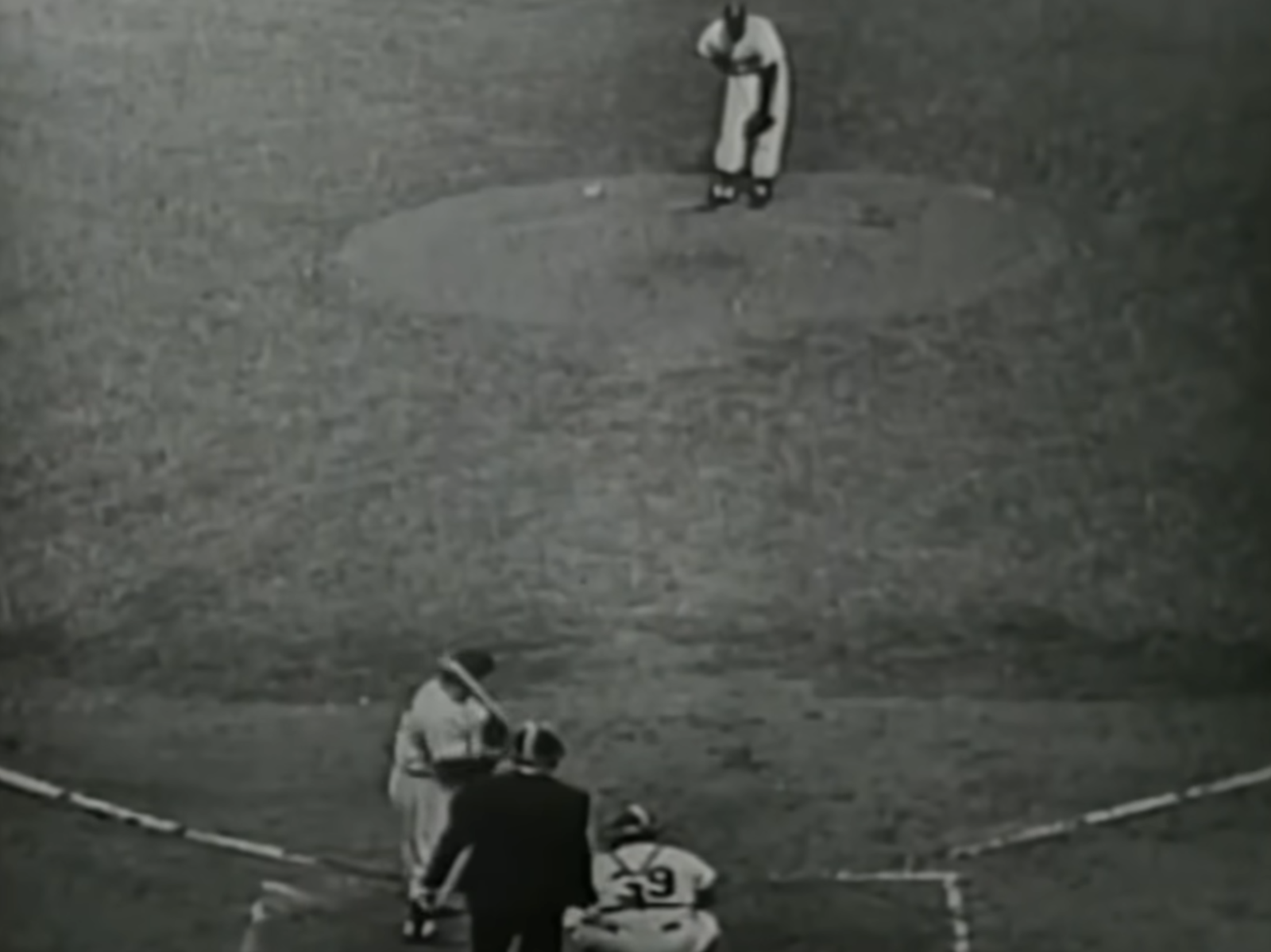
This is where Barber and Dean’s radio exceeds the image as a Greek form. Baseball stretches beyond its symbolic register — as it cannot be depicted. It is eternally in motion, even in its moments of stillness, which are undergirded by anticipation of the shift of the weather — the moment upon the palate or the tongue that is the sense of the turning of the clouds, the sensation of rain; the pitcher’s knuckles white around the ball as his pitch count climbs. In the early game, there is a battle against time, a stretching of the heart and mind and body against darkness. There is no light but the light which naturally gives and takes, turns and curves around the body of the Earth; baseball is what it must be, the play amongst it. And Barber — in particular — senses this heroism. He lets the game breathe with the interspersed poetic line which draws the game from a sense of flat immediacy into the poetic dimension. Regarding Joe Black in Game Seven of the 1952 World Series match against the New York Yankees, he condenses the entire energetic fulcrum, the push and pull, the struggle to the final moment of the season in a back and forth between Black and the Yankee starter Eddie Lopat — repeating over and over again a sense of witnessing for the exhausted Black, starting on two days of rest; the aging Lopat, nearing the end of his career. The game would go to 11 innings, with the Yankees thwarting the Brooklyn team once more — who would only have their culminatory moment and final victory of the Boys of Summer years come 1955.
Barber’s reverence for the pace and pulse of the game is stretches of absolute silence, crowd noise, and game noise — interspersed with metaphor which draws the game into the poetic dimension. Flat lines:
“… pitch is low, outside. Ball one. this is Reynolds’ game to win and Black’s game to win. Reynolds’ to lose and Black’s to lose — and the Yankees are ahead 2-1”
Periods of silence extending fifteen seconds… thirty seconds…
“Black fires on the mound. Low. Ball two.”
More silence.
“Curve fouled. Two and one.”
All there is is the clicking of the film reel; the warbling static of the radio, chatter of the crowd and players — impact of the ball in the leather mitt of Campanella.
Barber’s cultivation of the radio voice is the breath of the game condensed into sound — and the absence of sight… which evokes the imaginative mind. Even with the invocation of the black and white television broadcast by the year of 1952 — as referenced above — Barber’s space of the game is the dimension in which baseball is itself an atmosphere, a night in a country dell where the crickets and the low chatter and the organic wood and leather are the instruments of the music of the game itself, a lull and a sleep and a way of being in time which is entranced, entrancing.
This is what the radio provides at it’s highest with Barber as a technology — it is a transmitting and a transference of the power of baseball through auditory compression; it is the gift of the game in a space-less way to record; in this way it is much like what the particular music of an artist like Dexter Gordon or Bill Evans gives us in the mid-century vernacular of American sound — a full sonic plate of a room of a place; the uninterrupted stadium of a ballpark; the majesty of baseball when given away from itself in the primary and former register of its ingestion: the eyes… and revealed to be that which it is in a character of its fundamental voice.
It is precisely Barber’s power and the high radio power which is the power of the removal of speech; to allow the atmosphere or the space between the notes to speak. The technology and radio wave and the tuning of the transistor and the compression of the microphone and space of the stadium gives way to a unique form — a sound artifact which is not merely the game but the movement of the game through the emergent technological device which allows the game to be present and moving everywhere and nowhere at once; relieves it of spectatorship — returning baseball to the dream of the memory of looking at the silver gelatin relief of ages past: the Red Sox infield of 1916 huddled in smiles before the dugout after securing the league championship; just before the World Series… or the early Brooklyn National Club, lined up in a row as panoramic, cirkut photographic technology unfolds and popularizes in 1913 by top artisans of light capture and transference — being transcribed in the light of an expanding mechanical and chemical time.
These are audial and visual chambers of memory — which contain the fundamental sound of their era — an era of rapid change. And like Barber, the images of the past in their raw, original form — the first prints, artifacts and shards of the time which birthed their imagery — contain the raw essence of the whole, vastly shifting world and American aperture which birthed them. The faces of the miners, factory workers, farmers… and the honest, attuned voice of Red Barber — caught between history, narrating history; himself elevating baseball to the realm of poetic immortality.