Opening Sketch: Whitman, Twain, Thoreau & The Birth of The American Game
Opening Sketch: Whitman, Twain, Thoreau & The Birth of The American Game
00:00
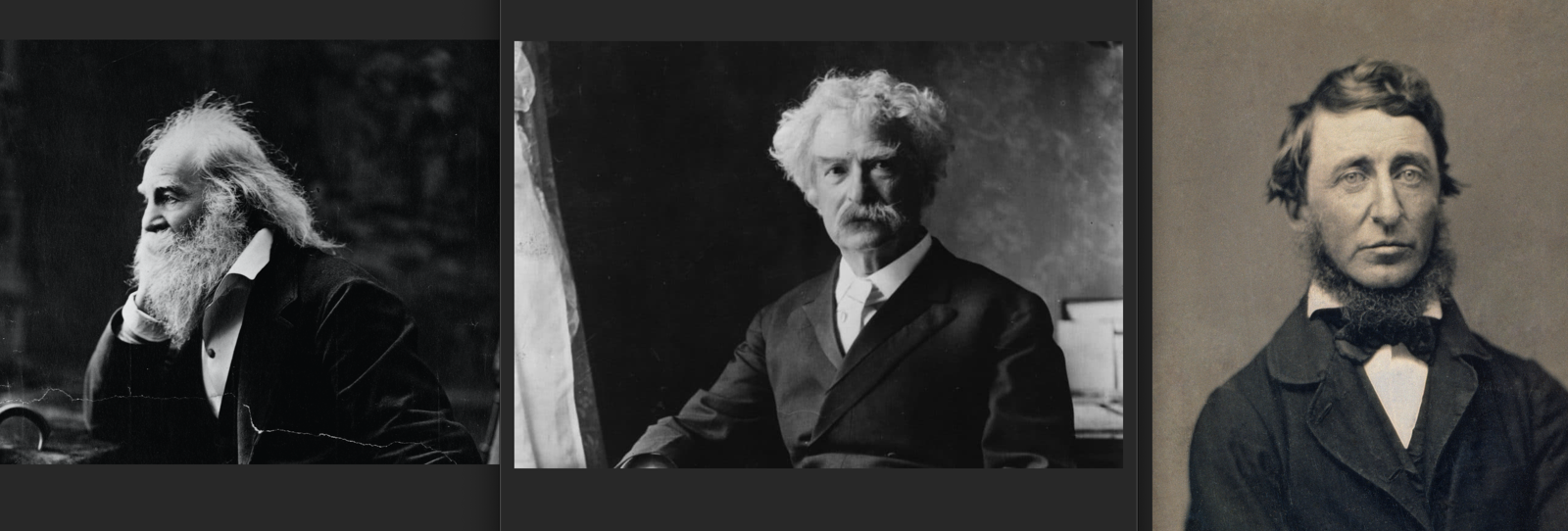
So I just want to wax poetic here just for a second on Mark Twain and Walt Whitman as early figures in baseball history — 19th century baseball history — and the intuition of the early American intellectual and the early American creative genius as it intertwines with baseball.
And I think my big quote here is by Twain at the banquet speech for the return of Spalding’s World Tour, where they went to Egypt, Italy, France; played baseball in front of the Pyramids, the Eiffel Tower; even attempted to play at the Colosseum.
Twain states the following — at the banquet for their return and celebration, in 1889:
Baseball is the very symbol, the outward, visible expression of the drive and push, rush and struggle of the raging, tearing, booming 19th century.
01:00
And you also have Walt Whitman, who worked very early on as a reporter for the Brooklyn Daily Times, often remarking on the early Brooklyn Atlantics baseball team. Whitman’s work here as a beat writer for the Brooklyn Daily is essential early documentarian work in baseball history. It is not trivial.
And also — too, during Spalding’s World Tour — he saw baseball as a possibility of uniting global culture, which is actually something… funnily enough, we’ve already been discussing here in depth. Bridging cultural divides globally through sport; through craft, character, nature, and play.
Whitman wrote quite a fair bit about baseball, as did Twain. Twain actually ended up becoming a part owner in the Hartford Senators in the 1880s — as he lived in Hartford; followed the Dark Blues (Hartford’s name prior to the switch to ‘Senators’) — one of the earliest American baseball clubs.
02:21
So I just want to discuss — this is so much a part of the late 19th century milieu of intellectual figures — both the Transcendentalists… even Thoreau, Henry David Thoreau. Thoreau actually remarks upon observing a baseball game in the mid 19th century in his journals.
And these are, in the deepest historical sense — clues… that help us begin to look back in time and understand the early origins of baseball, especially local baseball, as it began to increasingly professionalize during Whitman’s lifetime, Thoreau’s, and Twain’s lifetime; become the game as we know it today.
When the sixty feet, six inches, pictures mound to home plate system was standardized in 1893… as well as the progressive, as we’ve already discussed, formalization of the photographic image; portraiture through the photographic image; adoption of silver gelatin as a profection of the chemical medium.
And therein, the creation of the modern vision of baseball as a cultural archetype, which is predominantly conveyed via photograph. And this is the creation of a national historical memory; an insight into imminent history; a history of what is now over 150 years of practical, mechanical baseball imagery.
At least until the 1950s, with the adoption of regularly televised games — a visual language of movement and pixelization… and we are then deeply into modernity as a historical structure.
03:19
So I just find this very fascinating… if you start to draw a constellation of these essential early modern and just barely pre-modern intellectual figures and their connection to the unfolding of the sport of baseball — because we begin to understand, by way of this intersection of the intellectual tradition and the creation of the cultural archetype of baseball…
That it was being observed in real time by the greatest minds of America. And not just observed, but celebrated and profoundly moved.
The greatest culturally, socially, politically active minds that were interrogating the American soul; the human soul; the profoundly humanistic questions which plague everyone from Dostoevsky to Tolstoy to Emerson.
Again, in terms of the Transcendentalists, I was looking into Emerson to see if there was any baseball related information, but I couldn’t find any on Emerson… which was somewhat surprising to me — considering that he was much more socially and publicly active he was, far moreso even than Thoreau — where Thoreau has baseball documentation, however scarce, in his journals as documentation of contemporary civic life and emergent American spirit.
04:45
The realization... of baseball as being one of, if not the spiritual seat of, this period of the emergent American consciousness — as it moved out from the agrarian past of its birth into the industrial future of its formative years and its early and young adulthood.
And this conviction, both on behalf of Whitman and Twain, is a conviction that baseball is embodying the American spirit or the American soul. Is giving heart and voice and structure and expression to the American spirit and the American soul.
Here, another quote — from Whitman:
It’s our game. That’s the chief fact in connection with it. America’s game has the snap, go, fling of the American atmosphere; belongs as much to our institutions… fits into them as significantly as our Constitution’s laws; is just as important in the sum total of our historic life.
06:07
And this both of these quotes, interestingly enough, from Twain and from Whitman both emerge in response to the Spalding World Tour. It incites a profound philosophical reaction from within each of them. Twain comments on baseball as the spirit of the time; as movement — the embodied, emergent transition of industrial and modern consciousness; Whitman comments on baseball as a fundamental and foundational particular and elucidation of the American soul.
And I think the sense that the Spalding World Tour… in so far as the information available to us in the hindsight of history provides, denoted both to Whitman and Twain the real cultural possibility of a global literacy and a common understanding in the creation of this American cultural artifact, which is itself profoundly poetic; profoundly literary in the real history of its formation and its dissemination and in its participation — but is also in itself a great driver forward of the American character and the American spirit out into the world at this point. They are marking the anticipation of baseball being a critical global cultural artifact of emerging modern consciousness; not only that, but a critical global force — as these remarks are made in the midst of Cuban baseball as a revolutionary political national identity and self-making vehicle in the face of Spanish colonialism; unto the birth of baseball fervor in sites as diverse as Japan, the Dominican Republic, and Puerto Rico.
07:35
It is projecting… not only the contradictions of the time, as Twain elucidates: the push and rush and struggle of the raging, tearing, booming 19th century —
It is an embodiment of this stretching between the wood and the plant of the agrarian past, and the metal, steel architecture of the industrial future — which is the contradiction which hinges in the late 19th century. It hangs in the air just as much in France and Italy and Egypt as it does in America.
Just as much as baseball is characteristic of and depicting; born from the American atmosphere. It is born in the air of Elysian Fields; born in the air of New York City as an emergent global icon; new city of the world… and the particular spirit of the great whole which animates the industrializing American ritual civic life. And this is precisely the spirit which Twain and Whitman are at work in craft to actively harness, breathe, elucidate, digest, and depict. It is no coincidence that they are deeply entwined with the mass cultural ritual which speaks their language into formal, physical, incarnate being.
08:10
It is the American character… which is a regional, which is a national character in relationship to the period of the time. And this is something that is intuited by America’s poet and America’s primary prose writer.
This is no coincidence, because what both Twain and Whitman are doing is creating and seeking to embody or bring into being a transpersonal folk spirit, the zeitgeist of the early modern American spirit and the hinge that is breaking into the 20th century. This is native to the philosophical literary project as a reflection of and inflection into life as it is in place and time. An experience being brought to bear by the metaphysics of literature and the mirror of knowledge as a way of seeing into that which is behind the screen of the seeming slow creep of being into epochs and stages and phases of perennial transformation.
And it is the inspiration of this Spalding World Tour which reveals to them the possibilities of the future. The radical sight of the Americans at the foot of the Sphinx in the desert — or being ushered away from the Collosseum by the Italian government.
And these possibilities of the future are the possibilities of the expansion of the American consciousness or the American spirit out into the world as in an expression of the very soul that Whitman and Twain attempt to depict — in everything from Huckleberry Finn to Leaves of Grass.
A tradition of spirit bent in the particular American inflection which is then later inherited by the poet T.S. Eliot and William Faulkner on the prose side.
09:52
So this is the great question here that I think is so powerful about Whitman and Twain… they were not just casual admirers of the sport. Whitman was himself a beat writer in the earliest days of professional baseball. Just as Twain was a part owner in one of the earliest professional baseball teams in Hartford, where he lived.
This... conviction of cultural participation, which is the greater milieu of baseball history as an American history of democratic passion and participation par excellence — which of course is far outside the personal pursuit of the poetic and the prosaic; the intellectual and the abstract register, as in Whitman and Twain — suggests to me that what each of these two great American minds observes independently and experiences viscerally as an emotional passion towards the game of baseball…
Is a profound spiritual value in the creation of the cultural artifact of the baseball game — in that it is able to speak to and from and as the American soul which they are reaching towards in language and in symbol and in letter. Whereas the American game is a embodied depiction which is to say it is the cultural skeleton which provides form to the American spirit in a way that language can’t. It is the real infernal engine of the spirit toward which they gesture with speech, words, language, simile, image, vision.
11:57
The snap, go, and fling of the American atmosphere. Just as Twain says — the drive, push, rushing struggle of the raging, tearing 19th century. Baseball is the very symbol, the outward invisible expression.
So we’re talking about primary experience, which was incredibly important to Whitman and which is what the majority of his poetry is about. It’s the body electric, right? Just as it was for Thoreau. The real, raw, absolute — direct and unmediated experience of life. To know it truly; to know it, if it was mean, sublime… whatever it may be. And that this was the true quest of the spring of life for the early American transcendental mind. It was a highly natural, beatific quest that resided entirely and absolutely within the experience of life as in the experience of the body and the raw fuse and force of nature proper as in the lived experience of being.
And this is in direct relationship to the real nervous system movement and full body involvement and participation in the game of baseball, which Whitman advocates for… in ‘taking the national character out of doors’:
To go out and howl, swear, run, jump, wrestle, even fight. If only by doing so we may improve the guts of the people. The guts, vile as guts are, divine as guts are.
13:09
So you have Whitman and Twain deeply embedded within baseball history — which is already a central American history, as we’ve discussed — in that it is the embodiment of the spirit of American character.
It is the elucidation of the American character, the soul as emergent in the cultural game. But then we have these two predominant and preeminent figures — literary, cultural, civilizational; philosophical — men of letters… of the late 19th century, mid to late 19th century.
Utterly ensconced within baseball history itself, in their participation in both the media and executive administration of the practice of the game itself. Whitman the beat reporter and Twain the club owner. This direct civic involvement suggests to me, in relation to the lived history and looking back upon it, just how apparent this emergent importance of baseball was and would be — prescient; intuitively seen, felt, and heard — in both of these great American spirits, hearts, and minds.
To Twain and Whitman… this emergent game was not meagre ritual, but rather an imminent expression of the American soul — the American scripture writ and lived bare among and upon its pastoral fields, even as early intimations of skyscrapers and factory furnaces shot up among and around them. Baseball, unlike literature or poetry — was not merely a mirror to the American soul… it was its very skin, flesh, bones; nerves, and beating heart.