Partial Recovery of the Game
Partial Recovery of the Game
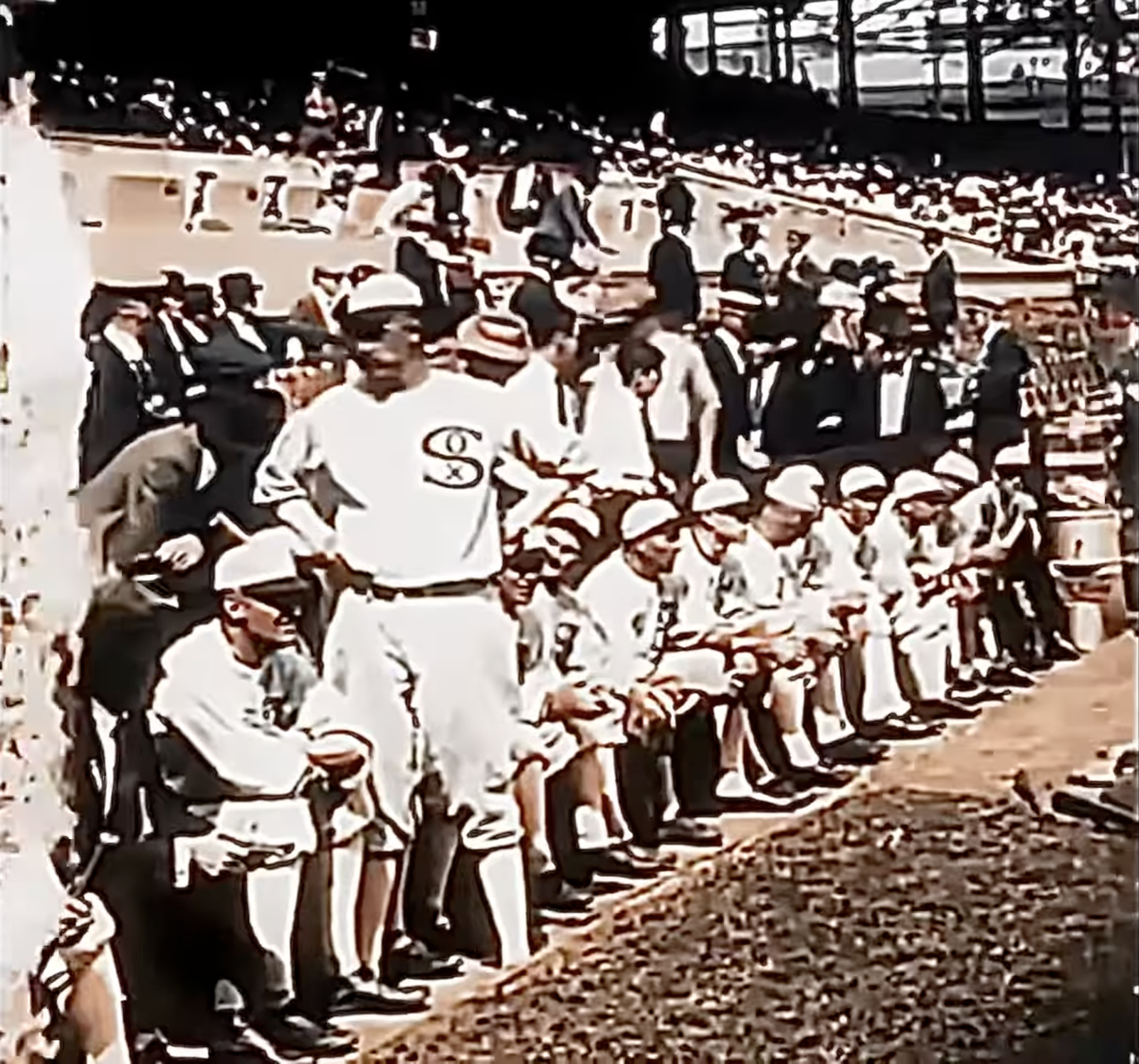
One of the most fascinating exercises for me is to dig into the full sensorium of what is available and remains in the archive of baseball historiography — the film reel clips; the radio broadcasts and snippets — in addition to the journalistic and snapshot photography, balls, bats, and so forth.
The news reel and radio clips in particular are the most revealing, due to the nature of corrupt file and failure to recover, digitize, and thus preserve in and for the public record and domain. Photographs themselves can be relatively easily obtained and viewed in the public market and institutional archives; balls, bats, and gloves besides.
But when more complex forms of media are introduced — namely reels and broadcasts, corruption to image and sound in the file and physical reel itself is introduced as an action of time, as well as loss as in failure to preserve the artifact altogether. One off historical broadcasts; reels tossed by film companies and broadcast theatres are here included in what is lost to record.
The corrupt audio and video files of the 1910s to 1940s are the most fascinating examples — as well as radio from the 30s. They are exemplars of loss of fidelity revealing the systematic corruption of history through time — wherein that which is retrieved is a fragment, a corrupt memory, an artifact which is a partial aspect of the totality of the passage.
These files skip, blur, color distort, drag, static, and fail fidelity. They are as such fidelious to the true nature of time in this failure; this corruption is the explicit revelation of the work of time within the artifact, even as it is digitized and artificially restored. Preservation of these historical artifacts runs counter to their slippage into the past; as such they emerge as sublime restorations of a past which can no longer be; a past which was surely forgotten — translated into a contemporaneous, digital, publicly accessible form across vast distances in space.
File corruption is a pure history of that which is always already partially recoverable; is most apparent and stunning in video form. Color drag and slowed, distorted speech on audio video files of the 1932 World Series or the 1934 All Star Game stuns viewers with the living form and corporeal speech of Ruth, Foxx, or Greenberg; all the while, the break in fidelity continually reintroduces conscious awareness of the break in time therein and improbability of technological recovery and translation of these audio video artifacts into digitally transmittable files.
These artifacts abide a very different, specifically modern code of projection; translation — waveform files compressed and encoded into physical architectures which must be digitally translated from their initial reel and airwave forms and formats. They are modern devices, far different from the purely physical artifacts of photos, programs, balls, and gloves. They are devices that may physically remain even as they become unintelligible — the code or transmission within them corrupted and irretrievable.
This is also the nature of what makes them multidimensional; moving images of historical time compressed into reel artifacts and tapes. That the script within them is read anticipates the code function of computational devices; the slow movement of technological history into a liftoff that mediates the physical object processing code to produce the appearance of an abstract realm of light, sound, color. This technological advancement occurs within and alongside baseball’s modernity project; fascinatingly, produces artifacts of baseball history and civilizational culture that cannot be owned or possessed — but rather are projections of light and sound in their most distilled and unmediated forms.
The photograph is light capture developed onto the paper; the glove, ball, and bat are physical waveform densities which remain firmly in Newtonian time. However, the film reel and the radio broadcast achieve transmissive liftoff in that they are read by technology; received by transmitter and projected by projector. They are intermediary mediums, mediums that require a technological device to transform them so they can unreel the scroll of their script to become intelligible across time. This function is bridged by the panoramic photograph; the art historical concept of automatic writing in the Surrealist literature.
That these artifacts become corrupted by time is twofold — the physical forces that act upon their delicate reel and wave form nature and inner code preserved by the outer plastic and encasing, bur furthermore that they are corrupted in translation of these physically degraded forms into digital archival forms. They must be carried over, or achieve digital space furthermore, from their initial liftoff as early forms of media technology that require technological mediation to be seen, heard, and revealed as a scroll of and through time. The photograph, the bat, the ball do not have these issues. They stand hard and firm in Newtonian space and time, opaque, unrevealing; yet unconcealing of history in their presence. They do not speak, yet they incarnate and embody immediacy.
Technological mediation across epochs is multiple translations of light and sound and wave through degraded and degrading physical forms — technologies simultaneously becoming outmoded by human innovation and corrupted by way of the physical forms which carry them and thus corrode genetically and corporeally in time. This is information transmission by way of various different degrees of sophistication. It is what the object carries — the information and image that is it and is of it; how that message is conferred by degrees of mediation. The technological revolution of the mid 20th century and onward is a consolidation of those powers towards an archival fidelity that retains the full scope of the broadcast increasingly toward a full spectrum historiography of retained time.
This, however, is an inauthentic methodological revolution that loses the nature of the corrosive quality of history; inauthenticity lies in the still nascent, broken technological media devices which were susceptible to archival corruption due to space in time and early innovation and unselfconscious preservation and even destruction. This unselfconscious early mediation of history through the reel and the waveform produced a relic that truly is itself a historical break, a bridge, a separation between epochs; between worlds of perception and possibility of capture.
They produce and reproduce the sensation of entering into profoundly symbolic, archetypal time — entering into, by way of the technological break — an entirely ulterior era and altogether past form, something impenetrable; entirely pre-historical. And this is not due to a severe distance in time — but of one hundred years. It is instead due to how the technology of one hundred years produced, preserved, distributed, and recorded time itself. How that production and preservation and distribution was possible, popularized; unselfconsciously broadcast, reported; either cast aside or corrupted by the technological race of mankind into the speed of light.
These early forms of reel and radio are thus of a profound authenticity; a nascent technological mind and consciousness intermingled with a nascent and rapidly maturing pastime finding its cultural form and foothold in broadcasts, advertisements, slang, and speech. The record, as it appears, with skips, jumps, slows, and color gradient shifts; crackling of the airwaves, dropping out of information both sonically and visually — is an authentic record of how the abridged function of the memory of time actually functions and occurs in the psychological record of mankind — it is a record that partially resembles historical reality; yet leaps out primarily in its incompleteness and brevity and fragmentation, chips, and shards as mythic time.
This mythic time is the partial recovery of the game. Always already partially recovered, in this way it is preserved in the breach between total historical memory which is impossible illumination and mythic and dream time — the world in which the bottom falls out of history and reveals the falsification of the attempt to resemble it. In turn, the reel and the airwave recovery through transmission and translation of the corrupt code within the physical shell is the psychedelic, sublime revelation of turning about to face historical time as it unravels that which it captured in a span of seconds, minutes, hours, and waveform fluctuations encoded into contemporary digital architectures — spitting out the in flux image of the truth of historical time, encoded with all of its corruption into the amber of digital architectures: which too may reveal their post-historical qualities of degradation; which too will transmute, shift, and alter the form of history which takes course and forms face and name to future contemporaries.
This process itself is the shifting face of historical time as it emerges over time; is availed to the possibilities of each imaginative mind who attempts to assemble the full stained glass window of time and gaze through it into an uncorrupted and total historical vision of the game, which is itself a vision of American history and roots which reach far into the religious and philosophical past of Western and global history. The missing aspects, the darknesses, the blanks, the silences, shifts in gradation — these are the aspects of the historical grid at large which make the encounter with deep, ancestral time much like staring into an infinite well, an infinite abyss; down into a cavern or a canyon obscured by shadows — cast far away from the light — shadows of deep time into which the strictures and limitations of ancestral technology cannot yet reach to speak and show us a total auric panorama of all time; their time — the sound and force of language and the form of the total body of history.
That we live in the wake of only with parts, we are peering through a faulty glass, or a shattered oracle — down into the past of time; attempting, with the broken bearings of text, auditory hallucination, sound, video, still images, hieroglyphs — to know the full spectrum of what can be known of the past of the dead — which resides in the deeps of time — in the silence of shadow; in the stillness and stone of history.