Picasso’s Bulls, Prigogine, Newton, Rimbaud, Marx in Translation & Nuclear Fusion: Modernity’s Revolution and Revelation of the Character of Being as Super-Substrate Operator Identity (May 30, 2026)
Video
Picasso’s Bulls, Prigogine, Newton, Rimbaud, Marx in Translation & Nuclear Fusion: Modernity’s Revolution and Revelation of the Character of Being as Super-Substrate Operator Identity (May 30, 2026)
Sedimentary History, the Operator Identity, and the Modern Convergence
As the French Revolution makes history intelligible for Marx, it makes visible the material relations in space and time — and of space and time — to understand the underlying principles of existence, or the underlying reality at hand. So Marx, in relation to the French Revolution, which spurs his thought, which then becomes a political economy of historical materialism, or the transformation of material relations in history through technology, revolution, and civilization — particularly Western civilization, and the advent of capital as a principle which transforms in time, which we have discussed in terms of patrilineal inheritance all the way up through the French Revolution and into the 20th century.
We have phenomena which extend far beyond Marx in a political-economy sense — into neuroscience, the study of the natural world. We have Goethe, Da Vinci, biology, chemistry, geology — which is a sedimentary history, a scientific observation of real time. We will get to why this is so critical. It is an exploration of the relations that occur in space and in time, which is deeply Hegelian: the dialectical relationship that occurs in time across all scales. Whether that is astrophysical — Kepler, Galileo, Copernicus — all the way down to historical material relations, which is Marx’s study of history and capital; down to the cellular level, or the genealogical level, the sub-species level, where we could talk about Prigogine and the dissipative-structures theorem in biology and chemistry.
Sedimentary History
What we are looking at across scales is sedimentary history as this scientific observation of real time, in a macro and microcosmic sense, prosthetically, via the telescope and the microscope. This is the inquisition into nature, which is the scientific revolution of Western civilization, which produces — via scientific advancement — the technological apparatuses of everything from the machine gun to the atom bomb to the airplane, to the car, to the microscope, to the Chicago Pile.
These relations, which I am calling historical-sedimentary because they accumulate over time and leave residue, are the sedimentary ground of history. You can see the pathways the Roman centurions marched upon, laid into the earth progressively as historical time moves — literal bodies and epochs of history being laid into the earth. It is a geological time scale. This is the time scale we are examining as a cosmology and a cosmogony. This cosmos is a cosmos of relationships.
This is even in a solar-system and galactic sense — in terms of the mass of stars, the fusionary mass of stars, and how networks of galaxies form and transpose themselves in and upon space in a gravitational relationship due to the literal density and mass of bodies in space. We are looking at these relations as movements, transmissions, and transformations of energy — everything from stellar fusion down to the formation of cells and the compounding of cells, or molecules forming compound beings, compound bodies with complex nervous systems, et cetera.
This is itself the gleaming, this process of transformation, which is observable across scales — and the necessity of understanding this gleaming, which Hölderlin elucidates in a poetic fashion and Heidegger zeros in on as a critical function of perceiving and understanding being. In a Western civilizational-historical sense, the foundation of scientific disciplines, from the telescope to the microscope, is a full-throated phenomenological inquisition into the foundations of nature. It is the establishment, historically, of material conditions so that structural and superstructural conditions can be understood.
Marx and the Substratum
This is what Marx grasps through the historical phenomenon of the French Revolution, in terms of his structural political economy of energetic transformation, the relationship between man and machine — but also the foundation and establishment of capital as a material relation. This is occurring as an as-yet-unacknowledged subconscious substratum, which is being articulated through the Western civilizational time-current into global modernity. Prigogine’s dissipative structures, or Einstein’s revolutions in space-time, are the elucidation of the substratum of phenomena, which again includes Newton’s gravity, that is informing the presencing of being into space and into time — everything from the leaf dropping from the tree to fungal spores to the Russian Revolution in the 1910s, to the inner psychological and existential movement of Dostoevsky’s literature, to the formation of the Milky Way.
These all appear to be disparate and unconnected phenomena, but to inquire into them at depth and find their fundamental structural realities is to begin to allow for the emergence of a true unified understanding of, as I have described and discussed, the operator identity , which moves through perceived substrates. Which is everything from the tree to the cell to the stone, to the archive of Marx’s historical, literary, political-economic, and philosophical works, to ancient Chinese empires.
This is the ability to understand the cosmological historical-material current of all space and all time as an operator identity, as a superstructural character — which is the emergence of being into space and into time phenomenologically. This is critical in terms of what this groundswell of Western philosophical-scientific-technological modernity allows for. It emerges through industrial-technological modernity because it is the acceleration of energetic possibilities through the dredging up of fossil fuels — an increased energetic capacity, which is the emergence of the political power of what is dredged up from beneath the earth. Deeply Platonic in a Greek sense, a historical claim on history that emerges in modernity, fundamentally — again, in terms of a paradigm shift or phase change of history — different than what was possible before. The human capacity emerges into an engineering thrust, an engine-thrust made possible by the interlocution of thermodynamics and fossil-fuel exposition from the earth.
McLuhan to Wiener
What occurs here, and what I want to get really deeply into — I may just elucidate quickly a quotation which I found quite important.
These perceptions — of everything from the electron valve to Rimbaud’s poetic excursions, technological innovations of the vacuum tube and heavy industry and poetic techniques being used — this amplification of power from small units. I am just excerpting here briefly: high energy levels by a mechanism in which important details of control are carried out at or as these levels.
These are quick excerpts from a letter from Marshall McLuhan to Norbert Wiener. I want to drop those: situational, superstructural analogy. I have also made a connection between Prigogine’s dissipative structures and what I have found in terms of the operator identity, which is the operation of pseudo-closed constraint architectures — system cells in space and in time, and how their persistence functions across substrates.
This itself is — this may be slightly abstract — the idea-transmission, which is to say the operator identity itself, constraint architecture, transmitting through translation, which is the perceived substrate, which is the phenomenological appearance of beings — cell, tree, French Revolution. And the process of the historical exposition that occurs in and through Western civilization, in terms of the foundation laid on the concept of subjectivity or the individual.
We have this theory of capital elucidated by Marx, which is translated into everything from Arabic to English to Russian to French to German to Japanese to Chinese to Italian. This process of being-in-translation of this idea — this is understood culturally, historically, and civilizationally, particularly through literary or linguistic translation — as in the insurrection into and the emergence of the operator identity, which is a process of inquiry occurring across the entirety of human history.
The emergence of groundswell techniques — Marxist political economy, or Prigogine’s dissipative structures, or Newton’s gravity, or Einstein’s space-time — are primary supra-physical or metaphysical linguistics, which from different dimensional perspectives are hitting at this operator-identity groundswell, which again is persistence-against-constraint of pseudo-closed systems in an entropic universe. Cells, so to speak, or prisms, through which this apparatus is functioning. These prisms themselves have different configurational architectures, which then are processing and translating this procedure differently in space and in time, which creates phenomenological difference.
The Perspectival Language of the Universe
This is the perspectival language of the universe — as in the formal appearance of diversity, which is linguistic itself, derived primarily from this chain, which is thermonuclear transformation, an astrophysical or cosmological phenomenon, into the genome and configurational architectures at the earth level, but also stellar architectures and galactic architectures at the astrophysical or cosmological level.
So we are looking at a superstructural or meta-structural phenomenon, which is the operator identity, occurring through these different apparatuses — all of which themselves are elucidations of this same structural or skeletal principle at work in the world.
Picasso’s Bulls
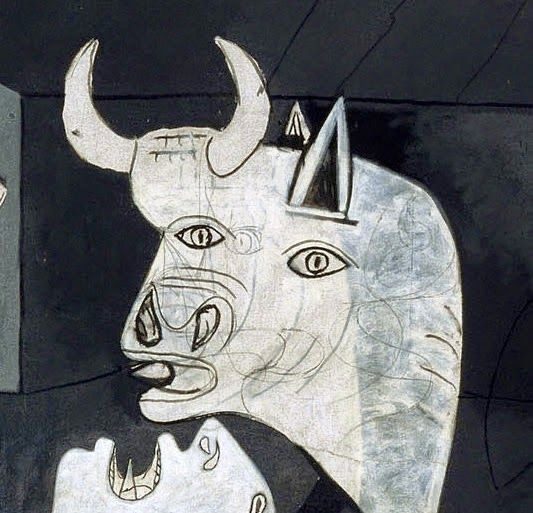
What captivated me a little earlier was Picasso’s deconstructions of the bull and the minotaur — and the humanism applied, or the cosmism applied, to his elucidations of the bull and the minotaur as an archetypal symbolism of the transformation of man from this primordial genealogical groundswell, which is fundamentally violent and four-brained, so to speak. As in: without this evolutionary transformation, the primordial substrate of the animality of man — which is itself deeply founded in nature in an unbroken sense, without the critical reflexive capacity.
The reason I bring that up: when Picasso deconstructs the bull into a skeletal outline from this fully-fleshed-out, human-eyed Minotaur figure — which stretches between the appearance of the anthropomorphic universe of the time of mankind, into the evolutionary past — what is being deconstructed, with this letter from McLuhan to Norbert Wiener, is this superstructural skeletal-systems process, which is operating across and through space and time. This metaphysical structural transformation occurring in space and time, via the evolution and transformation of constraint architectures, is an informational-technological revolution at a cosmological level through different spheres and scales of constraint — from the super-stellar, the nuclear, down into the metabolic chambers of organisms and the cellular respiratory chambers of cells.
The constraint architectures of configurational devices — mountains, or stones — are at a low-resolution entropic state and exist across massive time scales, because they are not in relational, regulatory, configurational architectural states. They are not intimately in the energetic processing-transforming, transformational, neural, cellular relationship to nature, which is a high-energy state of transformation. It is a different time scale of relation to being, which is itself a deeply psychedelic experience, and is itself the birth of consciousness through delicate energetic neural architectures, which are transmitted through genome structure — as in reproduction, recombination — in the organism sense, the plant sense.
Wiener, McLuhan, Prigogine — The Convergence
What is understood by these transformational theorists — McLuhan and Wiener are two of them in this period of time, as is Prigogine — is that at a sufficient level of depth of understanding these disciplinary structures, there is a total inquisition into the foundational meta-structural articulation of being as character, which emerges in everything: through Rimbaud’s poetry, to cellular metabolism and the chemistry of cells, electron valves, vacuum tubes and heavy industry, and the poetic techniques of Joyce and Eliot in the construction of their works.
To further quote: Their use of illusion as situational analogy effects an enormous amplification of power from small units at the same time that it permits an unrivaled precision. Their stripping of rhetoric and statement corresponds to your observation that it is no longer necessary to control a process at high energy levels by a mechanism in which the important details of control are carried out at or as these levels. He says: Mallarmé made this observation by his own poetic technique in 1885. In short, appearances and pedagogical limitations aside, there never is or can be a dichotomy between top-level perceptions and procedures in the arts and sciences of an age.
This is a coming-into-consciousness, or maturation, of the human process of knowledge acquisition, as in self-understanding, at a cosmological level — not just at an individual level. It is critical that Rimbaud is mentioned here in relation to the electron-valve process that Wiener is describing — that McLuhan says represents a principle discovered in 1870 by Rimbaud, applied to poetry and painting at the time.
The connection McLuhan is making is that as the emergence of modernity occurs, there is a real-time consolidation, an emerging revelation superstructurally, that across experience or across the architecture of the cosmos itself, there is a fundamental metaphysical-characterological emergence, which is being. This is the great historical and philosophical project of humanity, which is to understand being, or articulate being, or be in relation to being — which is emerging through these disparate substrates of inquiry.
This resemblance is coming into a high-contrast or high-fidelity picture, and is being unified by these transdisciplinary theorists who are making possible, and making visible, from the material relations being articulated by these different fields — whether science or cosmology or history of poetics or philosophy — the meta-structural architecture, which is itself applied across scales and dimensions, an articulation of the character or essence or operator identity of being itself.
Rendering Out from Under the Real
To return to Picasso’s bulls and minotaurs: this is a process of rendering out from under the phenomenological appearance of the real. This is why art is so historically and fundamentally critical, as is Surrealism itself, as an emergence of modernity. Out from under the appearance of the real, the real emerges — through inquiry into what produces the phenomenological appearance of reality.
This is the Blakean intuition which guides philosophical and scientific modernity, which is again inquisition into the technologics of being, or the informational technology of being. This process — of deconstructing is not necessarily the right word, but rendering from the appearance, which is primarily sensual, in that the human being has a sensory field of experiencing being — is itself, again, the perspectival language of the universe, which is articulating the human being as a linguistic phenomenon derived primarily from the chain of thermonuclear transformation into genome architectures and configurational architectures.
From this mode of persistence, which is a deep-time historical emergence of the forebrain, the nervous system, the human being as a species function, it is perceiving beneath and beyond the veil — the articulation of the emergence of the organism-self, which is a pseudo-closed thermodynamic boundary consuming and excreting energetic forms and products which themselves have particular configurations: meat, fecal matter, urine, et cetera. Semen especially, when we are talking about the transmission of information.
This is the phenomenological appearance of the world, or of the universe, as in being-in-time. The question of being in time is peering beneath and beyond the seeming diversity of phenomenological substrates into the operator identity which produces them, which is working through them — and thus to understand the character of being, not simply the mechanical behavior of being, but that which produces the movement of being in time.
Modernity’s Multifaceted Inquisition
This is a sophisticated understanding only possible through the modernity which produces Fermi’s fusion machine in practice, technological practice — but also produces Picasso’s bulls, and produces the poetic technique of Mallarmé or Rimbaud, which is deeply connected to Cecilia Payne-Gaposchkin’s work on the nature of stars, the composition of stars.
This is a multifaceted, interdimensional articulation by the inquisition into the experience of being, which is the existential condition of being human — Camus or Rimbaud. Picasso in relationship to the architecture of the bull and the genealogical space-time and the pull of the past and the present of the experience of being — an ancestral genealogy which is actually trans-special.
This exploration, in relation to the chemistry of cells, cellular biology, in relation to thermodynamics as in Maxwell or Boltzmann, the composition and articulation of space-time as in Newton or Einstein — these explorations across scales and dimensions themselves create articulations at nodes of being which allow for the full-face and full-form articulation of the full picture of being to emerge. This is occurring again through the perspectival language of the universe, as in the formal appearance of the human being, which is a linguistic transformation, as in the genome, of thermonuclear energy across deep time.
The Operator Identity Made Visible
So the transmission of this fundamental idea, which I have described clearly as the operator identity itself, is the making-visible of the underlying energetic-transformational, informational-technological current of thermonuclear energy as it is translated and is translating down through substrates, which are encountering — via substrate difference, which is a tree or a human being or a stone or a rock — this fundamental principle at work in the entropic universe, or the natural world, or the cosmos, differently. And as such is processing it differently at an existential level.
This is why, again, I have said existential philosophy and existential literature is the primary evolutionary revolution, or the vanguard of what it is to be human, because it is articulating directly the experience of being human, unmediated by — we could say — cultural presumption, or even the allowed presumption of identity. When Rimbaud says I is another , he is saying that there is a space beyond this pseudo-closed boundary, which is the name and number of the organism, which is the perception of a closed order of a self. There really is an energetic substrate at work in the root of being itself, which is visible everywhere and is yet veiled by the phenomenological appearance of substrate difference, which is again Hölderlin’s gleaming. Nature’s gleaming is the higher-revealing. These are the historical-sedimentary relations as the movement of energy.
Marx in Every Language
This is what is so powerful in modernity: there is a recursive process of linguistic translation. Again, Marx in every language, from Arabic to Chinese to Italian — which is the real-time reflection of the human being as an iterative genomic infrastructure, an information technology, which is becoming, through scientific and technological revolution, the revolution of modernity. Everything from psychology to neuroscience to biology to political economy to history is becoming recursively aware of this informational-technological superstructure of being itself, as these high-fidelity, intricate, highly complex codes and systems.
These are occurring at different substrate levels and have different substrate identities — biochemistry, or the exploration of the human condition via the poetry of Rimbaud — and through this exploration, this inquisition, this journey being undertaken into the depths of these substrates, the superstructural condition or character which is being expressed at the base of them is being deconstructed. The deconstruction of Picasso’s bulls into linear skeletons or linear forms, stripping away to the bare articulation, the bare character beneath the phenomenological appearance — in all of these different dimensions of articulation is the possibility of articulating the operator identity, which is in progress and in movement and in expression through all the different substrates.
Beings Folding Over Onto Being
So this recursive translation of Marx is this exact process of beings folding over into and upon being itself.
There never is or can be a dichotomy between the top-level perceptions and procedures in the arts and sciences of an age, because they are all coming to the same realization, which is Hegel’s philosophy of history. Modernity is a hyper-acceleration of this dialectical consequence into the singular realization of the operator identity, which is the character of being itself, the universal characterology of existence — beneath and beyond and behind this deep-time evolutionary field, a changing field of energetic transformation through which emerges the human being capable of recursive consciousness.
This process of the vacuum tube and heavy industry in relation to Joyce or Eliot — high energy levels in a mechanism — or Mallarmé in his poetic technique. This is modernity’s thrust toward the realization of the transformative and transformational architecture of existence itself, beneath all forms.
This is revelation. This is disclosure. This is the finding, knowing, grasping, and becoming, in terms of this deep and intimate relationship to being as in nature’s gleaming — the higher-revealing behind all forms, which is being revealing itself to beings.
The Human Breakthrough
The human breakthrough: the operator identity behind substrate operations, which is the phenomenological appearance. Again, to return to Blake: Man sees through narrow chinks in his cavern. If he saw everything as it was, all would appear to him to be infinite.
This is what the infinite is, and constitutes. It is a character of being.