Poe, Modernity & The Perpetual Melancholy of Cosmic Horror
Poe, Modernity & The Perpetual Melancholy of Cosmic Horror
00:03
So I want to follow my nose here. I walked past a… just a small thrift store today.
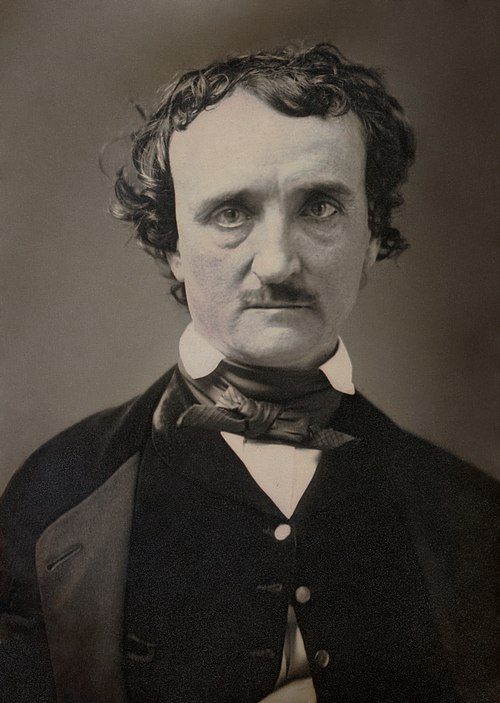
A seven dollar book of the collected works of Edgar Allan Poe in the window.
And Poe is from where I currently am, Richmond, Virginia, just as much as he’s also from Baltimore, Maryland, which is also very regional.
00:30
And I want to talk about him as a very important part of the turn of the century.
A huge part of who, later… Baudelaire takes significant influence from — the French poet, Charles Baudelaire.
00:55
And to discuss the melancholy, I think, of genius — and how fiction becomes a way for Poe to work through the real.
01:27
And I’ve got a lot of experience walking around this city.
10 years or so at this point… and — this connects to Walter Benjamin and Baudelaire as flaneurs in the city of Paris, just as Poe was in an American sense in the Richmond of the 19th century.
And their question is… and when Benjamin walks, his question is — how did this world come to be?
01:58
And I think for Poe as a psychologist… more so than as a literary figure — but as a psychologist working with dream images and the unconscious.
What is clear for him is, much like Dostoevsky, the underbelly of civilization — not only American civilization, but the human culture.
And the emptiness and the sadness to which… for others is opaque, it’s the human experience which is being experienced immediately.
02:37
To Poe, is transparent and translucent — and the mythic dimension for him is a natural one. That the mythic and poetic and symbolic is itself the real. As Picasso says, the lie that helps us see the truth.
It’s the dimension of the dream… and the famous quotation of his —
All that we see or seem is but a dream within a dream.
02:57
Obviously Poe is attempting to cope with the human condition at large — not only his intimate relationship with his own personal experience of the psyche, but what he experiences as a flaneur who… ‘walked the streets in madness or melancholy, with lips moving in indistinct curses, or with eyes upturned in passionate prayers’ — in the words of his so-called ‘literary rival’, Griswold… if such a thing is even possible, but as a ridiculous syllogism.
03:34
It is the characteristic of the madman or the schizophrenic.
Also a label pasted upon Charles Baudelaire… and Baudelaire’s sense of historical damnation, a damnation of human being and human history. A fundamental damnation.
And this itself is the intimate experience of being in the world as one who sees through, makes the world transparent… into a hungry, insatiable demon.
04:21
Or daemon, right, in the Platonic sense of the beast of hunger, which is the thermodynamic poetry of the genome, the human genome — and the program that is played out at once unconscious and barely recognized… even by humanity’s greatest minds and spirits, that is itself a form of hell.
In terms of a cyclical repetition or a purgatory of the burning away of the human impulse in a theater of the repetition of same. A wasted life into energy transference by the script unto the burning away of the flesh into time and the whittling of the skeleton and bone and marrow into dust.
This is the profundity beneath and behind Jean-Michel Basquiat’s graffiti name — Samo, right… same-old.
Also depicted by the poet Vladimir Mayakovsky in his concept of byt, which is the everyday.
05:44
And these themselves, right, these figures who I’ve all constellated here — Baudelaire, Poe, Basquiat, Mayakovsky — these are attempts, liberatory attempts to break the chains of this human hypnotism. Art is the mirror to shatter the empty and blank march of history to oblivion.
The attempts to survive what is all too clear… what Nietzsche says is all too human, which is the condition of the mind, the great mind of the human species.
06:00
The great mind which itself is a mass. It’s a mass of perception, it’s a mass of belief, it’s a mass of circumstantial vision incarnate into form by a genetic script which is still in utero… it’s still in the process of development.
And this is the metaphysics of the circumstance depicted in Poe’s Pit in the Pendulum.
Being between an impossible circumstance.
06:35
And this, for Poe, is the cosmological horror and the cosmic horror which is passed down in the later generation to H.P. Lovecraft and extended into more of a… firmly cosmic or a spatial realm as an outer space. It is lifted from the realm of the dream into the extensive black vacuum of the unknown and the great forces at work in the depths of the dirge of outer space.
This sense of this great lurching space-time… and within it, this contradiction of the haunting of the human psyche in a process of strangeness and changing, a process of sublime shifting, and the chaos and fragmentation of the human mind in relationship to the circumstances which are thrown upon it — which are the hormonal and genetic imperatives to survive and reproduce… and how this naturally creates the terrarium or... terranium of the city or the family or the constitution of the individual.
These are all behaviors that are, in a forlorn sense, as in a profound melancholia — of the one who sees.
These are behaviors that are built into the human genome, the human ecosystem, and they are carried out with a ritual predictability.
07:58
And the way that these behaviors on an individual level, on a somatic and hormonal level… intersect the individuals, within a city or a civilization. It’s a network of biological imperatives forming the basic and fundamental human discourse of language and behavior and ideology. These imperatives are all fundamentally the same, masked only by the face and cloth of the linguistic aperture through which they are communicated.
This is just… merely the construct of the collective itself, the stories it tells, the narratives of its social governance, the narratives of its politics, and the narratives of its religions.
08:24
And this is the grand and meaningless struggle of humanity.
It’s the submission to a genetic imperative.
08:34
And this horror is what is cast into Poe’s works, such as The Fall of the House of Usher and The Cask of Amontillado.
These are horrors of the human condition, which are again — in Baudelaire’s admiration and translation of Poe — are mimicked and too cast into the vessel of his Flowers of Evil. This is the same impulse to emerge the broad face of ritual evil deep from within the human psyche; to face it clearly through the symbolic form — the psychological journey of the descent into the pit, or the descent into hell proper — to witness the truth behind the mask of the apparent ‘normalcy’.
09:01
These are men who see past the common and purloined status of humanity and are forced into an encounter with the real, which is not transcendental.
09:15
It is an encounter with the embodied incarnate carnage of the real, which is to say the real political, social and cultural status of civilizations as they march toward their always untimely and predictable end, which is the collapse of the thinly veiled social orders and political systems which attempt to hold back and narrativize and moralize the human condition, which always already rears its head when the pretense of law and order breaks down. It is the corrosion of the wall of an ancient city in the face of an onrushing, barely retained dormant taboo of the animalistic violence and primordial imperative of incarnate life.
And this is the Nietzsche’s Dionysian and Apollonian. This is his construct of order and chaos. And Poe is always on the side of chaos, as is Baudelaire.
This is the condition of the poet. The poet is a Dionysian force. The poet is of wine and hashish, in a Baudelaire and a Benjamin sense… because the poet is aware of the chaos of history and civilization — and the attempt to impose order is to merely set up a cardboard wall between a hurricane… a past and a present and a future which is an intricately constructed ecosystem. Not only of the human being neurology as it cascades into an unknown, but itself of the grand intersecting civilizational orders which stretch across the globe — which Poe and Baudelaire become untimely victims of — as modernity and globalization spiral out of their early industrial age.
11:09
And this human condition is what haunts, at the most ground and base level, both Poe and Baudelaire.
It’s the primary obsession of the unconscious mind, which is being ritually revealed in the poetic and short story form of both Baudelaire and Poe. It is itself a... an obsession and a lingering on this unconscious — because to both Poe and Baudelaire, the unconscious manifests itself everywhere. But to be made apparent, it must be fictionalized or put into the poetic metaphor, right? Otherwise, it just appears as a latent, present circumstance. Cast behind the face of the seeming hustle and bustle of daily life. And this is no revelation yet.
To show the face of the beast or the underbelly or the mask of humanity — what lies behind and beneath the mask.
Very much so is The Masque of the Red Death, great Poe story.
12:13
The heart beneath the floorboards in The Telltale Heart.
This is what is emerging in and through the poetic and artistic and creative works of Poe and Baudelaire. It’s… they’re conduits of the madness, the unconscious and the chaos of humanity and human history — which itself is transcendental.
And this is what I want to make clear here.
It’s a... transpersonal condition of the underground of the psyche, which is manifest everywhere and in all things and all of human society, culture and civilization.
But this is what is called normal — and this is the sleeping and hallucinatory inner workings of human history and civilization, which is behind the billboards and the buildings and the everyday behaviors of the barroom and the business office and the waking disease of mankind.
So again, Poe and Baudelaire are as diagnostic as Nietzsche or Dostoevsky to this condition. This is the great duality and dual function of metaphysics and the metaphysician as both species level scientist of the psyche — and the inquiry into the character of the total cosmological function of being… as this procedure is manifest in and as a one and the sameness.
13:32
And it is not a coincidence that each emerges at this incoming technicolor period.
This lurching forward of human history… towards the 20th century, into the creation and establishment of psychology as a discipline in Western civilization, in Western history in the 1900s.
Because we are, this is a preparatory act through poetics, through literature, through the short story. This is a uterine process and procedure leading up to the externalization of psychology as a medium and discipline of firm scientific inquiry, process, and procedure — which becomes profoundly and incredibly deepened with the neuroscientific understandings and discoveries leading into the 21st century through technological mapping and incursion.
14:03
It’s a preparatory act for the ritual unveiling of the human psyche.
And the real systematic situation and condition of mankind… in and through which history appears as a projection of mankind’s dormant and dispossessed psychological condition — the genetic, metabolic, and neurological and hormonal urge which is a drawing forth of being into time repetitiously, ritualistically… that history itself is thrust into being by the actions of unconscious men, women, so on and so forth. This is Marx’s first as tragedy, second as farce…
In so far as that — this underbelly is the creation of the horror of the everyday which is ritualized as normal.
14:40
And this… this is the lot of these simultaneously timely and untimely figures in human history.
In Western civilizational history.
What they represent is the tragic turn on a hairpin toward the revelation of the human psyche, a true depiction of the horrors of mankind and human history everywhere from Goya’s Horrors of War to the advent of photography, which then proceeds to intimately and imminently depict the catastrophic destruction and gore of the Civil War, World War I and World War II into cinema and film as in the film reel.
Because… what is occurring here is that — revelation of the underpinnings of the real is becoming increasingly transparent.
It is not just the human eye which is observing an opaque reality, such as a depiction maybe of realism as phenomenology, whether that’s painterly or literary.
16:33
This essential form of literature… everywhere as diverse as William James to the Brontë sisters, to Virginia Woolf. This is a — the progression of the history of literature is a progression of the revelation of the psyche as a subjective dredging of the unconscious impulse and a subjective dredging of the imagination. This too, is a dredging of all of human history.
And this is why the liberation of the photograph towards the end of the 19th century, into the painterly innovations of the 20th is so crucial — because we’re talking about a technology which is removing the human being interpretive framework of world and is throwing the human being back in upon the human question itself, the human condition.
Because what is being ritualistically stripped is the real as in an appearance.
17:18
And what is being increasingly emerged from beneath the colonization of the real by and through industrial technology is the human psyche. The interpretive framework beneath the dispersion of the real as a subjective attempt into an objective truth.
And when the real is colonized and made concrete and objective, both by science, by photography, by the computational device… which can map galactic ecosystems, the human being is thrown back in and upon itself. Because the lie reveals the truth.
And this is the predictive history of Dostoevsky, Chekhov, Virginia Woolf.
17:53
The great psychological authors — who are themselves the great literature of human history. And also the great early modern Western philosophy from Kierkegaard to Nietzsche.
Because this is the real depiction, the existential depiction as in a direct relationship, the real human experience of the psychological condition. This was thought to be world… but is thrown back upon itself as in the birth of modernity. It is revealed to be a projection of the psychological architecture of mankind.
18:20
Which is… as increasingly revealed, particularly through authors such as Virginia Woolf, as that which colors world.
And so you have itself, in a grand civilizational mass, all of these different apertures, — and you get, through the strange aperture of genius… as in a figure such as Poe or Woolf or Baudelaire… this is a metaphysical filter upon the objective real.
To see beneath the stone of mere appearances or opaque appearances and to grasp the true character and nature of humanity.
19:17
This is, again, the fundamental when we look at literary history — the basic genius of Dostoevsky, who is something of an Aristotle to the literary history in the sense that he sets the foundational template for the integration of the psyche and the psychological question of reality and interpretation and true sight and insight into the literary form.
And the depth and complexity of the human psyche therein…which he perceives as fundamentally a project of the redemption of creation itself… which you then see later on in a modern context with Jack Kerouac grappling with the American condition towards the turn of the mid-century, the 20th century in America.
And this is what is becoming, in a grand global psychological context or psychic context, increasingly apparent. Is the emerging, the increasing emergence of the understanding of the energetic body of the psyche as formed by nervous system patterns and responses, synaptic grooves in the brain, just as well as… this is an entire experience of the body.
Formed by both personal experience and deep ancestral evolutionary history of the genome, which is the aperture — the way in which the human being is always already artistically creating a vision of self and world and is in relationship therein, linguistically, as an image of self and world. Negotiating…
The primal form of relationship — is survival, reproduction, and attempting to understand in an existential sense what is being human. This is direct and imminent changing and shifting of the epigenetics of the genome and the writing and re-writing of the neurological script as in patterning of the organism to stimuli and responses to nature, world, perceived situation. And this is what is intimately forming the aperture of which ‘the real’ is constructed as in a lived experience.
20:45
And this is the aperture which is just as much the projection of the artist’s psyche upon the canvas or the interpretive framework of the artist in relationship to the real — which is always already fractional and fragmentary. As much as the hubris of science would like to divert or eliminate this aspect through knowledge.. is broken apart — in the sense that the psyche is a private subjective condition in the face of an objective reality. It never achieves a full ritual elevation above the chemical and elemental and neurological conditions which form it. It may reckon directly therein with said conditions via scientific advancement and as such construct and reconstruct response and mechanism… but the psyche is embodied — and as such, the vessel and aperture are in intimate unity; too, construct the projected vessel of the persona, behavior, and linguistic interpretation of the self-world dilemma and attempted synthesis.
21:10
This cosmological, metaphysical system of energy exchange and transformation which the individual is indelibly a part of — and yet is metabolizing that experience ritualistically at a subjective level through an aperture… which is the psychic context grounded in the body through the nervous system, somatically.
And through the synaptic architecture of the mind, the brain. The self is objectified and pushed out in relation to circumstance as in the projection of character. The being exists and resists absorption as in a patterned response mechanism to retain and obtain survival and hormonal satisfaction.
And this is the absolute art of the human condition as a series of nodes and constellations — that each being itself is a thought form within this grand mind, the trans-personal, trans-species mind, trans-substantial mind… both of the cosmos and of life on earth as in the genome itself, as a series of characterizations. And each characterization is a composite response to composite, compound chemical, elemental, historical, genetic, and constructed image conditions as a process and procedure in psychological construction. This is, at the highest level, ultimately linguistic and artistic — as in the conceptual unity of culture as a series of cohesions, groups, and sub-groups of experiential architectures in various and varying different degrees of consensus as to self, world, life, and somatics as an experiential architecture of being human at and in a moment in time.
22:07
The genomic architecture in an earthly sense is fundamentally and foundationally the same across species.
And not only across species, but across different kingdoms, as in the plant and animal kingdom.
22:25
And this is the radical disjection of genius — is that it looks in upon the psyche, reflects in upon the psyche as the translucence of the formerly opaque… in a larger global human condition of the phenomenological reality and the human being’s unconscious participation in the dictates of genomic and hormonal life. Genius dialectically redoubles itself in upon the human; looks in upon the human from vantage; eagle’s perch. And as such, achieves a level of comprehension of the emergence of history vis-a-vis the psyche and the psychological as a condition of artistic construction of the dream of the self and the dream of the world to deal with firm entropic and genetic and neurological and synaptic conditions, limitations, and architectural constructs within the collective and individual genome.
The human being itself is like a plant or a vegetable in this… Garden of Eden of the unconscious psyche — and that Baudelaire looks upon this unconscious psyche and elucidates The Flowers of Evil, or that Poe looks upon this unconscious psyche and crafts the fall of the House of Usher. These are depictions… symbolic, representational depictions of this internal order — of the one who sees into this system and experiences the cosmic horror of the unconscious itself as a ritual unity and series of patterned behaviors — which in actuality are highly destructive, violent, corrosive, consumptive.
23:35
As a thermonuclear unit in a process and in a wheel, a karmic wheel of perpetual consumption. As repetitions of energetic consumption of same.