Regime Constitution: The Live-Ball “Ruthian Blanket” (1920–1935): Constructing a Two-League Run Ecology for MLB and the Major Negro Leagues — and Regime-Normalizing Dominance
Regime Constitution: The Live-Ball “Ruthian Blanket” (1920–1935): Constructing a Two-League Run Ecology for MLB and the Major Negro Leagues — and Regime-Normalizing Dominance
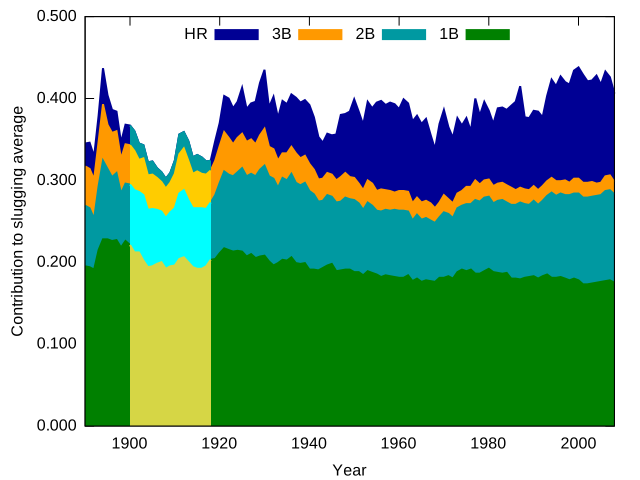
Regime Constitution: The Live-Ball “Ruthian Blanket” (1920–1935)
Constructing a Two-League Run Ecology for MLB and the Major Negro Leagues — and Regime-Normalizing Dominance
If Negro League and Major League performances are to be integrated architecturally—without collapsing one statistical world into another—then the first requirement is not player comparison.
It is baseline integration.
All dominance metrics depend on a scoring atmosphere.
Before comparing pitchers, we must declare:
What is the scoring climate of MLB in this regime?
What is the scoring climate of the Major Negro Leagues in this regime?
What would the baseline look like if both operated inside one ecological field?
That declaration is the regime constitution.
I. The Principle: Dominance Is Baseline-Dependent
ERA+, OPS+, and similar metrics are not intrinsic player traits.
They are:
separations-from-baseline inside a declared statistical universe.
If the universes differ, the dominance metric differs.
Therefore:
Cross-league comparison requires cross-league baseline construction.
II. Defining the Ruthian Blanket
We declare the Live-Ball “Ruthian” regime as:
1920–1935
This period reflects:
The ball transformation beginning in 1920
Sustained elevated scoring
A relatively stable offensive geometry before the late-1930s contraction
This is not claiming uniformity across years.
It claims that the scoring ecology is of the same structural order.
III. Constructing the Run Ecology (RE)
We define:

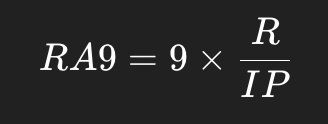
For first-order regime construction, team R/G is treated as a proxy for league RA9 under the assumption of scoring symmetry across closed league systems (total runs scored equals total runs allowed).
This is an approximation suitable for regime-level comparison.
IV. MLB Ruthian Run Ecology
Using MLB total runs (1920, 1925, 1930, 1935), and standard team-game counts:
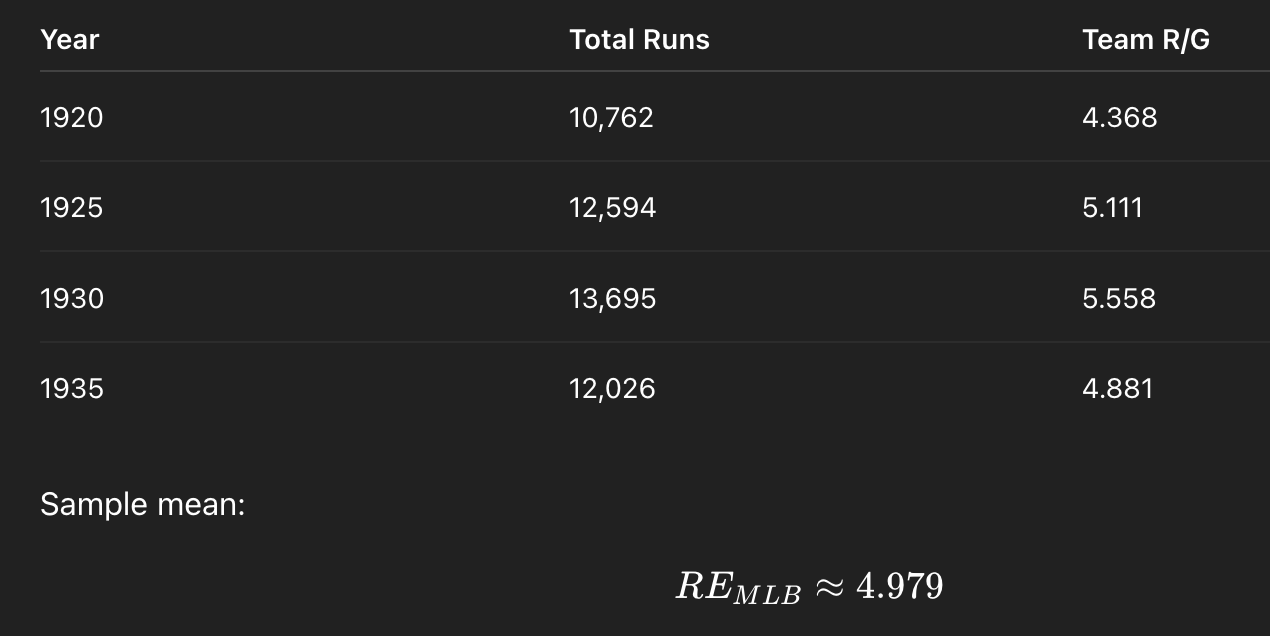
This is the MLB scoring ground of the Ruthian blanket.
V. Negro League Ruthian Run Ecology
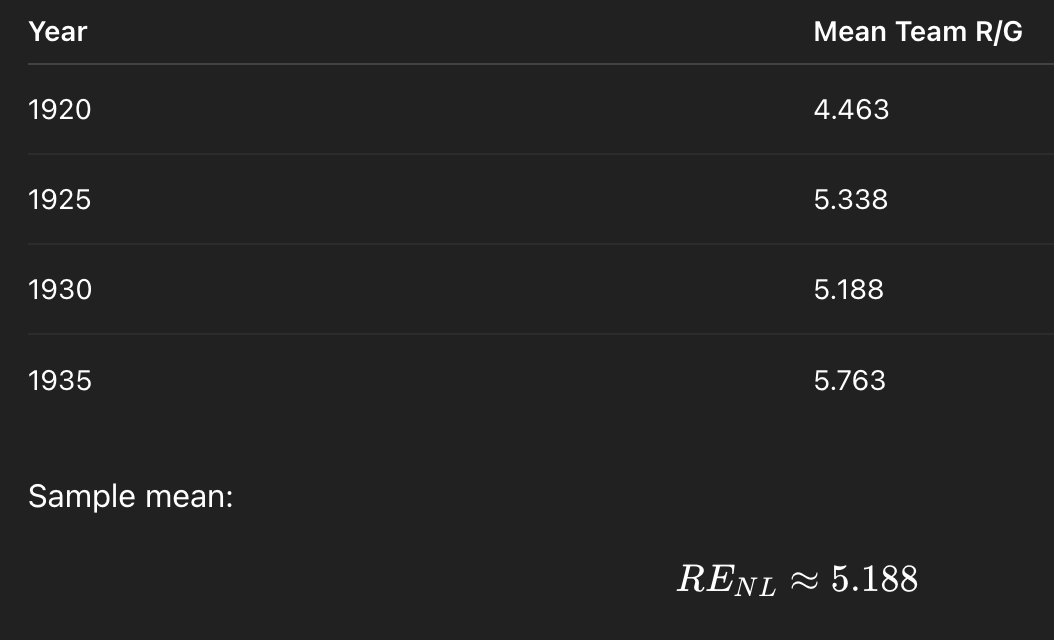
Using Seamheads official-league standings R/G for the same sampled years:
VI. Constitutional Result

Within this sample, the Major Negro Leagues appear to operate in a scoring atmosphere roughly 4.2% higher than MLB.
That difference is modest.
It is not trivial, but it is not structurally massive.
This matters.
Because it implies:
Run ecology alone does not explain large dominance divergences.
VII. Eliminating ERA+ — Using Raw Run Prevention
To remove boundary and recalculation conflicts, we discard ERA+ entirely.
We use only:
Runs allowed (R)
Innings pitched (IP)
Define:
Willie Foster (Negro Leagues official games)
IP = 1877.2
R = 720

Lefty Grove (MLB regular season)
IP = 3940.2
R = 1594

VIII. Regime-Normalized Dominance (RND)
We define dominance relative to the integrated Ruthian atmosphere:
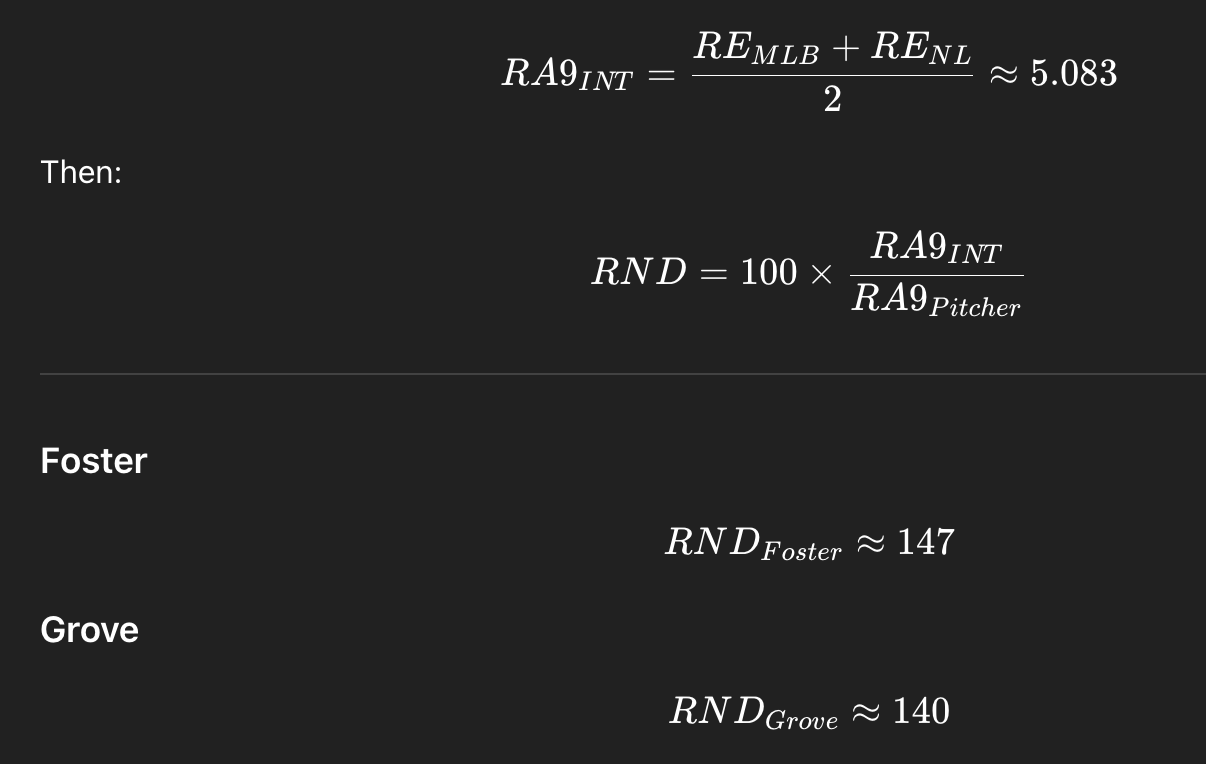
IX. Interpretation
Under:
Official Negro League games only
Official MLB regular season
Ruthian blanket baseline
Raw runs allowed (RA9)
No ERA+
Foster’s run prevention grades slightly stronger relative to the regime atmosphere.
This result differs from both ERA+ frameworks.
That divergence reveals something important.
X. Structural Insight
Three frameworks yield three outcomes:
BRef ERA+ (strict schedule) → Foster far ahead
Seamheads ERA+ (NL-only broader context) → Grove ahead
RA9 Ruthian blanket normalization → Foster slightly ahead
The atmosphere difference (~4%) is modest.
Therefore:
The major driver of ERA+ divergence is boundary inclusion and baseline recomputation, not scoring ecology.
RA9-based normalization appears more stable across boundary definitions than ERA+-based comparison.
XI. Necessary Qualification
Grove’s career extends slightly beyond 1935 into post-peak scoring contraction years.
Foster’s career concentration is more tightly clustered inside the peak Live-Ball scoring window.
A fully year-weighted Ruthian-only career isolation would refine the comparison.
This analysis is first-order regime normalization.
XII. What Remains Unresolved
This framework does not yet incorporate:
Competitive density
Talent pool distribution
Opponent concentration
Schedule compression
Record survivorship bias
Run ecology has been integrated.
Competitive structure has not.
That is the next architectural layer.
Final Constitutional Statement
Dominance must be evaluated relative to a declared ecological blanket.
When we:
Declare the Ruthian regime
Construct cross-league run ecology
Normalize raw run prevention against that baseline
Eliminate derived league-relative recalculations
Dominance becomes:
Performance relative to ecological physics, not database architecture.
Under that constitution, Willie Foster’s run prevention in the Ruthian Live-Ball regime grades slightly stronger than Lefty Grove’s.
Not because of narrative.
Not because of database recalculation.
But because of runs allowed per inning relative to a shared scoring atmosphere.
That is the cleanest integration layer yet.