Rising Into the Shock: Delahanty, Duffy, and Cross-Epoch Dominance Across the 1893 Rupture
Rising Into the Shock: Delahanty, Duffy, and Cross-Epoch Dominance Across the 1893 Rupture


Rising Into the Shock
Delahanty, Duffy, and Cross-Epoch Dominance Across the 1893 Rupture
Baseball from 1888 to 1906 was not one scoring system.
It passed through a structural hinge:
Pre-1893 (≤1892) — pre-distance pitching geometry
The 1893 Shock (1893–1900) — mound relocation, sustained offensive expansion
Early Deadball (1901–1906) — contraction toward a lower, stabilized run climate
When the denominator changes, dominance must be rebuilt.
Two elite hitters crossed all three skies:
Ed Delahanty (1888–1903)
Hugh Duffy (1888–1906)
At the career level, they look nearly identical.
At the regime level, they separate sharply.
I. The Geometry (Auditable and Denominator-Honest)
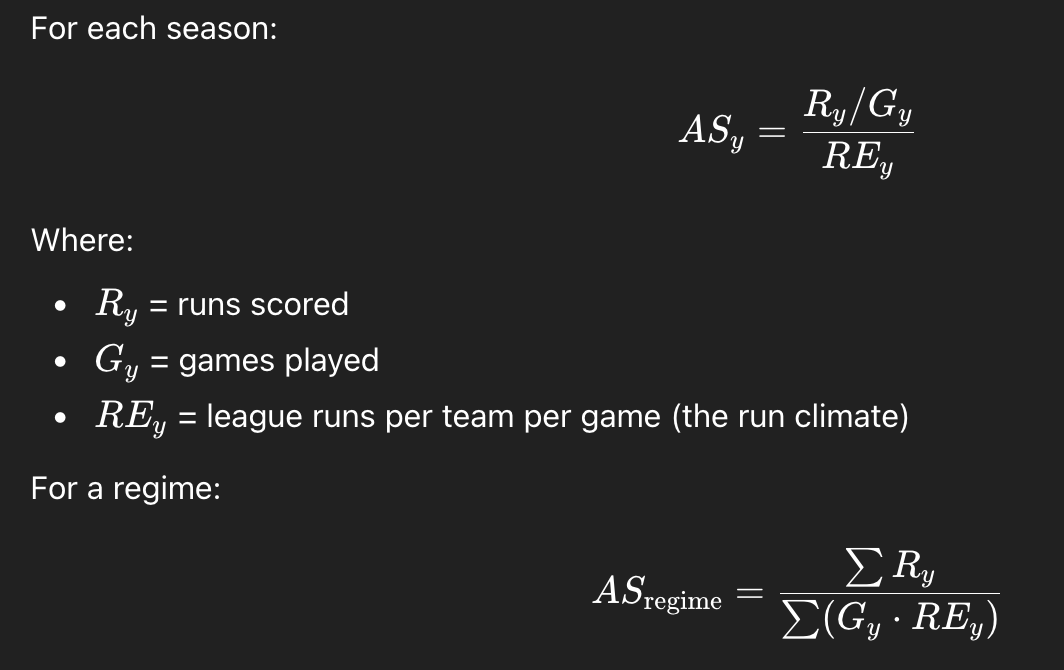
Interpretation:
Atmospheric Share (AS) = the fraction of the scoring sky a player personally accounts for, per game.
This is conservative (runs scored only), fully auditable, and structurally consistent with the pitching “sky” framework.
II. Games Played Across Each Sky
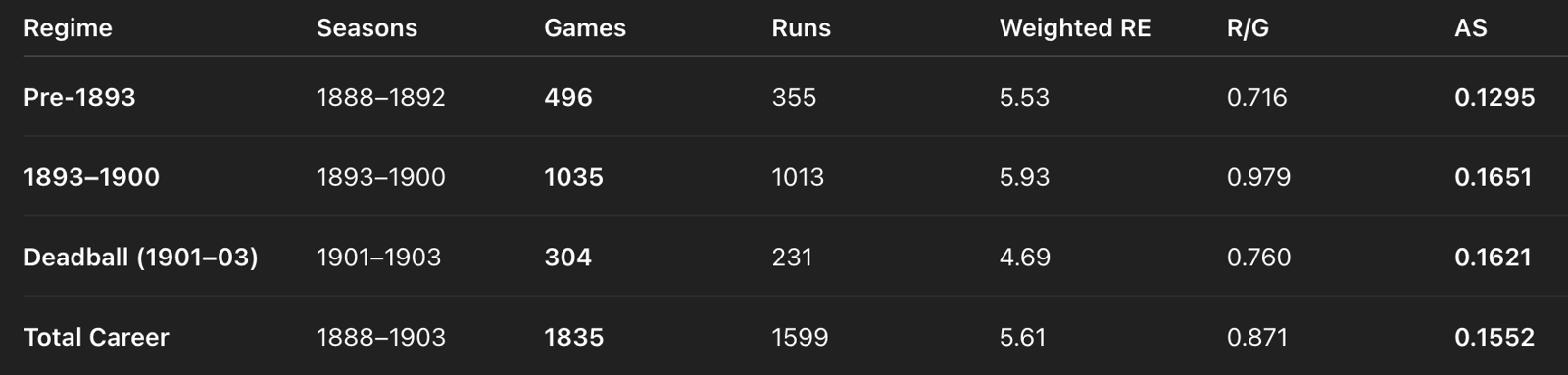
Ed Delahanty
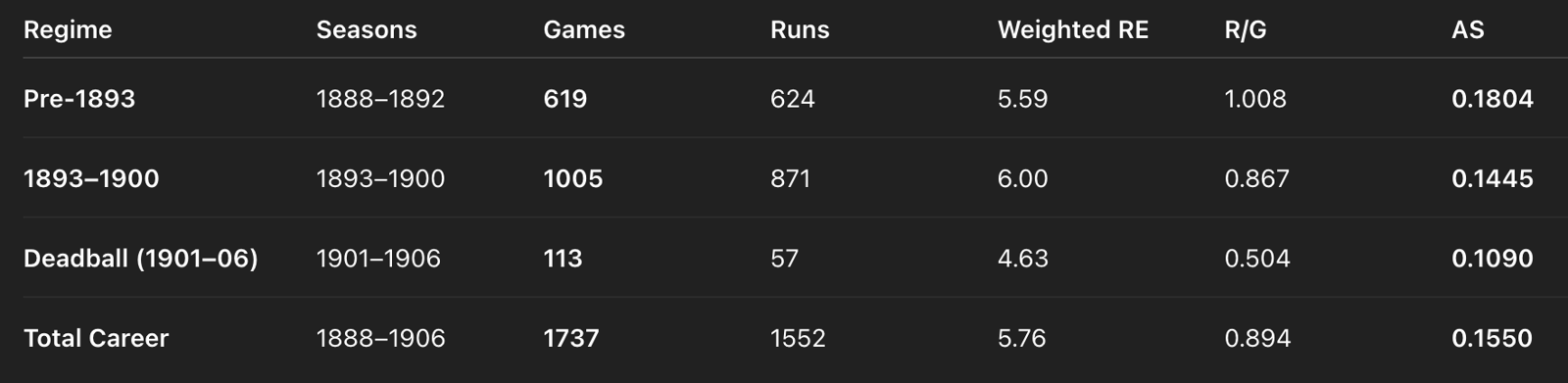
Hugh Duffy
III. What the Full Distribution Shows
1. Career totals are virtually identical
Delahanty career AS: 0.1552 over 1835 games
Duffy career AS: 0.1550 over 1737 games
At the macro level, they are statistical equals.
But regime weighting reveals structure.
2. Duffy’s dominance is front-loaded
619 games in the pre-1893 world at 0.1804 AS
After 1893, his share declines:
0.1445 in the shock regime (1005 games)
0.1090 in deadball (113 games)
His largest atmospheric imprint lives in the pre-shock geometry.
3. Delahanty rises into the shock regime
496 pre-1893 games at 0.1295 AS
1035 games in the shock regime at 0.1651 AS
304 deadball games at 0.1621 AS
He does not merely benefit from the expansion.
His fraction of total scoring increases when the denominator expands.
Then it stabilizes under contraction.
IV. Why One Rises and the Other Falls
This is not random fluctuation.
It reflects style scalability.
Duffy’s profile
High-contact, batting-average dominant
Optimized for pre-1893 pitch geometry
Share sensitive to environment shifts
Peak share tied to one sky
When the denominator expands:
His share falls.
His production scales less than the environment.
Delahanty’s profile
Greater total-base production
Power-integrated offensive shape
Run-generation elasticity
When the denominator expands:
His share rises.
His production scales faster than the environment.
That is critical.
If the sky grows and your share grows, your skillset scales superlinearly relative to inflation.
That is not passive benefit.
That is adaptive dominance.
V. The Meaning of Rising Into the Shock
The 1893 rule change is a structural stress test.
Most players experience volatility when the denominator shifts.
The hitter whose atmospheric share increases during a denominator reset demonstrates:
Transferable mechanics
Adaptable timing architecture
Production independent of one specific rule geometry
Then comes the second test:
Deadball contraction.
If share collapses under contraction, dominance was environment-bound.
If share persists, dominance was transferable.
Delahanty’s 0.165 → 0.162 transition passes this test.
Duffy’s 0.180 → 0.144 → 0.109 sequence does not.
VI. The Structural Conclusion
Both men are career-level equals.
But they represent different types of greatness.
Hugh Duffy is the apex hitter of the pre-1893 sky.
Ed Delahanty is the adaptable hitter whose production scales upward in the 1893 shock and remains durable into deadball contraction.
The difference is not in peak.
It is in regime resilience.
Final Thesis
When the sky changes, greatness is re-tested.
Duffy dominates one environment.
Delahanty rises into the rupture and re-establishes his share under a new physics system.
Career totals obscure this.
Regime geometry reveals it.
And what it reveals is simple:
Elite cross-epoch performance is not merely surviving structural change —
it is expanding your share when the structure itself reorganizes.