Shamanic Boundaries: The Face
Shamanic Boundaries: The Face
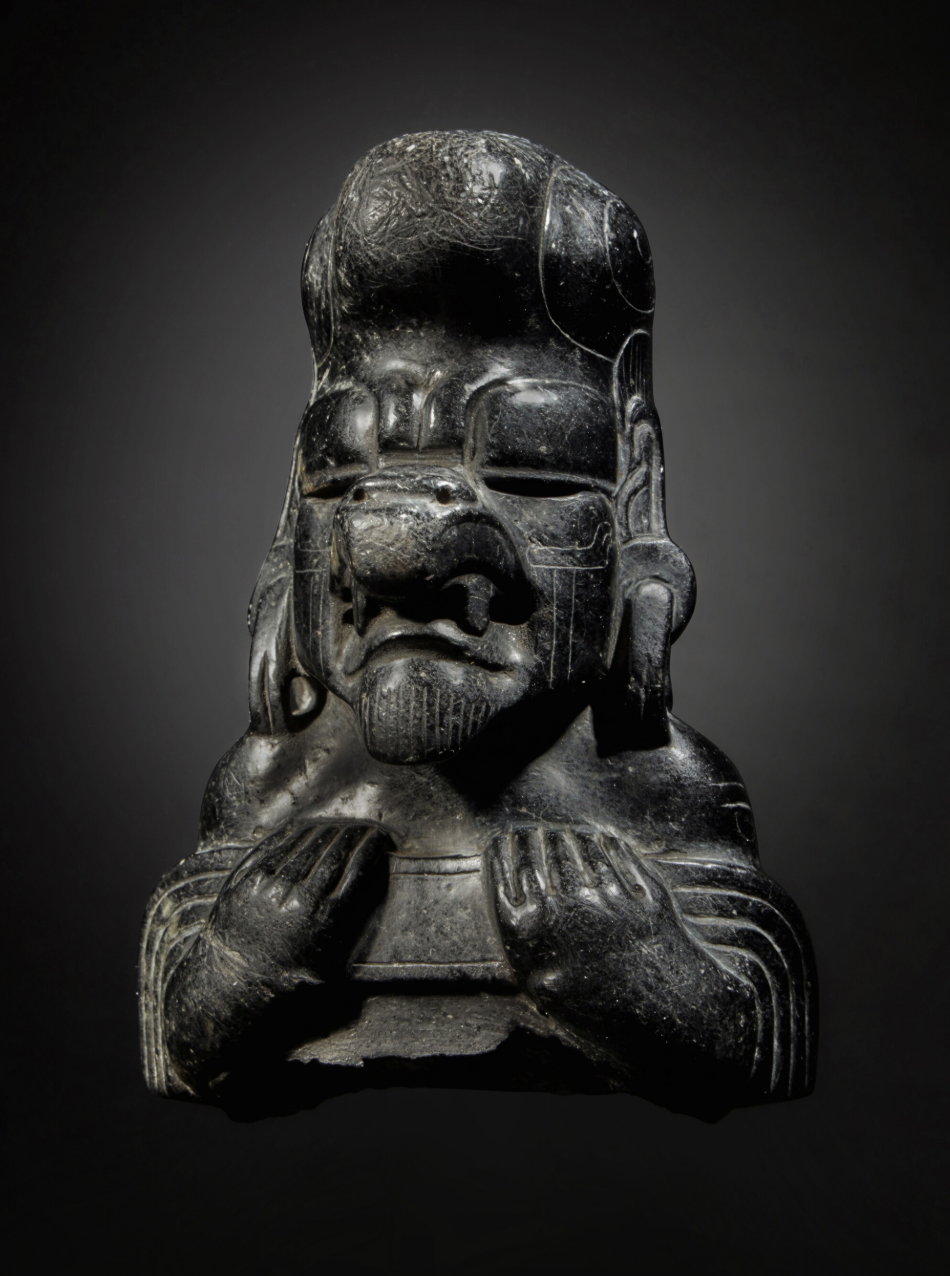
The Guennol Olmec Figure of a Deity, Middle Preclassic, circa 900 - 600 B.C.
The shamanic boundary is the key to states; manifested outwardly historically across cultural and world civilizational bounds as in and through the face; the mask. This boundary, depicted above in the Olmec Rain deity, is a blurring of the bounds of human, animal, and super-primal — a figuration and formation which is meant to represent an amalgamation of the nagualic powers — or a manifestation of and from the energetic realm into the space of interpretive art; thus and as such, the creation of an imaginal figure.
This is the crux of the shamanic relation to the real — the contortion, bending and stretching of space and time as in the body to produce the hyper-real, or hyperboric figure of consciousness: a strain which is between states, species, and realms. This is the world historical typical figuration of the shamanic figure in an archetypal sense, the psychopomp, the hierophant, the walker between worlds, or the jaguar.
In this way, the shamanic figure is a representation of the liberated quality of the human being as in a liminal one — a way of identifying the human being first and foremost as a psychic phenomenon always already in utero in a grand cosmological sense; as such, channeling the real cosmological condition and existential condition of mankind as a species in the midst of being perennially remade. This remaking is an imminent process of transformation down to the bacterial and cellular and genetic level of the constitution and reconstitution of the body in a perpetually returning historical moment of and as in the now.
The Olmec-descendant Nahuatl songs of the Aztec as depicted in Cantares Mexicanos are a linguistic relic of this shamanic tradition engraved in stone — that which remains of the former, deeper historical Olmec ancestry. Retrieval of the linguistic tradition reveals the same principle at work — an imminence of awareness and knowing of the human being in the stream of birth and death and perennial making and unmaking. The voice emerges from this register, not the register of subjectivity, or the colonial ‘I’ of manufactured statehood:
We’ve only borrowed our flower drums, only borrowed our flower rattles,
These, our songs — our flowers!
The Aztec psyche is profoundly death informed; this is the substrate of the unified Mesoamerican heritage as a shamanic heritage of traveling between worlds — the land of the dead and the world of the living — the dual function of the jaguar or the shaman as deep psyche informed; retrieving, the retrieval of chthonic information and awareness; bringing this awareness back to the light of day of the people and revealing it somatically through body consciousness and imminent ritual transformation, as in the mask dance, the psychedelic rite, or the theatrical performance as in the initiation to consciousness change; the substratum through structural descent.
This form of awareness is linguistically modified by the poet Frederico Garcia Lorca in his work on duende, the visceral force of blood and the awareness of death. This is the somatic awareness of the organism in space and time as an interval, a breakpoint of consciousness; as such, a native as in bodily sensation is transmitted directly through the encounter with the bardo principle of life — as being in between phases of transformation — which we may call, again, birth and death:
Those dark sounds are the mystery, the roots that cling to the mire that we all know, that we all ignore, but from which comes the very substance of art. ‘Dark sounds’ said the man of the Spanish people, agreeing with Goethe, who in speaking of Paganini hit on a definition of the duende: ‘A mysterious force that everyone feels and no philosopher has explained.’
So, then, the duende is a force not a labour, a struggle not a thought. I heard an old maestro of the guitar say: ‘The duende is not in the throat: the duende surges up, inside, from the soles of the feet.’ Meaning, it’s not a question of skill, but of a style that’s truly alive: meaning, it’s in the veins: meaning, it’s of the most ancient culture of immediate creation. — Frederico Garcia Lorca, Theory and Play Of The Duende
Lorca, in the modern fashion, is theorizing the ancient memory of the shamanic practitioner which remains in traces, traces of ‘the old world’, or ‘the old word’, so to speak, in modernity. It is the voice of the body proper, the somatic voice of consciousness situated imminently, pre-linguistically, beyond all ideas and ideals — in being human proper as an existential condition; sings and dances and moves and embodies from that place of direct awareness. And this, by way of course, necessitates a full psychological wholeness — the shamanic capacity to engage in a direct encounter with death; as such, constitute the full chiaroscurotic embodiment of life in the face of the truth of transformation, ephemerality; the psychedelic temporality of the transformation of forms within the larger nature itself.
This is the key characteristic trait of psychedelic experience — the imminent sense of phasality. Of being between states; the imminent doorway into the next transformation out from the flesh or shell of the former. The stripping away of space and time, sensed, felt, and embodied down to the absolute presence and unity of the body within the larger shifting form. This is felt and sensed super-somatically — where the senses in and of the body are as utterly and entirely singular. The body is one vehicle within itself for this experience of consciousness; utterly one with the great body cosmos. And as such, the entire analog of space and time is made imminently available to the shaman as and in the body itself. As an entire compendium of sacred and sacral historical knowledge.
This imminent presence renders, as in the Mesoamerican sense, a full emergence of the total powers of the nagual, or the disapparent spiritual powers, or the real and absolute, supra-phenomenological powers of all of existence — manifest in and through the vessel of the tonal as in a total embodiment of nature and the universe in form. These capacities, harnessed by the shaman, are the opening of the doors of the real to the emergence of the total powers imminent in and through the body. It is the absolute energetic gateway for spiritual transformation and transference — ritually represented in the Olmec in the were-jaguar — as the imminent manifestation of the transformation of the shaman between thresholds — jaguar as the nagual superstructural powers of creation, emerging through the changing of the face of the human shaman in ritual midst.
What the Olmec relics do is immortalize the absolute moment in time in stone — which is to say the absolute moment of transformation; the bridge between the temporal and eternal manifest in the moment of shamanic transformation and change — a moment which itself manifests the absolute conglomeration of paradigm shifts; species shifts as grand historical epochs in all time. Movements and phase shifts where the phenomenal changes form; in that immediate blink of a change reveals the grand, organizing force of the supra-phenomenological.
This is precisely what gives the pre-linguistic Olmec shamanic heritage its power; the specificity of the Olmec shamanic tradition in relation to other historical traditions hitherto uncovered and exegeted. This moment is the moment revered and reproduced and explicitly referred to in each aspect of Olmec heritage and culture: the moment of change; the bridge between the human shaman, the walker between worlds; the eternal world of the organizing powers of the jaguar, or the nagual.