Structural Equilibrium Under New Physics: The 1893+ Boston Beaneaters and Systems Stabilization After Mound Expansion
Structural Equilibrium Under New Physics: The 1893+ Boston Beaneaters and Systems Stabilization After Mound Expansion
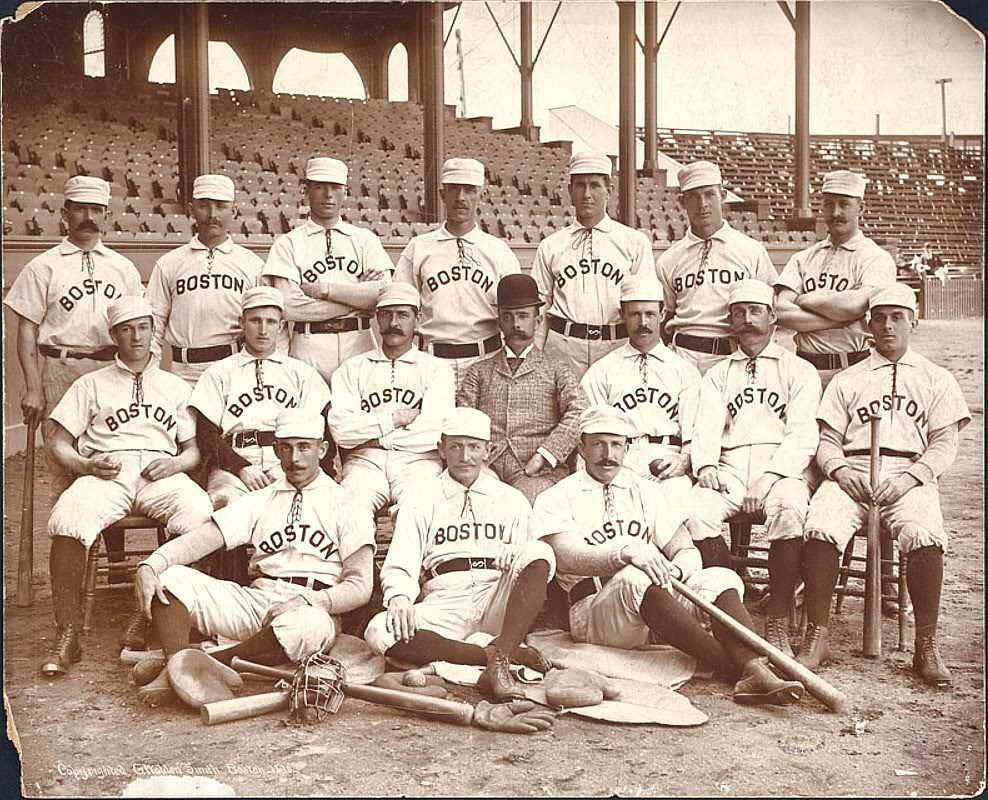
Structural Equilibrium Under New Physics
The 1893+ Boston Beaneaters and Systems Stabilization After Mound Expansion
In 1893, Major League Baseball altered the geometry of the game.
The pitching distance was moved permanently to 60 feet 6 inches.
This was not an incremental adjustment. It restructured the reaction window between pitcher and hitter, expanded offensive timing margins, and immediately destabilized run equilibrium. The early 1890s became the most volatile offensive period of the 19th century.
Most teams rode the expansion.
The Boston Beaneaters stabilized it.
This is not mythology. It is structural analysis supported by record.
I. The Shock: 1893 and the Expansion of the Sky
Run scoring jumped sharply after the distance shift. League batting averages climbed. Power and extra-base hits surged. Pitchers were recalibrating in real time.
Within that turbulence, Boston did not collapse or spike erratically. It consolidated; through the executive leadership of manager Frank Selee, assembled a dynasty of consistent systematic excellence across a paradigm of physical revolution.
The core stabilizers:
Kid Nichols (joined Boston in 1890)
Billy Hamilton (joined Boston in 1896)
Hugh Duffy (joined Boston in 1892)
These were not transient stars. They were infrastructural anchors.
And by 1896, Selee and the Beaneaters had put together one of — if not the first — complete modern dynasty: equipped and fit at structural root to defy and dominate the demands of modern baseball.
II. Hamilton: Possession Control in the First Modern Season
In 1893 — the first year at 60’6” — Hamilton produced:
82 games
431 PA
.380 AVG
.490 OBP
.524 SLG
1.014 OPS
167 OPS+
110 runs scored
He reached base nearly half the time in the first season of modern pitching distance.
This is not contextual inflation. The 167 OPS+ confirms dominance relative to the exploding environment.
Hamilton’s career totals:
7,609 PA
.344/.455/.432
141 OPS+
1,697 runs
1,189 walks
914 stolen bases
In a system expanding offensively, Hamilton increased possession stability.
He did not chase volatility.
He extended innings.
This is structural offense.
III. Nichols: Suppression Stability Through Expansion
If Hamilton stabilized possession, Nichols stabilized prevention.
Career line:
361 wins
4,967 innings
140 ERA+
100+ WAR
Post-1893, Nichols did not disintegrate under offensive expansion. He adjusted.
From 1893–1899, during the highest-scoring stretch of the 19th century, Nichols remained among league leaders in ERA+ and innings.
This is not peak volatility. It is durability across atmospheric change.
IV. The Beaneaters’ Progression Through the 1890s
The structural story is clearest when mapped seasonally.
1891
Boston wins the National League pennant.
Nichols posts a 2.39 ERA in a 4.03 run environment (ERA+ 167).
1892
Boston wins again (first half champions in split season).
Nichols throws 453 innings with a 2.41 ERA.
1893 (Distance Shift)
League scoring surges.
Boston finishes 86–43 (.667).
Hamilton posts .490 OBP.
Duffy hits .363.
Nichols logs 34 wins.
The 1896 nuclear core adapts immediately.
1894
One of the most inflated seasons in baseball history.
Boston goes 83–49.
Hugh Duffy hits .440.
Hamilton posts .521 OBP.
Nichols wins 30 games.
The coming Beaneaters are not overwhelmed by offensive chaos.
They operate inside it.
1897–1898
Boston wins back-to-back pennants with their now established modern core of OBP excellence and defensive backbone (including Fred Tenney at first; Hall of Famer Jimmy Collins at third).
Nichols:
1897: 31–17, 2.64 ERA
1898: 31–12, 2.23 ERA
Hamilton (1897–1898):
.461 OBP (1897)
.480 OBP (1898)
This is not a spike dynasty.
It is prolonged structural equilibrium.
V. Why This Is Different from Earlier Dynasties
Pre-1893 teams operated under different physics (50-foot pitching distance). Their dominance belongs to an earlier kinematic regime.
The Beaneaters are the first dynasty that must prove itself under modern pitching geometry.
They do not just survive the rewrite.
They stabilize it.
Earlier teams reflect competitive experimentation.
Boston reflects systemic consolidation.
VI. Why Not the Orioles?
The 1890s Baltimore Orioles under John McGraw are remembered for tactical aggression and stylistic innovation.
They revolutionized strategy.
Boston stabilized structure.
The Orioles changed how the game was played.
The Beaneaters demonstrated how the new physics could be sustained over volume.
One is stylistic revolution.
The other is systemic equilibrium.
VII. The Structural Conclusion
The 1893 mound expansion marks the birth of modern pitching geometry.
The Boston Beaneaters become the first team to demonstrate equilibrium within it.
Their architecture was clear:
Hamilton: high-volume possession control (.455 career OBP; .490 in 1893; .521 in 1894)
Nichols: cross-regime run suppression (139 ERA+ career; 361 wins)
Duffy: offensive amplification (.440 in 1894; four seasons above .340 in a five year window)
They did not rely on singular volatility.
They built repeatable dominance across an unstable environment.
That is why the Beaneaters feel like a flashpoint.
They sit at the hinge between experimental baseball and structurally modern baseball.
They are not merely a 19th-century dynasty.
They are the first team to stabilize the game after its first great physical rewrite.
And at the center of that stabilization stands Hamilton — the possession constant inside a newly expanded sky.