The 1893 Mound Shock, the Birth of Modern Pitching, and the Architecture of Modern Dominance: Kid Nichols, Dan Brouthers, and the Beaneaters–Orioles Adaptation Era
The 1893 Mound Shock, the Birth of Modern Pitching, and the Architecture of Modern Dominance: Kid Nichols, Dan Brouthers, and the Beaneaters–Orioles Adaptation Era
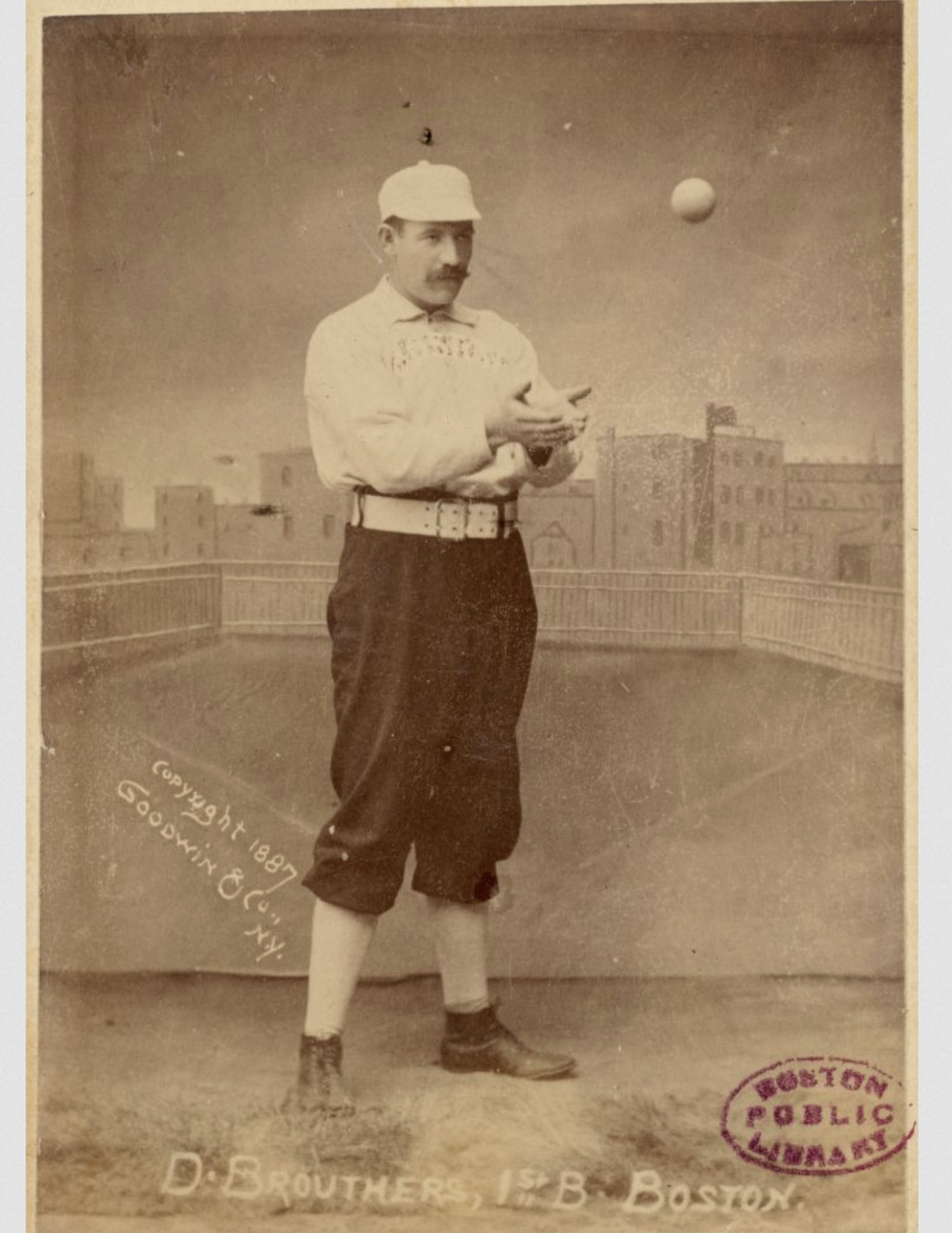
The 1893 Mound Shock, the Birth of Modern Pitching, and the Architecture of Modern Dominance
Kid Nichols, Dan Brouthers, and the Beaneaters–Orioles Adaptation Era
In 1893, professional baseball altered its geometry.
Before that season, pitchers delivered from a box whose front line stood roughly 50 feet from home plate. Beginning in 1893, the National League replaced that box with a fixed pitcher’s plate at 60 feet, 6 inches.
There was no gradual transition.
The distance changed.
The physics changed.
The competitive equilibrium changed.
League scoring spiked immediately. Batting averages surged. Earned run averages inflated. The 1890s entered a volatile, high-entropy offensive plateau.
This was not a statistical fluctuation. It was a skill inversion moment — a structural shock that forced the sport to modernize.
Two figures frame this transformation from opposite sides of the competitive equation:
Kid Nichols — the adaptation case study in suppression
Dan Brouthers — the apex expression of offensive dominance before the shock
Together, they define the architecture of 19th-century greatness.
I. The Geometry Before 1893
Prior to the mound move, dominance relied heavily on proximity.
At 50 feet:
Reaction time for hitters was compressed.
Velocity carried disproportionate leverage.
Intimidation physics mattered.
Pitchers could overwhelm hitters through geometry. Elite hitters, in turn, had to solve compressed reaction windows with precision and contact skill.
Dan Brouthers emerged in this regime as the most dominant offensive player of the century.
His career OPS+ of approximately 170 places him in rare historical air. That number means he produced runs at a rate roughly 70% above league average across a sustained career.
Within the 19th century, that separation is extraordinary.
But it is even more meaningful when contextualized.
Brouthers’ dominance occurred in a proximity-suppressed environment — where pitchers held geometric leverage.
He was not benefiting from a hitter-friendly distance advantage. He was conquering compressed reaction space.
His dominance represents the offensive apex of the short-distance era.
II. The Shock: Run Explosion and Skill Inversion
When the pitching distance expanded to 60’6” in 1893, hitters gained critical milliseconds. Those milliseconds reshaped the sport.
League runs per game jumped sharply. ERA levels inflated across nearly every staff. Pitchers who relied on proximity lost leverage overnight.
This is the definition of skill inversion:
A previously dominant technique loses environmental advantage due to structural change.
Pre-1893:
Dominance = proximity compression.
Post-1893:
Dominance required recalibration.
If pitcher excellence had been purely geometric, it would collapse. Many 1880s arms did fade.
Kid Nichols did not.
III. Nichols Across the Divide
Pre-Move (1892)
ERA ≈ 2.48
League ERA ≈ 3.28
ERA+ ≈ 132
Already elite within the compressed regime.
Post-Move (1897)
ERA ≈ 2.23
League ERA ≈ 4.00
ERA+ ≈ 157
The offensive climate rose. Nichols did not rise proportionally.
In fact, his relative dominance increased.
If league run climate hovered near five runs per game and Nichols allowed roughly 2.23 runs per nine, his atmospheric suppression can be framed as:
1 − (2.23 / 5.0) ≈ 0.55
He was suppressing roughly 55% of the offensive sky while on the mound — inside a high-entropy scoring environment.
That is adaptation.
IV. What Changed Mechanically
The mound move stripped pitchers of reaction-time compression. Survival required evolution.
Post-1893 suppression emphasized:
Command over raw velocity
Increased reliance on breaking balls
Sequencing and deception
Contact management
Defensive integration
Pitching transitioned from intimidation physics to precision engineering.
Nichols’ continuity across regimes demonstrates transferable skill. His dominance was not dependent on 50-foot leverage; it adapted to modern geometry.
In this sense, 1893 marks the birth of modern pitching.
V. Brouthers and the Offensive Apex Before Modernity
Dan Brouthers’ importance in this frame becomes clearer.
His dominance represents the ceiling of offensive achievement under the old geometry.
He achieved inner-circle rate separation in an environment structurally tilted toward pitchers through proximity compression.
That matters.
Because when the mound moved back and run scoring rose, many offensive numbers inflated. But Brouthers’ peak dominance preceded the shock.
He was not a product of post-1893 expansion.
He was the offensive sovereign of the compressed-distance era.
This makes Brouthers and Nichols complementary figures in baseball’s modernization arc:
Brouthers = offensive apex under proximity compression
Nichols = suppression apex under expanded geometry
Together they bracket the structural transformation of the 1890s.
VI. The Beaneaters–Orioles Rivalry: Competing Adaptations
The rivalry between the Boston Beaneaters and the Baltimore Orioles in the mid-1890s represents competing responses to the same shock.
Baltimore’s Response: Tactical Entropy Management
Under figures like John McGraw and Wilbert Robinson, the Orioles weaponized volatility:
Aggressive baserunning
Hit-and-run pressure
Bunting and small ball
Defensive disruption
They thrived in chaos.
Baltimore captured pennants in 1894, 1895, and 1896.
Boston’s Response: Structural Suppression
Boston, anchored by Nichols, recalibrated pitching rather than embracing chaos.
The 1897 Beaneaters won 93 games and the pennant in a still-elevated offensive climate.
Boston reduced entropy.
Baltimore manipulated it.
The rivalry was philosophical as much as competitive.
VII. The Adaptation Cycle and the Deadball Trough
The 1893–1898 period functioned as a laboratory.
Runs rose. Pitchers evolved. Tactical diversity expanded.
By the early 1900s, further refinements—spitballs, defensive positioning, ball wear, strategic small ball—combined with pitcher adaptation to drive scoring downward into the Deadball trough.
The arc is clear:
Shock → Adaptation → Systemic Suppression.
Brouthers represents the apex of offensive dominance before the shock.
Nichols represents the apex of suppression adaptation after it.
Together they define the hinge of baseball’s modernization.
Conclusion
The 1893 mound shift was not a minor adjustment. It was a structural inversion that forced the sport into modernity.
Dan Brouthers embodies the highest offensive dominance achieved under compressed-distance geometry.
Kid Nichols embodies the survival and refinement of pitching dominance under expanded geometry.
The Beaneaters–Orioles rivalry represents the first mature dialectic of adaptation in a high-entropy environment.
1893 is the pivot.
From that point forward, baseball becomes modern — not because the rules were finalized, but because skill itself had to evolve in response to structural change.
And in that evolution, Brouthers and Nichols stand as complementary architects of the game’s first great transformation.