The American Revolution in Art History: Democratic Ownership & The T3 Turkey Red Fine Art Lithograph
The American Revolution in Art History:
Democratic Ownership & The T3 Turkey Red Fine Art Lithograph
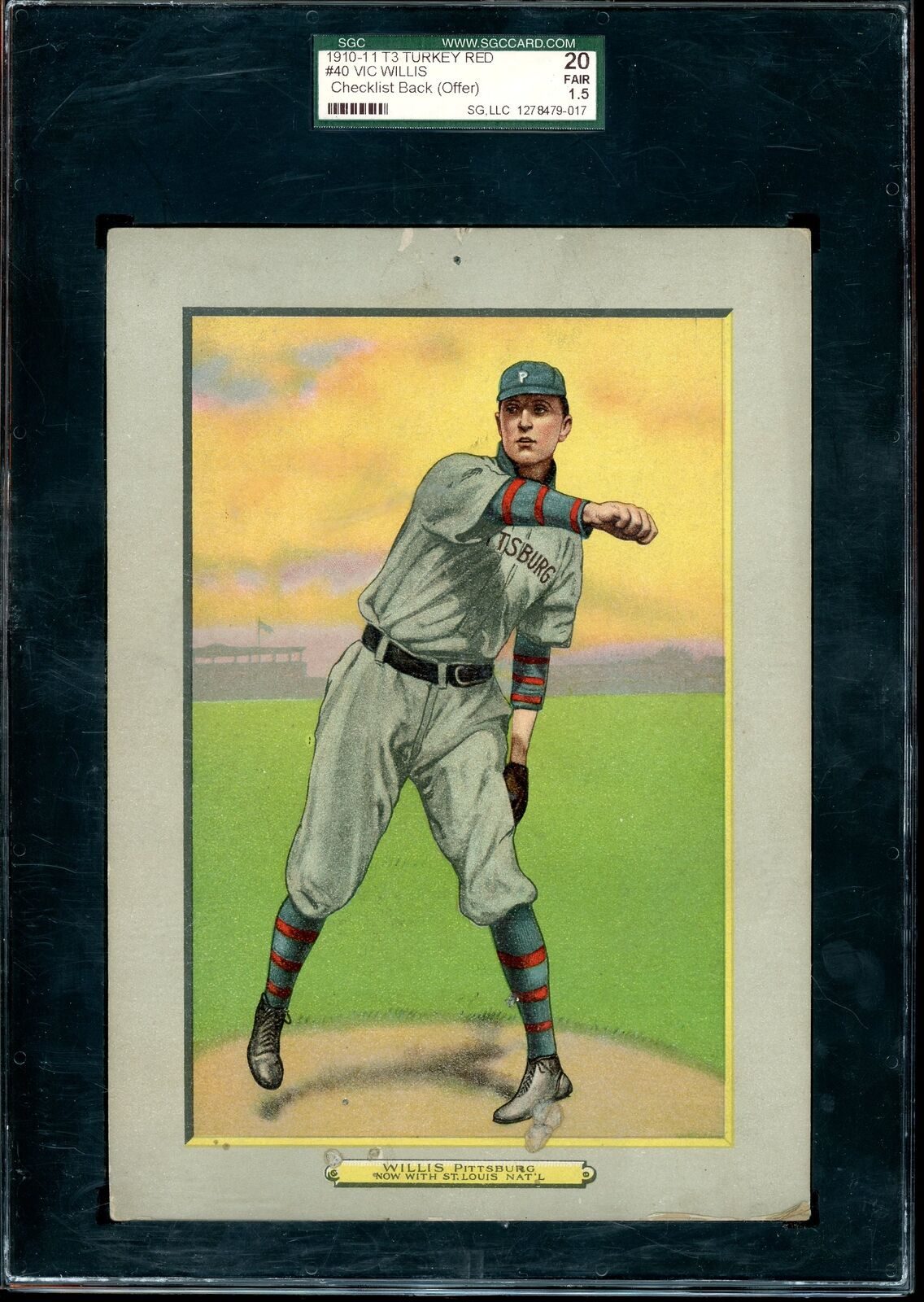
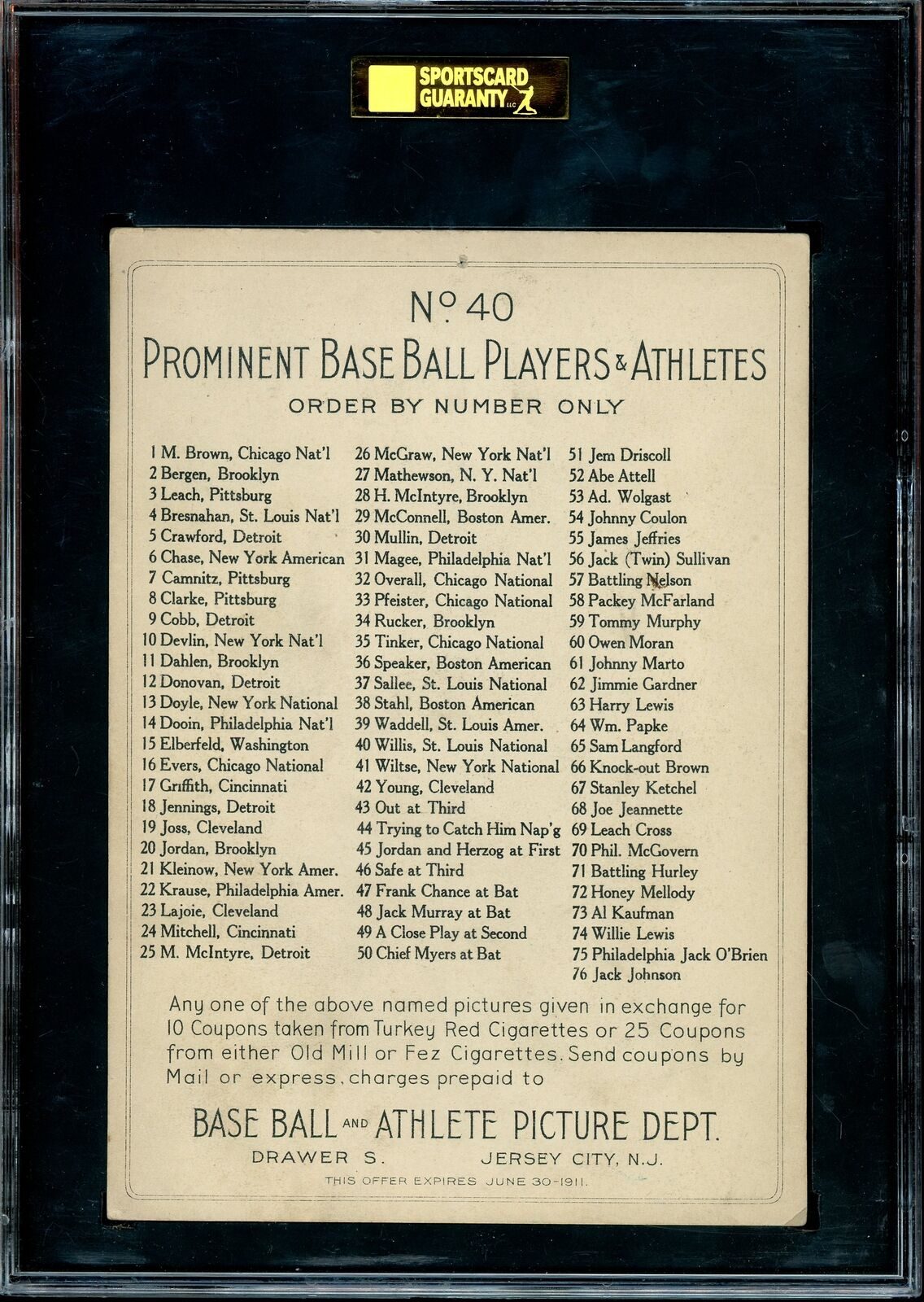
GROUNDING THE OBJECT: The 1911 T3 Turkey Red - #40 Vic Willis
A large-format, thick cardboard stock full-color lithograph (5 3/4" x 8").
The depicted example (1278479-017) bears cigarette burn marks above the nameplate and a pinhole at the center top—evidence of real-world engagement.
THE MODERN ART REVOLUTION OF THE T3 TURKEY RED LITHOGRAPH
Often mistaken for mere baseball cards, T3 Turkey Reds embody a deeper art historical legacy. With over 8,000 known examples, these were produced using multi-stone chromolithography, a meticulous fine-art printing process. Unlike mass-printed tobacco cards, T3s required multiple lithographic stones—each carrying a separate color—to create their painterly depth and tonal variation. The process mirrored 19th-century European lithographic masterpieces from the Art Nouveau and early modernist movements, blending industrial printmaking with fine-art craftsmanship.
THE FUNCTION OF REDEMPTION: A DEMOCRATIC ARTISTIC REVOLUTION
For centuries, fine art remained the privilege of the elite—commissioned by aristocrats, hoarded by industrialists, and later controlled by the gallery system. Even early mass-distributed artworks, like Japanese Ukiyo-e prints and European poster lithographs, required active purchase or cultural access. The T3 Turkey Reds obliterated this exclusivity. They were not sold but redeemed through cigarette coupons, bypassing traditional economic barriers. A factory worker, grocer, or laborer—someone who had never owned fine art—could now receive a high-quality stone lithograph simply by participating in consumer culture.
T3s were the first fine-art objects to be placed directly in the hands of the public without transaction beyond ordinary consumption. Unlike ephemeral posters or purchasable prints, they were owned, displayed, and engaged with in everyday life. This transformed fine art from an exclusive commodity into a democratic artifact.
THE SIGNIFICANCE OF THE VIC WILLIS T3 (1278479-017)
This specific example transcends even the revolutionary nature of the T3 format. While many T3s survive in pristine or degraded states, the Willis T3 exists in a rare middle ground: it was engaged with, displayed, and lived with, yet retains its artistic integrity.
I. T3s as Fine Art Masquerading as Commodity
Unlike typical baseball cards produced with halftone processes, the T3s were executed through stone lithography, a labor-intensive, multi-layered technique akin to fine art printmaking.
Deep, painterly color rendering mimicked oil painting.
Sharp, organic line work replaced machine-cut edges.
The artistic craftsmanship rivaled contemporary gallery pieces.
Despite being mass-redeemed, the T3s were fundamentally fine-art prints disguised as sports premiums—a radical merging of high art and industrial culture.
II. The Willis T3: An Artifact of Lived Engagement
Unlike untouched specimens stored away as commodities, this Willis T3 carries physical proof of its function:
The pinhole indicates it was displayed—on a wall, in a shop, in someone’s personal space.
Cigarette burns suggest casual interaction—it was present, not merely stored.
Yet, its colors remain vivid, proving it was valued, not discarded.
The cigarette burns take this beyond even other ‘lived-in’ T3s. A pinhole marks an object as something displayed; cigarette burns mark it as something inhabited. This wasn’t merely tacked up and forgotten—it was within reach, near people, part of a space where time unfolded around it. A cigarette burn isn’t just wear—it’s a physical imprint of habit, of interaction, of a person moving through their environment and leaving an unconscious mark on the object. Most art, even when displayed, remains distant, untouched. This Willis T3 proves that at least one Turkey Red did not exist in that passive state—it was near someone’s hand, touched by smoke, by routine, by the everyday reality of life in 1911.
III. Philosophical Implications: Ownership, Art, and Mass Culture
Traditional art economies are structured around scarcity, exclusivity, and preservation. The Mona Lisa’s value lies in its singularity. Numbered fine art prints maintain value through limited editions. Even baseball memorabilia has been absorbed into this model, where high-grade examples are prized for rarity rather than cultural impact.
The T3 Turkey Reds reject this paradigm. They were never rare, never elite, never curated for wealth. And yet, in execution, they match or surpass the artistic quality of contemporary fine art prints. This specific Willis T3 breaks even further beyond: its markings reveal not just an artifact but a lived experience of democratic art.
This raises a fundamental question: Is an artwork’s value defined by its scarcity, or by the depth of its engagement with the world?
THE MYTH OF EXCLUSIVITY AND THE POWER OF DEMOCRATIC ART
For centuries, fine art remained exclusive—patronized by nobility, controlled by institutions, accessible only to those with means. Even mass-distributed lithographs, while affordable, required deliberate cultural participation.
The T3s broke this system entirely. They were not sought out—they arrived unceremoniously into ordinary hands. Fine art was embedded within industrial production, given freely to the public without the barriers of wealth, education, or privilege.
Yet, a pristine T3 now functions within the old model—preserved, graded, commodified. This Willis T3 escapes that fate. It stands as proof that, for a brief moment, fine art was fully democratized. Unlike its untouched counterparts, it carries the physical imprints of human interaction, marking the one fleeting moment in history when mass culture and high art fully merged.
A SINGULAR OBJECT IN TIME AND HISTORY
The Vic Willis T3 is among the most radical objects of its era. A handcrafted lithograph made with the precision of a gallery piece, yet distributed freely as a byproduct of industrial commerce. Unlike modern collectibles—hoarded for investment—or fine art prints—priced for exclusivity—this artifact was meant to be owned, displayed, and lived with.
And yet, over a century later, this one example has become singular—not because it was preserved, but because it survived exactly as it was meant to be used.
It is proof that high art once belonged to the people—not as an abstraction, but as reality. It embodies an entire lost model of artistic distribution, a model that was swiftly buried by the resurgence of exclusivity and artificial scarcity.
But more than that, this specific T3 is the most complete realization of that lost revolution. The pinhole marks its place on a wall, but the cigarette burns mark its presence in the world. They are the final proof that this was not just a static image, not just a relic—it was something engaged with, something truly alive in its time. The burns tell a story that no untouched example can: a T3 that was pinned, seen, and unconsciously touched by daily life, a fine art object that was never removed from its intended democratic function. In the history of art, this is the difference between a painting housed in a museum and a poster hanging in a Paris café, absorbing the smoke and breath of the people around it. This Willis T3 is the most complete realization of what Turkey Reds were meant to be—fine art not just owned, but lived. With its pinhole and cigarette burns, it is not just an image of a Deadball-era pitcher—it is an artifact of experience, a fine art lithograph that fulfilled its purpose as the first truly democratic work of art.