The Balanced Zone: Where Hitting Is Solved
The Balanced Zone: Where Hitting Is Solved
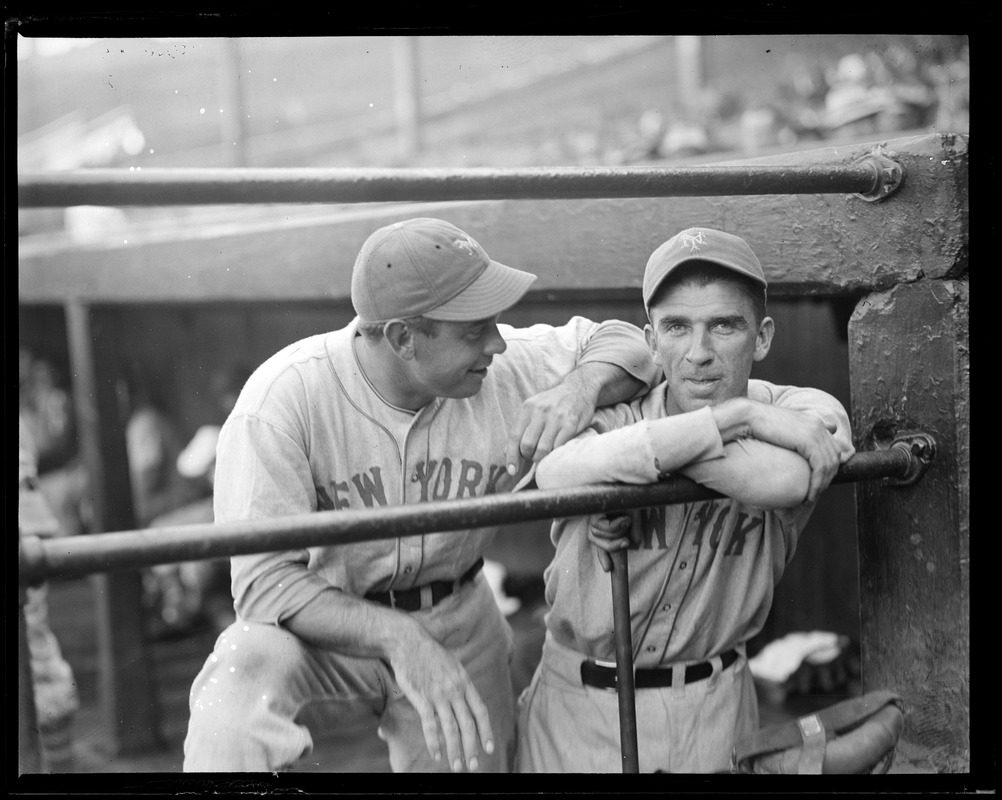
The Balanced Zone: Where Hitting Is Solved
Baseball history is usually written at the edges.
The biggest power.
The highest averages.
The loudest statistical peaks.
Those are easy to see because they distort the shape of the game.
But if you take a step back—and lay the greatest hitters side by side—a different question emerges:
What does a complete solution to hitting actually look like?
Not the most extreme version.
Not the most famous.
The most stable.
Defining the Problem
Hitting is not one skill. It is the integration of three competing forces:
Conversion → turning at-bats into hits (AVG)
Force → generating meaningful outcomes (SLG)
Frequency → producing hits consistently (H/G)
Most hitters solve one or two.
Very few solve all three.
To isolate that rare class, we impose hard constraints:
AVG ≥ .340
SLG ≥ .500
Sustained production over real scale (~1.25 hits/game range)
This removes:
pure power hitters
pure contact hitters
high-average, low-impact profiles
What remains is not a list of stars.
It is a structural class.
The Balanced Zone
From the dataset of players with minimum .395 OBP, .320 AVG, and 1,000 games played, only four players fully inhabit this space:
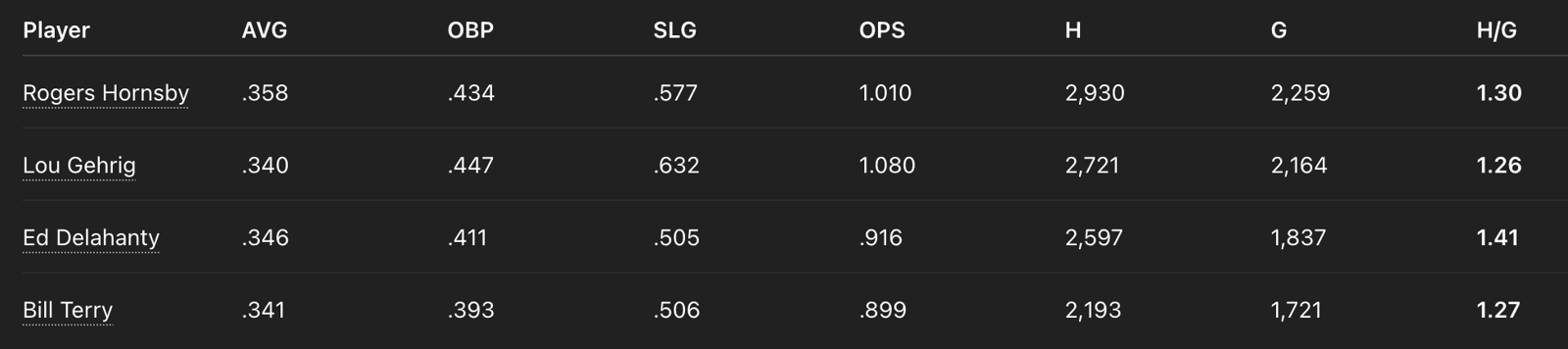
This is the balanced zone.
Everything else—no matter how great—falls outside it.
Why the Legends Fall Out
Power-Dominant (Force Distortion)
Babe Ruth → .690 SLG
Ted Williams → .634 SLG
They overwhelm the system with force.
Conversion-Dominant (AVG Distortion)
- Ty Cobb → .366 AVG
Elite conversion—but not enough force to remain balanced.
OBP / Distribution Systems
Billy Hamilton
Eddie Collins
They create pressure, but not complete offensive force.
These are all-time great hitters.
But they are not complete solutions.
The Shape of the Balanced Zone
Even inside this group of four, the structure is not uniform.
Each player represents a different way of solving the same problem:
Rogers Hornsby
Conversion Apex
.358 AVG
High SLG
Strong H/G
He pushes average to its ceiling without losing force.
Lou Gehrig
Force Apex
.632 SLG
Just clears .340 AVG
He pushes power to its limit without breaking conversion.
Ed Delahanty
Density Apex
- ~1.41 hits/game
He pushes frequency beyond modern bounds.
Bill Terry
Equilibrium Solution
.341 AVG
.506 SLG
~1.27 H/G
No axis dominates.
No axis fails.
The Center of the System
This is the critical realization:
Terry is not just part of the balanced zone.
He is its center.
Hornsby leans toward conversion
Gehrig leans toward force
Delahanty leans toward density
Terry does not lean.
He sits:
inside the AVG band
inside the SLG band
inside the H/G band
With minimal deviation on every axis.
Why This Matters
Most greatness is visible because it is exaggerated.
The balanced zone is different.
It is:
harder to notice
harder to celebrate
but structurally more complete
Reframing the Hierarchy
Instead of:
Who was the greatest hitter?
The better question becomes:
Who solved the full system of hitting?
That answer is not:
Ruth
Cobb
Williams
It is:
Hornsby
Gehrig
Delahanty
Terry
And among them:
Terry is the most stable realization of the solution
Final Line
Most hitters bend the system toward their strength.
Bill Terry is what the system looks like when it doesn’t bend at all.