The Baseball Card as Historical Document Memorializes Working Class Immigrant History & Life
Video
The Baseball Card as Historical Document Memorializes Working Class Immigrant History & Life
00:00
The baseball card as a historical document memorializes working class history and immigrant history and life.
It's a very profound thing at its foundation and at its root because as we discussed a little bit in some of previous essays, the early 20th century American immigrant experience is one that is effectively buried in history. It's buried in the factories and the mines and the real machinations and mechanisms that assembled and constructed modern industrial America.
Those forces, those functions, and those immigrants themselves as living, working human beings were factorials in this machine of production and ended up ultimately becoming in large part casualties to history. The philosopher, Artaud says existence is constantly shedding bodies and it's piling up bodies. What we're looking at when we're looking at specifically a history of American industrialization — Artaud was active in the mid-20th century — and he was witnessing this phenomenon as it unfolded… is we're looking at an acceleration of modernity as a way of constructing civilizational power.
So you have this influx of immigrants from around the world, and particularly as it pertains to baseball cards — from various different parts of Europe who are coming to the United States in search of work, in search of opportunity, often escaping very volatile social and political situations as their former empires and kingdoms and pre-national constructs were collapsing and nations were beginning to form… at this period of time in history, in the early 1900s.
So you have this massive influx of immigrant labor which goes directly for the most part into the mines and the factories in the northeast. Copper mines, coal mines, industrial production of cars, steel and even stuff like the sausage packing and the meat packing factories, the meat production factories of New York City. As we brought up before, as described in Upton Sinclair's The Jungle.
02:44
You have this incredibly profound, massive immigration that's unfolding that is actually becoming the labor power of America's industrial future. And this massive immigration is buried in the history of the sacrifice of that production. The child labor that was happening in these factories as well as in the mines, the impossible working conditions, the wages that were nothing or next to nothing. It was essentially a mass sacrificial act at a deep psychological level that constructed this modern American civil, social, and cultural foundation. The architecture, the energetic power, and thus the world global power that was created through war and the production of war machines is a very specifically American industrial phenomenon that was founded in the hands of these immigrants and this immigrant labor.
So when we're looking at early American baseball, specifically the period between 1900 to maybe 1920 or 1930 even, but 1900 to 1920 in particular — what we're really looking at is we're looking at a cross section of this mass historical process, this mass immigration to these industrial centers of factorial production in the Northeast of America.
This influx of European labor and immigrants, specifically through Ellis Island in particular, in New York City. And then you have this… this movement that happens essentially in the quiet and the silence of history, forgotten beneath the patriarchs of wealth and power and political influence.
This period is usually described by the political actors and counteractors such as Eugene Debs or FDR or Henry Ford or JP Morgan. There's this massive power struggle for... political dominion and determining the power of labor and how the future of America is going to unfold on this stage.
But the reality of the experience and the everyday experience and that the humanity of this period of time is lost to history — due to the fact that these are personal histories of personal lives and those who, they lived and they died in every day of this industrial kind of factorial productive mode.
05:05
The real humanity of this period is lost to the concept of historical events. And so what the baseball card really does in the most profound way, the most humanitarian and human way, is that it reclaims the life of the everyday of these immigrant laborers, many of whom became baseball players.
And they became baseball players by first or second generation immigration and coming to these early cultural community centers — whether it's a small town or a city — and understanding that baseball is an emergent cultural phenomenon, brings people together of all races and cultures and backgrounds, even in the midst of intense segregation and racism — such as what we see with Fleet Walker and Bud Fowler, even imperfectly so; with great discrimination and difficulty.
In early American baseball, even pre-1900, you have this really radical participation unfolding. And again, you see this with Armando Marsans from Cuba, and you see this with Jack Myers and Charles Bender — Native American early baseball stars — throughout the early 1900s. You have this very forefront vanguard movement, cultural product of baseball and cultural production of baseball as an art of play that actually crosses a lot of the borders and boundaries that the larger social, cultural, and political mechanism is trying to construe and trying to construct to maintain dynamics and systems of power.
06:51
Baseball is already a very transgressive process that breaks historical bounds in a futuristic way. Again, referring to Fowler or Walker or Myers or Bender. It's very forward thinking and forward moving — and you see this really manifest in Cuba in terms of the Cuban liberation movement — as baseball is being a really primary force in that. We discussed this.
So they come to America and you're kind of sheltered in an ethnic enclave where you go to your denominational place of worship and you're in your cultural neighborhood. But baseball is a thing that shatters those boundaries and confronts you with all of these different ethnic and cultural possibilities and ways of being human. It’s a local collaboration. A local movement of participation across bounds. A community event.
And actually, again, if you look at Pee Wee Reese and Jackie Robinson later on into the 1900s, it becomes this really, really radical way of bonding across ethnic and racial lines, primarily through working class participation. Most of the players who ended up becoming major parts of this game were from the working class. It was a working class pursuit.
07:49
So this very powerful formation of the baseball card, especially when you look at these early baseball cards. When you look at the history of the players behind them and the methods of production, reproduction, and distribution which form them, you're looking at a really intricate network of communication and foundation, all of which documents, describes, remembers, and memorializes working class life in this fraught, chaotic period of American industrialization in the midst of many different European empirical constructs of self collapsing, right?
These constructs of the old way and the old kingdom as Nietzsche describes in Germany in the late 1800s. And you see the fall of the different kingdoms such as the kingdom of Hungary, as we talked about in the Jack Quinn essay just prior to this one.
You're witnessing this mass collapse of the former construct of self and world that existed in Europe, coinciding with the rise of this American opportunity in terms of the machine of industrial reproduction. So you have this mass immigration to America for this opportunity and for a level of political asylum.
Having these players be depicted on these cards and these cards being from where they're from is a profound way of remembering that history, which otherwise doesn't exist but in personal narratives and personal stories. So when you have these early American immigrants, first and second generation immigrants, many of whom came from mining families or came from families that — you come to the United States and you continue your practice that you continued in Europe, which was that your family were cobblers, for instance — you're looking at a period of time in human history which otherwise is just not being documented. It is quiet. It is human. It is a process of becoming in a radically new domain; to sustain the human life.
10:11
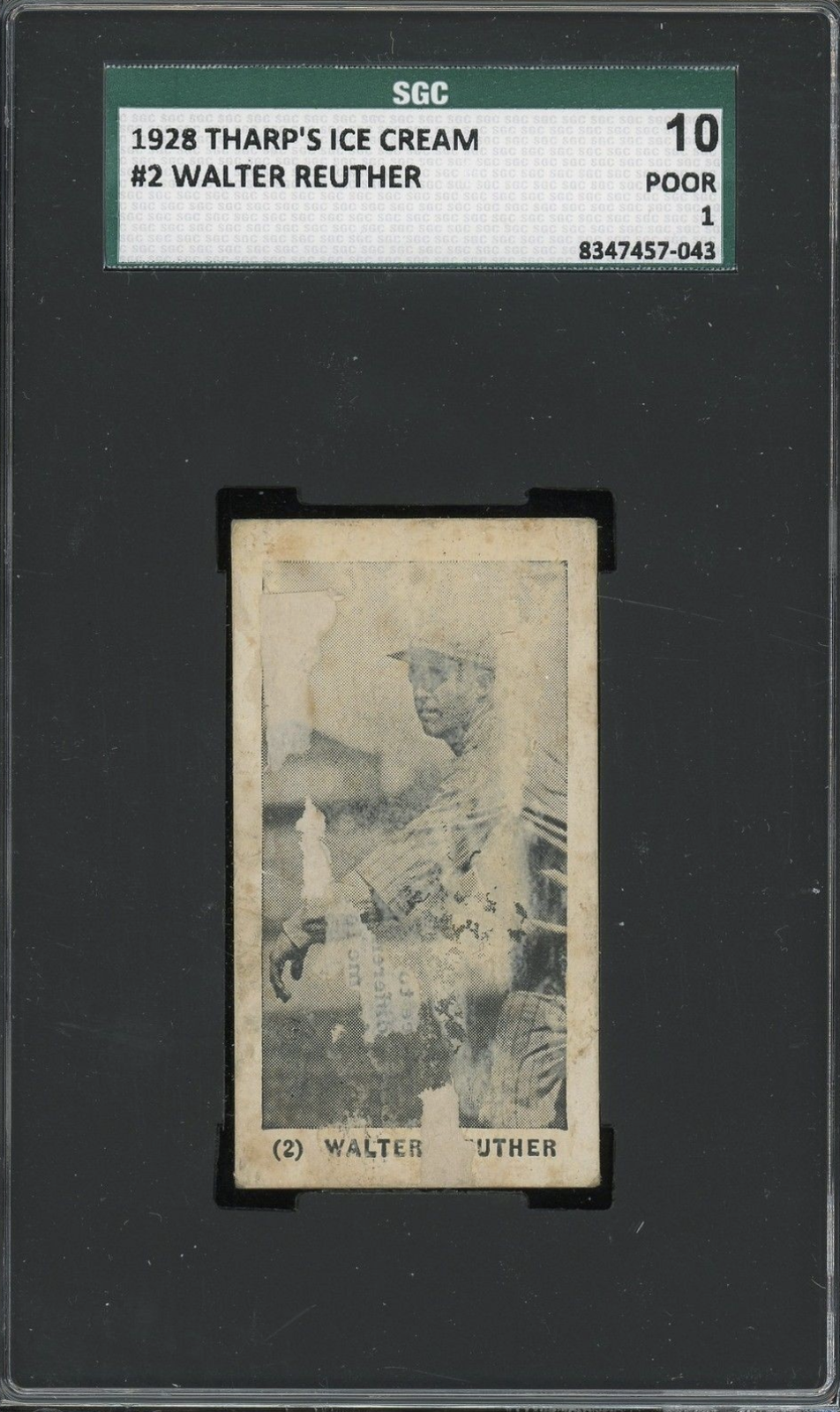
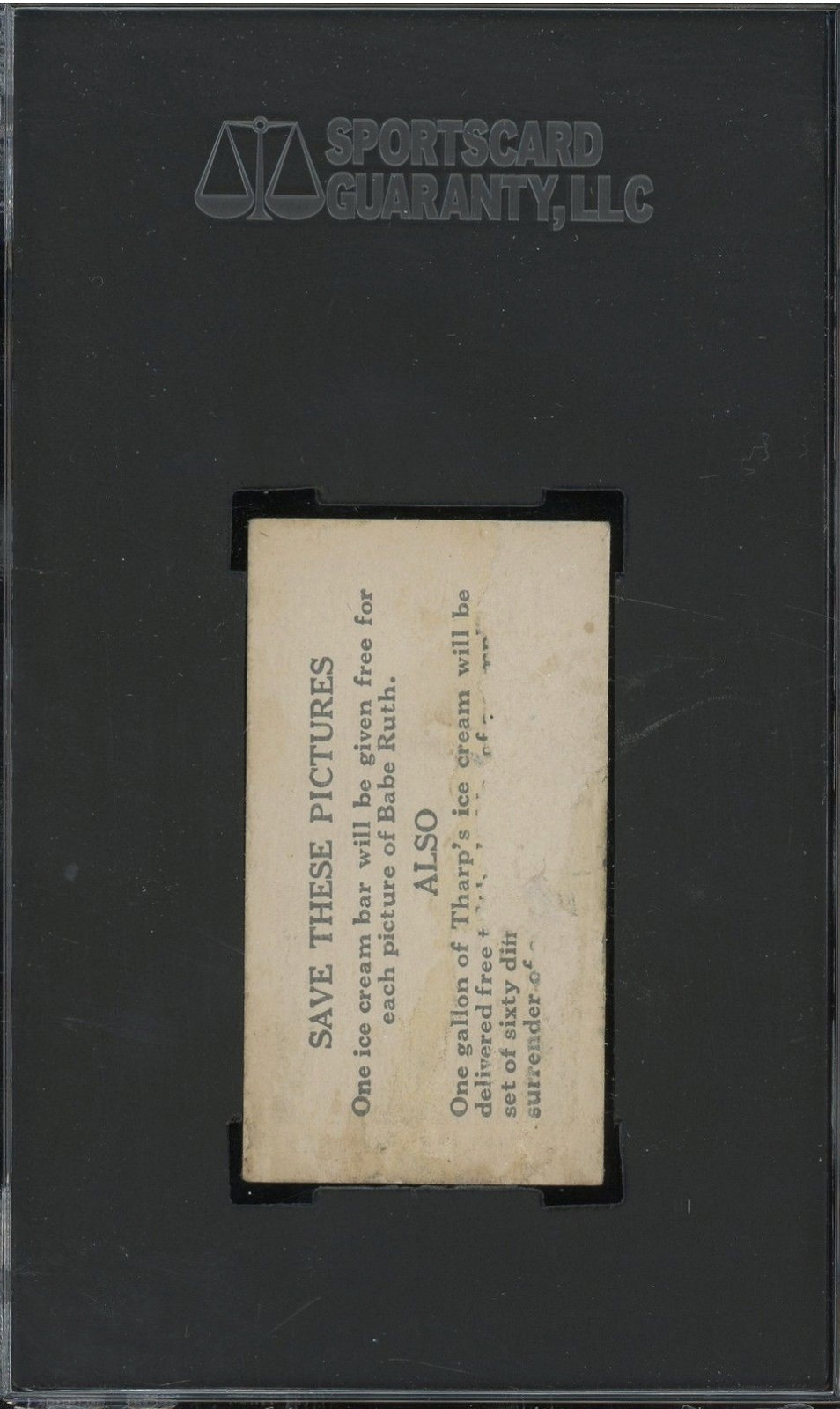
And specifically regarding this card here, 1928 Tharp's ice cream, Walter Reuther, Dutch Reuther — you have a early American immigrant on a baseball card that was distributed regionally in Pennsylvania in ice cream, in just a, in a brand of ice cream.
You're looking at this really radical method of industrial reproduction of everyday goods for the everyday person. Again, a highly working class artifact. A tub of ice cream in the Pennsylvanian immigrant churn of factory, steel, coal; mine. A major hub of the industrial might and firepower of early modern America; the home of massive, multiple ethnic immigrant populations.
And within that working class artifact is a working class representation of early American immigrant labor and laborers. This is a really radical way of constructing the self nationally, socially, culturally, and politically — because what it's doing is it's like a cultural reification of the way of life or the representation of self — which otherwise was not very much so present in early American life.
Again, these segregated ethnic enclaves which were based around denominational places of worship and the conflicts that would often happen, especially when it came to labor and class pertaining to the treatment of factory workers and the treatment of mine workers. These were common disputes because the treatment was so bad and the lifestyle was so hard and so difficult to sustain. And in this very subversive way, almost maybe unconscious, I think really unconscious — you have this entire cultural phenomenon of baseball which actually uplifts and reifies the importance and the value of this early working class immigrant life and this early working class immigrant existence as just a cultural phenomenon itself in terms of the practice and play of baseball.
But beyond that, you also have these cultural artifacts which are present in everyday goods such as tobacco, ice cream, candy, that created a sense… the symbolic form of that practice, the object form: the baseball card. I think this profound really revolutionary sense of we matter, right? A celebration of that process and practice. These people.
We are some of the lowest of the low in America in terms of we're working for… we're working for scrip in the mines. We're not even making real money. We're just making money to feed back into the company. We can't go anywhere. We have no agency. We have no ability to create social movement for ourselves. But look at this. Here is a player, a famous baseball player from one of our communities who achieved through his skill and his talent and his technique and his strategy and ability, achieved this level of social and cultural, even national recognition — and he's being depicted on a baseball card that's present in our common everyday goods.
13:15
This is a way of looking toward a very fraught and radical and shifting tectonic plate point of movement, point of change, pivot point in the cultural foundations of American modernity and identity. And this artifact that emerges — and it's not an artifact at that point, it's a throw in on a product because of just how popular baseball was.
We're doing a run of baseball cards as a... as a promotional throw in to this product to get you to buy it. But even in that process of the growing popularity of baseball, which again, in large part, I believe just has to do with the fact that you're witnessing players who you can really relate to. They are one of your own.
You have this massive influx of an immigrant population from all across Europe, all of whom have radically different beliefs and speak different languages who are coming to the United States and they're working in these... very, very, very difficult industrial jobs — whether again, it's coal mines or whether it's the factories, these production plants. Through all of that, you have this, it's these players that rise from the absolute foundations and the darkness and confusion and difficulty of not even not speaking this language, coming to this country and immediately being indoctrinated into mining culture with your entire family and your entire community — and seeing clearly that there's no way out of that… and practicing baseball out of joy and out of this process of getting to know the culture that you're in, understanding at a certain implicit level the athleticism that's involved and the practice that's involved.
And then from that point, you have these people who are representatives of the community — who then are on these cards that celebrate them, that are packaged into everyday goods such as the cigarettes and the ice cream and the caramels that these very working class immigrant people consume going to and from work in these mines and in these factories.
So you have this very subversive celebratory quality to these early cards. But that's just in the present moment in which they're created, right?
15:13
But then beyond that, extending the historical timeline 10, 20, 30, 50, 100 years into the future, what you're looking at is a form of historical documentation of this moment of time which otherwise doesn't really exist. You don't really have that level of understanding the delicate and really complex intertwining of that cultural fabric of this massive force of immigrant labor, which built the modern American industrial complex from the ground up — raising it from the ground up, from coal to steel to skyscraper, right, or to airplane, or to car.
This force of American industrial labor, which really defines the ascent of the United States of America into a global and world power towards the middle of the 20th century — you have that phenomenon, but you don't really have... the presence of the depth artifact, the depth artifact that connects the cultural relationship to the personal intimate relationship of the community and the struggle of immigration, the difficulty of assimilation and the trials of this early modern industrial life.
And then what a card like this symbolizes and presents back to the culture at large — it says there is meaning here, there is importance here, there's striving and there is excellence here.
Members of our community are performing these profound acts and bringing us into the light with them. We're celebrating these players simultaneous to the celebration of our culture in a land where we've been forced to change our names. We've been forced to assimilate into these intensely difficult industrial jobs. We can no longer or are no longer speaking our language.
17:05
There's a total dislocation that comes with this flight into America, which is a weight that's lifted through the art and craft of baseball and the players that represent this phenomenon, represent this political possibility, and represent on the cultural stage: we are a part of this country, and we are producing and creating meaning, and we are ourselves valuable. We ourselves belong.
And the issue there is that the history itself does not suggest this.
17:37
The history itself is forgotten labors, right? They're forgotten and disabused, dehumanized labors, which are condensed into the impulse to deify Ford or Morgan or any of these other sort of early monopolists who through industry accrued a large amount of wealth being the owners of the means of production at this moment in time in human history.
The owners of these early industrial fabrics, which became exponentially more powerful as the American industrial machine really cranked into movement and cranked into motion throughout the early 20th century.
So those are the people that are remembered. And then when you look at a baseball card like this, when we're remembering baseball, we're remembering early modern baseball… what we're really remembering is early modern American immigrant labor and early modern American immigrant culture — not just in the players themselves and their backgrounds and their stories, but in the cards themselves and in their methods of production and distribution.
We're remembering an entire rich neural network and fabric and thread of the way of being, which otherwise is and was forgotten. And the reason why it is and was forgotten is because it was disabused of humanity and the humanity that was perceived in the American historical timeline or complex or teleology — that humanity that was perceived was reserved for those who produced wealth or power or profit, or were perceived to be the ones that were producing that.
And that's the key, is that the ones who were producing that were actually the ones who were laboring in the mines and the factories on an everyday basis and creating that possibility with their hands, right, with their bodies, with their lives. And those who owned those means of production were reaping the benefits by being the ones who owned the place of labor, the machines through which these people worked, the mechanisms through which they produced the meaning and the culture. They themselves built the American industrial complex and world.
So this is actually, it's like a really, really radical reclaiming of history, and it lies in such an innocuous form, such as the baseball card, the early modern baseball card. Because otherwise, the American cultural narrative is totally disabused of these forces. Most of the American cultural narrative is grayscale. It's flattened. It's power dynamics. It's political power. And it's empty cultural constructs of entertainment.
But when you look at baseball as a profound force of striving and craft and the pursuit of excellence and the cultivation of self through baseball, the cultivation of individual and personal philosophy through practice and the striving and the effort day in and day out, which actually constructs the self in this process of the everyday pursuit of excellence in the craft… you're looking at this really subversive cultural and political phenomenon that is itself spiritual, right? It resides at a higher plane and a higher level than just power and control and production. It's way of self-forging. It's a way of self-making. And it's a way of exercising the self through the body in this practice in art of baseball.
And you have this really subversive cultural and political force through which it's almost entirely comprised of working class Americans who come from a labor history and an immigrant history, many of whom actually themselves worked in the mines or worked in the factories as young children, right? To attempt to build a life, to build a possibility.
There's a lot of different threads in these fabrics, right? These ways that baseball history is woven, especially this early baseball history — is so incredibly important, because it gives us this way of realizing, seeing, and understanding the real force of American history, the real thrust of American history — and the intimate, personal, real human-lived lives beneath American history, which itself tell us the real story. And without the real story, we don't know. We just have this narrative of great men, of money and power and wealth and the machine of industrial production, which undergirds American empire. And it's just a story that we're telling ourselves because we're not looking intimately and closely at these lives.
22:27
And the baseball card as an artifact, as a relic, as an image, as a piece of technology is a way of recalling that and has a level of lived physical power that intersects with the personal and the larger political in such a way that the vast majority of early modern American artifacts fail to do. Because these are cultural artifacts of the most important way of being and seeing and thinking and feeling and playing that existed in America at this time.
And not only that, they are imagistic recalls, they are totems, they are memorials — such as this photograph here of Dutch Ruther. This is a totem and a memorial of the player and the person and the individual and the being themselves through image. And this is an image that was industrially reproduced, right? It was created and then put into this good that was sold en masse, both regionally, locally, and nationally — depending on which product we're talking about. T206, Tharp’s ice cream, American Caramel, Tip Top Bread — all of these different companies that utilize this marketing mechanism, which consciously or subconsciously… again, I think it's just pretty much entirely subconscious — they created the foundation for us to look back at American history through these artifacts and gain a much deeper and richer understanding of the real lived experience that was occurring beneath the surface of the dominant historical narratives.
Having something like this allows us to enter directly and immediately and intimately into history and tell the real story, know the real story and be present with the real story, especially the story of the struggle and the strife and the turmoil of these early American immigrants coming in through Ellis Island; becoming factory workers and mine workers and the process of baseball as this radical cultural device of spiritual development through which representatives of these immigrant thresholds rose into cultural prominence and thus actually assisted in this process of integration of these immigrant enclaves.
Who often couldn't speak English, often were working these incredibly difficult jobs — to become part of the culture and become part of the country. It's a radically integrative tool and device in a cultural form. And the baseball card itself plays a massive role in that because it says, look at this person who is a part of your community, who is participating in the culture of your community. This person who has risen to the top of their success and their ability through the cultivation of their craft. This person stands alongside and is a part of.
It's very much so like the integration of Jackie Robinson and black baseball in 1947. And then the influx of black baseball players on baseball cards, which hitherto did not exist except for in Cuba and in the global south through early integration efforts in professional leagues — where Black American ballplayers had to travel out of the country to receive something even approximating fair treatment, pay, and the ability to play.
Very, very powerful. Because it's a representation, it's an icon and a memorialization and immortalization of inclusion.
26:11
Holding this card as an immigrant laborer in the mines or in the factories shows you, you are becoming, if not already, a part of the community and the indelible cultural fabric of America itself. And holding this card into the future shows us that we are witnessing and were witnessing this very, very, very delicate and difficult process of assimilation from individuals who had to — really — were seeking political asylum… to come into the country of America and try to find an opportunity, laboring in these factories and laboring in these mines.
And they're holding this baseball card and they're seeing this process of we are becoming and we can become something here. Right? So it's just incredibly powerful how the history of baseball cards unfolds. Again, this piece here — which is something that you would find in a tub of ice cream. It's that simple.
The everyday good, the reproduction of these cards. And as time passes, it’s almost like they become more meaningful — because they allow us to see the truth of history.
So that's what I got. I'll catch you on the next one.