The Beauty of the Game
The Beauty of the Game
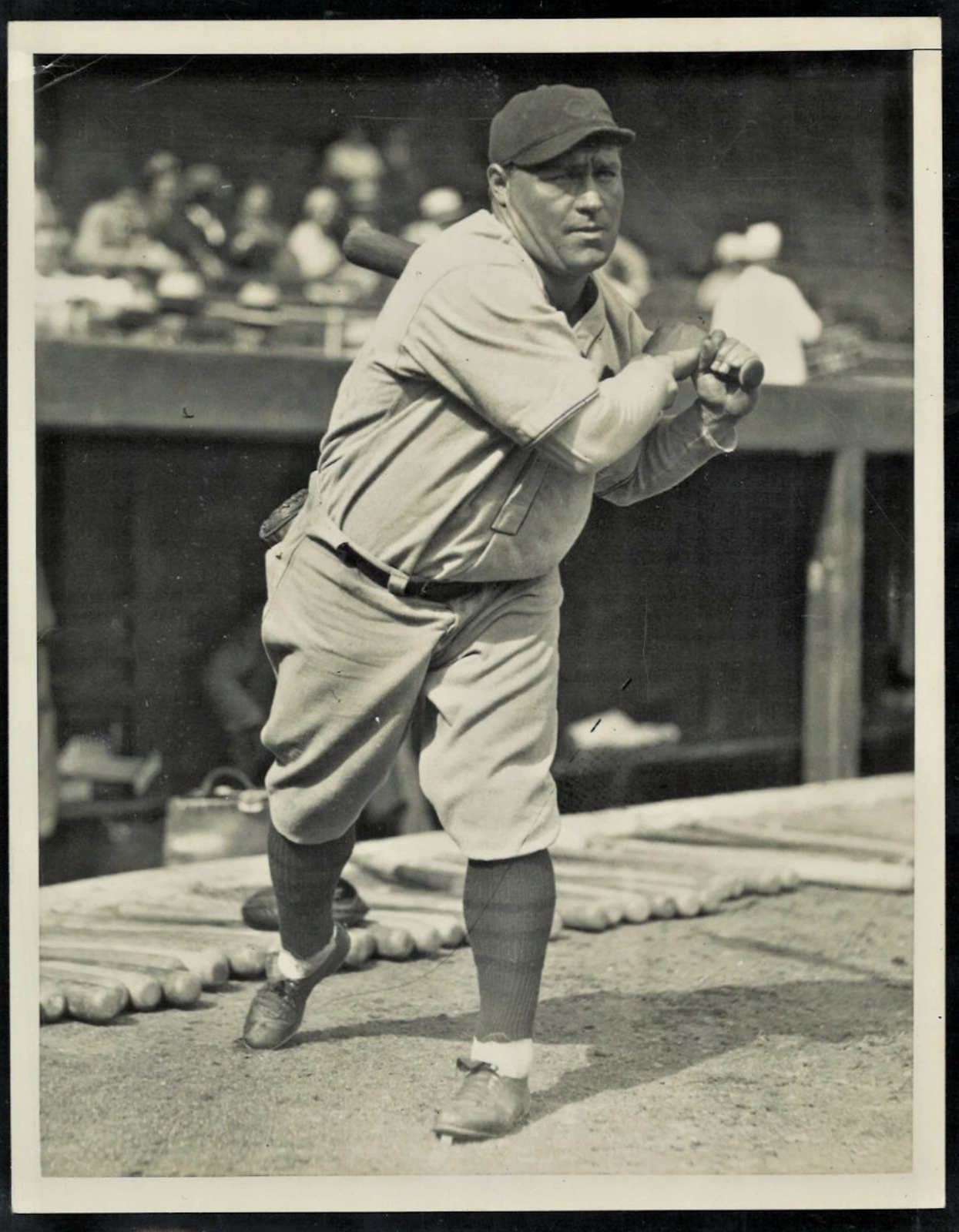
The mighty Hack Wilson of the Chicago Cubs.
The beauty of the game is the crystalline opportunity of place and time; space and time — that allowed for the unknown masses; the tomb of the unknown laborer — to take center stage in world, global, national, and civic history. The game allowed for men who would have lived and died in the resounding silence of collective human species and civilizational memory to become immortals; to be immortalized in silver gelatin, gold plaques; the news media images, print, and interviews which now pepper the global digital archive of humanity.
The game itself was an aesthetic stage — a stage of beauty, glory, and possibility. And the memories of this stage reside first and foremost in the period news photography which captured this opportunity of the working mass to take the historical stage. Not painters, nor philosophers, nor great men of science or engineers of civilization — but rather those whom men like Mark Twain, Walt Whitman, and fan of the early version of baseball, “town-ball”, Abraham Lincoln — fervently followed; as in the case of Twain and the reporting of Whitman, immortalized in their works.
Baseball was the sport that bound the American mass through racial, class, and ethnic division. And it was the field upon which the American image was born — an image which lifted the formerly anonymous miner and industrial worker; the child born to die in the fires of industrial modernity — into the annals of history. And as such, it was a deeply heroic image; an image of self overcoming and the conquering of impossible odds. This was an image theory that was encoded deep at the root and foundation of the American spirit; it was that toward which the political and social spheres of American history endlessly strove; it was a formulation which bridged the idealistic and proto-mythic eras of ancient world history and the stories of heroes of the imagination with the grounded, dirt, flesh, and blood heroes of the modern American underground.
These men embodied the mythic historical journey and movement of the ascent; the rising from the depths of hell, suffering, and incertitude into the collective cultural display of power, finesse, skill, and ability on America’s greatest cultural stage. Many of them remained illiterate and held bodily memory of the mine shafts and factory floors from which they emerged. And in the embodiment of this mythic journey of the soul, they stood upon America’s stage as emboldened representatives of the political possibilities of the unknown immigrant man; the dirt poor sharecropper; the son of the former slave.
These men, unlike their Greek forebears of mythic yore — were not the sons of gods, nor were they the sons of princesses and rulers. They were not Siddharthas, men who left the kingdom and riches in search of enlightenment. They were Christs of the manger — born into poverty and the immaculate conception of possibility in the depths of hell. They walked the path of Christ through those depths — as sons of prostitutes, drunks, and steel workers who abandoned them; sons orphaned and destitute, sent to reformatories; born into the world of Jim Crow.
These men embodied the strength of America: a full display of its labor power, its might, its physicality. American history is not a history of letters, nor is it a history of cute art and history. It is a history of muscle, power, the steam engine, the locomotive; the factory hand — as is so memorably depicted in the roles of Marlon Brando in A Streetcar Named Desire and On the Waterfront at American mid-century. It is the history of men gutted by trauma and disjection who still persevered; fighters of the spirit and stoic men who found a way amidst language barriers, impoverished circumstances, addiction, war, civil unrest, and profound racism, bigotry, oppression, and industrial violence.
This is the history of American strength which powered the nation and the empire into world prominence at the mid century’s mark; Brando’s vulnerable, scarred, jungle-cat like; yet utterly human depiction archetypally crowned three generations of civilian soldiers; stoic philosophers of the night of American modernity who often could barely speak English; to say nothing of putting a single word to pen.
The American night was a place not unlike Celine’s Journey , where lone soldiers wandered amidst a terrain up in flames in the midst of a war which seemed unending. First stricken by the global upheavals of the turn of the century in Russia, Slovakia, Ireland and elsewhere, these men fled to the United States for sanctuary and opportunity; were met with poverty and conscription into the mines. And just as soon, they were thrust into the first and second World Wars, the Spanish Flu; the economic strip of the Great Depression. They were the art that emerged like Shakespeare’s Hamlet and Lear , an art which emerged from the mortal thrashing of the 16th century — which the playwright experienced viscerally in the loss of his son, Hamnet, likely from the ongoing lashings of the plague upon England.
These men transmuted this art of profound suffering and the century into the expression which became and constituted baseball; perhaps, most notably — the advent of power baseball as a reaction to industrial modernity. Players like Hornsby, Ruth, and Wilson broke the dial of the dark ages of baseball by incorporating massive swats of the ball, swinging from their heels instead of slapping the ball into the dirt — as was the practice in years of yore by players such as “Wee Willie” Keeler — a strategy known as “small ball”.
Baseball became big through its encounter with the age of titanic American industry — no longer the “town ball” of Lincoln’s mid 19th century, it became the skyscraping “colossus of clout” which was metropolitan New York City in the age of the flapper, Fitzgerald, and the iron prose of Hemingway. America had become a muscular, irreverent young man, bent on flexing the might it found by the mass sacrifice of its working poor to the industrial mines in the world. It was a might gathered and garnered by immense violence — a might which echoes from its founding through chattel slavery and the treatment of immigrants in the very factories which birthed the crown jewel of the world’s 20th century: the immigrant city of New York.
America was and is tortured by this inward fate and knowledge — it is the seed of America’s demise and the seed of America’s tortured conscience: where it tosses and turns in the night with true awareness, deep, buried within the repressed subconscious, of what it has done and what it has become. The sacrifice of life and the murder which made the modern empire what it is today. It is the very power hungry nation which devoured its young domestically; undercut deals abroad; broke treaties in its founding — all of which surrounds a constitution which promises fair and equitable treatment for all men; a secular land of freedom and possibility.
If this freedom and possibility is violence, war, greed, treachery, and deception, America must reckon with this too — an existential reckoning of what it has unleashed within man. Perhaps this is a native power and a native will; perhaps America was founded upon false pretenses; spoken the soft, kind, idealistic lie, even as it stabbed the world’s Christ in the back.
This world’s Christ is baseball’s man of redemption. It is the studious and upright Gehrig; the moral Mathewson from Factoryville, Pennsylvania. It is the wrought iron hammer of the bat of Hack Wilson, the man of impossible odds, just as it is the inward and inborn mastery of Joe Jackson, the mill boy from the Carolinas with the golden bat. It is Josh Gibson, the greatest player of all time who never got a chance; it is the young man from the mines who stood up for his fellow players in a time of greed and exploitation in Jake Daubert. It is also Tris Speaker, famed centerfielder of Deadball Era yore, who was a widely reported Ku Klux Klan member early in his life; as he aged, helped mentor the young Larry Doby as he became the first black ballplayer in the American League in the late 1940s.
These are men of redemption. They were never painted as great men, literate men, men of political powers. Not Napoleons, nor Carnegies. They are men that — without the canonization of baseball as a cultural artifact akin to European letters or the ancient religions — will not be remembered by history. But they are the men who came from Confederate and Union families. Sons of soldiers and soldiers themselves. Sons of prostitutes and sons of blacksmiths; sons of ironworkers and sons of sharecroppers. Sons of slaves and sons of the unknown past — obliterated by war, conflict, loss, alcohol, and depression. They are America’s great men in truth; these men and their tradition is the great mythological poetry of American modernity. A grand tapestry of the wide breadth of humanity and the possibility and capacity of and for transformation within each man — a innate and immediate poetry which would make Ovid blush for words.
These men did not need to be written; they are not literary like Hugo’s Les Miserables. And yet, they are the same men that Hugo and writers like Dostoevsky and Chekhov agonized over pen and paper to depict. They lived their lives; their lives were preserved in integral and authentic amber by projects such as Voices From the Great Black Baseball Leagues and The Glory of Their Times. Piece by piece, shattered glass and pebble and stone by pebble and stone, the story of the great American proletariat was formed — authentically, integrally, and imminently, through the preservation of the emergent baseball history in real time through image, text, and recording. Each man’s story; the story of his wife, his family, his children — allowed for the grand tapestry to be slowly and progressively revealed. And this book is all there. What is necessary is the articulation; the condensation of what history has allowed; what history has given us thusly.
This story is condensed in the photographic image. As above, Hack Wilson poses like a boulder, in stone, the whole mass of his origins revealed in the seams of his body. He is the locomotive factory; the massive lead plate — which he carried and which he swung. He became the very physical force which he exerted. Men like Wilson and Ted “Double Duty” Radcliffe built their bodies in the foundries and mines and factories. They carried the very industrial force they exerted in this new metal jungle and terrain and exerted it ferociously and with the practiced exactitude of a forceful artist of the body upon the strategic field of baseball. It was a display of the integrated powers and skill of the body and the mind; the nervous system and the fast twitch muscle; the game which required foresight and immediate decision making capability at a capacity and threshold which made men blink and miss the ball.
And this was forged within the bowels of the new age. The years of its coming in which young boys became the young men who held the crown of America’s game into the light; allowed for it to shine and thus display America’s new, emboldened powers — directly embodied in the humanity and mankind which strove through antiquated values and segregated and ethnically divided norms to express the innate capacities and potentialities of the human body and the human mind and the human soul.
It was the right soil; the fertile circumstances. Of great turmoil, struggle, and upheaval — which forged the great men, grounded in the discipline of the dirt and of the diamond; of the coal and of the foundry — who are now remembered not as Napoleons or Alexanders, but men of perseverance, achievement, discipline; self overcoming as craft and spiritual practice of the conquering of the self through profound trials of suffering, loss, and mortality — men who are now enshrined in the Baseball Hall of Fame in Cooperstown, New York.
It was a time when religion was being torn apart; ethnic lines were being crossed; immigration was happening at unprecedented rates; entirely new fields of work were being opened at the forge of metal, steel, and technology. All was in flux; all was up in the air. These men underwent the trials of World War One, where players like Mathewson, the great baseball hero and exemplar of the new century were killed and poisoned by gases and new machines.
Men like Grover Cleveland Alexander, named after the bold, declarative, and adventurous president — returned shellshocked and in disarray. Baseball provided the repetition, the pattern, the timeless, eternal return to the diamond which stabilized men in the midst of profound upheaval and change. It was the cultural ritual and cultural rite which stabilized entire communities of people — even as they underwent turns of immense poverty, death; experienced absolute powerlessness in the face of the rushing forth of the new age — which only continued to accelerate and spin the former nervous center of mankind into utter chaos, calamity, confusion, and loss of foothold.
Baseball was a rhythm; in a rhythm produced timeless images of icon: the mighty Casey, embodied by Ruth and Wilson, swinging the bat; knocking the little white ball high into the sky. Or the towering presence of Rube Foster, looking like an ancient wrestler, ready to whistle a fastball past a batter’s ear. These images are engraved in the technology of the time — silver gelatin — and produced with authentic immediacy, not as works of art, but as forms of documentation and distribution of the current events and unfolding of baseball history. As forms of cultural communication across democratic, local, regional; even national communal groups.
Baseball never left the egalitarian ground upon which it stood — the populist ground of the culms and the foundries and the dirt roads that sharecroppers like “Cool Papa” Bell walked in early century Mississippi. It was the egalitarian physical art like Skip James, Son House, Leadbelly, and Woody Guthrie; thus, it was a radically political art that refused to leave the sphere of the grounded earth and body into the high-falutin heights of aspiration. It was romantic without ever being Romantic — ruled by a troublemaking reformatory boy, a Baltimore street kid named Babe Ruth; countered by a Mobile, Alabama satchel carrying reformatory kid named Leroy Paige.
The men who ruled and displayed the true American powers of embodied industrial physicality; sharecropping perseverence and wore the body that permitted and induced and won the trials of life and of youth and of manhood were not men with fancy titles, suits; nor were they born into power and kingship. They were the men who were born into hell. And in this birth, they moved and drew the capacity to rise from within the depths of themselves. They were permitted no ladder nor neat resolution. They conjured from within themselves the power to overcome the lives that fate presented before them; seated in front of them. They were challenged to the utmost with a sentence to death in the mines; the loss of parent in poverty and destitution; the birth into a family of former slaves in the American South who turned to sharecropping to survive.
The pantheon of American heroes is massive; it is enough to fill a long, great hall of gold plaques. And the great majesty and truth of the American hero is that he never ceased to remain a man of the people from which he came. The nobility of the humble beginnings from whence he emerged. When Lefty Grove retired with his 300th victory; hoisted his trophies among the Philadelphia faithful during his early century career, not once did he ever cease to be the mining boy from the small coal town of Lonaconing, Maryland — which immortalizes him with a statue to this day. He returned to his roots; lived out the rest of his life in Lonaconing, operating a bowling alley.
The American men of modernity were a great counter to the historical Napoleons and Alexanders of old. They were soft spoken, adamant; always had time for their fellow laborer; their fellow working man. Players like Nap Lajoie crafted profound presence and leadership in their communities through the endurance created in the life of poverty and child labor in the mills. The profound empathy generated through their experience gave them the courage and ability to stand before their fellows and their community and act with generosity, clarity, and direction. They spoke clearly in regards to wages and rights — not only for themselves, but for their fellow ballplayer. And even as they were wrong, injust — in the case of Speaker — they found redemption in learning; a learning which expanded their roots from bigotry to compassion, as was the case with Dizzy Dean’s formative friendship with the aforementioned Leroy “Satchel” Paige, a union which overcame deeply entrenched racial conceptions and divides.
We look to them, not to presidents or titans of industry for inspiration. We look to them to learn how to be human in the midst of trials; how to transmute suffering and trials into the gold of the spirit and soul. What the spirit of early modern American baseball left behind is the gold of this mass process of spiritual transmutation of an entire collective; an entire community — gathered not ultimately around money or power, wealth or political prestige — but around baseball as a witnessing of America’s most perseverant and disciplined souls in the midst of their perpetual task, day in and day out, to cultivate the full body skill, focus, and attention required to perform at the highest level on the dawning diamond of American history.
This is the gold that remains visible most clearly in the images, cards, and reportage that surrounds the game — as it does in the glowing literary and philosophical endorsements of America’s most acute and capable minds: minds that witnessed the birth of a game that gave bearing and measure and birth to the trials of mens’ souls amidst the birth of the hells of industrial modernity: a game which broke from words and speech; spoke with the iron forge and the foundry of the human body — perhaps only possibly remembered in the fleeting, flashing images that captured in light this time of the forge of the American body in the sun. The intersection of historical circumstance, compound, profound trials of the human soul; a game wrought to let it speak.