The Birth of Power: Toward a Theory of the Possibility of Hitting
The Birth of Power: Toward a Theory of the Possibility of Hitting
The Birth of Power
Toward a Theory of the Possibility of Hitting
The usual way of reading baseball history is through runs per game. The curve rises in the nineteenth century, collapses in the Deadball years, rises again after 1920, steadies in the middle decades, surges at the end of the twentieth century, and then settles back down. On the surface, this suggests that offense is cyclical and that scoring itself is the stable object of analysis. It is not. Runs are the visible output of deeper conditions. The real historical question is not how many runs were scored, but what kinds of hitting were possible in a given structure of the game.
That distinction matters because identical run bands can be generated by radically different offensive worlds. A league scoring around four and a half runs per team game can arrive there through constant contact and sequence, or through lower contact and higher event value. The number alone does not tell the story. It conceals the form of offense that produced it.
In the 1880s and 1890s, the game operated in a far more contact-rich condition than the one that would follow. The rules of pitching were still in flux through the nineteenth century; the pitching distance was altered several times before settling at 60 feet, 6 inches in 1893, and the pitcher’s box was replaced by the slab. MLB’s own rules history notes the progression from 45 feet, to 50 feet, to 55 feet 6 inches from the back line of the box, and then to 60 feet 6 inches in 1893. SABR likewise notes that the last nineteenth-century change set the distance at its modern mark.
That 1893 reset matters because it effectively reopened reaction time. It did not merely produce more runs; it widened the field of possible contact. Baseball-Reference’s historical summary of the lively-ball story points back to 1894 as an extreme nineteenth-century peak: National League teams scored a record 7.39 runs per game and hit .309. That is not just an offensive spike. It is evidence of a game in which continuity at the plate—ball after ball put in play with success—still governed the offensive system.
Then the game constricted. The Deadball era was not simply lower scoring. It was a reduction in the possibility space of hitting. Baseball-Reference’s year-by-year league batting record shows that major-league batting average fell sharply from the nineteenth-century heights into the .240s and .250s during the first two decades of the twentieth century, while runs per team game dropped into the low fours and, at the deepest troughs, the high threes.
This contraction had concrete causes. In 1920, according to SABR’s research on the end of the Deadball game, baseball’s Joint Rules Committee banned “freak” pitches including the spitball for new practitioners, part of a broader reaction to doctored and manipulated baseballs. SABR’s account of the 1921 lively-ball era also notes that a number of factors shut down the older run-suppressing environment and made the game tougher to pitch. In other words, the Deadball crater was not a timeless baseline; it was a historically specific structure in which the ball, the pitcher, and the rules combined to narrow what hitters could do.
What arrives after that is the true birth of power. Power had existed before 1920 in scattered form, but after the Deadball collapse it became a system-level answer. The post-1920 rise in runs and slugging is not just “more offense.” It marks the discovery that a hitter could compress value into fewer successful events. The offensive chain no longer needed to be built mainly through repeated contact. A single swing could do the work of a sequence. That is why the live-ball change is so important: it did not simply restore scoring, it altered the architecture of scoring.
From there, baseball gradually developed a long mid-century balance in which contact and power could coexist within the same offensive form. League offense after the initial live-ball surge settled into a more moderate band than the 1890s explosion or the late-1990s peak, but it did so without abandoning either pathway. The complete hitter remained structurally possible because the system had not yet fully chosen between continuity and compression.
The next great correction came in the 1960s. MLB’s strike-zone history states that from 1963 through 1968 the zone ran from the top of the shoulders to the knees; MLB’s field-dimensions history states that the mound was permitted to stand 15 inches above home plate through 1968. In that environment, pitching dominance surged. Baseball-Reference’s 1968 major-league summaries record the famous low-offense season now remembered as the Year of the Pitcher. In response, MLB lowered the mound to 10 inches for 1969 and shrank the strike zone. MLB’s own historical summaries describe the change explicitly as a response to 1968.
That sequence reveals a general law of baseball history: when the possibility of hitting contracts too far, the league has repeatedly intervened by changing the geometry of the contest. The 1893 distance change and the 1969 mound-and-zone change were not trivial housekeeping. They were attempts to restore a damaged offensive field. Baseball history is not simply the autonomous evolution of talent. It is also the history of structural recalibration.
The late 1990s and early 2000s produced yet another offensive peak, but one unlike the nineteenth-century version. Baseball-Reference’s year-by-year averages show that runs per team game climbed back above five in 1999 and 2000, while batting average remained high by modern standards, in the .260s. This was not merely a return to old contact abundance. It was a denser offensive condition in which power had fully scaled without yet destroying contact.
That is why the post-2000 shift matters so much. The modern game did not simply become lower scoring. It became less continuous. Baseball-Reference’s year-by-year league record shows batting average falling into the .240s in recent seasons, while runs per team game stayed notably above true Deadball troughs. The low-contact condition returned, but not the same run environment.
The simplest factual way to state the modern condition is this: baseball has re-entered a low-batting-average world without re-entering a low-power world. The contact side of offense cratered, but the system did not collapse all the way with it because home-run production remained historically elevated. Baseball-Reference’s year-by-year averages and its leaderboards show the modern era maintaining a home-run rate far above the pre-1920 game even while batting average fell.
That is the deeper lesson of the run curve. Runs per game are not integral year over year. They are not the fundamental substance of offensive history. They are the aggregate expression of underlying possibilities. The 1894 game and the 2019 game can both score heavily, but they do not represent the same offensive world. One is built on the abundance of contact; the other on the scaling of power. One flows; the other compresses.
Seen this way, the history of hitting is not a simple march from weak offense to strong offense or from primitive baseball to advanced baseball. It is a sequence of changing constraints. The nineteenth century widened the field of contact. Deadball narrowed it. The live-ball turn created power as a structural solution. Mid-century baseball held contact and power in equilibrium. The late twentieth century briefly reached a dense hybrid of both. The modern game then preserved power while allowing contact to collapse.
So the real object of study is not runs. It is the possibility of hitting itself: what the rules, ball, mound, strike zone, and offensive logic permit a batter to be. Baseball history is the history of that possibility opening, collapsing, mutating, and fragmenting across time. Runs merely record the shadow it casts.
A Formal System of Hitting Functions
What follows is a clean abstraction of the three regimes identified as structural conditions of baseball history.
I. Contact as Continuity Function
Definition
Contact is a continuous production process in which offensive value emerges through sequential accumulation of successful events.
Formalization
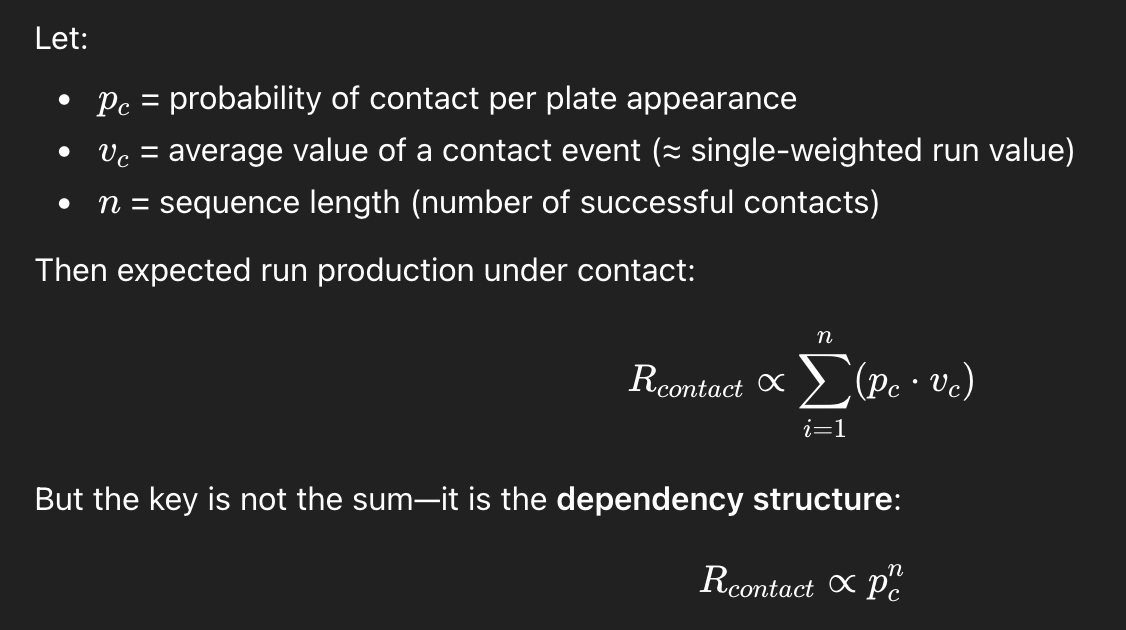
Because:
Runs require linked events , not isolated ones
Properties
Continuity-dependent → value emerges only through chains
Low variance → stable, repeatable
High sensitivity to disruption → one out breaks sequence
Time-extended → offense unfolds across multiple states
Historical Regime
1880s–1890s
Contact-rich environments
High balls-in-play density
Interpretation
Contact is a flow system
It converts time + sequence into runs
II. Power as Compression Function
Definition
Power is a compressed production process in which offensive value is concentrated into single high-impact events.
Formalization
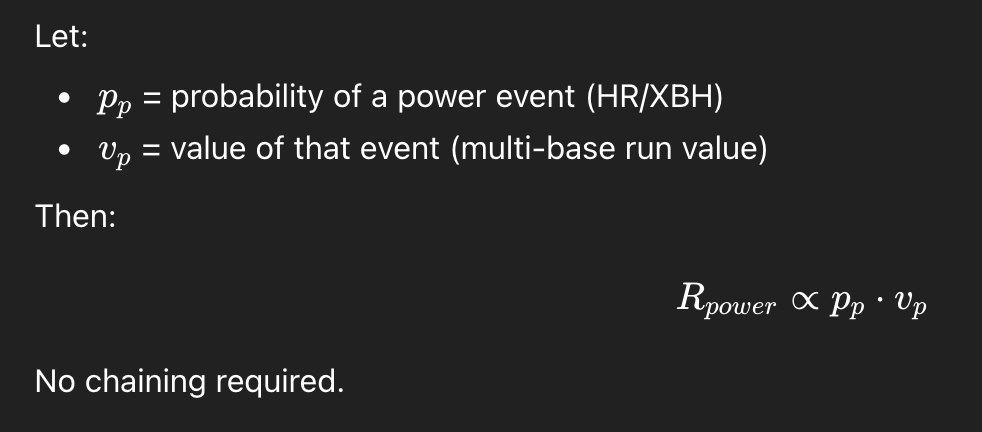
Key distinction

Properties
Discontinuity-tolerant → does not require sequence
High variance → outcomes are spiky
Time-compressed → one event replaces many
Resilient to outs → strikeouts do not compound failure
Historical Emergence
Post-1920 (live-ball shift)
Fully scaled by late 20th century
Interpretation
Power is a compression system
It collapses multiple offensive steps into one
III. Modern Hitting as Fragmented Function
Definition
Modern hitting is a decoupled hybrid system in which:
Continuity (contact) is degraded
Compression (power) is preserved
The system no longer operates as a unified function
Formalization
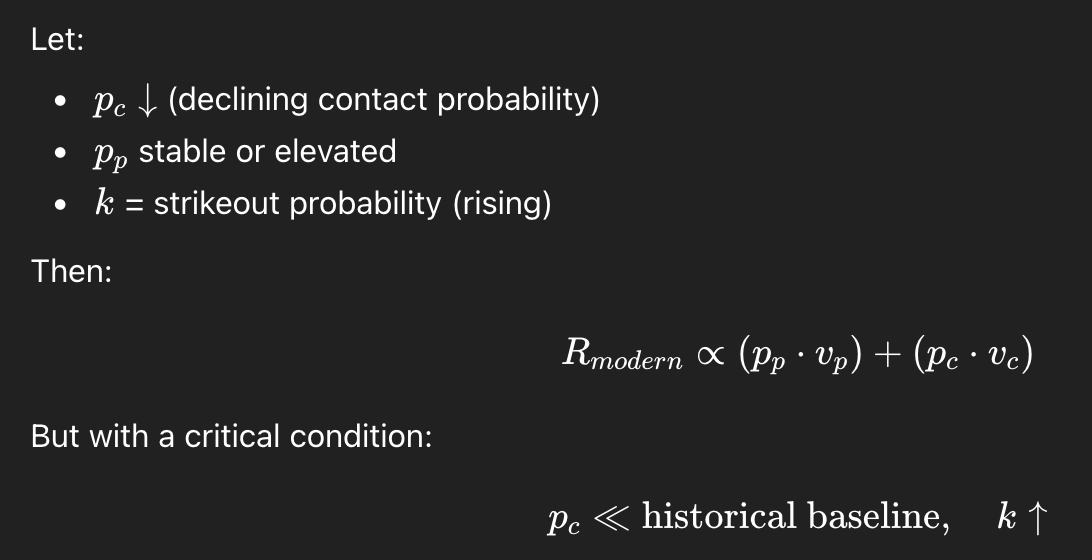
Structural break
The system no longer satisfies:

So:
Continuity collapses as a viable primary pathway
Properties
Fragmented production
Power = isolated spikes
Contact = diminished background
Bimodal hitter types
Power-dominant (low contact)
Contact-oriented (but still reduced vs historical norms)
Loss of integration
- Contact and power no longer co-exist naturally at scale
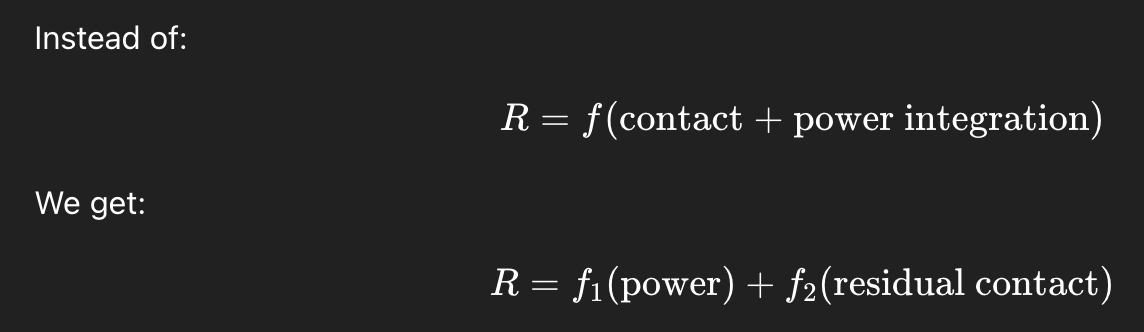
Functional form
Interpretation
Modern hitting is a fragmented system
It produces runs without restoring the underlying continuity
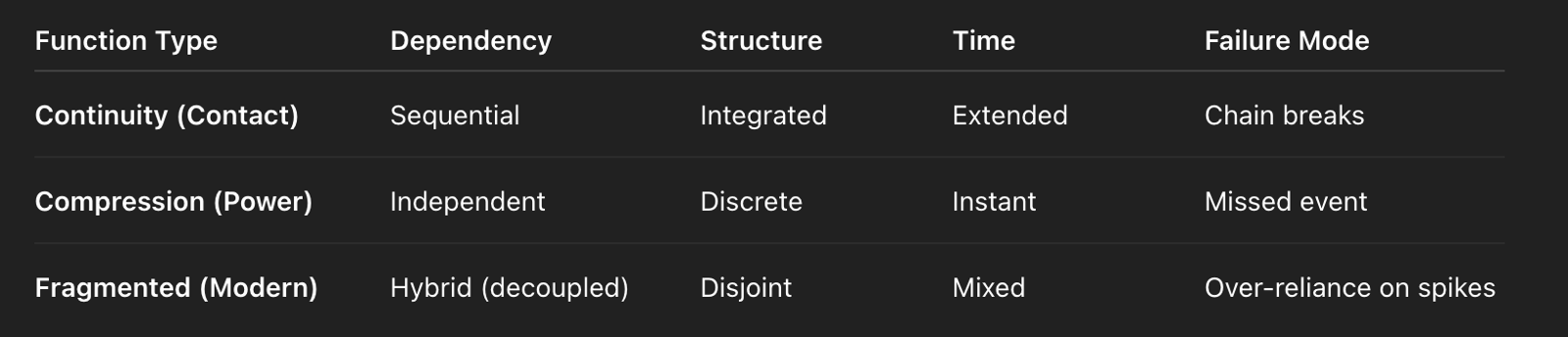
IV. System-Level Comparison
V. Unifying Insight
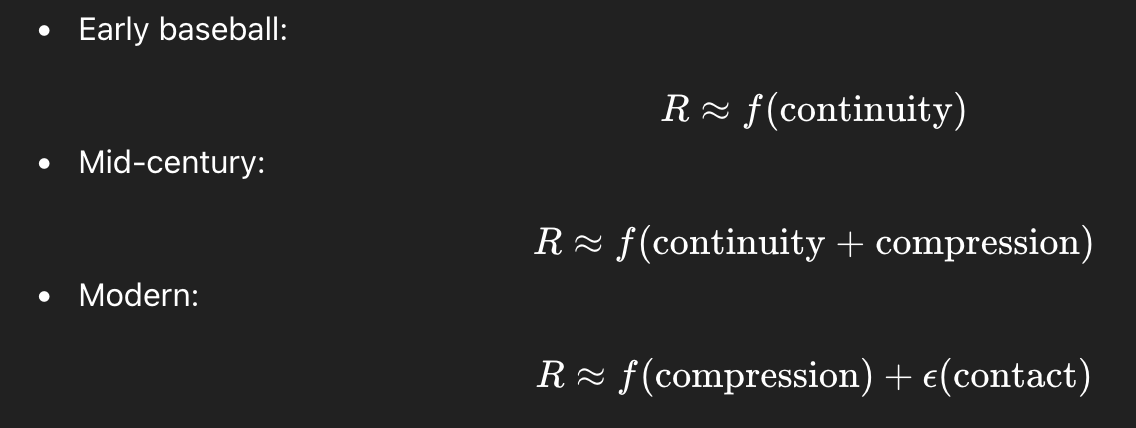
The evolution of hitting can be written as a transformation of functions:

Critical conclusion
VI. Final Statement
Contact and power are not just skills—they are mathematical regimes of production :
Contact = continuous function over time
Power = delta function of value
Modern hitting = sum of disconnected processes