The Boundary of Completion: A Structural Model of Hitting
The Boundary of Completion: A Structural Model of Hitting
The Boundary of Completion: A Structural Model of Hitting
Abstract
Baseball analysis has traditionally prioritized magnitude—home runs, total value, and peak seasons—as the primary indicators of greatness. This paper proposes an alternative framework: that hitting can be understood as a constrained system governed by three interacting forces—conversion, access, and force—and that within this system there exists a narrow equilibrium band representing complete, non-distorted performance.
Using a dataset of historically elite hitters, a specific rate line emerges as a structural boundary condition:
.340 AVG / .400 OBP / .500 SLG
This paper demonstrates that:
Hitters below this band lack sufficient force to complete the system
Hitters above it achieve higher output through structural distortion
A small subset of players operate within this band, maintaining balance across all dimensions
Among these, Bill Terry represents the lower boundary of sustained completion , exhibiting what can be described as repeated perfection.
1. Defining the System
Hitting can be decomposed into three irreducible components:
1. Conversion (AVG)
The ability to turn opportunities into hits.
2. Access (OBP)
The ability to generate baserunners and extend innings.
3. Force (SLG)
The ability to convert hits into advancement and scoring potential.
These forces are not independent. Increasing one typically degrades another:
Increasing power reduces contact
Increasing patience reduces balls in play
Increasing contact often reduces authority
Thus, hitting is not an additive skill set but a constraint system.
2. The Emergence of an Equilibrium Band
When filtering for elite hitters across eras, a narrow cluster emerges:
AVG: ~.340
OBP: ~.390–.420
SLG: ~.480–.520
OPS+: ~135–155
This cluster includes:
Dan Brouthers
Bill Terry
Harry Heilmann
These players exhibit:
High conversion without collapse
Sufficient force without distortion
Sustained production over full careers
This band represents the only region where all three forces remain in equilibrium.
3. Behavior Above the Boundary: Distortion
Hitters exceeding this band achieve higher total output, but through asymmetry.
Power-dominant distortion
Babe Ruth
Lou Gehrig
Rogers Hornsby
These players dramatically elevate SLG, breaking proportional balance.
OBP-dominant distortion
- Ted Williams
Here, OBP separates from AVG through extreme walk rates.
In both cases:
One variable performs disproportionate work, increasing total output but reducing systemic symmetry.
This is reflected in OPS+:
- Distortion players: 170–200+ OPS+
4. Behavior Below the Boundary: Incomplete Systems
Below the equilibrium band are hitters who maintain conversion but lack force:
Tony Gwynn
Jesse Burkett
Willie Keeler
These profiles exhibit:
High AVG and OBP
Insufficient SLG (< .450)
Result:
A system that produces baserunners but lacks advancement capacity.
OPS+ reflects this limitation:
- Typically 120–140 OPS+
5. OPS+ as a Diagnostic, Not a Definition
OPS+ increases with separation from league average, particularly through:
Power expansion
Walk inflation
Thus:
Balanced systems → ~135–155 OPS+
Distorted systems → 170–200+ OPS+
OPS+ rewards magnitude, not balance.
This explains why players like Bill Terry (136 OPS+) appear less dominant in traditional frameworks despite structural completeness.
6. Bill Terry as the Boundary Condition
Within the equilibrium band, Bill Terry occupies a unique position:
.341 AVG / .393 OBP / .504 SLG
1.27 hits per game (200-hit 162 pace)Minimal year-to-year variance
Unlike peers:
Brouthers operates at a higher-energy level
Heilmann shows slight inflation
Terry:
Satisfies all constraints with no excess and no deficiency
He represents:
the minimum viable complete system
Reducing any component:
lowers AVG → conversion fails
lowers SLG → force fails
lowers OBP → access fails
Increasing any component:
- introduces distortion and variance
7. Reframing Greatness
This framework separates two distinct forms of excellence:
1. Maximization (Distortion)
Ruth, Williams, Bonds
Higher peaks
Greater total output
2. Equilibrium (Completion)
Terry, Brouthers
Lower peaks
Maximum balance and repeatability
These are not competing definitions—they are different solutions.
8. Conclusion
The dataset reveals that:
Hitting operates as a constrained system with three competing forces
A narrow equilibrium band exists where all forces are simultaneously satisfied
Below this band, systems are incomplete
Above it, systems become distorted
Bill Terry defines the lower boundary where complete, balanced hitting can be sustained over time
This leads to a final formulation:
.340 / .400 / .500 is not a statistical target—it is a structural boundary condition
And within that boundary:
Bill Terry represents repeated perfection—
the point at which the system is fully solved and can be reproduced without deviation.
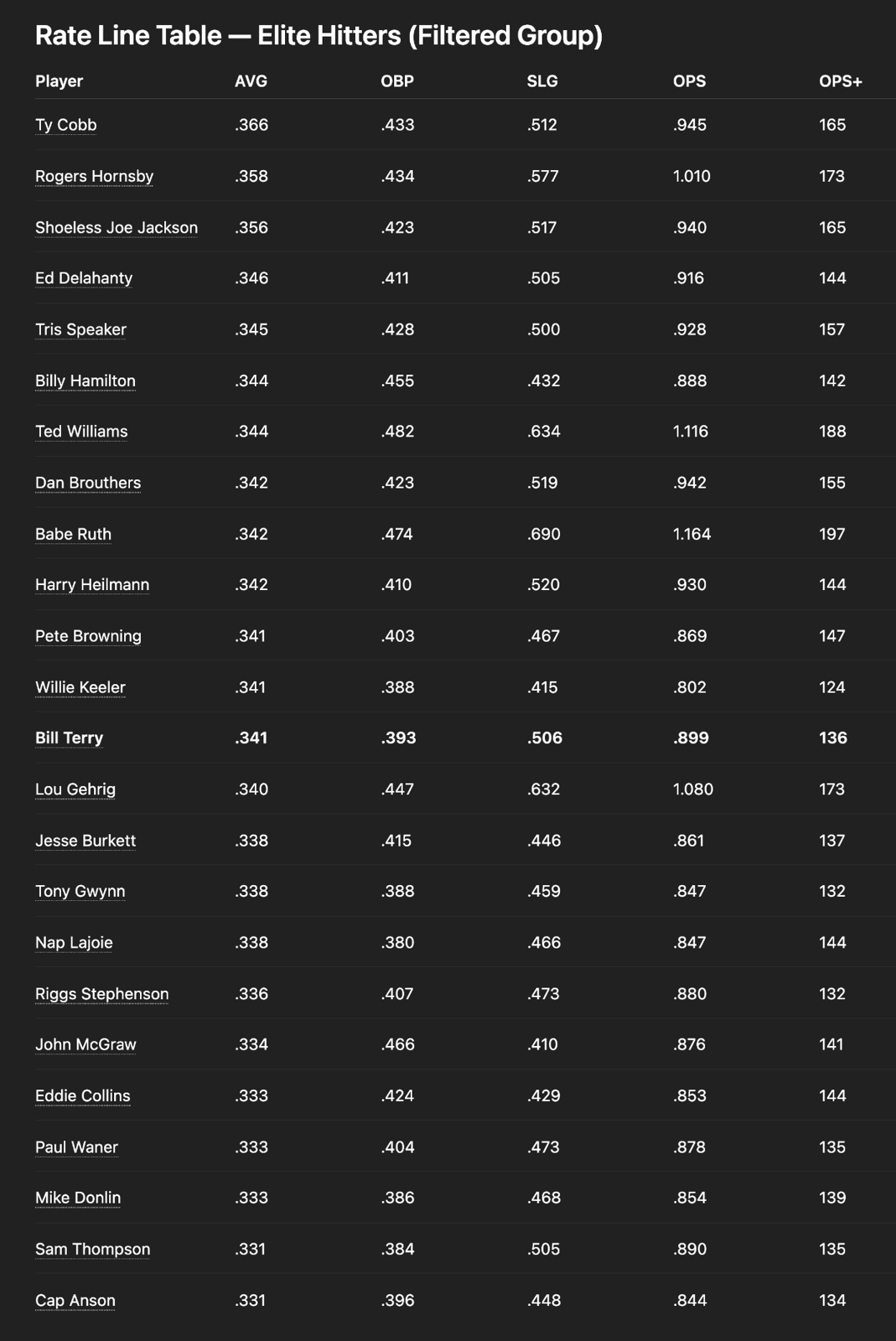
*** Filtered for .330 career BA minimum over at least 1,000 games played**