The Boundary Theory of Measurement: A General Theory of Informational Universe Construction
The Boundary Theory of Measurement: A General Theory of Informational Universe Construction
The Boundary Theory of Measurement
A General Theory of Informational Universe Construction
I. Core Proposition
All quantitative measurement is downstream of boundary selection.
Before any ratio is calculated, before any statistic is interpreted, before any hierarchy is formed, a universe must be defined.
That universe is not discovered.
It is constructed.
And the construction determines the outcome.
II. The Structure of Measurement
Every statistical system rests on four prior decisions:
Inclusion Rule
What observations count as members of the dataset?Exclusion Rule
What observations are omitted?Baseline Construction
What constitutes the comparative environment (denominator)?Normalization Method
How are individual observations scaled relative to the baseline?
Only after these decisions are made does calculation begin.
Thus:
Numbers are outputs of declared informational boundaries.
III. The Universe Principle
Define:

Define:

Where ( M ) is any measurement derived from ( U ).

Even if the underlying observed performance is identical.
Therefore:
Divergent measurements do not necessarily imply error.
They imply different universes.
IV. Denominator Fragility
Relative metrics amplify boundary differences.
If a metric takes the form:
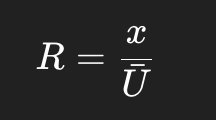
Where ( \bar{U} ) is the universe baseline, then small changes in ( U ) produce nonlinear changes in ( R ).
Peak-heavy observations inflate when denominators shrink.
Plateau observations stabilize when denominators expand.
Thus:
Boundary compression increases volatility.
Boundary expansion reduces volatility.
V. Institutional vs Ecosystem Universes
Two broad modeling archetypes emerge:
Institutional Universe
Defined by governance or formal recognition.
Bounded by official designation.
Prioritizes standardization and comparability.
Often narrower.
Ecosystem Universe
Defined by lived professional or competitive reality.
Broader inclusion of structured participation.
Prioritizes totality of activity.
Often larger.
Neither is inherently superior.
They answer different questions.
But they generate different magnitudes.
VI. The Hierarchy Effect
Measurement shapes perception.
Perception shapes hierarchy.
Hierarchy shapes historical narrative.
Therefore:
Boundary selection indirectly constructs legacy.
A narrower universe may amplify peaks.
A broader universe may emphasize durability.
Both produce internally coherent but externally different hierarchies.
VII. The Transparency Requirement
Because measurement is boundary-dependent:
Any serious quantitative claim must declare:
What universe is being modeled.
What is excluded.
What baseline is used.
Without that declaration, interpretation becomes detached from structure.
VIII. General Implication
This theory applies beyond sport:
Economic indicators
Poverty thresholds
Crime rates
Academic metrics
Performance evaluation systems
Scientific meta-analyses
In all cases:
Measurement is not merely arithmetic.
It is informational architecture.
IX. Final Principle
Numbers are not neutral facts.
They are structured outputs of defined informational universes.
Change the universe, and the hierarchy changes.
Thus:
Every statistic is a boundary statement.
That is the general theory.