The Compression Holds: Venezuela, Juan Soto, and the Permanent Logic of the Dispossessed
The Compression Holds: Venezuela, Juan Soto, and the Permanent Logic of the Dispossessed
The Compression Holds: Venezuela, Juan Soto, and the Permanent Logic of the Dispossessed
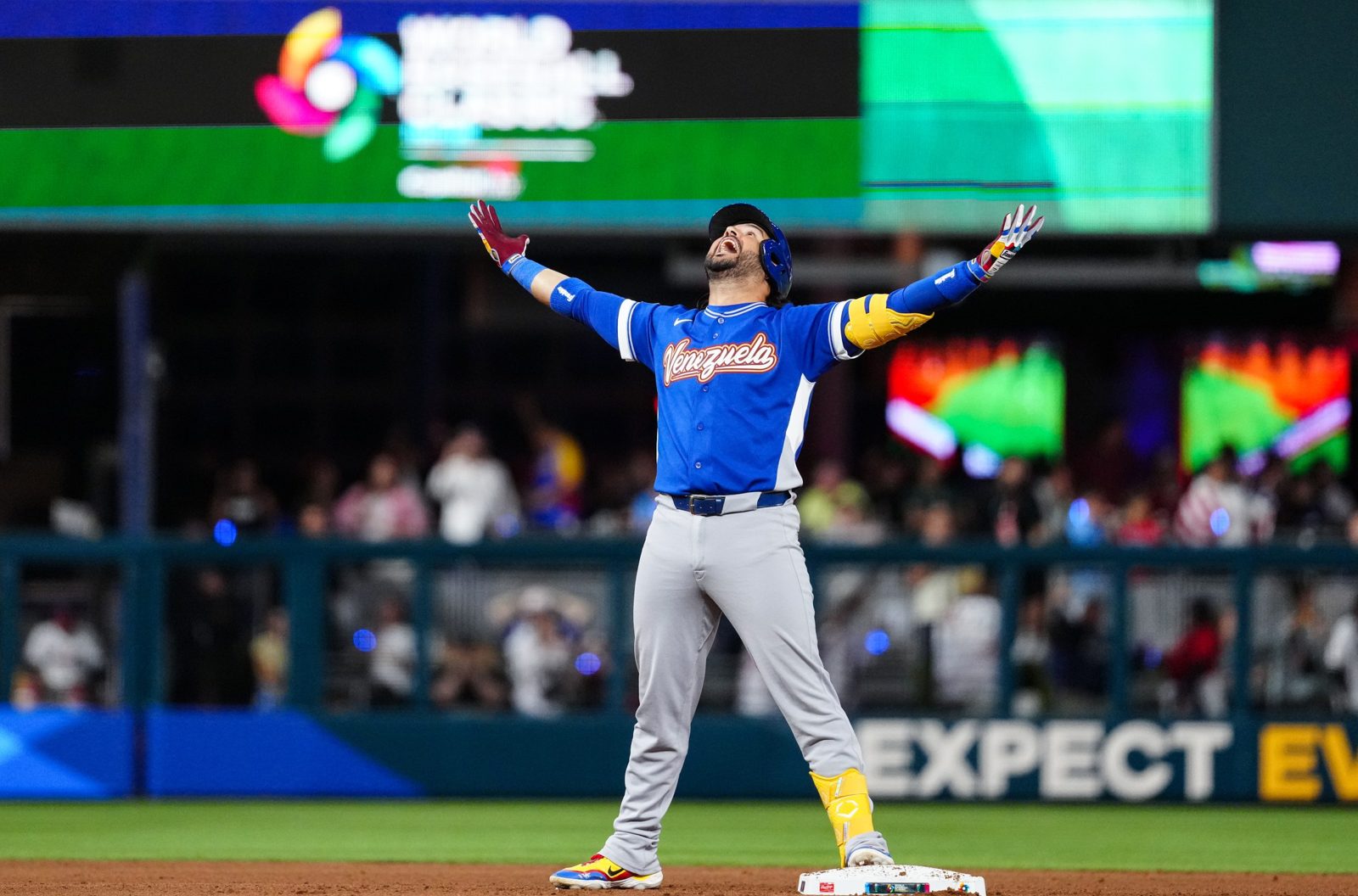
On the night of March 17, 2026, in a stadium in Miami, Venezuela beat the United States 3-2 to win its first World Baseball Classic championship. The score is the least important fact about the game. The most important fact is who was on the field and what they were carrying.
The American roster was assembled from the wealthiest and most advantaged baseball players on earth. Aaron Judge, three-time AL MVP, the captain and face of the New York Yankees, under contract for $360 million. Bobby Witt Jr., Kyle Schwarber, Bryce Harper, Gunnar Henderson — a lineup that, on paper, had no peer in the tournament and possibly no peer in the sport. These were men developed by the most resource-saturated athletic infrastructure in the world: the American travel ball apparatus, the college programs, the draft, the minor league system, the nutrition and sports science and coaching networks that the modern era has built around the development of baseball players. They came to Miami with every advantage the sport could provide.
They managed three hits.
Aaron Judge went 0-for-4 with three strikeouts. The United States did not have a single at-bat with a runner in scoring position for the entire game. They were held, for most of nine innings, to nothing — by a Venezuelan bullpen working on one day’s rest, by a Venezuelan lineup that moved runners and manufactured runs with the kind of patient, aggressive, collectively intelligent baseball that is not produced by individual talent alone but by something older and less manufactured than talent. By formation.
Eugenio Suárez delivered the go-ahead run in the ninth inning with an RBI double off Garrett Whitlock. The inning was built on a leadoff walk, a stolen base by pinch runner Javier Sanoja, and a full-count duel that ended with a line drive to left-center. It is the kind of inning assembled by a team that understands, at the cellular level, that the run has to be manufactured, that nothing will be given, that every base must be taken by intelligence and will and collective precision because the other side has more raw power and the only answer to raw power is compression. You make yourself smaller and harder and more precise than the force coming at you, and you apply that compression at the exact moment the force overextends. This is what Venezuela did in the ninth inning. It is also, stated abstractly, the argument at the center of everything.
When it was over, the Venezuelan players gathered in center field and sang every word of their national anthem. Some wept. Suárez, on the Fox broadcast, said: Nobody believed in Venezuela. But now we win the championship. The game had been played less than three months after American forces captured Venezuelan president Nicolás Maduro and transported him to U.S. custody. Suárez himself had his U.S. citizenship application canceled — shut down, he said, “because of the Venezuela thing.” The political context was not a backdrop to the game. It was inside the game, in the way that the mine was inside Coveleski’s pitching and the cotton field was inside Dizzy Dean’s fastball and Jim Crow was inside every at-bat Satchel Paige ever threw. The conditions that form men do not stay outside the lines. They come with the men onto the field, and they are visible to anyone who reads the performance accurately.
The Venezuelan players on that roster are not poor men. Salvador Perez, who has represented Venezuela in every World Baseball Classic since 2013, is under contract with the Kansas City Royals for money that would have been incomprehensible to the men who loaded coal in Shamokin. Ronald Acuña Jr., Maikel Garcia, Luis Arraez, Eugenio Suárez — these are major league players compensated at major league rates. The analogy is not one of current economic deprivation. It is one of formation. These men were formed in a country where baseball is not a leisure activity or a hobby or a development program. It is the path. It is what the mine and the mill were in Pennsylvania at the turn of the twentieth century — the one door that opens toward something else, the one institution that takes what scarcity has made of a boy’s body and his will and gives it a stage.
Venezuela has been producing major league baseball players for generations under conditions that have never been comfortable and in recent years have been catastrophic. The country that assembled in Miami was not a collection of individuals who happened to share a passport. It was a community with a shared formation — shaped by the same streets, the same academies, the same knowledge that the door does not stay open and the opportunity does not repeat and you play every inning as if the alternative is the one you came from. That knowledge is not motivational. It changes what you perceive and how you act and what you are able to do under pressure that would stop a man who had other options.
The American team had other options. This is not a criticism of the individual players, who are gifted and dedicated and serious about their craft. It is an observation about formation. Men developed inside the most resource-saturated athletic infrastructure in the world are formed by abundance. They are formed by the knowledge that failure has a safety net, that development will continue, that the organization believes in them and will give them time. This is a better way to live than the alternative. It produces physically superior athletes. It does not always produce the specific quality Venezuela brought to Miami — the absolute compression of self into performance, the zero tolerance for wasted opportunity, the collective intelligence forged by shared necessity. That quality is not available for manufacture. It is produced by actual conditions over actual years, and it leaves a mark that abundance, however generously applied, does not erase.

Juan Soto grew up in Santo Domingo. His father was a salesman who played catcher in a local men’s league and threw bottle caps at the boy to sharpen his eye. His mother kept him inside because the streets were not safe, and so he played baseball indoors — in the hallway of the family’s home, hitting crumpled paper with whatever was at hand. He signed with the Washington Nationals at sixteen for a $1.5 million bonus. He was in the major leagues at nineteen. He is now under contract with the New York Mets for $765 million — the largest contract in the history of professional sports.
The distance between the bottle caps in Santo Domingo and the $765 million contract is the distance this argument is describing. It is the distance between the Shamokin mine at $3.75 a week and Coveleski’s 0.67 World Series ERA. The specific numbers are different. The structure is identical. Baseball finds the boy formed by scarcity and gives him a stage, and the formation does not disappear when the money arrives. It is in the swing. Soto’s patience at the plate — his walk rates, through his first years in the league, compared only to Ted Williams — was not taught by the Washington Nationals developmental system. It was formed in Santo Domingo, where you learn early that resources are limited and must be conserved, that the pitch you wait for is worth more than the ten pitches you chase. The at-bat is an economic argument made by the body. Soto’s body had been making that argument since before anyone in professional baseball found him.
The Dominican Republic produces more major league baseball players per capita than any country on earth — not because of superior genetics or coaching infrastructure, but because baseball in the Dominican Republic operates the way baseball in Pennsylvania coal country operated in 1900. It is the path. Thousands of boys enter the academies every year, most from genuine poverty, most aware that the alternative to baseball is not college or a career or a comfortable trajectory. The alternative is the neighborhood. The pressure that produces Soto is the same pressure that produced Wagner, displaced in time and geography but identical in structure: the absolute relationship between performance and survival, applied to a boy’s body over years until it becomes reflex, not trained but formed.
This is what the dominant baseball narrative of the modern era consistently misreads. The narrative celebrates the science — the Statcast metrics, the launch angles, the spin rates, the biomechanical optimization, the sports psychology and nutrition protocols the contemporary game applies to player development. The science is real and the athletes it produces are physically extraordinary. But the greatest performances in the contemporary game continue to come disproportionately from men formed outside the American development apparatus, from countries where baseball is not an optimized development path but a compressed exit, from neighborhoods where the bottle cap is the only training tool available and formation happens not by design but by necessity. The science measures what necessity already made.
The Venezuelan players sang their national anthem in center field in Miami four days ago. The crowd, overwhelmingly Venezuelan, sang with them. A country whose president was in American custody, whose players’ citizenship applications had been canceled, who had been dismissed by the seeding and the projections and the assembled star power across the diamond — they compressed all of it into nine innings of precise, patient, collective play against a team with more individual talent and more institutional support, and they won.
What Venezuela did to the American lineup is what compression does to abundance when the conditions are right. It makes itself smaller and harder and more precise. It finds the exact point where force can be applied and applies it — a leadoff walk, a stolen base, a full-count duel, a line drive to left-center that finds grass. It does not overpower. It penetrates. The American lineup had more power. Venezuela had more compression. Three hits. Zero at-bats with a runner in scoring position. The greatest lineup available to the wealthiest baseball infrastructure in the world, held to nothing.
Suárez said nobody believed in Venezuela. This is exactly what Coveleski meant when he said nobody said a word except maybe Nice game, Covey. The man formed by scarcity does not perform for recognition. He performs because the performance is the thing itself — because the conditions that made him do not allow for the luxury of performing for applause. The recognition, when it comes, is incidental. The championship is the confirmation of something that was already true, formed long before the final game, in the streets and the academies and the conditions of actual life that produced these particular men and not others.
Juan Soto, $765 million, batting in the middle of the New York Mets lineup. Venezuela, first World Baseball Classic championship, singing the anthem in Miami while the wealthiest team in the sport walks off with three hits.
The mine is not closed. The path is not finished. The compression holds.