The Core Lineage of Contact Mastery: Ranking Baseball’s Pure Hitters Through Efficiency, Density, and Accumulation
The Core Lineage of Contact Mastery: Ranking Baseball’s Pure Hitters Through Efficiency, Density, and Accumulation
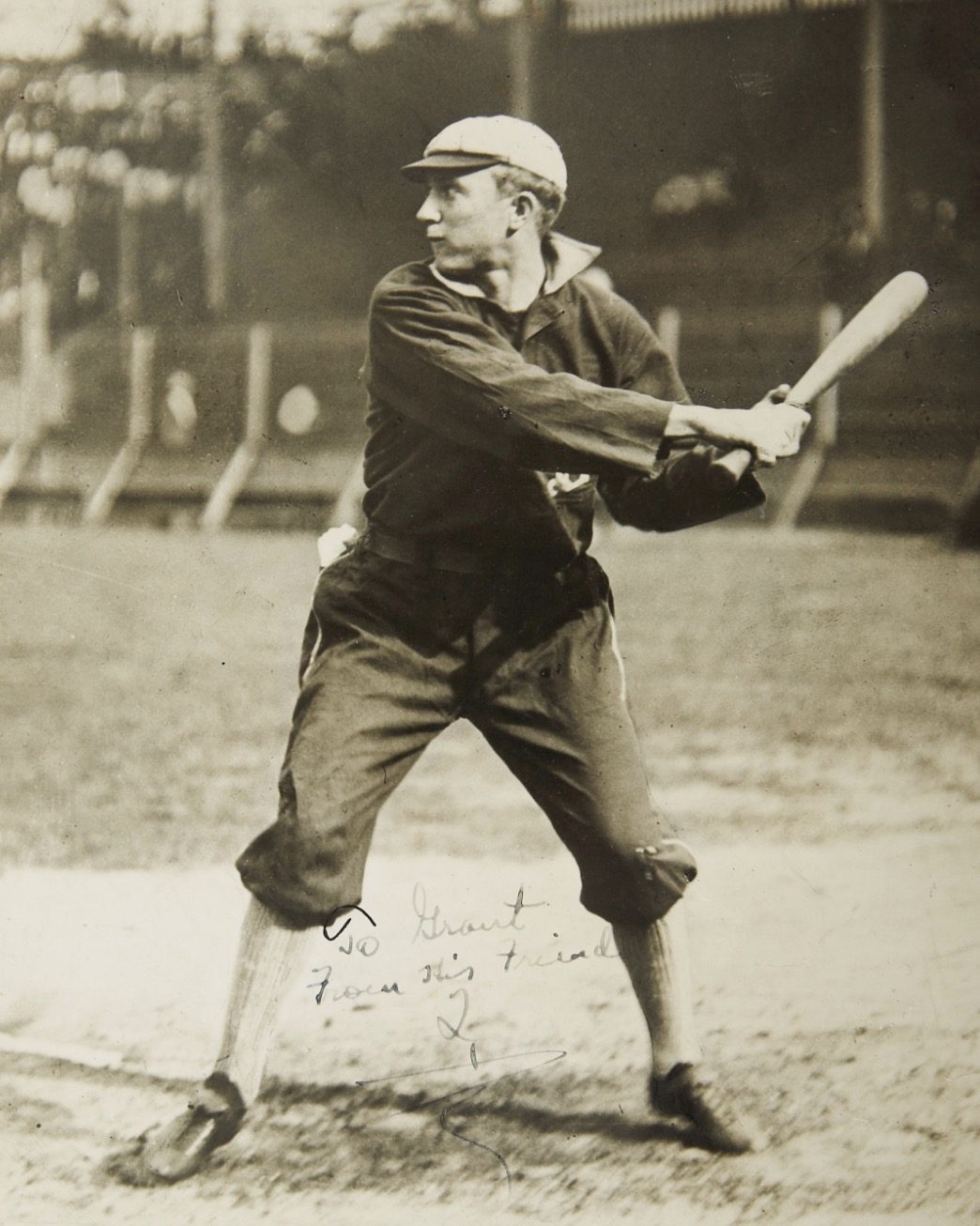
The Core Lineage of Contact Mastery
Ranking Baseball’s Pure Hitters Through Efficiency, Density, and Accumulation
Baseball history is often written in the language of power: home runs, slugging percentages, and total offensive value. But the game has always contained an older craft — one quieter and more fundamental — the art of producing base hits with relentless regularity.
Before the home run became the dominant currency of the sport, many of the greatest hitters in baseball history were defined not by power but by their ability to convert swings into hits with extraordinary consistency.
To identify the true masters of this craft, four measurements capture the essential dimensions of contact production:
Peak efficiency — best single-season hits per at-bat (H/AB)
Career efficiency — career hits per at-bat
Hit density — career hits per game (H/G)
Seasonal accumulation — number of 200-hit seasons
Because hits per at-bat are mathematically identical to batting average , the first two categories measure the same underlying skill across two time horizons: peak expression and career sustainability.
Individually each statistic highlights only one dimension of hitting. Taken together, they reveal a stable historical lineage of contact mastery.
A Structural Constraint of Early Baseball
Season length varied dramatically across baseball history.
Typical schedules were:

This difference has a profound statistical consequence.
To reach 200 hits :
In a 132-game season , a hitter must average 1.52 hits per game.
In a 154-game season , the requirement falls to 1.30 hits per game.
As a result, 200-hit seasons are not perfectly comparable across eras , and players who played under longer schedules had greater structural opportunity to accumulate them.
For this reason, the lineage of contact mastery is identified primarily through efficiency and hit density , while accumulation statistics must be interpreted cautiously.
The Core Contact Lineage
Across peak efficiency, career efficiency, and hit density, five hitters consistently appear at the extreme edge of contact production:
Ty Cobb*
Willie Keeler
George Sisler*
Ed Delahanty
Jesse Burkett
These players span the late nineteenth century and early twentieth century — the era in which baseball’s contact tradition reached its fullest expression.
*Cobb and Sisler played their careers under longer seasonal schedules than nineteenth-century players, giving them greater opportunity to accumulate 200-hit seasons.
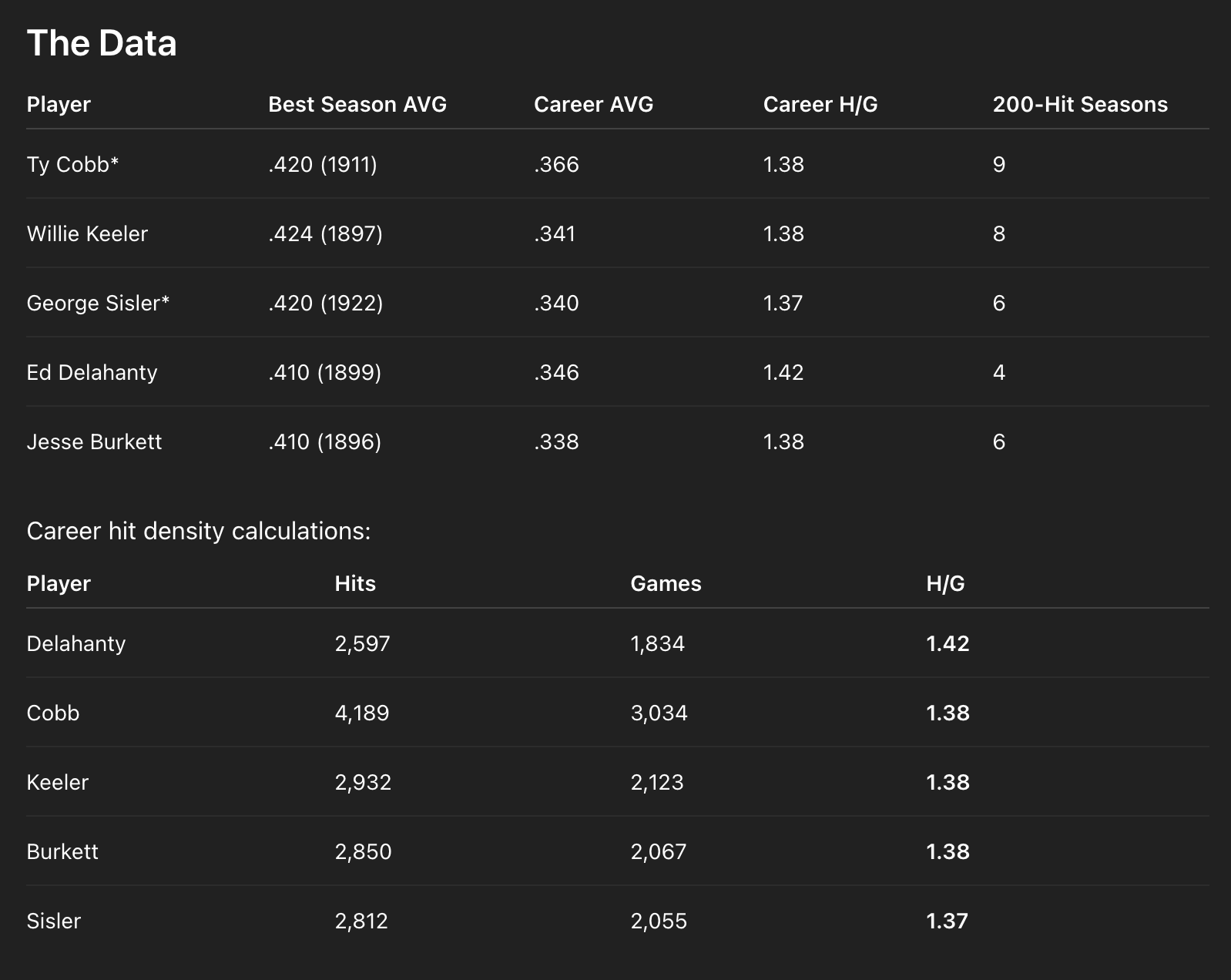
The Contact Hierarchy
1. Ty Cobb
Cobb stands at the center of the contact tradition. His .366 career batting average remains the highest in Major League history, and his extraordinary hit density across more than three thousand games places him at the apex of the craft.
2. Willie Keeler
Keeler represents the pure technician of the lineage. His .424 season in 1897 is one of the greatest contact seasons ever recorded, and his eight 200-hit seasons demonstrate remarkable consistency even within shorter nineteenth-century schedules.
His famous maxim — “hit ’em where they ain’t” — perfectly captured the logic of early baseball’s contact approach.
3. Ed Delahanty
Delahanty produced the highest hit density in the group (1.42 hits per game) while maintaining a .346 career batting average. Unlike many contact specialists, he also possessed significant power, making him a transitional figure between nineteenth-century contact hitting and the more balanced offensive styles that followed.
4. George Sisler
Sisler carried the contact tradition into the emerging live-ball era. His .420 season in 1922 stands among the greatest batting average seasons ever recorded and demonstrated that elite contact production could persist even as the game began shifting toward power.
5. Jesse Burkett
Burkett rarely leads any single category outright, yet he appears near the top in all of them. His .410 peak season , .338 career batting average , 1.38 hits per game , and six 200-hit seasons make him one of the most balanced contact hitters of the nineteenth century.
His greatness lies in persistent excellence rather than singular extremes.
The Statistical Outlier: Dave Orr
One additional hitter deserves mention.
Dave Orr produced one of the most extraordinary contact profiles in baseball history:

His hit density rivals the greatest hitters ever recorded.
Orr’s career, however, ended abruptly after he suffered a stroke , preventing him from accumulating the career totals necessary to appear alongside the other players in traditional leaderboards.
His numbers nevertheless demonstrate the statistical ceiling of the contact system that dominated nineteenth-century baseball.
The Meaning of the Lineage
This analysis reveals something fundamental about baseball history.
The art of contact hitting is not the achievement of a single player but a historical lineage stretching from the nineteenth century into the early twentieth.
At one end stand the craftsmen of the 1890s — Keeler and Burkett.
At the center stands Cobb, whose relentless accumulation elevated the craft to its highest level.
Delahanty bridges contact and power.
Sisler carries the tradition into the modern era.
And Dave Orr, in a short career, reveals the statistical frontier the system itself could produce.
Together these hitters define the upper boundary of baseball’s oldest offensive skill:
the ability to turn swings into hits with relentless regularity.
Long before the home run became baseball’s defining symbol of greatness, the game was ruled by these craftsmen of contact.