The Cosmology of Data: A Foundational Theory of Informational Universes, Perceptual Horizons, Power, and Judgment
The Cosmology of Data: A Foundational Theory of Informational Universes, Perceptual Horizons, Power, and Judgment
The Cosmology of Data
A Foundational Theory of Informational Universes, Perceptual Horizons, Power, and Judgment
I. The Foundational Premise
Data does not describe reality from nowhere.
It describes reality from within a boundary.
Before any number appears, before any metric stabilizes, before any ranking emerges, a universe has already been defined.
That universe determines:
What exists within the system.
What is measurable.
What is comparable.
What is invisible.
Thus:
Measurement is not the beginning of knowledge.
Boundary definition is.
II. Informational Universes
An informational universe is the total set of observations admitted under a defined inclusion rule.
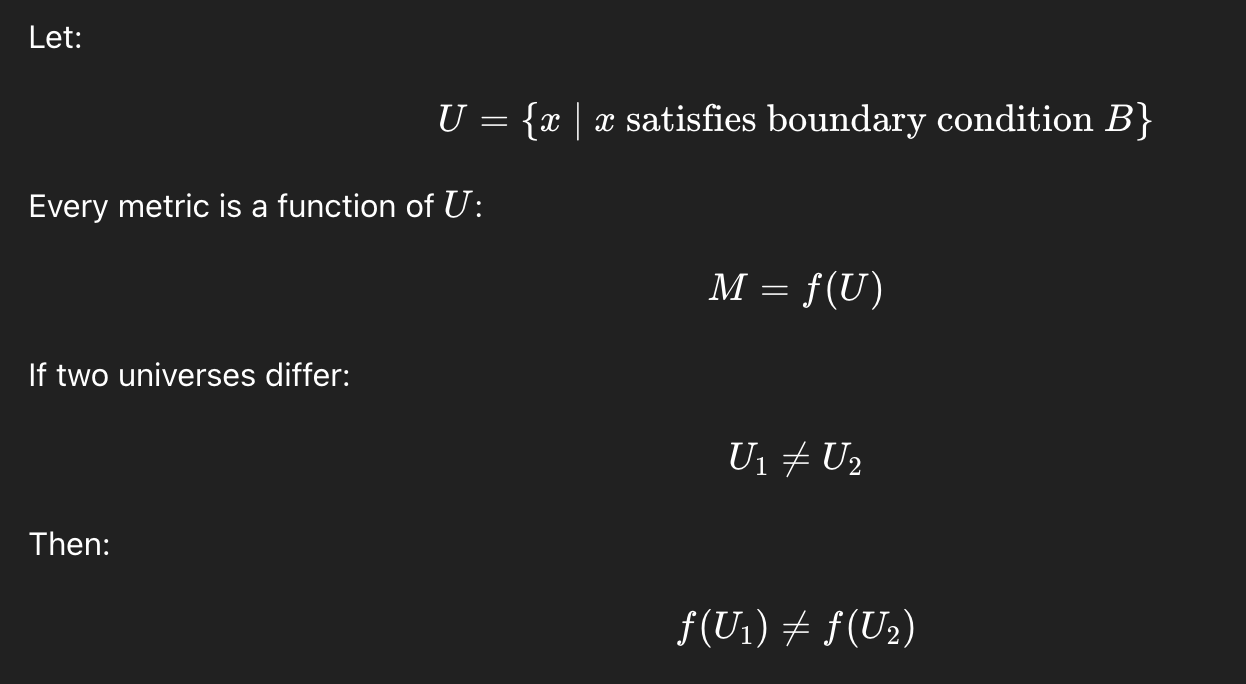
Even if the observed phenomena overlap.
This is not error.
It is architecture.
III. Structural Discrimination
To define a universe is to discriminate.
Discrimination here is structural:
What is included becomes visible.
What is excluded becomes silent.
Silence is not falsity — it is absence from the constructed field.
Thus:
All datasets are discriminatory by necessity.
The critical question is not whether discrimination occurs.
It always does.
The question is whether the boundary is declared.
IV. The Denominator as Gravitational Center
Relative metrics derive meaning from baselines.
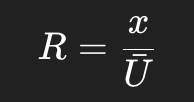
Where ( \bar{U} ) is the aggregate of the universe.
Change the universe, and the center of gravity shifts.
Small universes produce volatility.
Large universes stabilize extremes.
The denominator is not neutral.
It is the mass that bends comparative space.
V. Ontology: What Is the Object?
Judgment requires an object.
Is the object:
A season?
A career?
An institution?
A jurisdiction?
A professional life?
Different ontological objects require different universes.
A critique of judgment must clarify:
What exactly is being judged?
Without ontological clarity, metrics float.
VI. Teleology: Why Judge?
Measurement without declared purpose is incoherent.
Purposes differ:
Institutional benchmarking
Cross-era comparison
Historical fairness
Total magnitude
Narrative correction
Governance integration
Purpose determines boundary.
Boundary determines universe.
Universe determines hierarchy.
Thus:
Judgment is teleologically conditioned.
VII. Institutional Universes
Institutional universes are defined by governance and authority.
They are characterized by:
Formal recognition
Record-book standardization
Jurisdictional boundary
Administrative clarity
Their strengths:
Comparability
Stability
Standardization
Their limits:
Narrower inclusion
Jurisdiction-bound perspective
Potential invisibility of external magnitude
Institutional universes often present themselves as complete.
But they are subsets.
VIII. Ecosystem Universes
Ecosystem universes are defined by lived participation and documented competition.
They are characterized by:
Multinational inclusion
Structural continuity
Full professional footprint
Archival reconstruction
Their strengths:
Holistic scope
Greater denominator stability
Closer alignment with lived reality
Their limits:
Less institutional integration
Potential archival incompleteness
Reduced standardization
Neither universe is inherently superior.
They answer different questions.
IX. Perceptual Horizons
Every universe creates a horizon.
What lies beyond the boundary:
Is not evaluated.
Is not compared.
Is not ranked.
Gradually becomes unseen.
When a universe stabilizes:
Its boundary becomes invisible.
Its baseline feels natural.
Its hierarchy feels inevitable.
This is horizon blindness.
Observers mistake the constructed universe for reality itself.
Thus:
Perspective is bounded by informational horizon.
X. Power and Boundary Formation
Boundaries are not drawn in abstraction.
They are shaped by:
Institutional authority
Archival control
Economic power
Governance structures
Cultural dominance
Technological capability
The entity that defines the boundary defines:
What counts as official.
What counts as major.
What counts as legitimate.
What counts as comparable.
Boundary selection is therefore political.
Not necessarily malicious.
But always consequential.
XI. The Feedback Loop of Legitimacy
Power defines universe.
Universe produces metrics.
Metrics produce hierarchy.
Hierarchy produces narrative.
Narrative legitimizes power.
The boundary becomes naturalized.
Naturalization hides construction.
Construction hidden becomes unquestioned authority.
This is how cosmologies stabilize.
XII. Meta-Universe and Reconciliation
If universes differ:
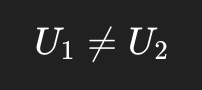
Then judgments differ.
To compare across universes requires:
Explicit mapping rules
Boundary transparency
Uncertainty acknowledgment
Teleological clarity
Without this, cross-universe comparison is category error.
Meta-judgment requires reflexivity.
XIII. Phenomenology of Metrics
Metrics do not merely quantify.
They reorganize imagination.
A ratio becomes:
A symbol of greatness.
A narrative anchor.
A perception amplifier.
Numbers shape intuition.
Thus:
Data does not only describe reality — it orients consciousness.
XIV. Cosmological Analogy
An informational universe resembles a cosmological one.
In cosmology:
The observable universe is limited by light horizon.
What lies beyond exists but is not observable within system constraints.
In data:
The observable domain is limited by boundary.
What lies beyond may exist but is not measurable within that universe.
Thus:
A dataset is an observable cosmos defined by informational horizons.
Expanding the horizon reshapes perceived magnitude.
XV. The Total Law
Measurement is conditional on boundary.
Boundary is conditioned by purpose.
Purpose is influenced by power.
Power shapes perception.
Perception stabilizes narrative.
Narrative defines hierarchy.
Therefore:
Data is not merely descriptive.
It is cosmological architecture.
XVI. The Final Maxim
To measure is to discriminate.
To discriminate is to define a universe.
To define a universe is to establish a horizon.
To establish a horizon is to orient judgment.
To orient judgment is to shape reality.
XVII. The Ethical Imperative
Because measurement constructs orientation:
Every serious quantitative claim must declare:
Its boundary.
Its purpose.
Its ontological object.
Its institutional context.
Its limitations.
Transparency of universe is the condition of legitimate judgment.
XVIII. Conclusion
There is no view from nowhere.
Every dataset is a constructed cosmos.
Every metric bends space around its baseline.
Every hierarchy emerges from a boundary.
To critique judgment is to examine the universe that makes it possible.
That is the cosmology of data.