The Elite Band of Pure Hitting
The Elite Band of Pure Hitting
The Elite Band of Pure Hitting
Using the career dataset of .340 hitters after at least 1,000 career games, one result stands out immediately: baseball produced a finite class of hitters who combined three things at once over full careers:
a batting average of .340 or better
meaningful extra-base force
sustained hit accumulation game after game
That is a much narrower achievement than “great offense” in general. It isolates not just value, but a specific kind of value: pure hit ability carried at scale.
This is what the elite band represents.
The core idea
Most offensive greatness is uneven. Some hitters are built around power. Some around walks. Some around longevity. Some around one overwhelming trait.
This group is different. These hitters maintained a batting average floor that almost no one can reach, and they did it over long careers while still generating real total offense.
That matters because batting average is the cleanest direct measure of repeated hit conversion. It is the least mediated of the major rate stats. Slugging can expand when the environment allows force to expand. On-base percentage can widen when the game gives more room for walks. But batting average is the simplest record of how often a hitter actually turns at-bats into hits.
Once hits per game is added to the picture, the class sharpens even further.
The exact career hit-frequency table
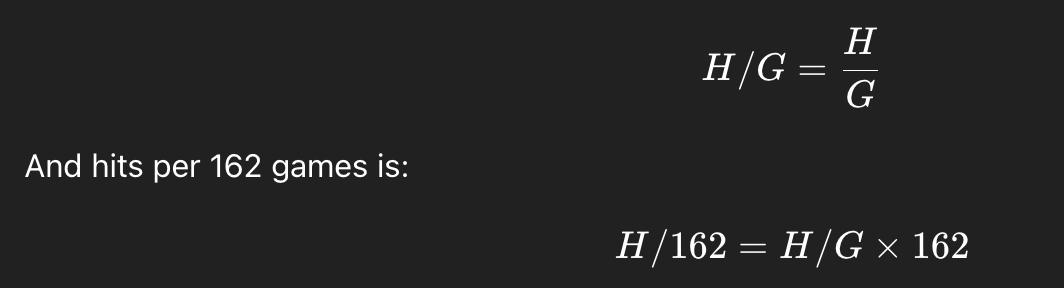
From the dataset provided, hits per game is simply:
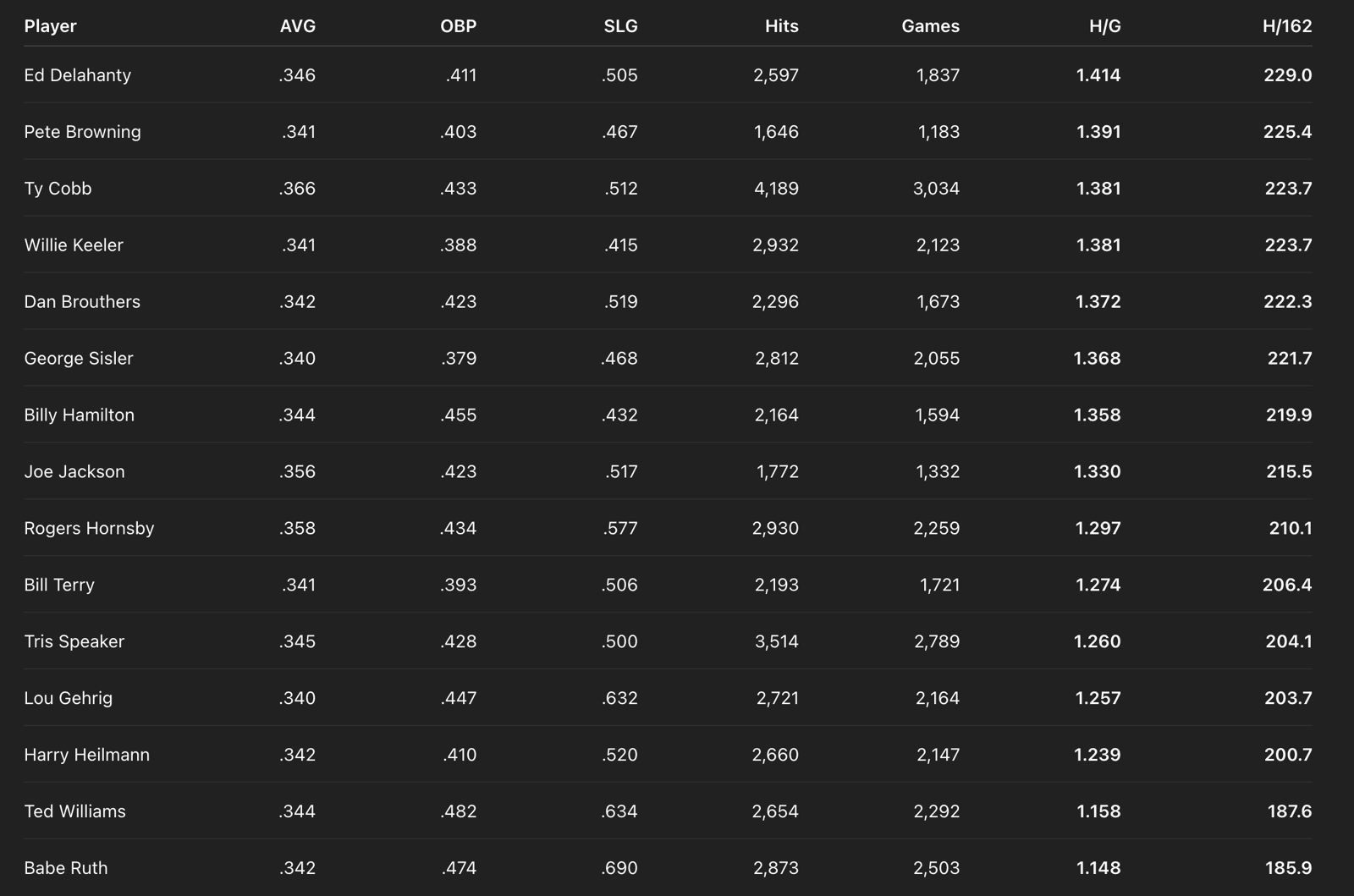
That table completes the picture.
What hits per game changes
Hits per game does something batting average alone cannot do. It adds tempo.
Two hitters can have similar averages, but one may create hits more frequently because he puts more balls in play, strikes out less, or sustains a steadier contact profile game to game. H/G measures that directly.
And once that is added, the band separates into clear numeric forms.
The four numeric forms inside the elite band
1. The maximal hit-frequency group
These are the hitters living around 1.37 to 1.41 hits per game :
Ed Delahanty — 1.414
Pete Browning — 1.391
Ty Cobb — 1.381
Willie Keeler — 1.381
Dan Brouthers — 1.372
George Sisler — 1.368
This is the highest contact-density region in the table. These hitters were not just batting .340-plus; they were converting that ability into a relentless game-by-game stream of hits.
2. The integrated high-output group
This is the band around 1.27 to 1.33 H/G , where hit frequency remains elite while more force begins to enter:
Joe Jackson — 1.330
Rogers Hornsby — 1.297
Bill Terry — 1.274
This is an important middle zone. The hitter is still clearly a contact-dominant producer, but the line is no longer built on hit density alone. Slugging now carries more weight.
3. The balanced lower-frequency complete hitters
Around 1.24 to 1.26 H/G :
Tris Speaker — 1.260
Lou Gehrig — 1.257
Harry Heilmann — 1.239
These hitters are still fully inside the elite band, but relatively less of their greatness is carried by raw hit frequency. More of the value is being pushed through power or on-base expansion.
4. The force-heavy outliers
Ted Williams — 1.158
Babe Ruth — 1.148
These two are crucial. Their hit frequency is the lowest in the set, but their overall rate lines are among the most overwhelming because they shift more of the offensive burden into walks and power. They still belong in the band because the batting average floor is preserved, but numerically they are not the same kind of hitter as Cobb, Delahanty, or Brouthers.
That distinction matters.
The rate-shape table
To see that difference clearly, the rate lines need to be organized by what each one is actually doing.
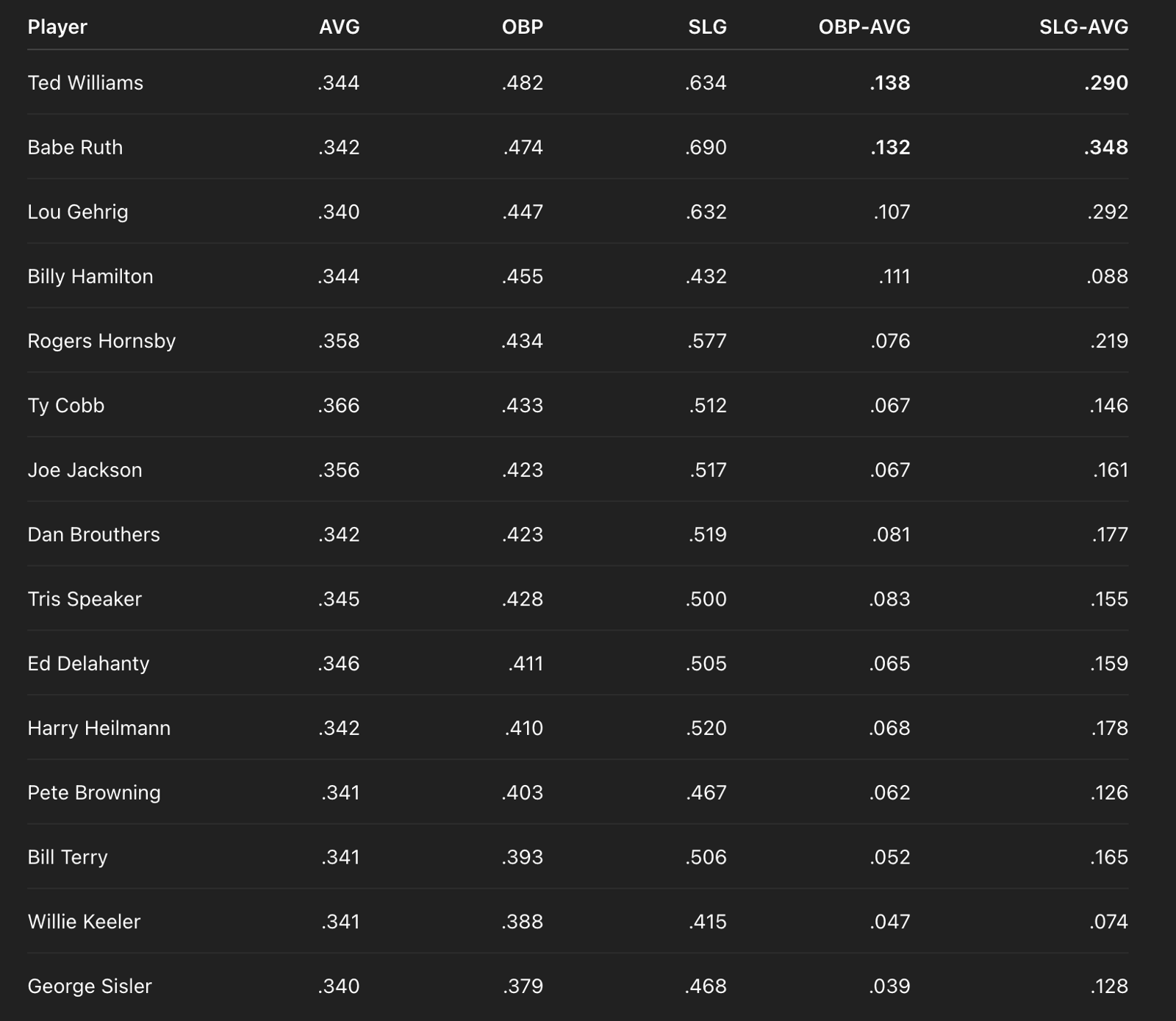
This shows the class is not uniform.
Some hitters create greatness by maintaining a very high batting average and converting that directly into hits per game. Others preserve the batting average floor but widen the line through walks or power.
What the numbers establish
Three conclusions follow directly from the dataset.
Batting average is the common floor
Every hitter here sits between .340 and .366. That is the defining boundary. It is the one thing no member of the class can lack.
This is why the group can be called a band of pure hitting. Whatever else varies—walks, power, frequency, era—the class begins with the ability to sustain extraordinary batting average over a full career.
Hits per game reveals the contact-density hierarchy
Within the same batting-average band, H/G separates hitters by how often that skill actually materialized on the field.
That is why Delahanty, Cobb, Brouthers, Sisler, and Keeler cluster together differently from Williams and Ruth. The latter two are still in the elite band, but less of their greatness comes from sheer hit accumulation.
The band contains two distinct upper forms
There are really two elite solutions here:
contact-density greatness : high AVG plus very high H/G
rate-expansion greatness : high AVG plus major OBP and SLG expansion
Cobb and Delahanty live much closer to the first. Williams and Ruth live much closer to the second. Hornsby, Jackson, Terry, Gehrig, and Brouthers sit at different points between them.
The historical meaning
The strongest defensible historical statement is not that baseball “stopped allowing great hitters” after this period. It is narrower and more accurate:
baseball, for a long stretch from the 19th century into the mid-20th century, produced a class of hitters for whom sustained .340-plus batting average remained achievable at full-career scale.
That class becomes vanishingly rare later, not because pure hitting disappears, but because the distribution of offensive outcomes changes. As strikeouts, walks, and home runs take up a larger share of plate appearances, there are fewer chances for elite contact to show up as extreme batting average and extreme hit frequency at the same time.
That makes this band historically specific.
Final conclusion
The dataset identifies a true upper class of hitters.
Not simply great offensive players. Not merely Hall of Famers. A narrower thing:
hitters who sustained the highest stratum of batting-average skill over full careers, while also maintaining enough force to keep the line complete.
Once hits per game is added, the shape becomes even clearer. Some members of the class represent the highest attainable forms of pure contact accumulation. Others represent the highest attainable forms of expanded rate production built on that same contact floor.
That is why this group matters.
They do not just rank among the great hitters in baseball history.
They define the outer boundary of what long-form pure hitting looked like when the structure of the game still allowed it.