The Equilibrium of the Complete Hitter: A Structural Interpretation of Bill Terry
The Equilibrium of the Complete Hitter: A Structural Interpretation of Bill Terry
The Equilibrium of the Complete Hitter: A Structural Interpretation of Bill Terry
I. Framing the Problem
The appearance of the “complete hitter”—a player who simultaneously sustains:
~.340 batting average
~.400 on-base percentage
~.500 slugging percentage
is not evenly distributed across baseball history.
Rather than treating this as a function of individual greatness alone, it can be understood as a structural outcome :
the result of an interaction between a player’s skill profile and the constraint conditions of the game at a given time.
This requires shifting the unit of analysis from:
- player → performance
to:
- system → solution
II. The Constraint System
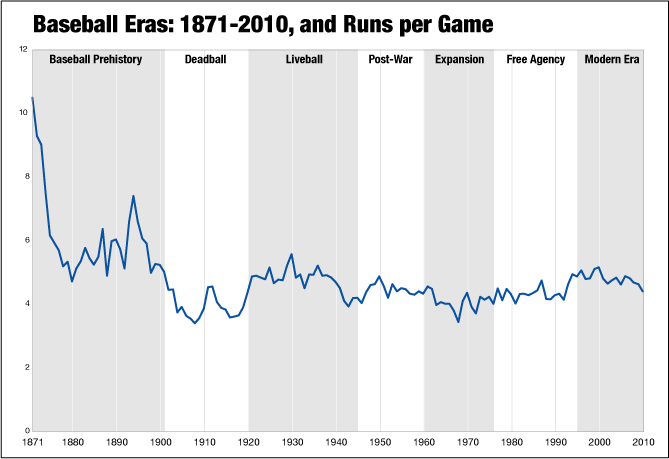
Run environment provides a usable proxy for the structure of the game.
Different phases correspond to different dimensional capacities :
Compressed systems (Deadball era)
low run production
limited extra-base outcomes
narrow solution space
Expanded systems (Live Ball era)
increased run production
accessible power
multi-dimensional solution space
Over-expanded systems (modern era)
further scaling of power
strategic and role specialization
fragmentation of skill expression
Each phase alters:
the number and type of variables required to produce elite offense.
III. The Complete Hitter as a System Solution
The complete hitter represents a joint optimization problem :
maximizing conversion (AVG)
maximizing access (OBP)
maintaining sufficient force (SLG)
These objectives are not independent.
They impose competing constraints on swing decisions, contact quality, and approach.
Thus, the complete hitter is not simply a high-output player, but:
a stable solution to a multi-variable system under constraint
IV. Phase-Dependent Viability
The feasibility of this solution varies across system states.
1. Compressed System (Deadball)
Example: Shoeless Joe Jackson
Power generation is structurally limited
The system primarily rewards contact
Maintaining high slugging in this environment requires:
solving for a variable the system does not naturally support
This produces:
low frequency of complete-hitter profiles
high structural difficulty of integration
2. Expanded System (Early Live Ball)
Example: Bill Terry
Power becomes accessible and repeatable
Contact remains necessary for elite performance
Here, the system supports both:
conversion
force
Simultaneously.
This creates a condition in which:
the constraint set aligns with the requirements of the complete-hitter solution
Under this alignment:
the solution becomes more stable
integration across dimensions becomes structurally viable
3. Over-Expanded System (Modern Era)
Example: Ted Williams as the terminal case
Power scales further
pitching and strategy increase complexity
role specialization emerges
The system now permits:
- extreme optimization along single axes
Which reduces the necessity of balance.
As a result:
the joint optimization problem becomes less commonly resolved
Not due to impossibility, but due to:
strategic divergence
system incentives favoring specialization
V. Interpreting Terry
Within this framework, Terry occupies a specific structural position.
He represents:
the equilibrium point at which the system’s dimensional capacity matches the requirements of the complete-hitter solution
This does not imply reduced achievement.
It indicates that:
the system no longer suppresses force (as in the Deadball era)
the system has not yet fragmented into specialized extremes (as in the modern era)
Thus:
the integration of AVG, OBP, and SLG is both necessary and structurally supported
VI. Implications for Evaluation
This model suggests that:
identical statistical profiles across eras do not imply identical structural conditions
player evaluation must consider:
system constraints
dimensional requirements
solution viability
In this context:
Jackson represents integration under suppression
Terry represents integration under alignment
Williams represents integration at the upper bound of a complex system
VII. Conclusion
The complete hitter is not a static ideal.
It is:
a phase-dependent solution whose viability is determined by the structure of the game
Bill Terry’s significance lies not in ease or difficulty, but in position:
he occupies the point at which the game itself is configured to support the full integration of contact, access, and force
This is the equilibrium condition of hitting.