The First and Last Complete Hitters: Dan Brouthers, the Structural Arc of Baseball, and the End of Balance
The First and Last Complete Hitters: Dan Brouthers, the Structural Arc of Baseball, and the End of Balance
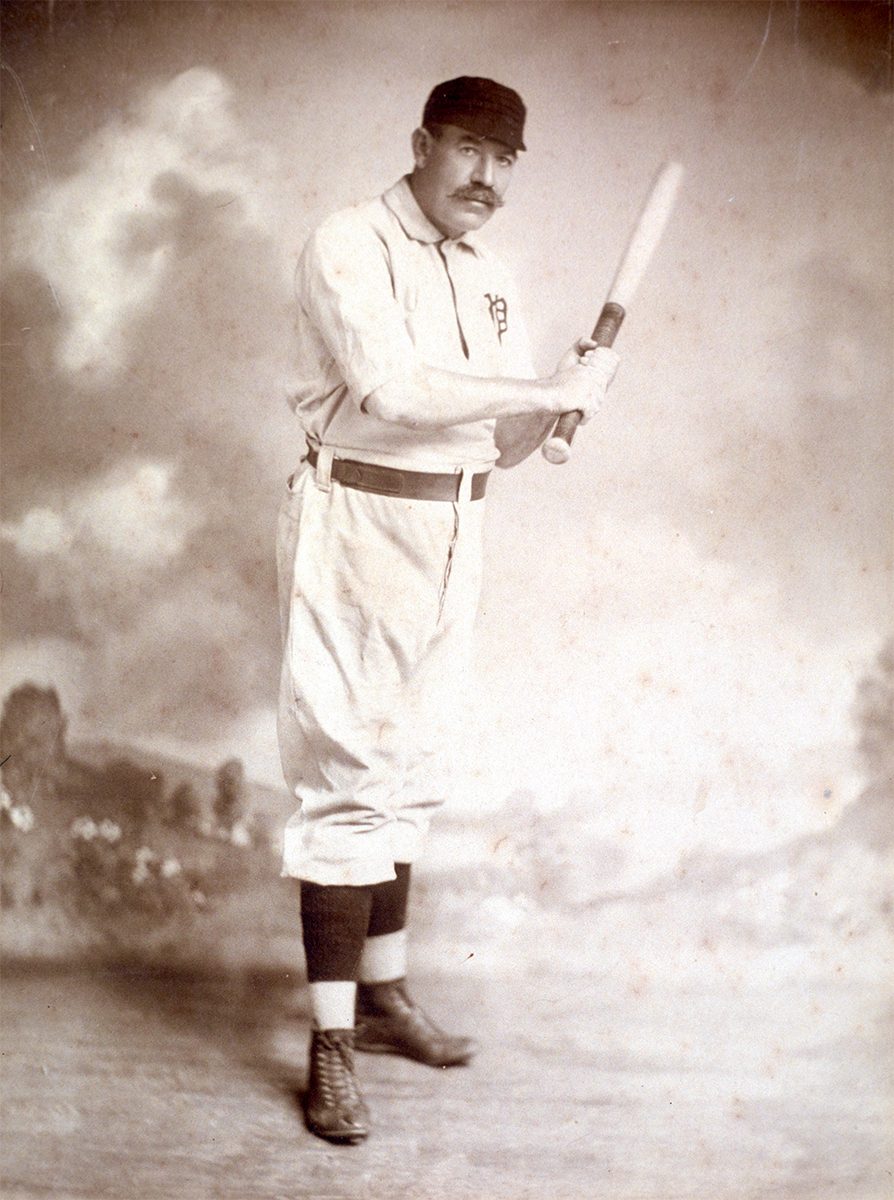
The First and Last Complete Hitters: Dan Brouthers, the Structural Arc of Baseball, and the End of Balance
I. The Form That Should Not Exist
Across baseball history, a specific statistical form appears only rarely:
~.340 batting average
~.400 on-base percentage
~.500 slugging percentage
This is not simply “great hitting.”
It is:
the full integration of conversion, access, and force
Most hitters resolve one or two of these dimensions.
Very few resolve all three simultaneously.
And yet, across radically different eras of the game, this form reappears.
II. The First Complete Hitter
Dan Brouthers
.342 AVG
.423 OBP
.520 SLG
Brouthers exists in a world that is not yet structurally stable:
evolving rules
fluctuating run environments
incomplete standardization of play
And yet, within this instability, he expresses:
the full geometric solution to hitting
This is the key:
The complete hitter appears before the game itself is fully formed
Brouthers is not benefiting from a mature system.
He is:
revealing a latent structure within it
III. Compression and Survival
As the game evolves into the Deadball era, the system contracts:
runs decline
power disappears
offensive bandwidth narrows
Most hitters collapse into:
- contact-only profiles
But one figure preserves the full form:
Shoeless Joe Jackson
.356 AVG
.423 OBP
.517 SLG
Jackson does not merely excel.
He maintains:
a higher-dimensional solution inside a compressed system
This is the second phase:
the form survives constraint
IV. Stabilization at Equilibrium
With the Live Ball era, the system expands:
power becomes scalable
extra-base production increases
offensive dimensions multiply
Now, the complete form is no longer anomalous.
It becomes stable.
Bill Terry
.341 AVG
.404 OBP
.506 SLG
Terry represents:
the equilibrium state of the complete hitter
He does not anticipate the system.
He occupies it at its natural balance point.
V. The Last Complete Hitter
Ted Williams
.344 AVG
.482 OBP
.634 SLG
Williams exceeds the form.
He does not merely balance it—he stretches it to its upper bound.
And yet, he is also:
the last clear instance of the complete hitter as a stable form
After Williams, the system changes again.
VI. Fragmentation of the Form
Modern baseball introduces:
extreme power scaling
advanced pitching specialization
strategic optimization
The system no longer rewards balance.
It rewards:
- maximization
Hitters diverge into types:
power-first
contact-first
on-base specialists
The integrated form dissolves.
Not because it is impossible—
but because:
the system no longer selects for it
VII. The Full Dynamic
The history of the complete hitter follows a clear trajectory:
1. Emergence (Pre-Structure)
- Brouthers
→ the form appears before the system stabilizes
2. Survival (Constraint)
- Jackson
→ the form persists under compression
3. Stabilization (Equilibrium)
- Terry
→ the form aligns with system expansion
4. Apex and Dissolution
- Williams
→ the form reaches its upper bound and disappears
VIII. What This Reveals
The complete hitter is not a timeless ideal.
It is:
a phase-dependent solution that appears only when the structure of the game permits balance across its core dimensions
It is:
revealed in instability
tested under constraint
stabilized at equilibrium
and dissolved under excess expansion
IX. Final Statement
The history of hitting is not the accumulation of great players, but the unfolding of a form. From Brouthers to Williams, the complete hitter emerges, survives, stabilizes, and ultimately disappears—not as a function of individual talent alone, but as a reflection of the changing dimensional structure of the game itself.