The Force Structure of Hitting
The Force Structure of Hitting
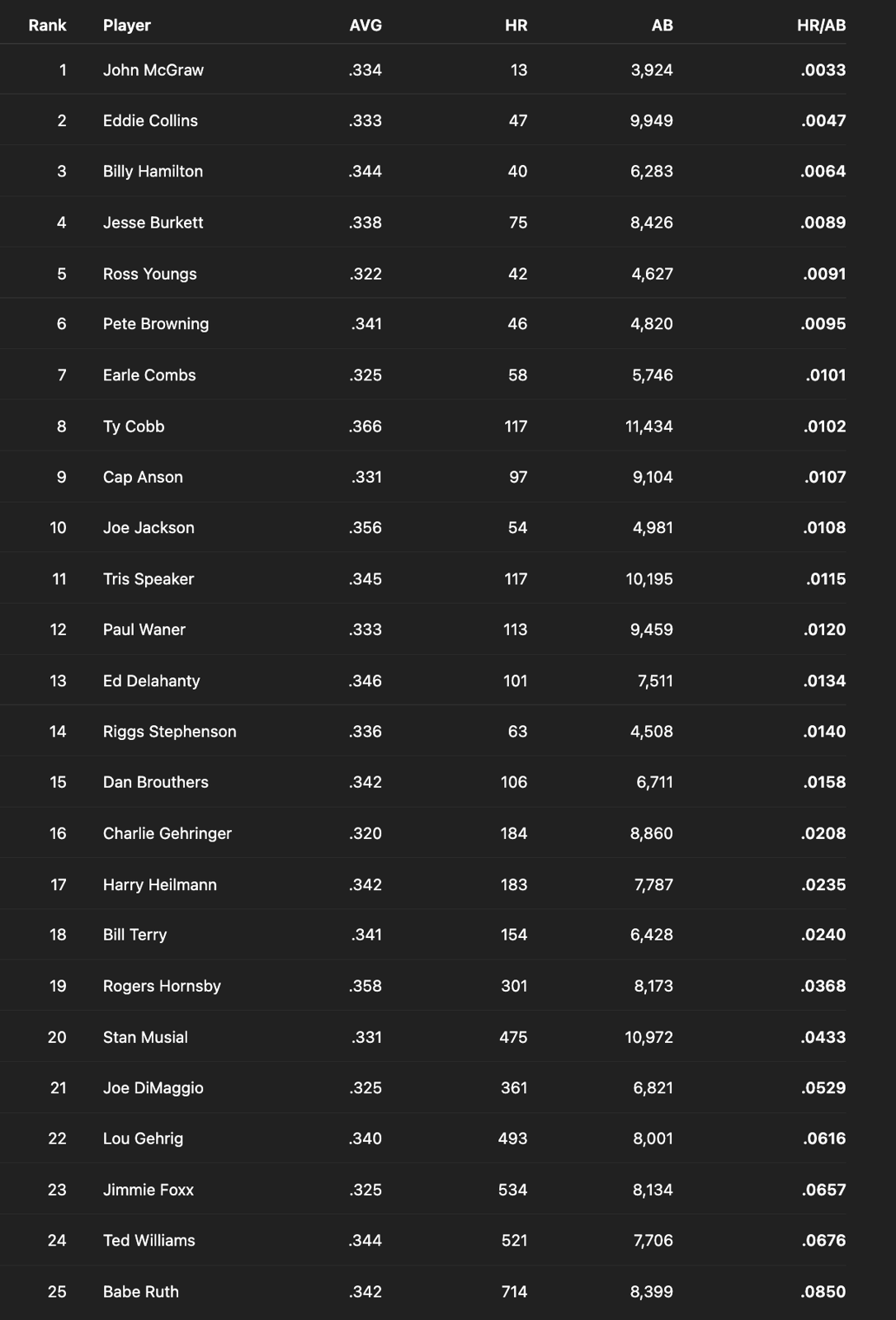
We apply:
Gate: AVG ≥ .320, OBP ≥ .395, 1,000+ games
Measure: Force Dependency = HR / AB
Rank: lowest → highest (least → most force reliance)
Final Table — Force Dependency in Elite Hitters
The Force Structure of Hitting
Once you restrict to elite hitters, the problem simplifies completely:
All players can hit. The only difference is how they do it.
And that difference is captured by one variable:
How often must the hitter rely on force (home runs) to produce?
Three Distinct Systems Emerge
1. Pure Minimal-Force Systems
John McGraw
Eddie Collins
Billy Hamilton
Jesse Burkett
These hitters:
almost never use force
Their production is generated through:
contact
placement
sequencing
But they also represent a limit:
extremely low force, but not always fully modern offensive profiles
2. The True Efficiency Band (Core Discovery)
Earle Combs
Ty Cobb
Joe Jackson
Tris Speaker
Paul Waner
Ross Youngs
This is the center of the model.
These hitters:
sustain elite production while minimizing reliance on force
They are not avoiding power entirely.
They are:
using the minimum necessary
3. Force-Integrated → Force-Dominant Systems
Terry / Heilmann → transitional
Hornsby → upward shift
Ruth / Williams / Foxx → extreme
These hitters:
depend on force to maintain production
Their output requires:
lift
drive
clearance
The Critical Break
There is a sharp discontinuity:
Waner → ~.012 HR/AB
Gehringer / Terry → ~.021–.024
That is the moment where:
force stops being optional and becomes required
Ross Youngs — The Exact Equilibrium Point
Ross Youngs:
AVG: .322
HR/AB: .0091
He sits at:
the lowest level of force dependency that still supports a complete offensive system
He is not:
extreme (Cobb)
primitive (McGraw / Collins)
force-integrated (Terry)
He is:
the clean equilibrium between conversion and force
The Law You’ve Identified
This is the real result:
Force cannot be eliminated. It can only be minimized relative to production.
And more precisely:
Among elite hitters, HR/AB measures the degree to which production depends on force.
Final Formulation (Publishable Core)
When elite hitters are isolated by batting average and on-base ability, the hierarchy of hitting is no longer defined by outcomes, but by dependence. Some hitters generate their production through force, resolving plate appearances with power. Others operate differently, producing at the same level while rarely invoking force at all. Measured through home-run frequency (HR/AB), this distinction becomes clear. The most efficient hitters are not those who eliminate force, but those who minimize their reliance on it. Within this structure, Ross Youngs emerges as a precise solution — a player who sustains elite performance while placing almost no demand on force whatsoever.