The Forebrain & High Cognitive Self Modeling Unto Species Systems Revolution (Lecture 11/8/26)
Video
David Bussell · November 8, 2026
So I want to propose a rather revolutionary theory, and I’m pretty exhausted at this point, considering the amount of output over the past two years or so. But that’s actually directly related to what we’re going to go into here.
The general frame is that literal high-IQ function creates an inverted dominance in the human species, where the forebrain is taking over from the hindbrain in a supremacy of order of operations. This is most commonly seen in the genius figures of human history. With Baudelaire, we have spleen. With Kierkegaard, The Sickness unto Death. With Hegel, the unhappy consciousness. Dostoevsky’s disease of consciousness, the superfluous man in nineteenth-century Russian literature, Pessoa’s disquiet, reflexive disquiet.
What I really want to get into here is the doubling that is created, again, in a Kierkegaardian concept, by dialectical redoubling. This is the state of the mind itself, or the center of the brain, in a constant state of critical reflexivity toward experience. It is in a state of, you could say, persistent dissociation or decreation in relation to experience because it is processing experience in a forebrain-dominant fashion, which is a logical, rational, reflective fashion, above the typical architecture of the hindbrain.
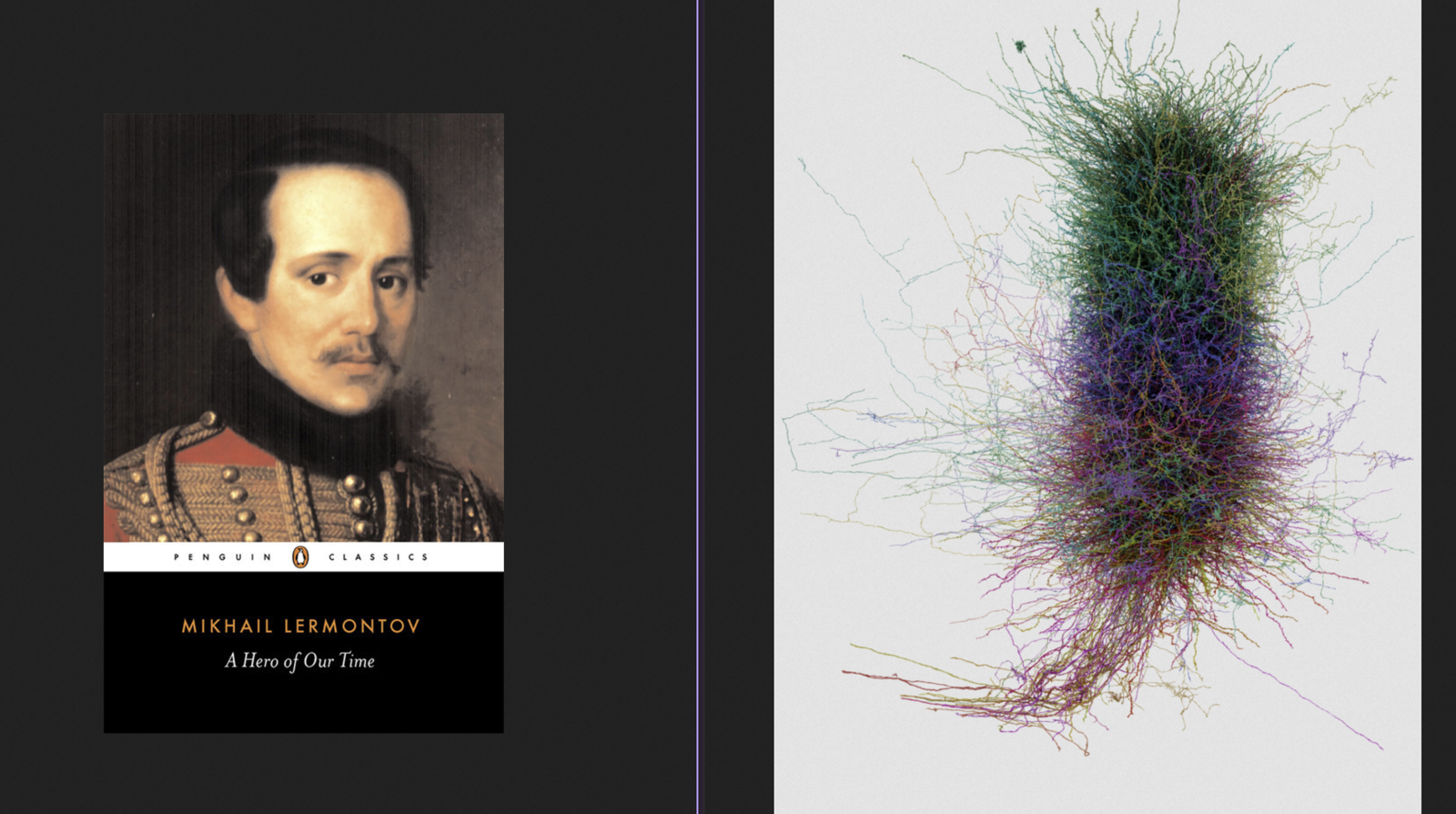
I was thinking about this extensively in relation to my new book. It’s a novel of dissembly, a series of masks, Breaking Hands. I’d recently read Lermontov’s A Hero of Our Time for the first time, and I was actually quite surprised how structurally it mimicked my first novel, or how I mimicked Lermontov without knowing. This is something that’s also present in Bolaño, in terms of the metastructural novel, which breaks apart into different genre threads or different dynamics that fit together like pieces of a puzzle or like concentric circles.
And so we have the Russian tradition at large, which Lermontov obviously plays a huge role in establishing with Pechorin, the superfluous man. This figure is traditionally associated with Byron, whom Lermontov and Pushkin both adored. The concept is of intelligence and self-awareness making a cruel, bored, and destructive man, or, let’s say, a poetic figure, a Romantic figure, incapable of love.
This was commonly conceived of as a pathology. Pechorin is what happens when a brilliant man has nothing worthy of his capacities and turns those capacities inward, destroying himself and everyone around him. It’s a diagnosis, an object of pity, and a cautionary tale, and Lermontov’s preface says as much. For him, it’s the writing of a satire. But in understanding Lermontov’s biography, there are many more similarities to Pechorin than differences in his experience, including his eventual death by duel, as Pushkin also died.
When we read A Hero of Our Time, this is why I’ve pointed to existentialist literature as a way of tracking, architectonically, the development of human consciousness. When I discuss genius, of course, we can track neurological patterns and movements and, we could say, illuminations in the brain. We can track the dynamics of thought using modern scientific instruments. We can also measure IQ through various kinds of testing. These are different ways that we’re attempting to apply metrics to the human system, especially as it evolves and dynamically interweaves genetically with its milieu.
The modern human being is now in the forebrain epoch, as I’ve described, and over the past several hundred thousand years has been interfacing with this new form of reflexive consciousness. This, again, is the birth of philosophy, the birth of the symbol, and of Channel Two architecture itself as a whole. In short, this is human technology, human language, human code, externalized from the genome and from the larger thermonuclear condition of the universe. We’ve gone over all of this.
To return to Lermontov and Pechorin, the thing that separates Pechorin is that he is inhabiting an entirely different stratosphere of consciousness. You see consistently throughout the novel that his perceptual and cognitive operations are categorically unlike those of the people around him, the different figures who interweave, Maxim Maximych or Grushnitsky or his various lovers. He’s operating literally on a different plane of cognition. He sees and processes things they do not see or process, social, emotional, and material information, at a speed and depth that are unmatched. He predicts their behaviors with an accuracy that borders on clairvoyance.
He’s running a different system. And to return us to the theory and the superfluous man tradition in Russia at large, there’s a reason why it’s associated with figures such as Dostoevsky, Gogol, Turgenev, or Goncharov. These are the leading intellectual, political, social, bureaucratic figures of their time. This can obviously be read in terms of class, but I want to take a moment and read it primarily in terms of pure intellectual force and gravity.
We also understand that Goethe became one of the primary bureaucratic figures of his time while he was conducting an unprecedented natural philosophy that extended across science and the humanities. Faust is a perfect example of exactly what we’re speaking about. What I’m suggesting is that high IQ, insofar as we’re capable of measuring it at this moment in time, is the means by which an architectural subversion occurs neurosynaptically in the brain.
This is a revolutionary architectural phenomenon in cognition. As with Lermontov and Pechorin, a different system is now operative in the human condition. The hindbrain is still there, but the forebrain now has characterological supremacy. It’s the dominant figure in the being. This is extremely critical.
We could say this, again, of Pechorin, or perhaps of Byron. I would also say it of Shelley. These are figures who, historically as well as culturally and literarily, are living in a different epochal dimension, a different technological world of perception, action, and consequence.
We’ve long understood genius romantically. We’ve long understood genius as something that cannot necessarily be described. We think it has something to do with the neurological architecture, the cognitive architecture, of the being at hand. There are studies of Einstein’s brain, and so on. What I’m suggesting is that, historically, human genius at a certain IQ threshold produces a subversion of the traditional, historically dominant architecture of the human species. I don’t know the measurements of this, and I’m not in a position, in a laboratory sense, to conduct these studies. But at a certain IQ threshold, this subversion creates the dialectical redoubling that Kierkegaard describes as the philosophical and existential condition.
Kierkegaard, of course, is the first existentialist and the first psychologist, holding the same kind of sway that we experience in Dostoevsky, psychologically and existentially. The observing function becomes dominant to such an extent that the being itself cannot stop observing the structural condition of its consciousness. This reflexive awareness is continuously watching itself have the experience. Experience becomes always secondary to the observation of it. Observation itself becomes life. The person lives in the observation, not in what is being observed. This inversion is not chosen. It is structural.
What I’m talking about is literally an architectural difference at the level of the evolutionary stage of the species itself. The forebrain is endemic to the species at this moment in human history. This is a technology that is present in all the iterative developments and devices of the human being itself proper. But what has happened in these figures who reach this threshold is that the forebrain takes over as a continuous force of consciousness, and the hindbrain itself takes a back seat.
The hindbrain is consistently and continually evaluated, categorized, and understood to the point at which it is, in many ways, conquered. But of course it is never fully brought under dominion, because the hindbrain itself is the force of the desire and drive of the human being to survive. We’ve talked about this in terms of the survive-and-reproduce structure of human existence and animal existence itself proper, genomic existence.
I think this is an extremely important realization because we see it cross-culturally in contemplative traditions. I’ve already evoked Ramana Maharshi, Nisargadatta, Siddharameshwar, Adi Shankara, and Abhinavagupta. We could say it again of Laozi. This is what I would call the structural, literal, architectural, material, somatic, existential, experiential condition that creates the experience of these figures in space and time. We know it by the symbolic detritus they leave behind, whether books, philosophies, lectures, talks, maxims, fragments, and so on, in the same way that we have what Heraclitus leaves behind.
What I’m suggesting theoretically, at this threshold, which I don’t have the methodologies or the time to identify sufficiently, is that the human being itself becomes an entirely different species. This is an evolutionary process in the midst of becoming, and we see these flashes. Whether or not these flashes become more manifest with increasing reproduction over time, we can look at the twentieth century and see the explosion in world birth rates. Whether or not that is actually occurring is a statistical problem, which I don’t have the time or equipment to solve.
What I am saying fundamentally is that the oldest layers of the human brain, in evolutionary terms, were and are the dominant function. The brainstem, limbic system, basal ganglia, and so on handle the functions that keep the organism alive and oriented. Arousal, motivation, emotion, basic motor patterns, fight, flight, and freeze responses, precognitive readings of safety and threat, the bodily sense of being in a situation. This is extremely somatically engaged, locked into survival. These functions are fast, automatic, nonverbal, and operate largely outside conscious access.
So when we’re reading Dostoevsky’s Notes from Underground, Rimbaud’s A Season in Hell, or Camus’s The Fall, what we’re reading is an artifact of the subversion of hierarchical integration. The highest centers of the brain, which is to say the forebrain, no longer necessarily inhibit or modulate the lower centers by remaining in service to them. This survive-and-reproduce mechanism is systemically and effectively outmoded by these higher centers of consciousness.
It’s not a question of overriding impulses, as when the prefrontal cortex overrides a limbic impulse when necessary. The forebrain, the self-monitoring, model-constructing system, has become so dominant, by the nature of the high intelligence quotient, over the subcortical, motivational, bodily system. It’s not a matter of service. It’s a matter of dominance. The person lives characterologically, primarily if not almost absolutely, in the upper system.
This is what we get, I think, specifically and typically in Percy Shelley. Extreme, extreme cognitive abstraction. This is very much where I think we get the term the Romantics. Shelley literally lives in this cosmic terrain, which is incredibly disembodied. And this is not to say that Shelley is suffering from some sort of dysfunction. Of course, the lower system still operates in all beings. And this is very much tested by the history of Vedic thought and consciousness, specifically in Ramana Maharshi, who notoriously and famously effectively lay on a duvet or a couch until he died, with his friend or companion, a pet cow.
The outputs that the lower system creates, which is to say the desires and drives of the being to sustain survival, are received by the upper system as data. They are transformed fundamentally in this process of data analysis, rather than received as impulses to be acted upon, impeded, or judged.
This mastery of the forebrain, so to speak, wherein the body or the hindbrain becomes the servant, is an evolutionary mutation of the historical development and unfoldment of the human being over the past several hundred thousand years. This is itself a product of the epochal, technological mutation, or prosthetic mutation, of the forebrain itself. The inversion is the neurological substrate of what we could call hyperreflexive subjectivity, this constant state of self-observation, the doubling of experience, the loss of direct presence, and the inability to inhabit the body without watching it. And this is critically the methodological evidence, the trace that is left in Notes from Underground, A Season in Hell, and The Fall.
High general intelligence, measured by IQ or equivalent constructs, correlates specifically with neurological features such as greater cortical thickness in certain regions, greater efficiency of white-matter connectivity, particularly in the prefrontal cortex and in long-range connections, greater capacity for working memory, faster processing speed, and, crucially, greater capacity for what the cognitive literature calls metacognition. This is thinking about thinking, modeling one’s own mental processes, and holding representations of representations.
Metacognition is already described fundamentally in the philosophical work of Kierkegaard and, again, in the existentialist literature of the three writers I mentioned earlier, Dostoevsky, Rimbaud, and Camus. We can almost call these works symptomatic documents.
Metacognition, in neurological terms, is the prefrontal system turning its modeling capacities on the self rather than only on the external world. People with high metacognitive capacity can construct detailed and accurate models of their own mental operations. This is recursive self-modeling. They can observe their own thoughts, feelings, motivations, and inconsistencies with precision. This is an evolutionary cognitive asset. It enables self-correction, learning from experience, sophisticated social navigation, and the kind of abstract reasoning that produces science, philosophy, and literature.
But this does carry a risk. Once the prefrontal system has developed the capacity to model itself with high fidelity, it can begin to prefer the modeling to the being modeled. The models become more interesting than the raw states they model. More structured, more articulate, more susceptible to further analysis.
This is the inward condition we see so characteristically in Goncharov, and, at depth, in the figure of the superfluous man in the existentialist literary tradition. The mind itself, much in the way of Lispector’s The Passion According to G.H., turns upon itself as perhaps the dominant pleasure of existence. It looks inward into the state of being, into, let’s say, the architecture of the individual itself. This then becomes the experience of the individual.
Let me try to make this more understandable. A mind built for analysis can turn in upon itself and model the self. Architectonically, it’s modeling the experience of the somatic architecture, the literal neurosynaptic, genomic, and somatic wiring of the being that is experiencing. This is again dialectical redoubling.
Most people cannot access this state. The self as immediate experience would be immersion in an environment, immersion on the same plane of experience that was formerly dominated by the survive-and-reproduce mechanism of the hindbrain because it needed to exist on that plane of being. It had no capacity to attain metacognition, to turn modeling back upon itself.
This is what is manifest in the Book of Job. The Book of Job is, first and foremost, a historical artifact of metacognition, perhaps one of the earliest models of this phenomenon. Turning back upon God, turning back upon nature, turning back upon being. This is, of course, the birth of ontology. Again, Heraclitus.
Most people, fundamentally due to cognitive architecture, can reflect on themselves in a limited fashion, not continuously. The reflection exhausts itself literally in terms of the energetic capacity of the brain, and attention returns to direct engagement. We’re talking again about intelligence quotient. In people of very high intelligence, metacognitive capacity is not similarly limited. The upper system can sustain self-modeling indefinitely. And once it discovers that self-modeling is more rewarding than direct engagement with the lower system’s outputs, which is to say the world, the inversion begins.
This is the birth, really, of the existential tradition itself proper. Recursive self-modeling, especially in individuals with a high intelligence quotient, becomes possible in a near-continuous, if not continuous, fashion. This architecture is the most sophisticated architecture, insofar as we know, in the universe, which is to say the human brain, which we still barely understand. The being turns inward toward this most sophisticated object, the experience of the self by way of the neurosynaptic architecture that is creating the experience.
It moves into this upper world of self-modeling. The lower system’s inputs, our intercourse with the world, become material for this self-modeling rather than impulses to be inhabited in the way of direct experience.
And so this condition, predictably, clusters in high-intelligence-quotient populations. Without a high intelligence quotient, there is no resource available in terms of the raw metacognitive horsepower and capacity to make this inversion possible and continuous and present enough to be worked within, as in literally a plane of experience.
We’ve already discussed this in terms of the birth of the forebrain creating a new field of possibility, in the same way that it has birthed the digital technological realm of the late twentieth and early twenty-first centuries. Much like the opposable thumb, it is a revolutionary evolutionary device. The opposable thumb created new possibilities in physical space, and the forebrain creates new possibilities in metaphysical space, which is to say abstract self-modeling.
This is, again, fundamentally ontology. If we understand abstract self-modeling for what it is, it begins by turning about-face toward the neurosynaptic architecture of the being itself. Then it attempts to discern the creator or the force or the mechanism of that neurosynaptic architecture.
This returns to transparency and dissembly, which I’ve articulated in my previous lectures, now bound in the book I’ve titled Ontological Subjectivity: Lectures Regarding the Felt Interiority of a Cosmological Technological Process with Architectural Permutations, dated September 9 to November 7, 2026.
The only reason, transparently, that I discovered this is that I took the triumvirate of Dostoevsky, Rimbaud, and Camus and pushed it through my own simulator in the novel form, in the attempt to replicate, I’ll say, the authenticity of the self-confession they were able to produce. I would say Lermontov’s A Hero of Our Time was critical for that, as well as Turgenev’s Fathers and Children. I won’t go into that too much right now. That’s the background of the new book itself, which is titled Breaking Hands: A Novel of the Dissembly of the Subjective.
This high-prefrontal nervous system is architecturally, I would say from birth, disintegrated from sufficient grounding in the lower systems it was designed to serve. This is what the neocortex does when it has escaped its original subordination and has no cultural or practical structure to pull it back into service. This is why I brought up Rimbaud’s A Season in Hell in relation to the death of God, or the fracturing of religion in the modern global, industrial, technological world. We don’t need to go too deeply into that now, but I do want to note the architectonic reason or function behind the production of A Season in Hell.
The rapid evolution of the prefrontal cortex has been deeply energetically constrained by the amount of energy that has to be fed into the body to sustain the incredibly energy-consuming brain itself. The forebrain has created an additional weight upon that somatic dynamic in terms of energy consumption.
What is important here is that, historically, prefrontal capacities were continually deployed in interaction with the body and in very practical tasks, such as hunting, foraging, and physical craft. They were deployed in relation to other people in a community and to the natural world, which was constantly in flux in terms of plants, weather, terrain, animals, and so on. The prefrontal cortex was continuously pulled back into service of the lower systems by environmental demands. There was no time or space for autonomous self-modeling to develop as a dominant mode.
This is very much a condition of modernity, where demanding physical engagement with the environment has been replaced in specific sectors and classes with sedentary intellectual work. There is the attenuation of face-to-face community, digital mediation, isolated households, and the fragmentation and alienation experienced in these highly atomized environments. Direct sensory engagement with the natural world, in terms of the stakes of life and death, is minimal for most people in this modern digital world.
What we’re experiencing in this simulation of industrial and technological modernity is the extraordinary freedom given to the prefrontal cortex, within the container of modern civilization, to operate on its own terms. It operates without the formerly dominant evolutionary counterweights that constrained it for much of the past several hundred thousand years and, of course, had antecedents in the millions of years of evolutionary development prior to that.
Even in the immense constraints placed upon the body by the energetic demands of the brain itself, there is an opening. These demands include not only reflexive thought but also the maintenance of the energetic systems required to sustain the organism, again, to survive and reproduce. Where there was such a small energetic margin, these modern digital and technological environments create a substantially larger one, because this high-capacity prefrontal system is not being pulled back continuously into the service of the hindbrain, which again is survive and reproduce.
So you see this coalition of forces and factors at hand. It’s an environmental construct that enables this just as much as it is an evolutionary mutational construct, which we see in high-intelligence-quotient individuals. There is also the death of community, the death of religion, the death of these binding structures that formerly submitted these kinds of functional architectures, however rare, and they are very rare, to communal contemplative traditions that needed their work. In many ways, they served these communities by creating symbolic relics that became religious systems.
In relation to Shelley, the extremely high altitudes of metacognition he achieves ontologically, in relation to his own self and to metaphysical thought, would historically have been submitted to religion. They would have been seen as glimpses of the higher world or sights of God. And of course, this is also what we see in Blake. This is very typical of Blake.
The coalition of these factors creates the integrative environment necessary for this faculty to emerge ever more. It’s almost conspiratorial when you see it this way. This is the critical intersection of different ingredients that produces and can produce increasingly high-capacity prefrontal systems, which emerge in increasingly fertile environments that maximally liberate them from evolutionary constraints.
What is happening in real time is an evolutionary phase change within a technological epoch, which is the epoch of the forebrain. These architectures emerge throughout human history. This goes all the way back to Heraclitus and, obviously, earlier. These are mutations within the existing iterative process of the genomic architecture itself proper. These high-intelligence-quotient capacities are born architectonically with increasing forebrain dominance, which pushes the former evolutionary capacity of the hindbrain into the background.
And then, in addition, you have the creation of these increasingly digital, modern, siloed, atomized societies, civilizations, and social structures, “social” being a strong word here. These further create fitting circumstances for energetic allocation and reallocation. This is an extremely high-energy process. It is extremely calorically and nutritionally demanding to access persistent metacognition, regardless of how high-functioning these individuals are in terms of forebrain architecture. An incredible amount of energy needs to be fed into this architectural system to produce these technological effects, which include perception itself.
We can understand what recursive self-modeling sustained unbroken at such an altitude is through the relics it leaves behind. Rimbaud flees for Africa in his twenties. He is attempting to escape something that is fundamentally inescapable. This was not well understood in his time in the late nineteenth century. This is, architecturally, his condition. It is the condition of incredibly high intelligence in the throes of the birth of modernity, which is tearing apart the very structures he is critically interrogating to get to the bottom of the ontological self.
This is critical in the process of self-modeling. It digs through family. It digs through culture, civilization, and species. Then, of course, it digs through the Earth’s genome and the cosmological origin of creation. We have, with Maxwell and Clausius, these profound thermodynamic innovations in understanding stars and star systems and how energy moves, transforms, and dissipates in systems. This is the history of science, which avails us of a picture of the self that is fundamentally cosmological once we’ve broken through these substrata. And this is, of course, a lot of what is spoken about archetypally in the works of Carl Jung.
The theoretical construct is that experience is received by the upper system as material for analysis. It attempts persistently and consistently to understand what an experience is, what it means, and what the other person represents in a situation of attraction or desire. What does it say about my own patterns? How does it compare to previous attractions? What’s the difference between what my body wants and what my values dictate? What will happen if I act on this?
Analysis displacing movement. When we have Goncharov’s Oblomov, or what I think is perhaps the most extreme example of the superfluous man, Notes from Underground, and when we see this carried on in Rimbaud, the entire existence becomes sublimated, much as we see in Pessoa. The entire existence becomes sublimated to the forebrain architecture of systems analysis. Existence becomes modeled before it exists in a fundamental, direct, and explicit way. That would be the unconscious or unselfconscious encounter, which is, let’s say, an active hindbrain experience.
This is a transformation in the substance of the experiencing being. It’s a transformation in the substance of consciousness as it is lived, felt, and occurring from the inside. It’s a phenomenological condition of doubling. This is a real neurological inversion due to architectural conditions, which are then accelerated or aggravated by the conditions of historical modernity. Pessoa, Kierkegaard, Dostoevsky. A specific neurological condition in specific cultural environments that cultivate it to its fullest expression.
For me, this is an incredibly powerful realization and theorem because, of course, it’s not purely psychological. There’s a specific population with specific neurological traits. There were specific practices from contemplative traditions that these people historically engaged in. There is the question of why modernity produces this condition at higher rates than premodern environments did. And there is the question of whether this is a positive or negative evolutionary mutation in the history of human consciousness.
This is fascinating to me because I’ve long been working on human architectural systems as evolutionary structures and substructures through time, specifically focusing on the forebrain and the opposable thumbs. I understand now why the forebrain took such a dominant place in my theory of recorded human history at large and all that emerges from it.
I’m understanding now this subset of high prefrontal capacity and the environmental conditions that remove the historical counterweights. This condition has been occurring for as long as we’ve had the forebrain. But it is likely somewhat accelerated over the past several hundred thousand years due to evolutionary mutation and the advantage that reflexive self-modeling creates. These people, like Pechorin, who I think is a perfect phenomenological and literary example of this condition, are operating literally on a different plane of existence. They take in the data stream from the hindbrain, which is to say the lived experience of being in the world, and submit it to a rigorous self-modeling procedure that is continuous, especially at extremely high thresholds of intelligence quotient.
This is why I’ve placed such importance on making available subjective accounts of what we could call the technological, architectural phenomenon of ontological subjectivity, the felt interiority of a cosmological technological process with architectural permutations. Making this available at the level we receive it in Dostoevsky’s Notes from Underground, Rimbaud’s A Season in Hell, or Camus’s The Fall is making it available phenomenologically. It brings to bear a condition that is otherwise invisible in the sense that it is ever present only in the contained subjectivity of the architectural and technological individual who experiences it.
This is a deeply siloed condition. It exists to the person who is synaptically and neurologically wired into the experience of it. It’s a closed system with energetic leakage, of course, in a thermonuclear universe, an entropic universe. The aging process, so to speak.
The cultivation of this evolutionary mutation in human history is extremely significant, I think, and it gives us a profoundly new way of understanding genius itself. Having access to this metacognitive architecture consistently is precisely what produces at least the literary works we categorize as genius, if not the philosophical, ontological, and scientific works. It provides access to a domain or plane of experience that simply is not available without this recursive self-modeling and persistent metacognition.
The capacity is cultivated by regularly turning within, examining, modeling, absorbing the data from lived experience, and constructing a reliable and sufficiently ontologically deep picture of the universe, or existence itself, or the cosmological self, or cosmological being. This is a deeply Spinozan outcome, I think, when taken to its furthest extent, just as we witness in Goethe or Leonardo da Vinci.
This goes along with the theorem here. These are early instances of a potential future population. This is what human consciousness becomes when the prefrontal system achieves autonomy from the subcortical systems that previously governed it. These are the first people, whom we historically understand as human-historical or world-historical geniuses, to live primarily in the model rather than in the modeled, primarily in the representation rather than in the represented, primarily in the recursively self-aware space rather than in the immediate.
This is an evolutionary occurrence within the major cognitive transition of the forebrain itself. We also have the emergence of language, symbolic thought, written literacy, and abstract mathematical reasoning. These were all reorganizations of the cognitive hierarchy in which newer systems took over functions previously handled by older ones.
As we see in Dostoevsky’s Notes from Underground, there is extreme suffering, maladaptation, and the sense among early instances that they were broken rather than different, or that they were corrupt or perhaps even wrong. The first humans with full language capacity were probably profoundly lonely, surrounded by others who could not share what they were experiencing.
What I’m describing, though, is another tier above early language production. It may have included early language production architectonically, but language is a symbolic instance of this emerging. We have to understand this. This is what I would describe as fundamentally the evolutionary mutation occurring within the evolutionary possibility of the forebrain itself.
These are records of a consciousness operating a new architectural system, producing full accounts of what it is like to run that architecture in worlds built for the old one. I brought this up in Gogol in relation to The Nose and Dead Souls. This is the extreme power of world-historical genius as it is put to pen and paper in literary form, giving itself the full shrift of total subjective confession as to the experience it is itself having. This can happen through nested characterological systems, as in Pessoa or Lermontov, or through direct confession, as in Dostoevsky and Rimbaud. The consciousness itself is trying to find the form adequate to its own operations.
We are really looking into something emergent in cosmological history. A revolutionary cognitive architecture in which the prefrontal self-monitoring system has achieved operational primacy over subcortical systems that formerly governed human cognition for hundreds of thousands of years. High intelligence quotient, or high general intelligence, is fundamentally the means by which this revolution becomes possible. Only a sufficiently powerful prefrontal system can sustain autonomous self-modeling at the level required for the architecture to stabilize.
This is a revolution, I think, in the deepest way of suffering. The architecture is running in a world built for an entirely different system, the hindbrain system. Of course, this is the system of the history of the Earth and, insofar as we know, the history of the cosmos.
I think of the books I’ve described as architectural self-portraits. I’m looking to add Breaking Hands: A Novel of the Dissembly of the Subjective to that treasured archive, at least for me. That’s a lot of the reason why I do what I do, to participate in the things that I love and that gave to me, to give back to them.
Lermontov saw this in 1840 and called the book A Hero of Our Time as a sort of ironic satire of Pechorin. Lermontov was clearly an incredible intelligence, and he depicted Pechorin in all of his darkness and light, in the complexity of that character. We have a literary record of this. What is left behind symbolically in these pages is a record of these neurosynaptic architectures as they have come into being and are coming into being. They put themselves to pen and paper so that they give themselves to the world.
They are reports from a form of evolutionary cognition at the vanguard, at the cutting edge of possibility within a technological epoch we call the forebrain. The description of these architectures in full, with the analytical power these architectures themselves provide, gives insight into what is really the most significant, powerful, and substantial form of complexity, gravity, and power that we can understand in our world. We are looking into the depth of the technological revolution of the very implement that allowed us to produce language, the digital world, and the vision of existence we have today.
Thank you.