The Greatest Hitter of All Time: Ted Williams and the Scientific Formalization of Hitting
The Greatest Hitter of All Time: Ted Williams and the Scientific Formalization of Hitting
The Greatest Hitter of All Time: Ted Williams and the Scientific Formalization of Hitting
Praxis, Experimentation, and the Codification of a Predictive Motor Skill
Ted Williams did something rare in sport:
He didn’t only perform elite hitting.
He formalized the method —turning an embodied, time-compressed skill into an explicit system of observation, prediction, and iterative refinement.
This document isolates what is actually scientific about that accomplishment: not “he had great eyesight,” but how he built a reproducible practice architecture —an applied science of interceptive action.
1) The Real Problem He Solved: Hitting Is a Prediction Task
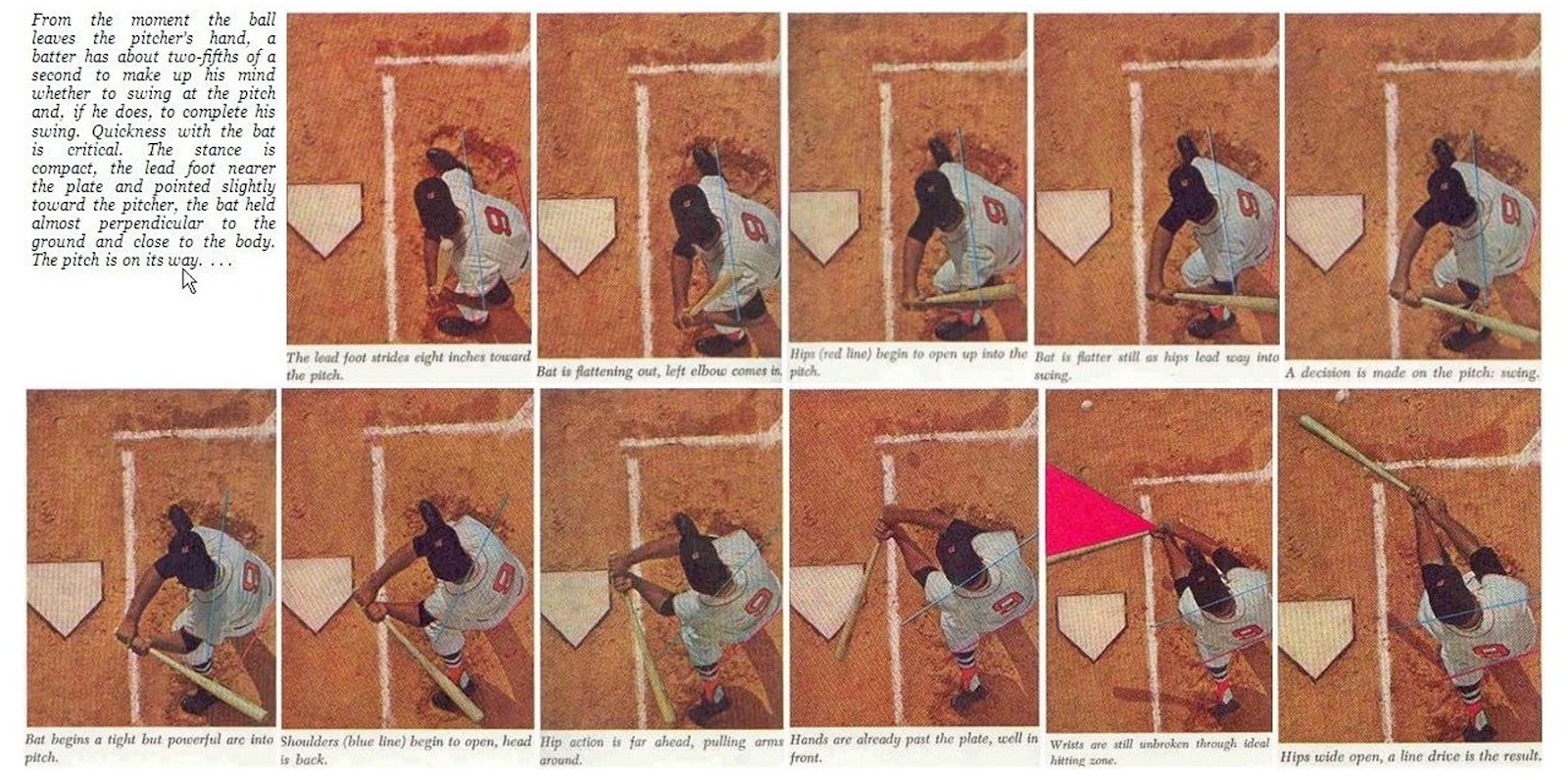
A fast pitch reaches the plate in roughly a few tenths of a second, and the swing itself occupies a large fraction of that window. By the time the bat is accelerating, the batter cannot “wait and see” in a normal sense. The task is therefore not reaction-first, but prediction-first.
This is not philosophy; it’s consistent with what controlled batting research shows: late-ball visual information contributes less than early information, and hitters must commit based on prediction and limited early cues.
Williams, writing decades earlier, states the constraint in plain language and builds his method around it: “0.40 second, with a round ball and a round bat” and the reality that the batter’s movement sequence begins before full recognition is possible.
So the axis of his “science” is not mechanistic fetishism.
It’s time-budget engineering : how to allocate attention, prediction, and commitment under severe temporal constraint.
2) His Core Scientific Move: Replace “Guessing” With Observational Inference
Williams is explicit that what people called “guessing” was, to him, inference built from observation :
“I was known as a hitter who ‘guessed’ a lot… but for me guessing was observing… knowing what you’ve swung at… knowing the pitch you hit or missed… knowing the pitcher’s pattern.”
That paragraph is basically an applied version of the scientific loop:
Observe : release tells, snap, spin, prior sequences
Hypothesize : what is likely coming next
Test : commit (or refuse) based on predicted value
Update : incorporate outcome into the model
Modern batting research explicitly supports the idea that hitters integrate probabilistic/contextual information with visual trajectory cues when guiding action—i.e., it’s not just “see ball,” but “combine priors + early trajectory.”
Williams didn’t have that vocabulary, but his praxis aligns with the mechanism: context + early cues → predicted pitch → gated swing decision.
3) “Know What You Swung At”: Measurement Discipline and Error Accounting
A hidden difference between mysticism and science is whether errors are treated as vague misfortune or as useful data.
Williams is blunt about his intolerance for unmeasured at-bats—especially hitters who couldn’t identify what they just faced:
“It dumbfounded me when a batter couldn’t tell what he had hit… ‘What was the pitch?’ ‘I dunno…’ even when he’d hit a home run.”
This is not just personality. It is a measurement ethic.
He is describing a requirement for skill acquisition:
If you cannot label the stimulus (pitch type/location/pattern),
you cannot update the internal model with precision,
and your learning signal stays noisy.
This maps tightly to what contemporary expertise research finds in other domains: experts extract more task-relevant information and reduce decision noise through refined perceptual categorization.
Williams’ method begins with an insistence on clear internal bookkeeping.
That’s science: identification → attribution → update.
4) The Strike-Zone as a Controlled Variable
Williams’ famous “zone carving” is not simply plate discipline rhetoric. Structurally, it is the introduction of a controlled variable into a chaotic task.
Instead of “swing when you feel it,” the hitter imposes a rule:
Define regions where expected value is high (“damage zones”)
Define regions where expected value is low (“trap zones”)
Refuse to expand, because expansion creates a negative feedback loop
Williams articulates the dynamic consequence of expansion with near-clinical clarity:
When you start “fishing” an inch off, “the pitcher—if he’s smart—will put the next one two inches off… Then three… and before you know it you’re making fifty outs a year on pitches you never should have swung at.”
That’s a systems argument: feedback, adaptation, and escalation.
Modern research on plate discipline and visual function treats the swing/take decision as a measurable, stable component of batting skill; visual and oculomotor measures correlate with plate-discipline metrics in professional players, indicating that the decision system has physiological and perceptual structure.
Williams’ strike-zone codification is therefore not just “patience.”
It is the explicit engineering of a decision boundary.
5) The “First Pitch” Rule as Calibration Protocol
One of the most scientific elements in The Science of Hitting is how Williams designs procedures to reduce uncertainty early in a game.
He describes (with near rulebook specificity) a strong tendency to take the first pitch—sometimes even a strike—because it refreshes calibration:
taking the first pitch “refreshed your memory of the pitcher’s speed and his delivery,” and provides information.
This is a calibration protocol:
Before you run the system at full speed,
you measure the parameters (velocity, break, release rhythm),
then you let your predictive model lock in.
Contemporary work on batting emphasizes that the earliest segment of ball flight and kinematics carries disproportionately important information for prediction, and that hitters integrate early trajectory with contextual priors.
Williams is essentially formalizing a pre-trial measurement step.
6) Practice as Automation: Removing Conscious Control From Mechanics
A defining line in Williams’ method is that in-game attention should not be spent on mechanics:
“You are not concerned about mechanics now. Your practice time has made them automatic.”
This is scientifically important because it recognizes a core motor-learning principle:
conscious control is slow,
elite performance requires automated motor programs ,
and attention should be reserved for perception, prediction, and decision gating.
Eye-tracking research in baseball and broader interceptive tasks suggests that expert performance depends on efficient visual strategies and stable pre-action fixation behaviors (often discussed under “quiet eye” and related gaze control frameworks).
Williams’ separation—mechanics automated in training, cognition reserved for game inference—is exactly what you would design if you believed hitting is fundamentally a perception–prediction–action coupling problem.
7) Williams’ Praxis as Iterative Experimentation
Put it together and his approach reads like field science:
He built a dataset
Patterns by pitcher
What got him out, and what the pitcher believed “fooled” him
How sequences repeat when the pitcher assumes ignorance
He formed explicit hypotheses
- “He’ll try to beat me the same way again.”
He ran repeated trials
- Each plate appearance is a test of the updated model
He updated fast
- He prized “second chances” because they are controlled repeats with improved priors
This is why his “science” is not metaphorical.
It is praxis designed to accelerate learning by shrinking uncertainty and improving prediction.
Modern experimental work shows precisely these levers matter: early cue use, contextual priors, and decision strategies differentiate skilled hitters and influence accuracy.
8) What He Truly Codified
Many great hitters are great privately. Their skill dies with them.
Williams made his system transmissible by codifying:
Observation as method (“guessing was observing”)
Pitch identification as a requirement for learning
Decision boundaries (zone control and its feedback consequences)
Calibration protocols (first-pitch information gathering)
Automation doctrine (mechanics trained to automaticity)
That is an architecture: not just “how to swing,” but how to run the whole system —perception, inference, gating, and execution—under severe time constraint.
Closing Claim
If “greatest hitter” means highest output , there are many arguments.
But if “greatest hitter” means:
the player who most rigorously formalized hitting as an explicit, experimental, predictive skill system—turning embodied talent into a transmissible method—
Ted Williams has a uniquely strong case.
His enduring importance is not that he saw better.
It’s that he built a discipline of seeing, predicting, refusing, and committing—then wrote the operating manual.
And modern perceptual-motor science increasingly describes the same reality with different words.