The Historical and Cultural Importance of Early Baseball Cards
Video
The Historical and Cultural Importance of Early Baseball Cards
00:00
So this essay or this video is going to be about the history of the global working class struggle, specifically as it pertains to baseball cards. And it's such a fascinating intersection. And it's something we've explored a couple of times now from different angles, especially regarding the T3 Turkey Red.
The concept of the coupon redemption system for cigarettes that were purchased by the common person in early modern America, as well as the concept with the T3s around… as beautiful works of art for the working class, right? Mass produced lithographic hand retouched works of art that were provided through this coupon redemption system to be displayed in the homes of people who otherwise would not have such high level works of art.
And the T3s themselves were extremely colorful, vibrant, high contrast, beautifully designed with figures that incorporated patterns and techniques and structures that actually anticipated some of the greater modernist perspectives, such as alienation in an industrial world and the way that those figures and forms within the context and bounds of modernist works of art were sculpted to reflect that emerging terror — as we discussed with painters like Otto Dix or the Surrealist movement at large… as well as constructivists and Dadaism… you can see the fomenting perspective that's taking place there.
Those T3s were made in 1910, 1911. So you're looking at something that actually anticipates by a couple of years the modernist movements that spring up in Europe in the mid to late 1910s.
Specifically as it pertains to baseball cards, there is something beautifully immortal about them in terms of how they are representative of a moment in time — especially the early modern baseball card, let's say from 1900 to maybe 1941 with the last Play Ball set and the onset of wartime production, which leaves only the Exhibit issues in mass circulation. Representative of a certain moment in time and yet to themselves hold a timelessness in that what they were created as and for.
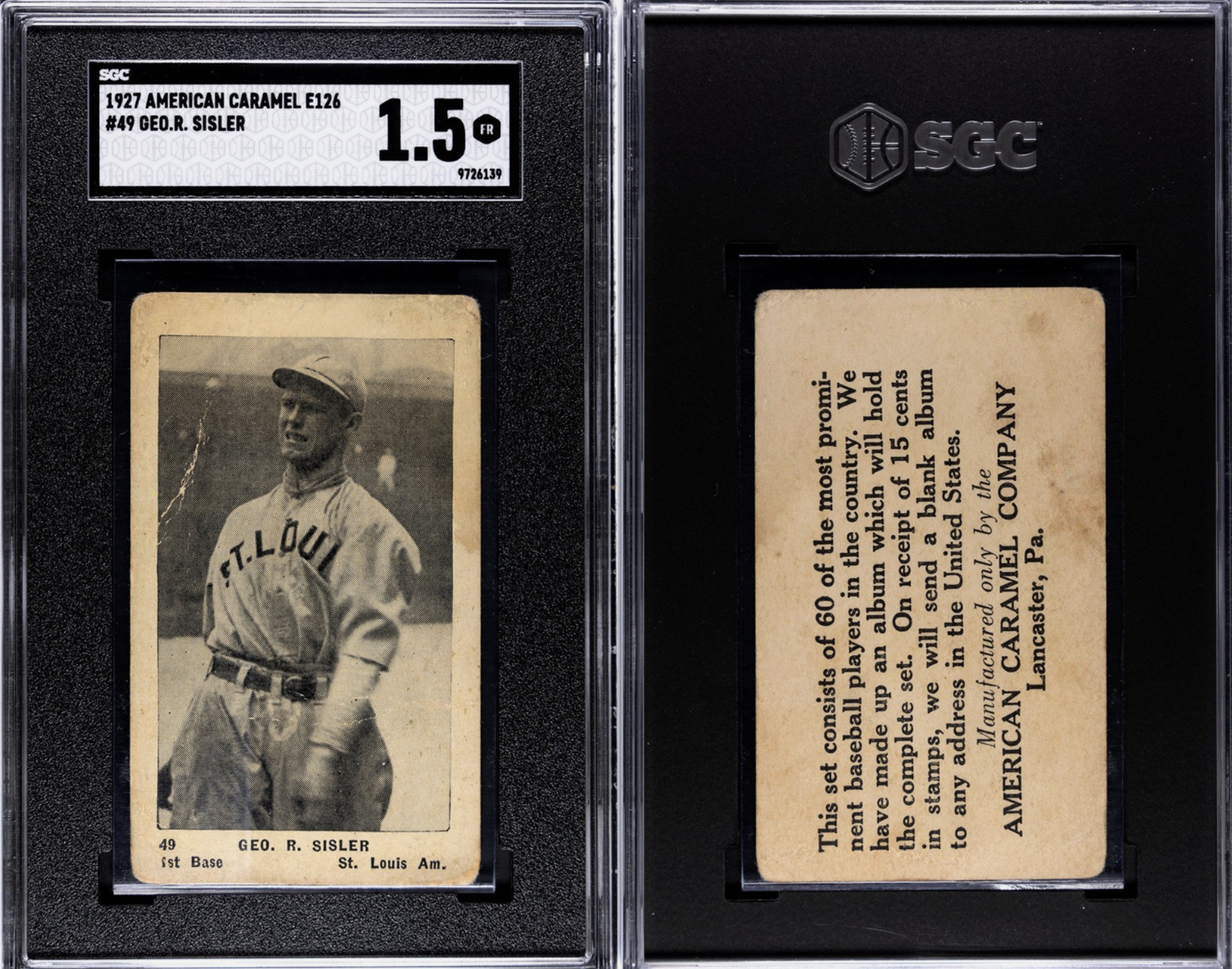
As you can see here with this George Sisler American Caramel E126 — as a marketing tool, right, to help sell caramels, to help sell candies, to help sell cigarettes. Clothes. I was up late, late last night obsessing over this card and thinking about the political culmination of this moment. 1927. Murderer’s Row. The last moments before the Depression. Dust Bowl. Sisler as the end of the Deadball Era; a turning point figure. Perhaps the greatest all around baseball player of his time in the major leagues in terms of skill and total athletic ability. This is the sunset of his career; yet the photo used here is the same as the one on his rookie card in the mid 1910s. It is also the last release by the famed and renowned American Caramel company before they went out of business. A small set. Scarcer than usual. And yet a major set, as it is the culmination, or the late style of their design imperatives, initiated decades prior.
03:13
And this imperative of the cultural production of baseball cards as marketing tools for primary, everyday goods slowly shifts with the introduction of companies that specialize in baseball cards for baseball cards sake, themselves as an art historical, cultural commodity such as Topps or Bowman in the 1950s.
The creation of these cards as marketing tools in the grand scheme of the development and cultivation of American industrial capitalism creates this underclass or working class of art form which is the industrially reproduced work of art that's handheld. It's a piece of pocket art, designed to be easily portable and to take with you — whether that's a photograph or a lithographic drawing or rendering of a figure that is kept and held by someone who is the child of a laborer in Lancaster, Pennsylvania, or someone who purchases bread from the local or regional bakery in terms of the Tip Top 1910 Pittsburgh Pirates set in Pittsburgh, Pennsylvania.
You're looking at an ecosystem which is regionally and locally active and present and communally engaged in real time that is creating industrial works of art in terms of the mass production of baseball cards due to the popularity specifically of the sport of baseball as a culture. This is, realistically, the regional and local goods and production company as a community service. A group, a industrial production that is created and consumed in the very immediate cultural, economic, and political environment that constitutes its entire life cycle. The world is located locally. It is a cultural ouroboros of language, meaning, and labor.
04:37
And then again, baseball images as something that that are in incredibly high demands from the late 1800s onward — in the sense of creating a mass participation network in the national movement of baseball itself. A way of creating nodes of participation across space and time through the propagation, production, and distribution of images which serve as surrogate or proxy for immediate localized presence as in the ballpark or the stadium itself.
People who otherwise cannot see a game of baseball are relying on a baseball card image or an image that's printed and published in the newspapers to commune with this force of such great cultural interest and fervor. You see this most commonly with the early World Series games in terms of the extreme presence, the media presence at the time. There's a large press and photojournalistic presence for these events to communicate them across the nation to those who otherwise are physically unable to attend; yet are desperate for the news of the event itself. This is the power of the news media photography as a creation of new cultural thorough-ways itself at the period of time. It is the creation of the first digital lines, the telephone poles of sight. It anticipates the wire photo; the cell phone; the digital image.
And yet baseball cards, in their production on cardboard as opposed to newsprint — stand to immortalize through durability the modern cultural baseball image proper. What this means is to create a work of art which is a memory of time as a new cultural art form — deeply wedded to photojournalism; the creation of new lines, ways, and methods of fostering cultural communion and participation beyond forced locality of sight as in presence of body at and in the event of the game of baseball itself. This is a totemization; a symbolization of history in such a way that it is the mass production of a system of art by way of merging the artistic, creative, and cultural instinct directly into the marketplace. The local and regional companies become the artist as network; baseball itself becomes the art form redoubled in the capture and commemoration of the baseball card object itself. In this way, you are encountering a form and formation deeply alien — yet in many ways more sophisticated and compound — than any form of art history hitherto conjured or created in its mass thrust and movement.
05:38
So when you look at baseball cards as being emblematic of the working class struggle, what we're talking about is we're talking about looking layers deeper than just an individual work of art or an individual human being or person. We're looking at an ecosystem and a mechanism of cultural production, which is happening altogether completely and thoroughly through local industrial food producers, cigarette producers, and goods producers, such as clothing stores; even going into car stores or car manufacturers.
You're looking at an ecosystem that is cultivated within the larger spiking, peaking American industrial manufacturing ecosystem as a regionalized phenomenon which is rapidly wiring into a national and global phenomenon of production and distribution — which is: goods that are created in the United States of America for the American population; therein are containing this additional level of marketing material, which is meant to draw customers toward their product. This is an economic force of the creation of industrial wealth that has hidden within it a sacral art historical power in the marketing object.
This additional level of marketing material as hidden art object of high power and force is again an American cultural phenomenon… underlaying the larger American socio-political event of industrialization through these local and regional manufacturing plants. The American history and legacy is one of rapidly scaling capitalism through technology. For there to be a hidden art movement within this economization of an entire ecological grid of land through property and industrial mass production is nearly providence.
Again, caramels, candies, cigarettes, tobacco. This is an ecosystem of production in terms of the creation of cities and towns; like the coal towns of Shamokin and Lonaconing — from which some of the greatest early ballplayers emerged — these towns and cities are organized around the economic opportunities created and provided by industry. And much as we discussed in terms of American Tobacco and their use of the automatic cigarette roller to increase production exponentially as in ability to create cigarettes with speed — this is the ecosystem that baseball cards are acting within as this hidden major modern art movement. They abide precisely the same economic and social and cultural principles that the larger force of American modernism and modernization is constructing and abiding in real time; as such, they are truly products of this higher, mass force… works of art done in time by an entire nation and nationalizing grid of the expansion of modes of production.
08:00
When you look at these cards — and particularly again how they're framed or encased in a modern context — it's easy to understand the subconscious recognition that's occurring at a collective level of these handheld pocket lithographies, which are usually, especially in the early modern context, written on the back of with a promotion or an advertisement of a store or a brand, for a company.
There is a recognition at the collective subconscious level of what these artifacts and these remnants of American history really are, which are themselves works of art. But they are by no artist; rather they are works of art created by early American industrializing companies — local and regional manufacturers of everyday goods for everyday people — and that itself being a system, or an ecosystem of production, where these cards are being outsourced to lithographers, such as the American Lithography Company, in the case of the Turkey Red T3s. This is a contract with the American Lithography Company in New York and American Tobacco to produce these works of art, to mass produce and reproduce them using artisanal techniques at speed via and through advanced lithographic artistry and mastery in order to create an accessible marketing tool, a marketing object underlying the commodity or the good that's being sold by said company — meant to undergird the offering of the product; in some cases even supersede the product itself in terms of interest garnered by baseball and card aficionados.
This is something that's historically unprecedented because you're looking at a major art movement that relies on mass production as a cultural and economic mode — and not only relies on mass production but uses mass production as a footstool and artist’s signature to create its biggest innovation, which is handheld pocket lithographic art for the masses. This movement all based around and centered around and depicting the most important cultural movement that's occurring in said civilization at the time, which is baseball.
10:47
When you look at these cards… and I think this this E126 is a great example — I think this is one of the greatest caramel sets ever created in terms of the composition. The succinctness of the descriptions as well as the promotional aspect on the back, collecting player cards and the redemption model. It sums up as a last moment of the caramel and ad back cards the early modern movement itself. “One receipt of 15 cents in stamps, we will send a blank album to any address in the United States. Manufactured by American Caramel”. This was manufactured just before the American Caramel Company went out of business. They were one of the longest running caramel baseball card producers in America.
You're looking at, again, something so telling about this being labeled as Lancaster, Pennsylvania. This is early industrial America. Pennsylvania is one of the epicenters of that process, especially with Pittsburgh and the outlying coal towns and coal country in the area. The Northeast is the true locus of this factorial force of production. It’s the tenement city of New York; the meat plants of Upton Sinclair; the surrounding coal country that feeds the beast of American steel and industrial empire.
You're looking at a relic of early mass production, and you're looking at a relic of how early mass production functioned; how early marketing tools subconsciously became a major art movement through the total productive force of what is going on so specifically in America at the time as the world’s emerging superpower of political and economic might — as, primarily, a and the production of force.
11:54
And the reason why I say major art movement here is not only because when you when you look at objects like this — even in terms of the photographic choices — there's a Babe Ruth that actually has a photo montage on it as one of the cards in this set…
Not only in terms of the photographic choices and the layouts of these cards, but the diversity of the methods as in broadness of styles and ethos of image production and composition in which they were produced as a way of creating marketing competition. The cards themselves went through several miniature major art movements and revolutions of paint upon canvas, so to speak — the canvas being cardboard; the paint being lithographic design innovation and depiction of content; the type of form therein.
You have companies like the DeLong Gum Company, Goudey Gum, Worldwide Gum. You have many of these different caramel companies, cigarette companies, gum companies that are competing for market space in this early industrial capitalist environment. And through this competition emerges a full spectrum or pluming of these colors, designs; radical sparks of beautiful imagistic depiction, representation; monumentalization or immortalization of the larger cultural undertow or underpinning of how baseball functioned; how it worked in the collective psyche of the time. And how time progressed and fractalized these innovations; how they redoubled back upon themselves to return or reference design aspects to evolve and churn the massive cultural art historical movement of the baseball card itself over time.
And this is an economic race — in terms of the companies who weaponize or utilize the baseball card as a marketing method — that is occurring domestically in real time. It has real, deep, and profound stakes as we observe in the trust suits of the age; the monopolies established by the historical tycoons such as Carnegie and Morgan and Ford who actually change the way the working world functions in America. They construct and own entire towns; gain entire forums of ideological propogation and political power by way of the economic thrust of their industrial markets. This modern American industrialization sets the stage for the America we have come to know and understand one hundred years later — despite struggle for power and voice of labor as a collective, the solidification of a political marketplace for hire, largely if not entirely controlled by corporate interests; dictated and propagandized and manipulated by the monied class. This is the American class war as the 20th century turns; a class war which wittingly produces baseball cards to leverage product visibility and increase consumption — but unwittingly produces a major modern art movement whose mode is radically outside of what we conventionally understand to be art; how we consider art to be art. This includes the press race for photojournalistic syndicates of image creation, capture, and print — Brown Brothers, Bain, Thompson, and the like. These are, again, capitalist and capitalistic entities which create and lay the foundation for the radical bridge between documentarian history, economic prosperity, and a forgotten art historical movement existent in plain sight.
13:21
And the way that these companies figure out how to gain further foothold in the market beyond just the power of the product is providing the larger American public with a hitherto undocumented or unrealized service — which is access to baseball images and participation in baseball imagery as a communal event — wherein many of these people do not have the ability to actually attend these events; to take the trips to attend these events… nonetheless to say that they own any aspect of this cultural phenomenon that they feel so spiritually or emotionally or psychologically engaged in.
I've spoken about stories where people will say, they stood by the radio just sitting out on the porch on the farm in Missouri listening to the Gas House Gang in the Depression era, just on the farm, and following and tracking this team and their exploits through the year of 1934. This is story and experience passed down over generations; orally communicated today.
We're talking about a level of devotional theater and cultural theater that is captivating the nation at the deepest level. And baseball cards serve a profound function in the sense that they allow for the average person — let's say that's a young child at a general store in Oklahoma or a miner or a factory worker in Pennsylvania or in the Appalachian — to own a piece of that history. It's not speculative, it's not imaginative. It’s a art historical immediacy which is a compression or a condensation or a distillation of a spiritual time and a spiritual age in the growth and creation of a nation into a participatory artifact. A piece of art that is history which is also a totem of a collective, communal phenomenon of passion and joy.
It's actually a real representative function and device that says this is a part of baseball. This is baseball, here, in this card. This is George Sisler, first baseman for the St. Louis Americans, and here is his baseball card. In owning and possessing this baseball card, you own or possess an aspect of American baseball culture and history. And that to me, in a socially realist sense, is actually far more profound than art itself, in the sense that art is conventionally conceived of as being produced by a single individual as an interpretation or a reflection of a cultural event or the personal or even ancestral imagination or psyche.
15:49
What this is is the communal mass cultural psyche that's being mass produced by local and regional companies in terms of a lithographic design. It allows for ease of production and scope. It allows for these artifacts and totems to reach the greatest number of people. And many of these are very creative. They're far outside the realm of just photography and composition of image and text. In terms of use of color: wild lime greens or deep purple backgrounds that are in high contrast. We discussed a lot of that in the 1939 Play Ball Aesthetics of Austerity essay.
Just the extreme amount of difference in creativity that's, actually — as a total ecosystem of the early modern baseball card from 1900 to 1940 — it is incredibly profound when you look at that whole ecosystem of the different set designs, including sets like the Cracker Jacks with the blood red backgrounds. You have to flip the 1915 release over and flip them upside down to read the text. They’re often stained and even streaked with dark red caramel from the bag in which the card was placed. In 1915 the cards were also open for redemption outside the product.
I mentioned the DeLong Gum manufacturer: you have a figure, black and white figure enlarged to epic proportions, like a giant — in front of a color background stadium with bright reds, yellows, blues, greens.
17:03
The creativity that's exhibited through the marketing for these early modern American companies is so deeply under recognized as an art movement specifically because it's social realism beyond even interpretation. The flat color backgrounds and gradients that tow the perfect line between innovation and necessity, form and abstraction — location and oblivion.
It's just the pure presentation of the fragment or the chip or the shard of the object of the collective cultural communal imagination which is the fascination with baseball. It presents it as it is in the most economized and distilled form while seeking and achieving marketing fluency in terms of catching and communicating the eye visually. With a simple advertisement for the company on the back saying: this is who we are, this is a coupon that you can redeem, this is how many players are in the checklist of the set. Most of the early modern cards function in that way, including the early caramels and the early tobaccos. They don't actually even have any player biography, they just function specifically as marketing tools. This is not the commodification of baseball — rather it is the creation of an entire cultural art historical movement of and behind baseball and American passion and fascination to support and uplift the rapidly scaling commodities market proper. And in this process you have something beautiful, unexpected, and unprecedented emerge.
18:01
So when you look at this and you see the power that underlies these early cards, I think you're looking at something that hitherto historically has been hidden or marginalized or obfuscated specifically because it is working class culture.
Contracted, of course, at the highest level by the company executives to sell the product. But these cards themselves are being designed and manufactured by working-class artisans at lithography companies, and they're being packaged into products that are being used and consumed and purchased by everyday working-class people. This is a subversive construction of an art market that rather is not an art market at all, but it's a commodities market of essential goods that are being purchased by the everyday person — and as such they are participating in and gain access to perhaps the most important major art movement in American history. Not only in terms of total oeuvre and presence and presentation, but in terms of radical innovation of the traditional form and historical definition of art itself.
And the reason why this would be so and is so is because this is not one person. This is not even a group of people acting as individuals.
This is a collective subconscious psychological, mythological and myth making function that is the massive explosion of the 20th century industrial revolution in America colliding with the creation of media in terms of mass production of images to create a network of cultural understanding: that we culturally are envisioning and visualizing the same things and thus know them to be true or know certain other things to be untrue. This is the collision of two technologies that are rapidly revolutionizing truth, visibility, interconnectivity; concepts of community and relationship at the speed of light.
20:07
And this again is what is so important about specifically photographic baseball cards, even going back to the Old Judge cards.
You're looking at a technology that's revolutionary in terms of what it allows people to participate in and how. A real image representation that is authentic or true to the real, at least in terms of when you flatten the three dimensional down into two dimensions in terms of the creation of an image. Participation in a visualization and representation of the real that is true to the real. And as such creates across time, across borders and bounds, the ability to participate in that historical moment or in that historical event through an understanding that goes beyond words and directly into the hidden unspoken language of sight and seeing, and thus an implicit visual agreement that exists below and beneath the image itself.
That art movement in terms of this mass production of the image at the level of the news image and the photographic baseball card is so undervalued because of just how egalitarian and populist it really is; because of how hidden and mass produced the source of its artistry really is. It’s a truly collective cultural art movement at the level of the networks of production and distribution and consumption that allow it to function and bubble up from the collective subconscious; as a mass desire and urge to image and images which creates, by necessity, these mechanized, industrial arms which in turn mass propagate and produce it. The desire is for baseball images; this desire is being fulfilled en masse and at scale by the rapidly accelerating machine of American industrialization — even in, as, and through its fulfillment of the basic needs of and for consumer goods.
This is something that wouldn't be allowed to be seen as art in a modern context because it doesn't elevate itself above its basic function and essential purpose, which is to propagate baseball imagery and sell basic consumer goods; allow for access into baseball history and sell an everyday consumer product through that additional marketing add-on. And that changes in the 1950s with Topps and Bowman and baseball cards for baseball cards sake, right? The removal of gum. The removal of tobacco — even though there are still companies that perform this traditional marketing function with baseball cards like Red Man Tobacco or Red Heart Dog Food. They still include and incorporate baseball cards into the food product or the everyday good.
But this is something that is rapidly becoming outmoded by the baseball card as a cultural object by and for itself, which is indicative, again, of the subconscious mass cultural psychological metabolism of the real, hidden, sacral idea and concept behind baseball cards; the realization that they are in themselves essential cultural artifacts and an art historical phenomenon that extends… it's really a movement of 100 years that occurs in America.
22:57
So again, looking at the way that these cards are framed, this is something that is just occurring just beneath the conscious mind, I think, in a collective sense. The way that these cards are framed in their plastic casings, as well as how they are… remembered in terms of historical collections, let's say intergenerational collections. Handed down through families of rail workers and factory workers or newspaper salesmen or farmers from this era of history — down into today.
When you look at art history, it's the passage of a painting down through institutions or wealthy donors or financiers. And the concepts of value and economy associated with these high-falutin institutional constructs. You're looking at a marketplace that is specifically devoted and dedicated to uplifting the art historical cultural artifact into the stratosphere of an investment.
And what you're really looking at in terms of baseball card history… the funny thing about these baseball cards is that they are not a commodity, they're an addition onto a commodity in terms of a marketing tool, which is to say have this piece of art or have this piece of history. If these cards were to be acknowledged as critical, crucial, even primary artifacts of American art history, it would break the foundational teleology of the art market and art history itself in two. Because it would reveal the commodification of art and art history and the individualism and status tools of the art market proper — by way of and through the very industrial, modern American movement which created and perpetuated these pseudo-elite social, economic, and cultural constructs.
It is itself the venom of the snake which made it — the revelation from within itself, produced from itself subconsciously — that destroys this entire systemic worldview and ideological imagination. That the baseball card, emergent from the most dense and rapidly scaling period of industrial wealth generation and creation; one of the most profound periods of exploitation of labor that led to significant governmental legislation and checking of capital — that the baseball card itself is a work of art that if not characterizes, defines the American creative, cultural, and historical impulse to memory and meaning and myth making in the 20th century.
And that offering is cemented deeply in the cultural memory, whether or not you want to call it art history. It is in truth, no matter. These are indelible aspects of American cultural history in terms of being relics and artifacts. They are engrained in the very fabric of what is remembered and recovered by the people themselves; held, owned, passed down, on, and forward as works of art; as pieces of aesthetic revelation; as fragments and potsherd of profound cultural and visual meaning and myth.
What is cemented, it's not even the product that was created by these companies, it's the baseball cards. And this is something that you can only look back at historically and understand — the subconscious bubbling up of this urgent process. It makes sense that such a hidden art historical movement would occur so innocuously and behind the veil of the development of the American corporate capitalist environment through the industrial modernization of the country itself, because it's a movement that occurs so rapidly and scales so vastly and so quickly.
26:45
It's a movement of such large cultural forces in coalition with the increased presence of baseball as a national cultural phenomenon in terms of access to images and access to the network of baseball through photography. This collision course of the demand for baseball images, as well as the cutthroat monopolistic creation of trusts — which also, you see that in baseball as well — with the Federal League antitrust lawsuit in the 1920s against major league baseball. This, the crossroads of these two major phenomena which are deeply intertwined — one is more cultural, artistic, and athletic. The other is more industrial, economic, and social and political in terms of its effects.
The subconscious bridge there in terms of the shrewdness of business of these rapidly scaling corporate entities to say, we're going to incorporate this totem or this relic or this object that provides this added level to our product or our good by way of creating access in that place that the entire nation is clamoring for, which is access to baseball images and baseball culture. Access to the baseball game without being able to be there or having to be there.
28:46
So to have that kind of art movement emerge so environmentally and cross contextually… and when you look at a card like this, it's a black and white, it's a very small, this fits in your hand.
There's no frills to it. This is what I love about this kind of late caramel design. It's been stripped of the frills and the colors that would be able to kind of give you the convenient argument that, oh, this is an art historical artifact, or this is a work of art because of the color or the composition. These have been stripped down to their most basic and essential parts and components as a sort of ruthless minimalist perfection of the baseball card, at least in an early modern context, right? An economy of communication which deeply matches the avant garde of their time — this being the imagistic mode of Samuel Beckett embodied. Deeply historically present and rooted. Art that is not art. Embedded in the fundamental fabric of the existential culture itself — how it moves, how it survives, how it sustains. Spoken with sparing and deadly clarity, accuracy; pinpointed scarcity of word.
There's no backs being added to these cards in terms of statistics and biographies. This… represents the ethos, I think in a lot of ways, of this early American modern industrial mind and psychology, as well as the ethos of early American baseball. The grit of the last of the Deadball age in movement with the emerging forefront of sparing, essential questioning in the European sense as it pertains to the — in particular — literary and philosophical movements of the time. A stepping out into a cultural moment of the essential. What is essential; why. This has, in large part to do with the horizon of the extreme economic and world shifts of war and commerce that emerge as manifest physically — as well as, I believe, with the larger questions humanity is forced to ask of itself as the traditional local and regional borders corrode into a mass information global interconnectivity.
30:11
It is something that has been distilled, sharpened, clarified.
So that's what I got. Thanks for watching.